Discovery-Sourced CMDB for SOC 2 and ISO 27001 Audits | Virima

CISOs decide patch order and audit readiness from the same inventory, but when that inventory is incomplete, both decisions get made on guesswork. A discovery-sourced CMDB for SOC 2 and ISO 27001 audits addresses that gap. It gives auditors defensible evidence for compliance reviews, and gives security teams the asset and service context to prioritize vulnerabilities by business impact, not CVSS score alone. Auditors still ask for complete ownership records with documented collection methods. Security teams still ask which vulnerable asset threatens an important service first. This guide shows how one record answers both questions.
What auditors expect from discovery inventory
Auditors reviewing SOC 2 Common Criteria 7 and 8 look for managed inventory with defined ownership and monitored change. Auditors reviewing ISO 27001 Annex A 8.1 look for accurate asset records that support risk assessment and technology compliance. The NIST Cybersecurity Framework describes the same foundation: governing asset inventory before protection decisions proceed.
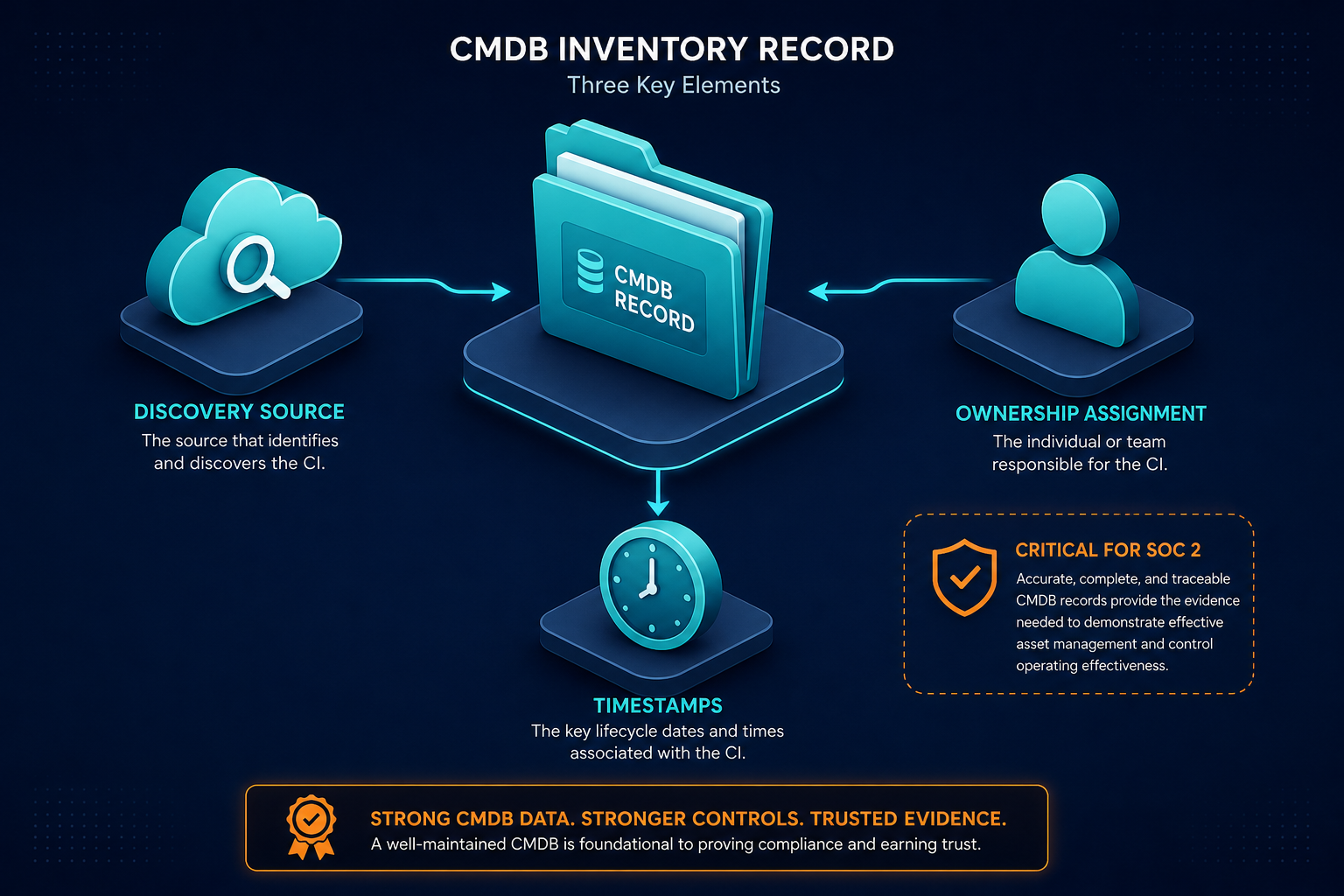
Virima collects inventory with agentless WMI, SSH, and SNMP, agents for Windows, macOS, and Linux, plus API collection for AWS and Azure. Each configuration item retains discovery source, timestamps, ownership, and life cycle stage. That lineage helps CISOs answer auditor questions about coverage and accountability without manual spreadsheets.
Incomplete inventory creates audit findings and missed exposures at the same time, and the gap is often wider than teams expect. In a discovery-based audit of a 14,000-CI CMDB, Virima found that 63% of configuration items had degraded within a single day CMDB Audit Essentials: Ensuring Data Accuracy and Compliance, split between stale records, ghost CIs, and duplicates. Discovery-sourced records reduce both risks by keeping ownership current between review cycles.
How Virima supports SOC 2 and ISO 27001 audit evidence needs
Virima schedules discovery collection, retains ownership and timestamps, and exports audit evidence for SOC 2 and ISO 27001 reviews using its CMDB. Customers retain responsibility for defining policies, access reviews, and control operation; Virima supplies the scheduled inventory data those controls depend on for consistent evidence.
For SOC 2 needs, teams export authorized asset lists with ownership assignments and change records from the CMDB. For ISO 27001 needs, teams show scheduled discovery cycles with reconciliation history and documented owners for servers and endpoints. NIST guidance supports this approach by placing inventory governance before vulnerability management activity. For a deeper walkthrough of the export process, see audit-ready dashboards.
Explore how discovery-sourced data reduces audit friction for security leaders. See how enterprise teams establish Trusted Runtime Truth to de-risk audit and patch decisions with source-attributed inventory records.
Can Virima discovery support SOC 2 and ISO 27001 audits?
Virima provides trusted discovery for SOC 2 audit evidence and ISO 27001 reviews, with ownership and change history retained in the CMDB across hybrid estates for auditor review.
How asset context improves vulnerability prioritization
Scanner severity alone overwhelms teams because high scores appear on low-impact systems. Hadrian’s 2026 Offensive Security Benchmark Report found that 0.47% of vulnerability scanner findings proved exploitable in real environments. The same report found that 95% of security leaders said they could not reliably prioritize remediation based on real-world exposure. Asset context helps teams focus remediation on exploitable issues that affect important services first.
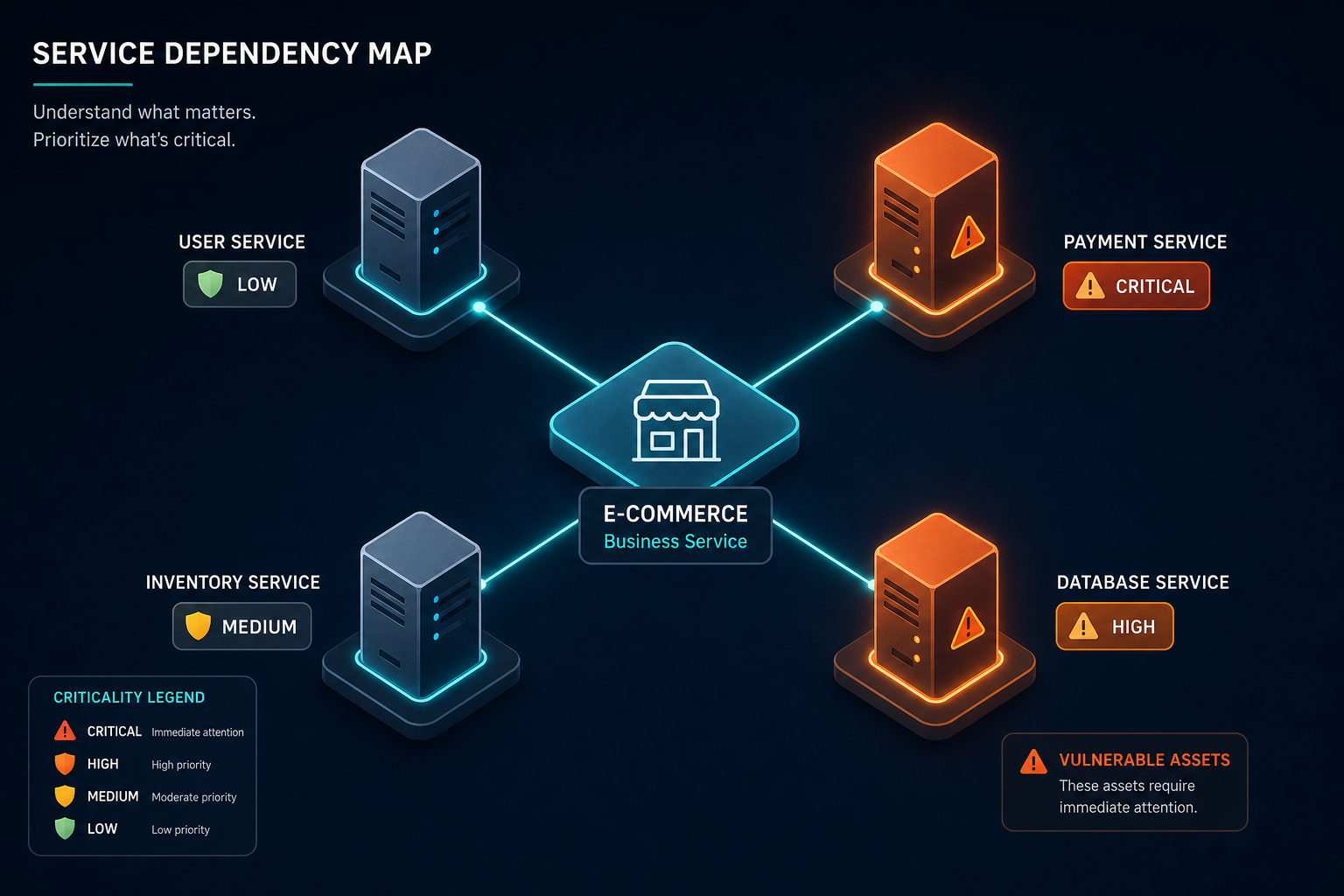
Virima enriches triage for security teams in several ways. IT discovery joins scanner findings to authoritative configuration items using serial number or cloud instance ID. ViVID™ service maps show business service dependency and blast radius around each affected asset. NIST NVD CVE overlays on ViVID maps highlight known issues found on Windows Servers, weighted by asset criticality.
This approach pairs with dedicated scanners rather than replacing scanner coverage. Scanners find exposures across operating systems and network devices with detection depth. Virima shows which exposures threaten revenue services, regulated data, or shared infrastructure that needs urgent attention.
Learn how your current scanner output maps to business impact with enriched context. Schedule a technical evaluation to map exposure with asset context while retaining existing scanners and ticketing workflows.
What Virima does not claim about coverage
Clarity builds trust with CISOs evaluating security tooling for regulated environments. Virima does not perform full, multi-OS vulnerability scans across every platform in the estate. NVD enrichment today applies to issues found on Windows Servers, which represent an important but partial share of most hybrid estates — so teams should pair that enrichment with their existing scanner coverage for other platforms.
Discovery itself runs on scheduled cycles, with high-frequency options available for critical segments. Service definitions are customer-provided through manual input, spreadsheet import, or connected sources, and Virima builds dependency maps from those definitions automatically. Because of that cadence, teams should plan control language around scheduled inventory rather than instant synchronization across all sources.
Integration with existing ITSM keeps enriched context inside response workflows for faster decisions. See supported connections through the integrations hub for ITSM handoff and enrichment routing without replacing current scanner investments.
Does Virima replace vulnerability scanners?
Virima does not replace scanners because dedicated tools provide detection depth across platforms. Virima enriches scanner findings with ownership and service context to guide patch priority.
Decision checklist for CISOs
Use this checklist during evaluation with security and GRC stakeholders:
- Confirm evidence export for SOC 2 CC 7 and CC 8 plus ISO Annex A 8.
- Confirm ownership assignment and reconciliation history for every in-scope asset.
- Confirm join logic uses serial number or cloud instance ID rather than hostname alone.
Also validate reporting for board-level risk communication and budget planning. Useful metrics include:
- Discovery coverage by domain
- Stale asset rate
- Mean time to assign ownership
- Share of critical issues tied to Tier 1 services
The same Hadrian report cited above found most security leaders already distrust their prioritization data, so these board-level metrics support renewal and resource decisions. For a closer look at how teams structure these reviews, see Active Directory monitoring guidance for security and compliance.
Frequently Asked Questions
How do teams provide SOC 2 inventory evidence from discovery data?
Teams export discovery sourced asset lists with owner, source, timestamps, and change history from the CMDB. Auditors review coverage, ownership, and monitoring cadence against SOC 2 criteria for logical access and operations.
How does Virima support ISO 27001 asset inventory accuracy?
Accurate discovery supports ISO 27001 Annex A controls for inventory, ownership, and technology compliance. Scheduled cycles and reconciliation records demonstrate that inventory remains managed rather than point in time.
Can Virima discovery enrich our existing scanner and ITSM workflow?
Yes, Virima joins scanner findings to authoritative configuration items and passes enriched context to ITSM through supported integrations. Your team keeps existing scanners and ticketing while gaining service aware prioritization.
How does CMDB asset criticality affect patching for Windows Servers?
Virima weights NVD findings by asset and Tier 1 service criticality so internet facing and revenue supporting systems move first. Service maps reveal shared dependencies so teams address broad blast radius exposures before isolated lab systems.