How Virima’s automated IT asset management boosts your ITAM processes

Most IT teams know exactly how many servers they bought last quarter. Fewer can tell you how many are still active, properly licensed, and mapped to a business service. That gap between what you purchased and what’s actually running is where ITAM breaks down and where automated IT asset management makes the biggest difference. According to Flexera’s 2025 report, only 43% of organizations have full visibility into their IT estate.
Automated IT Asset Management replaces manual spreadsheets and periodic audits with recurring discovery scans, near real-time inventory tracking, and software usage metering, making it a core capability of modern IT asset management software.
Instead of chasing asset data across teams, you get a single, accurate view of your entire IT estate: hardware, software, cloud, network devices, and physical assets included, enabling effective asset tracking across environments.
Virima’s platform is built for exactly this kind of work and stands out as a comprehensive management solution among enterprise-grade IT asset management solutions. It combines IT discovery, a full-featured CMDB, and service mapping with native ITAM capabilities, so discovery data flows directly into asset records without manual handoffs, giving visibility into assets throughout their lifecycles.
How automated IT asset management eliminates blind spots
The foundation of any ITAM program is knowing what you have. Manual tracking methods and inventories go stale within weeks. Automated discovery, a key feature of advanced IT asset management software, keeps your asset records current by scanning your environment on recurring schedules and strengthening overall inventory management.
Virima’s discovery uses three methods to cover your full IT footprint, similar to leading asset management tools:
- Agent-based discovery captures detailed hardware and software data from endpoints, including laptops and mobile devices, even when they’re off-network
- Agentless scanning uses protocols like WMI, SSH, and SNMP to identify assets across subnets and distributed data centers without deploying software on each device
- API-based discovery pulls asset data directly from cloud providers like AWS and Azure, as well as virtualization platforms
Virima runs these scans on configurable schedules, not as a one-time event. Every scan cycle updates your CMDB with new assets, changed configurations, and decommissioned devices. Because the data is sourced directly from the device or platform rather than manually entered by a technician, the asset information in your CMDB is accurate at the point of collection. That discovery-sourced accuracy is what separates a trustworthy CMDB from a glorified spreadsheet.
For data that can’t be auto-discovered (asset ownership, business criticality, lifecycle status, SLAs), Virima’s Autonomic Social Discovery (ASD) automates the process of gathering that human knowledge. ASD identifies missing data points in your CMDB and routes requests to the right people, so your asset records stay complete without chasing colleagues through email threads.
The result is fewer surprises during audits, especially important since nearly 45% of organizations have paid over $1 million in software audit costs in the past three years. fewer rogue assets slipping through, and a CMDB that your change management and incident response teams can actually rely on.
How does automated discovery prevent shadow IT?
Shadow IT (devices, applications, and cloud instances deployed outside of IT’s control) is one of the biggest accuracy killers for ITAM programs. If discovery doesn’t find it, your CMDB doesn’t track it, and your software license counts are wrong.
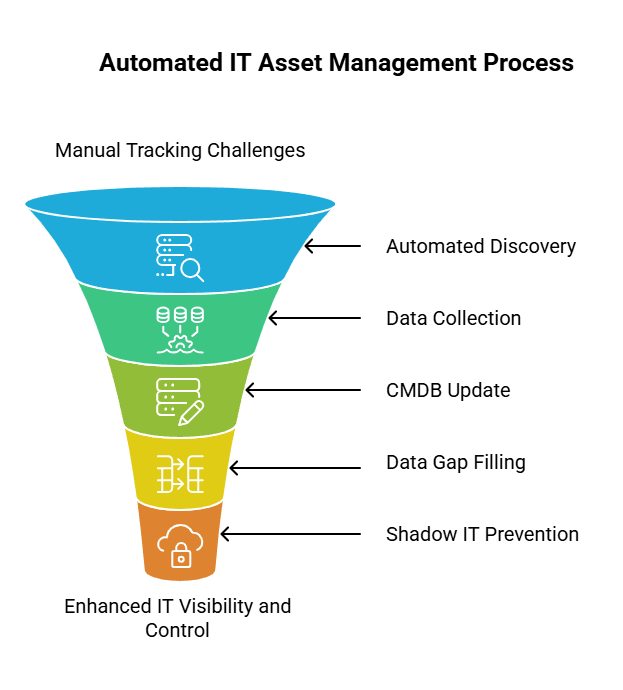
Automated IT asset management, as delivered through modern IT asset management solutions, catches shadow IT by scanning your configured subnets and connected cloud accounts on every scheduled cycle. When a developer spins up an unapproved AWS instance or a department installs unlicensed software on a monitored network, the next discovery scan flags it. This gives asset managers visibility they’d never get from purchase orders alone.
Service mapping and ViVID: seeing what connects to what
Knowing what assets you have is step one in effective tracking and management. Knowing how they connect to business services is where ITAM automation starts delivering operational value.
Virima’s ViVID™ (Virima Visual Impact Display) creates interactive maps that show the relationships between applications, infrastructure, and services. Instead of digging through spreadsheets to figure out which servers support your ERP system, you see the full dependency chain visually.
This matters for three operational workflows:
- Incident response: When a server goes down, ViVID shows exactly which services are affected and who owns them. No guessing, no war-room escalations to figure out blast radius
- Change management: Before you perform patch management on a database server, the service map shows every application that depends on it. Your change advisory board reviews the actual impact, not a best-guess estimate
- Decommissioning: When it’s time to retire an asset, ViVID shows whether any active services still depend on it. That prevents the “we turned off a server and broke payroll” scenario
Data-driven asset decisions through recurring insights
Automated ITAM isn’t just about building an inventory. It’s about using that inventory to make informed decisions faster.
Virima delivers recurring insights across several ITAM dimensions:
- Asset utilization: Identify which assets are underused, idle, or redundant. Reassign or decommission them before the next renewal cycle wastes budget on unused capacity
- Software license compliance: Track installed software against your entitlements. Spot over-deployment before a vendor IT audit catches it, and stay aligned with compliance requirements, and reclaim unused licenses to avoid buying more
- Software usage metering: See which applications your teams actually use versus what’s installed. This data is the foundation for license optimization and cost recovery
- Risk identification: Virima cross-references discovered assets against the National Vulnerability Database (NVD) to flag known vulnerabilities associated with installed software versions. This isn’t active vulnerability scanning. It’s a lookup that tells you where your exposure is based on what’s deployed
These insights turn your CMDB from a static record into an operational decision-making tool, which is a defining advantage of mature IT asset management software.
What’s the difference between ITAM and ITOM?
Asset management ITAM focuses on the financial and contractual lifecycle of IT assets: procurement, deployment, license compliance, and retirement. ITOM focuses on the operational health and performance of those same assets, covering monitoring, event management, and service availability.
In practice, the two overlap significantly. A server flagged for decommissioning in ITAM still needs ITOM visibility to confirm it’s not supporting active services. Virima bridges this gap by unifying discovery, CMDB, and service mapping data across both disciplines. Your asset managers and ops teams work from a single source of truth, which eliminates the version-of-truth conflicts that slow down change and incident workflows.
An automated IT asset management platform built for integration
ITAM tools are only as useful as their connection to the rest of your IT stack, which is why leading IT asset management solutions prioritize seamless integration. Virima fits into your existing ecosystem rather than replacing it.
Virima’s CMDB is PinkVERIFY ITIL-compliant and stores every discovered asset and its relationships. It is the authoritative data source for asset and configuration management, and every discovery scan feeds directly into it with full relationship mapping.
On the ITSM side, Virima’s own ITSM module connects asset data to incident, change, and service request workflows without middleware. For organizations already running a third-party service desk, Virima syncs bidirectionally with ServiceNow, Jira Service Management, Ivanti, HaloITSM, Cherwell, Xurrent, and Hornbill. Asset data discovered by Virima appears in your ITSM platform’s CMDB tables, and changes made in either system stay in sync.
The whole platform runs on AWS infrastructure with SOC 2 Type II certification, so there’s no on-prem server to maintain, the platform scales with your environment, and your data meets enterprise security and compliance standards.
How do you integrate ITAM with your ITSM platform?
The key is bidirectional data flow. When your ITSM platform receives an incident ticket, the technician should see the affected asset’s full configuration, dependencies, and recent changes, all pulled automatically from the CMDB.
Virima handles this by syncing discovery data with platforms like ServiceNow and Jira Service Management. CIs discovered by Virima appear in your ITSM CMDB, and status changes in the ITSM flow back. This means your service desk doesn’t manually look up asset details; they’re already attached to the ticket. The result is faster triage, more accurate impact assessment, and fewer escalations.
How automated IT asset management cuts costs and effort
The operational case for automated ITAM is straightforward: less manual work, fewer errors, faster decisions—outcomes typically associated with well-implemented IT asset management software.
- Reduced manual effort: Discovery runs automatically on schedule. Your team stops spending hours on manual inventory audits and data entry, and redirects that time to license optimization, vendor negotiations, or process improvement
- Improved data accuracy: Automated scans eliminate the transcription errors and staleness that plague manual asset registers. When auditors ask for your asset inventory, it’s current, not a best-effort snapshot from last quarter
- Faster incident resolution: When your service desk can see which assets are affected by an outage and who owns them, tickets get routed correctly on the first try. Mean time to resolution drops because there’s no guessing involved
For many IT operations teams, the cost savings from reclaimed licenses, avoided audit penalties, and reduced manual labor offset a significant portion of the ITAM platform investment early on.
Vendor and contract management that ties back to asset data
ITAM doesn’t end at discovery and compliance. Managing vendor relationships and contract terms is part of the asset lifecycle, and Virima’s ITAM capabilities give you the data foundation to handle both.
- Monitor vendor SLAs alongside the assets and services those contracts cover. When a vendor misses an SLA, you have the asset and performance data to back up the conversation
- Track whether purchases follow approved channels and contract terms. Use your CMDB and license data to flag deviations before they become audit findings
- Go into contract renewals with hard numbers from asset utilization and software metering data, not estimates. Know exactly how many licenses you’re using, which ones are idle, and what capacity you actually need
- Keep contracts current so they reflect your actual environment, not the environment you had two years ago
What should an IT asset lifecycle management process include?
A complete asset management process covers six stages: request/procurement, deployment, monitoring/management, optimization, retirement, and disposal. At each stage, your CMDB should reflect the asset’s current status, relationships, and compliance state.
Most ITAM programs struggle with the monitoring and optimization stages because they rely on manual updates. Automated IT asset management closes this gap by keeping asset records current between procurement and retirement, so optimization decisions like license reclamation, reallocation, or decommissioning are based on actual data rather than stale spreadsheets.
Why automated ITAM is the backbone of modern IT operations
Manual ITAM worked when IT estates were small and mostly on-prem. That era is over. Between cloud sprawl, remote endpoints, and expanding software portfolios, the only way to maintain accurate asset data at scale is through automation.
Virima brings discovery, CMDB, service mapping, and ITAM together in one platform, positioning it among the most comprehensive IT asset management solutions, while giving your team a single operational view of every asset, its relationships, and its lifecycle state. The payoff is fewer audit surprises, lower license costs, faster incident response, and a CMDB your entire IT organization trusts.
Ready to see how it works in your environment? Schedule a demo with Virima and see the difference automated IT asset management makes for your operations team.