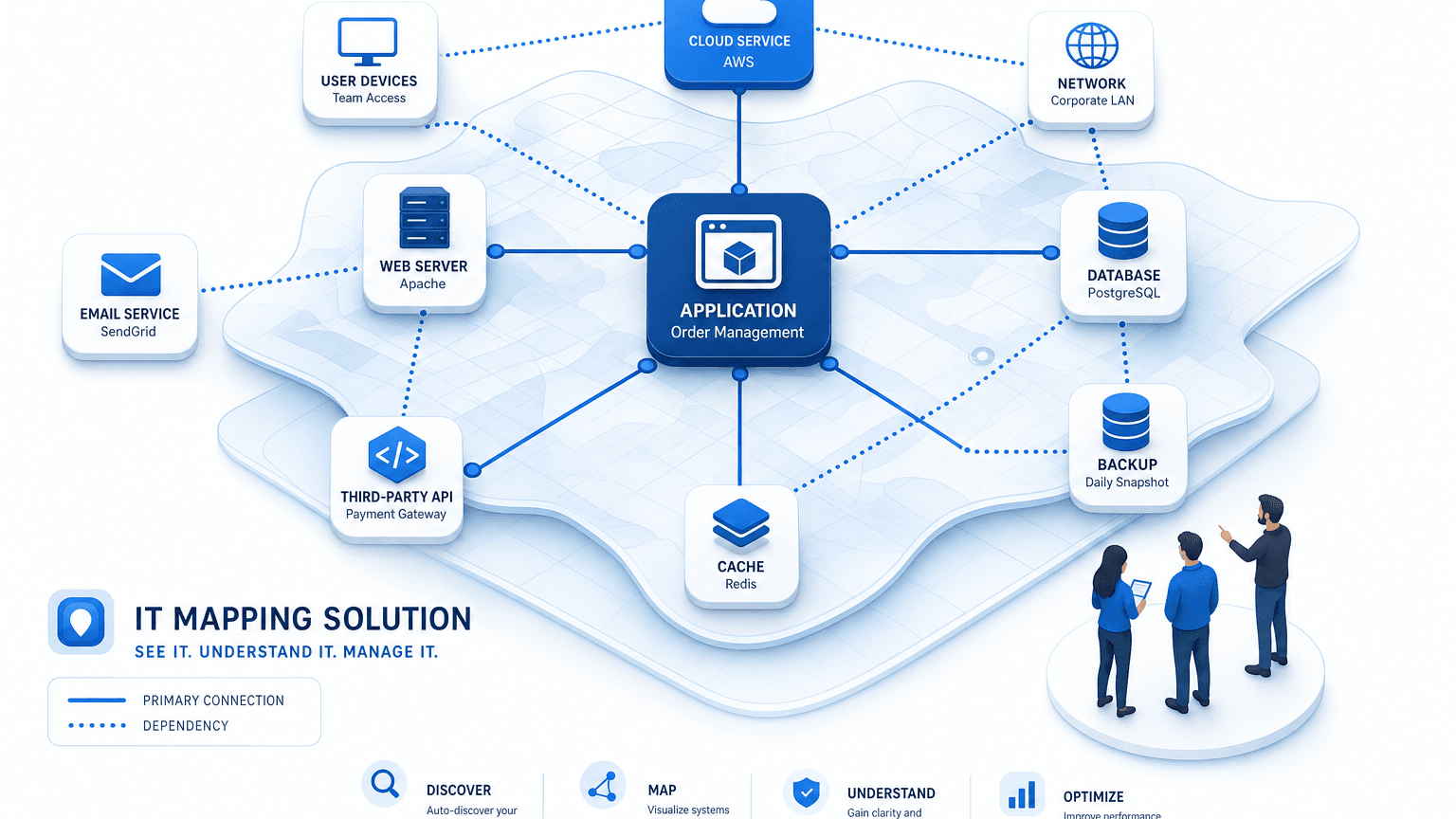
What’s the best IT mapping solution for small teams?

A six-person IT team still owns payroll, VPN, and the customer portal on the same weekend change window – headcount stays small, but blast radius doesn’t shrink with it. Spreadsheets list servers. They don’t document what fails when one host drops. The best IT mapping solution for small teams is a discovery-backed system that shows typed dependencies between services, hosts, and owners – not a diagram exported from a scan.
You need maps that support change, incident, and audit work. You need them without a full platform program that consumes the year. Small and mid-market teams reach that bar with discovery-backed maps, clear service definitions, and ITSM handoff.
Why “small team” still means enterprise mapping stakes
Small teams fail the same way large ones do when the map is wrong. A change window opens on a “safe” host. The ticket lists two apps. Production lists five paths nobody documented. MTTR stretches because owners live in chat history. Auditors ask for inventory of systems that process sensitive data. The answer is a filtered CMDB export plus tribal knowledge.
CISA BOD 23-01 pushed federal operators toward complete asset visibility and vulnerability detection on networks they run. The directive is public-sector. The operating lesson is not. Incomplete inventory makes every downstream control weaker, including maps that claim to show service impact.
That operating lesson shows up in the numbers too. Top-performing teams close a critical incident inside an hour, but the 2026 incident management benchmark puts the industry average for critical incidents at four to eight hours. Responders spend that window figuring out what actually depends on what.
Lean IT feels this harder, not softer. There is no separate mapping squad. The same people discover, ticket, and change. If the map tool needs a six-month pattern project before it is useful, the team will keep the whiteboard. Enterprise sophistication here means trustworthy relationships, owners, and last-seen evidence. It does not mean a lighter cartoon of the same idea.
Do small IT teams need full service mapping, or is a host inventory enough?
Host inventory answers what exists. Service mapping answers what breaks together. Small teams still run multi-tier apps, shared databases, and hybrid paths. Without dependency maps, change and incident work stay guesswork even when the asset list looks complete.
What the best IT mapping solution actually requires
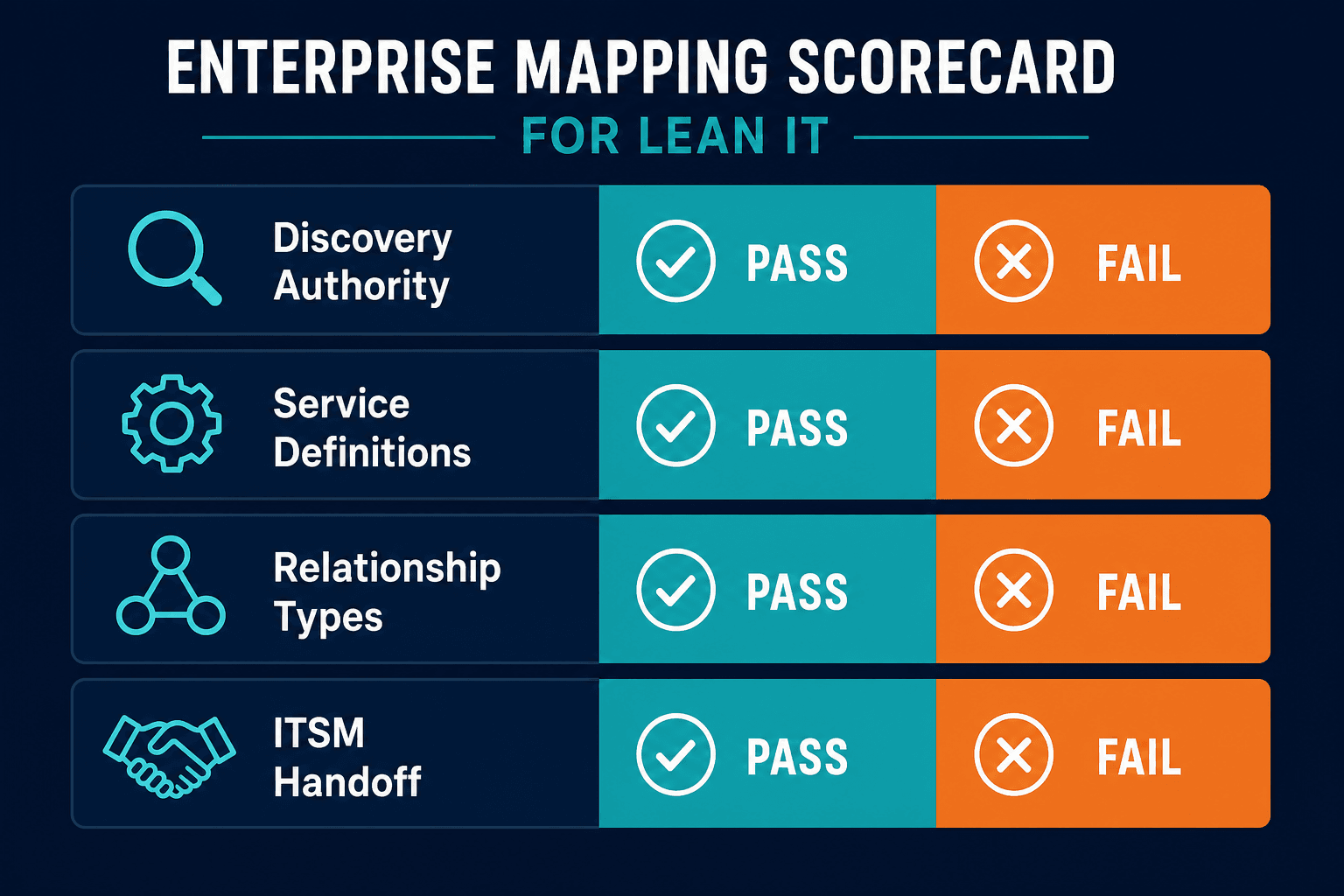
Vendor pages compete on icons and “auto maps everything” claims. Treat those as marketing until you can prove four enterprise tests on a short pilot estate.
1. Discovery authority under the map
Maps that float above a stale spreadsheet rot in weeks. The best stack feeds relationships from IT discovery that covers agent, agentless, and API paths on a high-frequency scheduled cycle. Scheduled refresh cycles keep last-seen dates current. That refresh matters because the starting point is usually worse than teams assume. Blazent’s CMDB accuracy research estimates that average CMDB data accuracy sits at only around 60 percent, and a small team’s spreadsheet rarely beats that baseline.
2. Service definition honesty
Service composition is not guessed from a logo on a rack. Teams define which applications and sites make a business service. Import or integration can carry those definitions. Once definitions exist, dependency map building can automate. Tools that skip this step produce maps nobody can trace to a service owner.
3. Relationship types operators trust
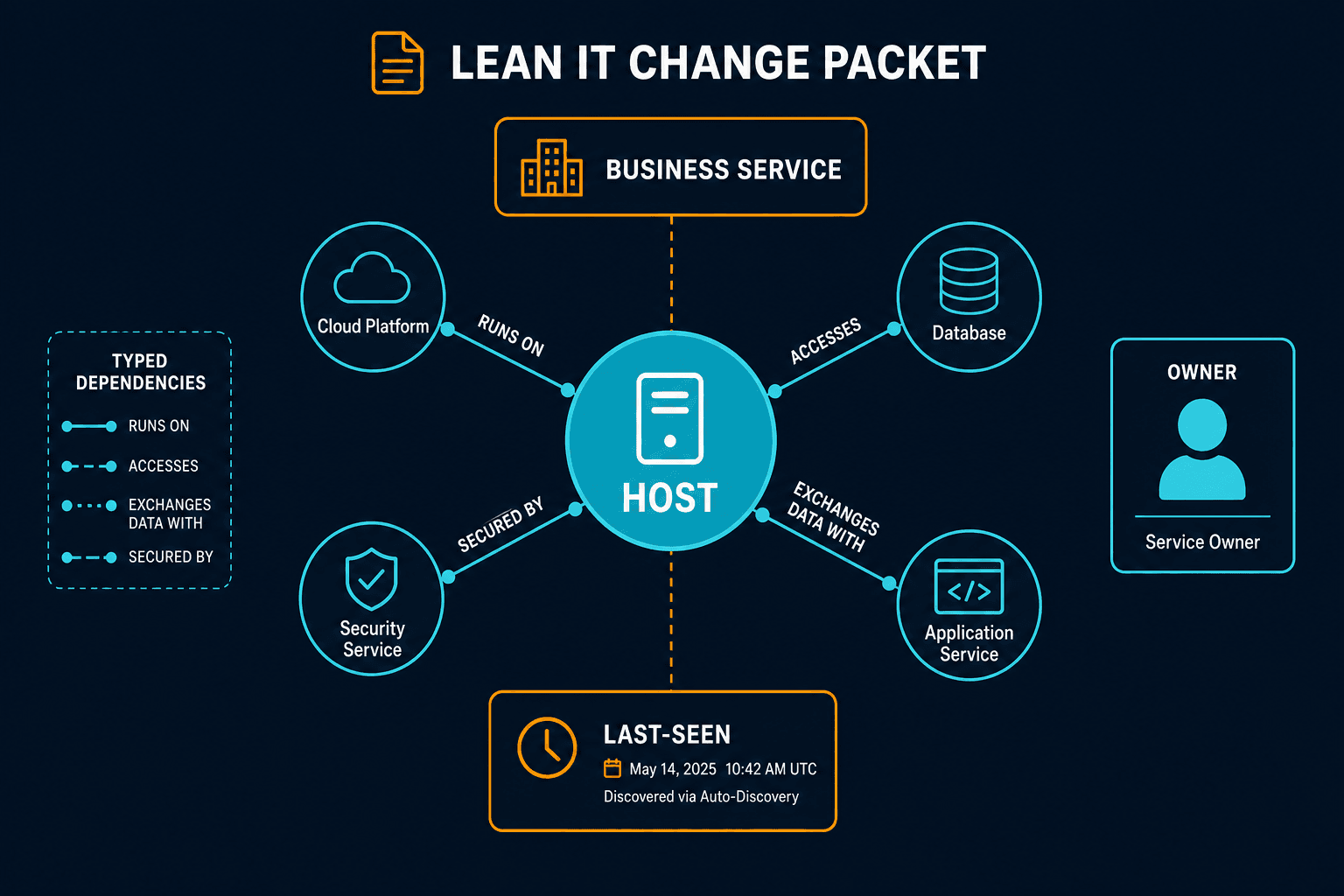
Installed on, runs on, uses, exchanges data with, virtualizes, and physically connected matter in different decisions. A flat “connected to” blob fails CAB questions. Enterprise mapping names the edge type so blast radius is explainable.
4. Handoff into the tools you already run
Small teams rarely rip out ServiceNow, Jira Service Management, Ivanti, HaloITSM, Xurrent, or Hornbill because a map product arrived. The map layer should enrich the ITSM of record. Virima connects to these tools through its ITSM integrations.
The shortlist patterns small teams actually evaluate
You will not evaluate fifty logos. You will land in a few patterns. Know which pattern matches the job.
Pattern A: Full ITSM platform mapping modules
Platforms such as ServiceNow include discovery and service mapping modules aimed at large operating models. Capability can be high. Cost, pattern libraries, and staffing often exceed what a sub-ten-person IT org can sustain. Many mid-market teams keep the ITSM for tickets and choose IT mapping without ServiceNow’s discovery add-ons, looking outside for authoritative discovery and maps instead. Virima’s own overview of business service mapping in ServiceNow covers failure modes such as scope overreach and fragmented ownership. Those failure modes hit small teams faster.
Pattern B: Application dependency mapping point tools
ADM tools excel at application topology. They may under-serve hardware, network, cloud, and owner fields your CMDB and ITAM processes need. Application dependency mapping for small IT teams often gets sold as “lightweight enough” on its own – but lightweight only covers app-to-app links, not the hardware, network, and ownership fields a change ticket or audit demands. A strong ADM view is necessary. Alone it is rarely sufficient for change packets and audit populations. Compare the category carefully against top application dependency mapping tools criteria, then ask what still sits outside the map.
Pattern C: Inventory-first tools with diagram exports
Inventory platforms draw pretty topology from scan data. Diagrams help conversations. They often lack durable CI identity, relationship governance, and ITSM sync rules. Pretty is not the same as authoritative.
Pattern D: Discovery CMDB plus service maps
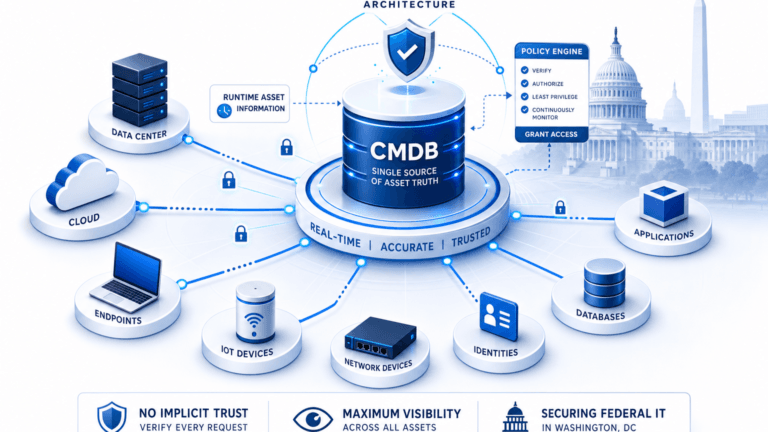
Discover with authority. Hold configuration in a CMDB you can govern. Build service maps after definitions exist. Push context into the ITSM you already use. Virima covers this pattern: discovery-sourced data, ViVID™ service maps once services are defined, and ITSM augmentation alongside your current tools.
What is the best IT mapping solution pattern for small teams in 2026?
The strongest pattern is discovery-backed CMDB relationships plus service maps built from explicit service definitions, handed into the existing ITSM. Full platform mapping modules can work but often exceed lean staffing. Inventory diagrams help talk tracks but rarely survive as system-of-record maps.
Criteria table small teams should force every vendor through
Use this as a pilot scorecard. Score each row pass or fail with evidence from your estate, not from a slide.
| Criterion | Enterprise bar | Fail signal |
|---|---|---|
| Discovery coverage | Agent, agentless, and API paths on hybrid estates (on-prem plus AWS and Azure as needed) | Single method only; cloud or network blind spots accepted as normal |
| Refresh discipline | High-frequency scheduled cycles with last-seen you can defend | Refresh claims with no schedule, owner, or exception queue |
| Service definitions | Explicit import or entry of what composes each service before map automation | Tool invents services from banners and hopes |
| Relationship quality | Typed edges operators use in change and incident | Single undifferentiated link soup |
| CMDB usefulness | Identity, ownership, and reconciliation rules, not a dump of scan rows | Export-only diagrams with no durable CI keys |
| ITSM handoff | Enrich tickets and changes in the platform you already run | Forces a second desk of record to get value |
| Operating load | A lean team can keep maps current without a dedicated mapping PMO | Value only after a multi-quarter pattern factory |
| Commercial honesty | Stated cost to expand coverage as the estate grows | Entry price hides renewal and scale math |
Don’t confuse enterprise capability with audience size – the table above scores capability, not company size.
How Virima meets the bar without asking small teams to become a platform shop
Virima delivers trusted runtime truth under IT operations: what exists, how it connects, what changed, what will break, and who owns it. That is enterprise service mapping for growing IT teams, built for mapping specifically:
- Authoritative discovery across methods your estate needs, on high-frequency scheduled cycles you control.
- CMDB as the system of record for configuration and relationships, not a side spreadsheet.
- ViVID™ service maps after service definitions are provided. Maps show typed dependencies operators can explain in CAB and incident bridges.
- ITSM augmentation so ServiceNow, Jira Service Management, Ivanti, HaloITSM, Xurrent, Hornbill, and peers remain the engagement layer while Virima holds discovery-sourced truth.
Lean IT teams get the same discovery, CMDB, and ViVID™ service mapping capability as larger programs.
If you want the category proof line in one place, start with Trusted Runtime Truth. For the mapping module itself, see service mapping.
Can a small IT team run enterprise-grade service mapping without a full ServiceNow ITOM program?
Yes, when discovery and CMDB relationships sit in a dedicated discovery-sourced CMDB and service definitions are explicit. The ITSM can remain the ticket system. Maps and impact context feed change and incident work without a multi-quarter platform rollout.
A 30-day evaluation plan that respects lean capacity
Week 1. Pick three business services that hurt when wrong: for example VPN, payroll file path, and customer portal. Write service definitions. List known hosts and owners.
Week 2. Run discovery against that slice. Compare last-seen and identity to the spreadsheet of record. Log gaps.
Week 3. Build maps for the three services. Force one change tabletop and one incident tabletop using only the map plus CMDB fields. Note every time someone opens a second tribal source.
Week 4. Push one enriched change or incident path into your ITSM. Measure minutes saved and wrong-CI rate. Decide stay, pair, or replace inventory-only tools with eyes open.
This plan is enterprise method. The sample is small. That is how serious small teams buy.
What to ask in the contract and the demo
Ask the vendor to show how a map is built when no service definition exists. Also ask how service definitions are entered, how often discovery refreshes, and which relationship types and owners the map stores.
Choose the map layer that keeps enterprise decisions honest
The best IT mapping solution for small teams combines discovery authority, explicit service definitions, typed relationships, a durable CMDB, and ITSM handoff. Virima provides each of these for lean IT teams.
Start by running the scorecard above against your current shortlist – score each row pass or fail before any vendor call. When you are ready to pressure-test three services on your own estate, request a demo and bring your scored results with you.
If change and incident work still hunt for live CIs and owners, explore how Business Pro brings full discovery, CMDB, and ViVID™ maps to a lean IT team without replacing your ITSM.
Frequently Asked Questions
What should small IT teams look for in an IT mapping solution?
Prioritize discovery that stays current, explicit service definitions, typed dependency relationships, a CMDB you can govern, and clean handoff into your existing ITSM. Team size changes staffing. It should not lower the quality bar for change and incident decisions.
Is service mapping different from application dependency mapping?
Application dependency mapping focuses on how application components connect. Service mapping attaches business service meaning on top of infrastructure and application relationships so impact and ownership are clear. Many teams need both views under one governed record set.
Do we need ServiceNow to get useful service maps?
No. ServiceNow can host mapping modules, but lean teams often keep ServiceNow or another ITSM for tickets and use a discovery CMDB mapping layer for authoritative relationships. The ITSM remains the system of engagement. The map layer holds runtime truth.
How does Virima approach service mapping for lean IT teams?
Virima discovers with authority, stores configuration in CMDB, and builds ViVID™ service maps after service definitions are provided. Maps and impact context can enrich the ITSM you already run.
How long should a pilot take for a small team?
A focused 30-day pilot on three business services is enough to test discovery freshness, map usefulness in change and incident tabletops, and ITSM handoff. Expand scope only after those three services survive real operating questions.
Does Virima’s mapping module require a separate discovery deployment, or does it use the same agents and connectors as the CMDB?
The same discovery agents and connectors that populate the CMDB feed the mapping module – there is no second deployment. Once service definitions are added, ViVID™ service maps build from the CI relationships discovery already collected, so a lean team maintains one discovery footprint instead of two.