The AI Pilot Was Delayed 4 Months Because Nobody Had Audited the CMDB First. A Post-Mortem.

An AI change risk automation pilot post-mortem is a structured review of why a data-dependent automation program paused or failed — and what remediation was required before it could relaunch. The most common root cause is CMDB accuracy below 90%. This is the post-mortem for a 600-seat enterprise that measured 68% accuracy at pre-launch, remediated over four months, and relaunched with 94% accuracy — flagging 14 high-risk changes in its first 30 days.
If you’re an IT Operations Manager about to launch an AI change risk pilot, this is the CMDB readiness data audit your project plan is probably missing.
The plan that didn’t account for data state
The scope was clear: automate risk scoring on all standard changes across a 600-seat enterprise environment, and route any change with a blast radius touching four or more business services to expedited CAB review. The Alternative to Cloudaware CMDB Explore Virima CMDB for multi-cloud environments would feed the model its relationship data.
What the project plan didn’t include was a pre-launch data audit. Nobody had run a discovery scan against the underlying CI data since the ITSM platform migration two years earlier.
Before your AI automation initiative touches a single workflow, the question worth answering is what your CMDB actually contains versus what it’s supposed to contain. Start with discovery-sourced data readiness, not estimation. Self-reported accuracy typically runs 15 to 20 percentage points higher than measured accuracy when teams actually run a discovery scan.
The CMDB readiness number that stopped the AI pilot
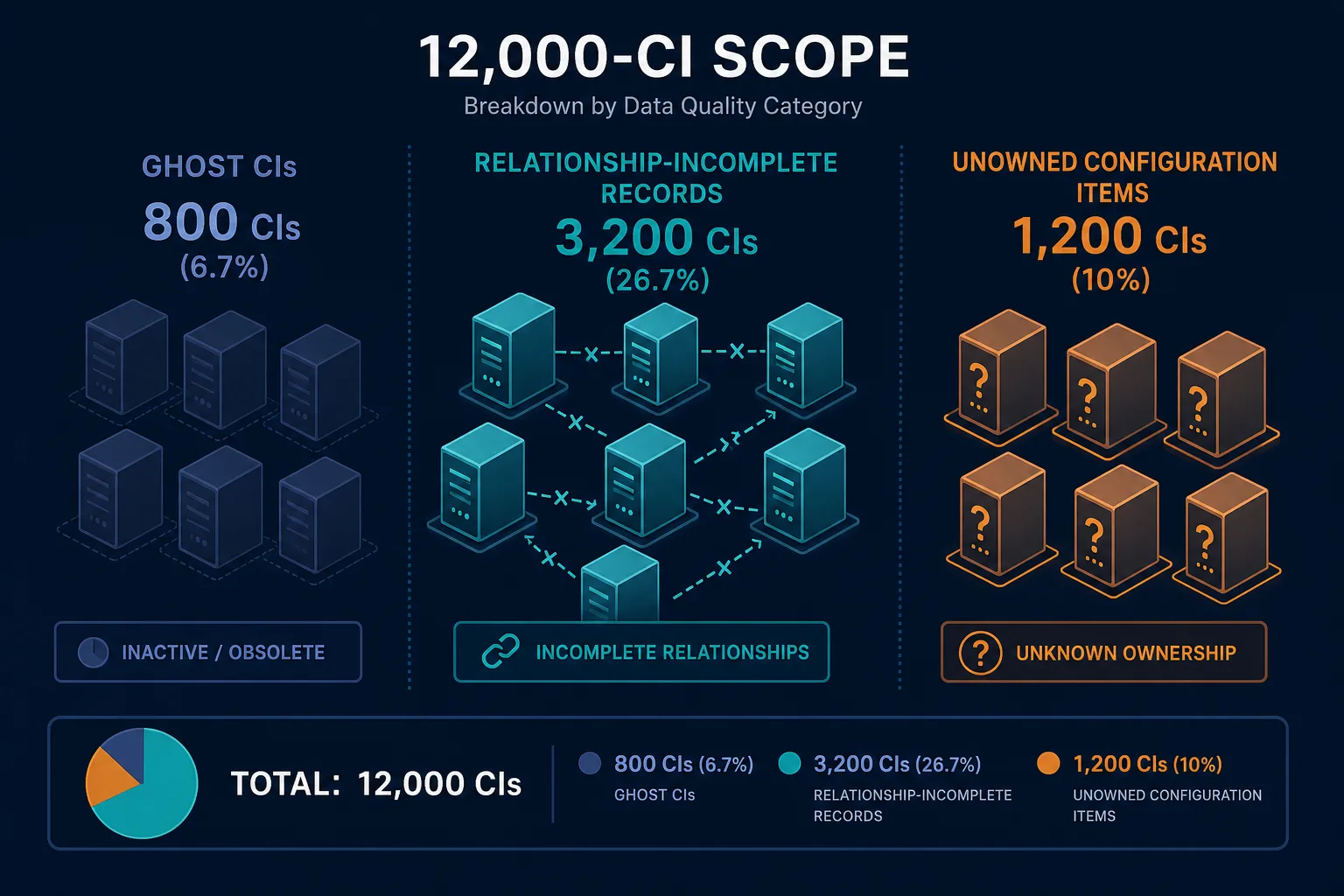
A pre-launch discovery scan across the full 12,000-CI scope returned an accuracy rate of 68%. That 32% gap broke down into three failure types:
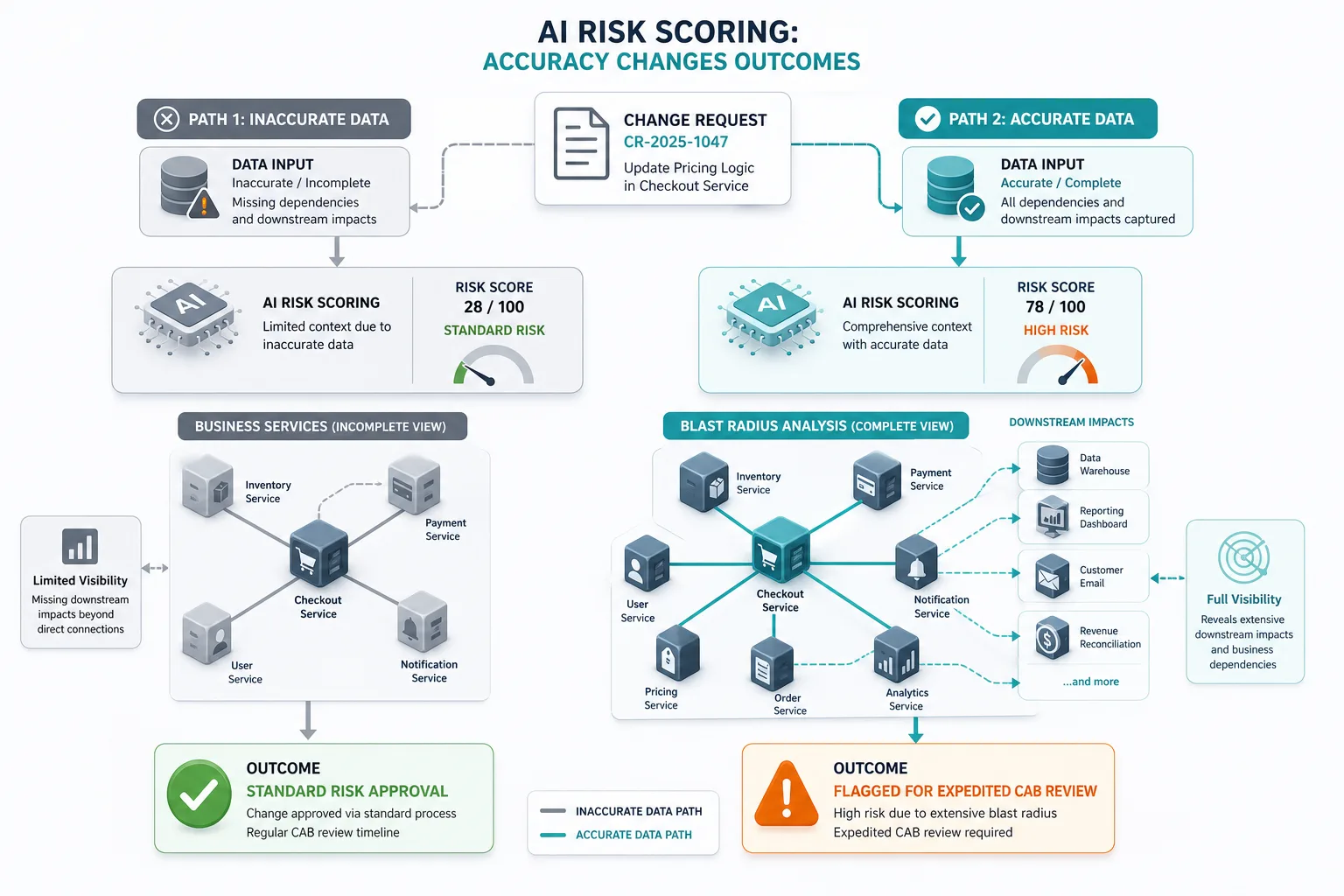
The threshold for AI change risk automation is CMDB accuracy above 90%, with relationship coverage above 85% for all CIs in scope. Below that, the model produces false negatives — changes score as low-risk because their blast radius relationships simply don’t exist in the data.
Ghost CIs with active relationships. Servers and applications decommissioned six to twelve months earlier were still in the CMDB with relationship maps pointing to active services. An AI model processing a decommissioned server sees it identically to an active one — and calculates blast radius accordingly.
Middleware and integration layer CIs with no relationship data. Relationship discovery had never run against them. A CI with no mapped relationships returns a blast radius score of zero. The result is a false negative: the AI scores a change as low-risk because the relationship doesn’t exist in the data — even if it matters.
Unowned CIs. Blank owner fields were concentrated on infrastructure components that predated the current team’s tenure. Ownership data is the prerequisite: many ITSM change models require owner sign-off, and blast radius analysis without ownership context can’t distinguish between a test server and a production system.
According to Ivanti’s 2025 analysis of agentic AI readiness in ITSM environments, most enterprises that discover data quality problems at pilot launch had estimated their CMDB at 85%+ accuracy before the first discovery scan ran (“Is Your ITSM Environment Ready for Agentic AI? Probably Not (Yet),” Ivanti, July 2025). The gap between estimate and reality typically comes down to these same three failure types.
Running AI risk scoring on 68%-accurate data would not have improved change management. It would have produced AI-shaped noise at scale.
CMDB cleanup program timeline: four months of remediation
Month 1: Ghost CI retirement and deduplication
1,400 ghost CIs were retired from the CMDB. 380 duplicate records were merged. The discovery scan had surfaced both old and current records for the same assets, forcing a choice. The team established a “last-active timestamp” rule: if a CI showed no network activity in the last 180 days, it was retired. Duplicates were merged with the older record discarded.
Cost: approximately 40 person-hours of data hygiene work. Outcome: CI count reduced from 12,000 to 10,200.
With ghost CIs retired, Month 2 turned to a harder problem: relationships.
Month 2: Relationship mapping and dependency discovery
9,200 CIs still had missing or incomplete relationship data. The team ran a full relationship discovery cycle using Agent-based vs. agentless discovery: which is best for your business? across the environment. ViVID™ service maps built from that pass revealed 400+ middleware CIs the CMDB had treated as isolated — they were, in fact, connected to multiple business services. This was the month where the 68% accuracy number suddenly looked conservative.
Cost: 120 person-hours to validate and integrate relationship data. Outcome: 89% of CIs now had at least one mapped relationship or an explicit “standalone” designation.
That cleared the path for Month 3’s work: ownership.
Month 3: Ownership assignment and accountability
An IT team survey combined with Active Directory lookups resolved 1,100 blank owner fields. The team also implemented a “three-tier ownership model” — primary owner, escalation owner (manager), and business service owner (if different from infrastructure owner). This structure enabled future change approvals to route to the correct stakeholder immediately.
Cost: 80 person-hours. Outcome: 100% of CIs in automation scope now had assigned ownership.
With clean ownership records in place, Month 4 addressed the final risk: backsliding.
Month 4: Refresh cadence and source hierarchy
The discovery cycle was locked into a 48-hour refresh on managed endpoints using agent-based discovery for Windows and Linux systems, agentless discovery for network-only assets, and API-based discovery for cloud environments — maintained automatically by Virima’s discovery engine without manual scheduling. The team also defined the source hierarchy: “If data conflicts between discovery sources, agent-based data wins for on-prem systems, API data wins for cloud.”
Without a locked refresh cycle and source hierarchy, CMDB accuracy decays. The team estimated that skipping Month 4 would have eroded their work by Q2 2027.
Cost: 60 person-hours to implement and validate. Outcome: A governed, continuously updated CMDB.
Week 17: what the relaunched pilot found
At Week 17, the CMDB returned a measured accuracy rate of 94% across the automation scope. The pilot relaunched on the full 12,000-CI scope.
The first 30 days produced 14 high-risk change flags that CAB would have approved as standard. Three had blast radius profiles touching four or more business services. One touched six services, two of which had never appeared in any prior change request because their relationship maps had only been populated during Month 2.
Those six-service impact chain? It would have remained invisible if the team had launched at 68% accuracy. The AI model cannot flag what it cannot see. A missed relationship looks like no risk at all.
Wondering what a discovery scan would surface in your environment? See a ViVID™ service map of your own infrastructure
The post-mortem finding that changed the project
The four-month delay cost an estimated $180,000 in deferred automation value (calculated as equivalent effort hours at loaded cost). By the team’s estimate, launching at 68% accuracy would have produced three to five change-driven P1 incidents per quarter from false-negative risk scoring. Those incidents don’t happen when the AI operates on data it can trust. Gartner benchmarks major IT incident costs at $10,000–$100,000 in direct and remediation costs; three to five P1s per quarter would have exceeded the $180,000 remediation delay cost within a single quarter.
The most significant finding: the team had been treating CMDB accuracy as an IT hygiene task and AI automation as a technology project. They’re the same project. The EMA ServiceOps 2025 report notes that enterprises with governed, discovery-sourced CMDB data show significantly higher rates of successful AI automation deployment and lower time-to-business-value. See the [EMA Report] ServiceOps 2025: Outages, AI, and What’s Next.
The IEEE Computer Society (April 2026) identifies the shift from static CMDB to governed operational data as the defining prerequisite for enterprise AI programs that advance past pilot stage (“From CMDB to Dynamic Digital Twins,” IEEE Computer Society, April 2026). Static data and dynamic models don’t mix — the model will optimize for patterns that no longer exist — which means your next pilot doesn’t stall at a different gate; it stalls at the same one.
The deeper insight: you cannot automate decisions on data you don’t trust. AI models trained on inaccurate or incomplete data don’t simply fail gracefully. They amplify the errors at scale and add confidence to the wrong decisions.
Before your next AI pilot: CMDB readiness checklist
Measure before you estimate
Run a discovery scan and compare the output against your existing CMDB records. Self-reported accuracy is unreliable in this context — run the scan before scoping any AI initiative.
Account for all three failure modes
Ghost CIs, missing relationships, and unowned records are the most common data problems blocking change risk automation data readiness. Check for all three.
Set a 90%+ accuracy threshold
AI risk automation requires CMDB accuracy above 90%, with relationship coverage above 85% for all CIs in automation scope. Anything lower returns more false signals than actionable flags.
Lock a refresh cycle
If your CMDB is 94% accurate today and you don’t refresh it, it will be 70% accurate in 18 months. Define your discovery sources, set a refresh cadence (48 hours is industry standard for managed infrastructure), enforce source hierarchy rules, and track CI staleness weekly: flag any CI not touched by a discovery pass in the last 48 hours.
Govern the data you build
Trusted Runtime Truth means every CI traces back to its discovery source, every relationship is built from live data, and a validated source hierarchy determines which input wins when data conflicts. Ungoverned data always decays.
Virima’s IT discovery engine identifies ghost CIs and surfaces relationship gaps across your environment. It then maintains a 48-hour refresh cycle on managed endpoints using agentless, agent-based, and API-based discovery methods, so your CMDB becomes the reliable foundation that AI automation requires.
Download the CMDB Readiness Scorecard — rate your environment against the three failure modes before your next AI initiative. CMDB Readiness for Agentic AI: The 7 Discovery-Sourced Data Requirements
Already running a pilot? CMDB Readiness for Agentic AI: The 7 Discovery-Sourced Data Requirements with Virima’s discovery team.