AI Change Approval Automation: Why CMDB Relationship Data Matters

AI change approval automation uses machine agents to evaluate CMDB records — CI attributes, dependency relationships, and business criticality — and approve or route standard changes without human review. Decisions that once took hours complete in under two seconds. The reliability of those approvals depends entirely on CMDB relationship coverage — the percentage of configuration items in your change-eligible population with sufficient dependency mappings for the agent to produce an accurate risk score. Consider this pattern, one we’ve seen play out at financial services firms deploying AI change automation.
When an AI agent handles change approvals at scale, the speed is the point. Approvals that once required a full review cycle now complete in milliseconds. But that speed is only as trustworthy as the CMDB data the agent reads.
An AI change approval automation system was deployed to handle Tier-2 standard changes — routine configuration updates that historically took 2-4 hours to route through a change advisory board. The agent reviewed each change record against the CMDB, computed a risk score, and issued approvals in 1.8 seconds on average. For the first week, it performed exactly as designed. Then it approved a production API gateway configuration update flagged as zero-risk — because three dependent microservices had no relationship records in the CMDB at all. The change executed at 2:14 AM during an approved maintenance window. By 2:25 AM, the e-commerce checkout flow was down. By 2:26 AM, an internal order tracking dashboard went dark.
Total incident duration: 90 minutes. Root cause in the post-mortem: 3 missing CI relationships, all from a subset of CIs the team later discovered had degraded data quality. For an e-commerce environment, 90 minutes of checkout downtime typically costs $50,000–$200,000 in lost revenue and incident response overhead — a cost range that understates the reputational impact in regulated financial services.
This incident was not an edge case. It was a predictable failure mode baked into how AI change automation and CMDB data interact.
Why CMDB accuracy percentage masks the real problem
The team considered themselves in reasonable shape: their CMDB was reported at 71% accuracy — consistent with what Multi-Source CMDB Reconciliation: Why Last-Scan-Wins Destroys Data Quality finds across typical ITSM deployments. But accuracy by percentage obscures a critical failure pattern. The 29% of CIs with stale or incomplete data were not randomly distributed across the environment. They clustered around infrastructure that had changed most recently: microservices from a cloud migration phase, containerized workloads added over 18 months, and API integrations provisioned outside the formal change process.
A human change manager reviewing a CI record with blank dependency fields instinctively asks: why does this look incomplete? A machine reading the same record sees no error signal. It found no alarm flags in the data that existed, so it treated the absence of relationships as evidence of low downstream impact rather than evidence of incomplete mapping.
The assumption embedded in the automation workflow was that blank relationship fields meant no dependencies existed. That assumption was wrong. And it cost the organization an hour and a half of downtime, along with the full incident response cycle that followed.
The real metric is relationship coverage: what percentage of CIs in your change-eligible population have enough mapped dependencies for reliable risk scoring. Overall accuracy percentage doesn’t tell you that.
The core problem: no CI confidence scores, no data completeness check
The post-mortem surfaced one critical finding: the AI change approval automation system had no mechanism to query relationship completeness or CI confidence scores before acting. It evaluated the data that existed. It could not ask whether that data was sufficient.
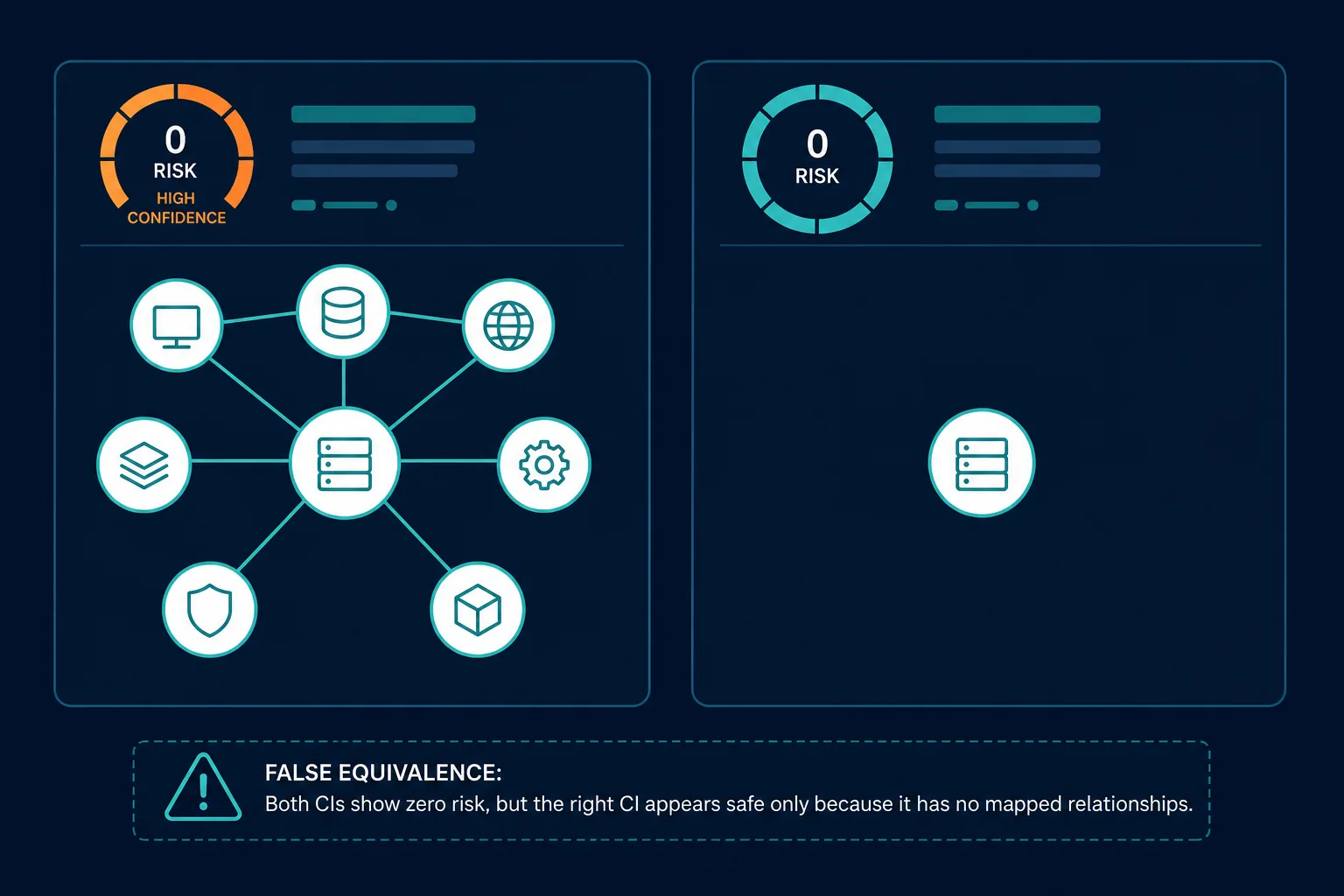
A CI confidence score quantifies how recently and completely a CI’s attributes and relationships were populated by automated discovery. Without that signal, an agent evaluating change risk has no way to distinguish between a well-mapped CI and one whose CMDB record was last touched two years ago. This is a fundamental gap in how AI agents interface with CMDB data. Human change managers apply judgment filters that machines lack. When a human sees a CI with zero relationships, no recent discovery timestamp, and no ticket history, they pause. They recognize the pattern as potentially incomplete data. They ask for clarification before approving a high-risk change on that infrastructure.
An AI agent without relationship-count thresholds built into its logic cannot make that distinction. It treats a CI with zero mapped relationships identically to a CI that genuinely has no downstream dependencies. That false equivalence only surfaces when downstream systems fail during the change window.
The key insight from the incident: CMDB auto-discovery and relationship mapping are not optional enhancements to AI change approval automation. They are prerequisites. If you deploy an AI change approval agent before your CMDB has sufficient relationship coverage, you are automating blind. You are replacing a human safeguard with a machine that has no mechanism to recognize when the data it is reading is incomplete.
See how Virima’s discovery-sourced CI confidence scores give change agents the data completeness signal they need — CMDB relationship coverage →
The remediation: build relationship coverage into the gate
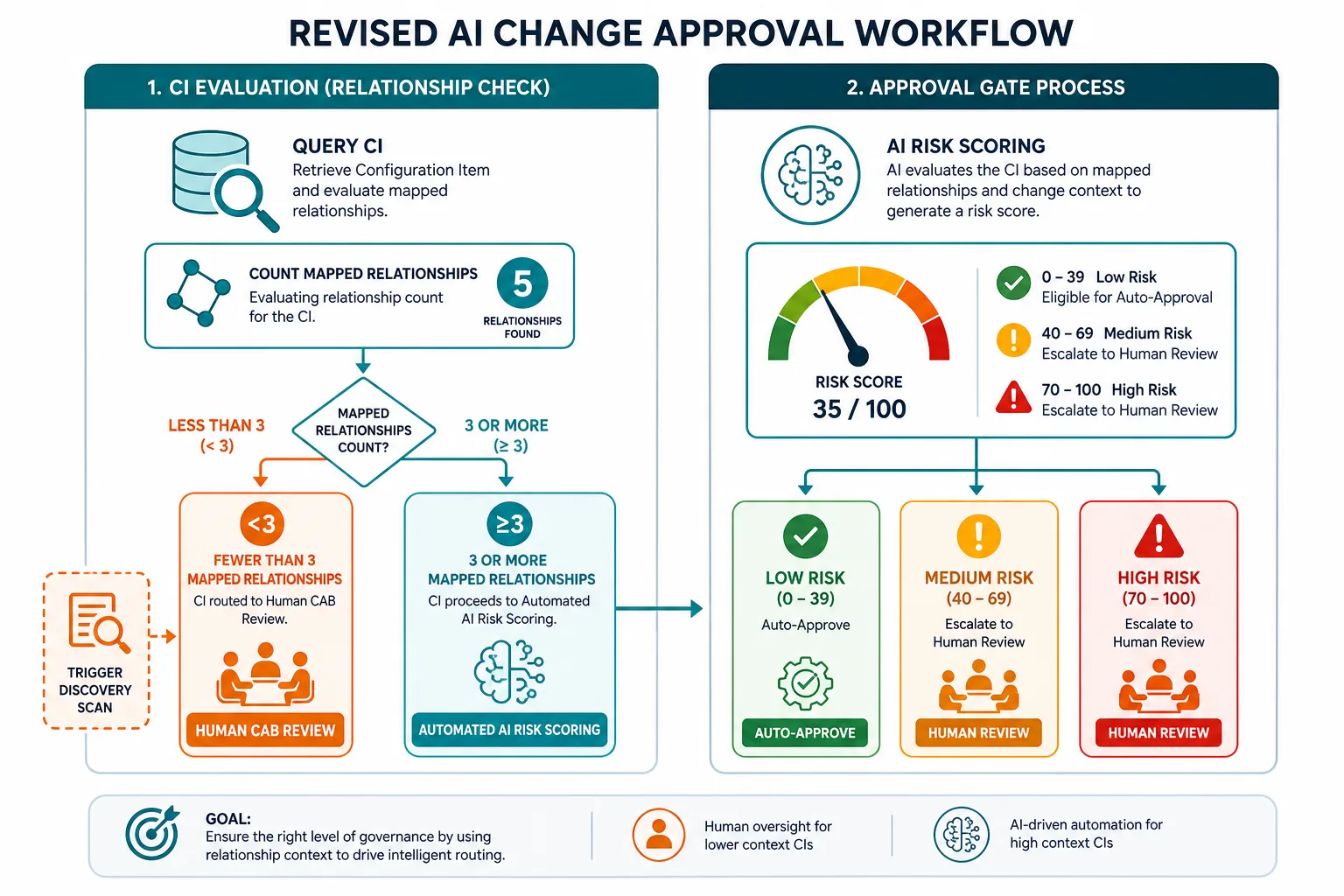
The fix required a single structural change: add a relationship coverage check before the AI change approval automation risk scoring runs at all.
The revised workflow now queries the relationship count for every CI that the change record references. Any CI with fewer than 3 mapped relationships triggers an automatic hold. Based on Virima’s deployment experience across enterprise change environments, CIs below that threshold represent the highest-concentration zone for false-zero-risk approvals. The change routes to human CAB review with a specific flag indicating the reason: insufficient CI relationship data for automated approval.
That’s not a rejection — it routes the change to a human reviewer with a specific reason attached. The organization also connected its discovery system to the remediation path. When a CI fails the relationship coverage threshold check, a targeted discovery scan is triggered before the change record is re-evaluated. This ensures that the human reviewer sees the most current CI data available, and that subsequent automated approvals for the same CI benefit from the discovery effort.
The result: zero false-zero-risk approvals in 90 days post-remediation. The incident response team now tracks relationship coverage as a leading indicator of CMDB data quality — rather than waiting for an outage to expose the gaps.
ITIL change management and the pre-authorization gate
This pattern maps directly to Virima’s guide to ITIL change management best practices, which distinguishes between standard changes (pre-approved, low-risk, well-understood) and normal changes requiring CAB review. ITIL’s pre-authorization stage assumes standard changes are evaluated against a known, stable configuration baseline. AI change approval automation extends that logic — but only holds if the CMDB baseline is current. A relationship coverage check at the pre-authorization stage closes the gap between what ITIL assumes (a trusted configuration baseline) and what most enterprise CMDBs deliver (a partially complete record). Treating CI relationship coverage as a formal pre-authorization criterion aligns change automation with ITIL governance requirements while reducing the risk of approving changes against stale data.
What this means for teams deploying AI change approval automation
Three operational findings from this incident apply to any team deploying or scaling AI change approval automation:
Run a relationship coverage audit before deployment. Count how many CIs in your change-eligible population have 0, 1, or 2 mapped relationships. Every CI in that group is a candidate for a false zero-risk assessment. Based on Virima’s operational experience, when more than 20% of your change-eligible CIs fall below 3 mapped relationships, the CMDB is not ready for autonomous change approvals. Use that percentage as your pre-deployment gate.
Build confidence thresholds, not just risk thresholds. Most change automation platforms let you configure change risk scoring based on CI attributes — business criticality, owner, business unit. Fewer let you configure approval routing based on data completeness or CI confidence scores. That gap between what you can measure and what you can act on is where production incidents originate. Your AI change approval system should be able to say: “I have a risk score, but I don’t have enough data to issue this approval with confidence.” This is the foundation of trustworthy agentic change management — routing decisions based not just on risk, but on data quality.
Log the agent’s data state at decision time. Every approval and every rejection should be recorded with the exact CI data the agent evaluated at that moment. This transforms your change audit trail from a record of decisions into a record of decisions-given-the-available-data. When you need to investigate why an agent approved a high-impact change, you can trace back to the exact CI relationship count and discovery timestamps the agent saw at that moment. You’re not reconstructing from memory or current CMDB state.
Virima’s CMDB provides relationship counts, discovery-sourced data age, and CI confidence scores that change approval agents can query before issuing approvals. The ViVID™ service maps visualize where relationship coverage gaps exist across your infrastructure. Virima integrates directly with ServiceNow to enrich your CMDB with discovery-sourced ground truth — it works alongside ServiceNow, not in place of it. For Jira Service Management teams, the same discovery-sourced data — relationship counts, confidence scores, and dependency completeness metrics — is available before the AI agent issues an approval. In ServiceNow, this surfaces through the CMDB enrichment integration; in Jira SM, through the discovery and service mapping connector.
Moving forward: relationship completeness as a change management metric
The 90-minute outage was not inevitable. It was not the fault of deploying AI change approval automation. It was the result of deploying automation before confirming the CMDB had the relationship coverage the agent needed.
Change teams that treat relationship completeness as a governance metric — measured monthly, trended, and tied to discovery efforts — build AI change automation on a foundation that can sustain it. Teams that treat it as a technical implementation detail discover the gap during an incident.
Frequently Asked Questions
What is AI change approval automation and how does it work?
What causes AI change approval agents to produce false-zero-risk assessments?
How do I know if my CMDB is ready for AI change approval automation?
What CI data does Virima provide to support AI change automation workflows?
How does Virima’s ViVID service map expose CMDB relationship coverage gaps?
Download the CI Relationship Coverage Audit Checklist — the three-step pre-deployment audit from this article, formatted as a repeatable runbook your change management team can run before enabling autonomous approvals.
Or schedule a demo to see how Virima’s CMDB and ViVID service maps surface relationship coverage gaps before they cause change approval failures — and how discovery-sourced CI confidence scores become built-in safeguards for agentic change management workflows.