Why AI Initiatives in IT Stall on Data Quality — Not Model Choice

AI initiative failure in IT operations is a data quality problem, not a model quality problem. When AI projects for change risk scoring, incident routing, or capacity planning stall, the root cause is almost always stale, incomplete, or ungoverned CMDB data — not the AI vendor selected. Organizations that establish Trusted Runtime Truth before deploying AI models see significantly higher success rates than those that treat data readiness as a parallel workstream.
Six months. Four parallel AI initiatives at a mid-size financial services firm. Three stalled within 90 days — not because of the models, but because of the data underneath them. The fourth succeeded.
What separates success from stall: the hidden dependency on data freshness
When IT leaders launch AI initiatives — change risk scoring, incident routing, capacity planning, alert correlation — they typically invest in model selection, vendor evaluation, and integration design. They track budget, timeline, and team capability. What they don’t track until it fails is the quality of the data those models read from.
The four initiatives reviewed were representative of what most mid-to-large enterprises attempt today. Three stalled within 90 days. The CIO’s first instinct was to blame the AI models. That was wrong.
The three initiatives that stalled each hit the same wall in a different place.
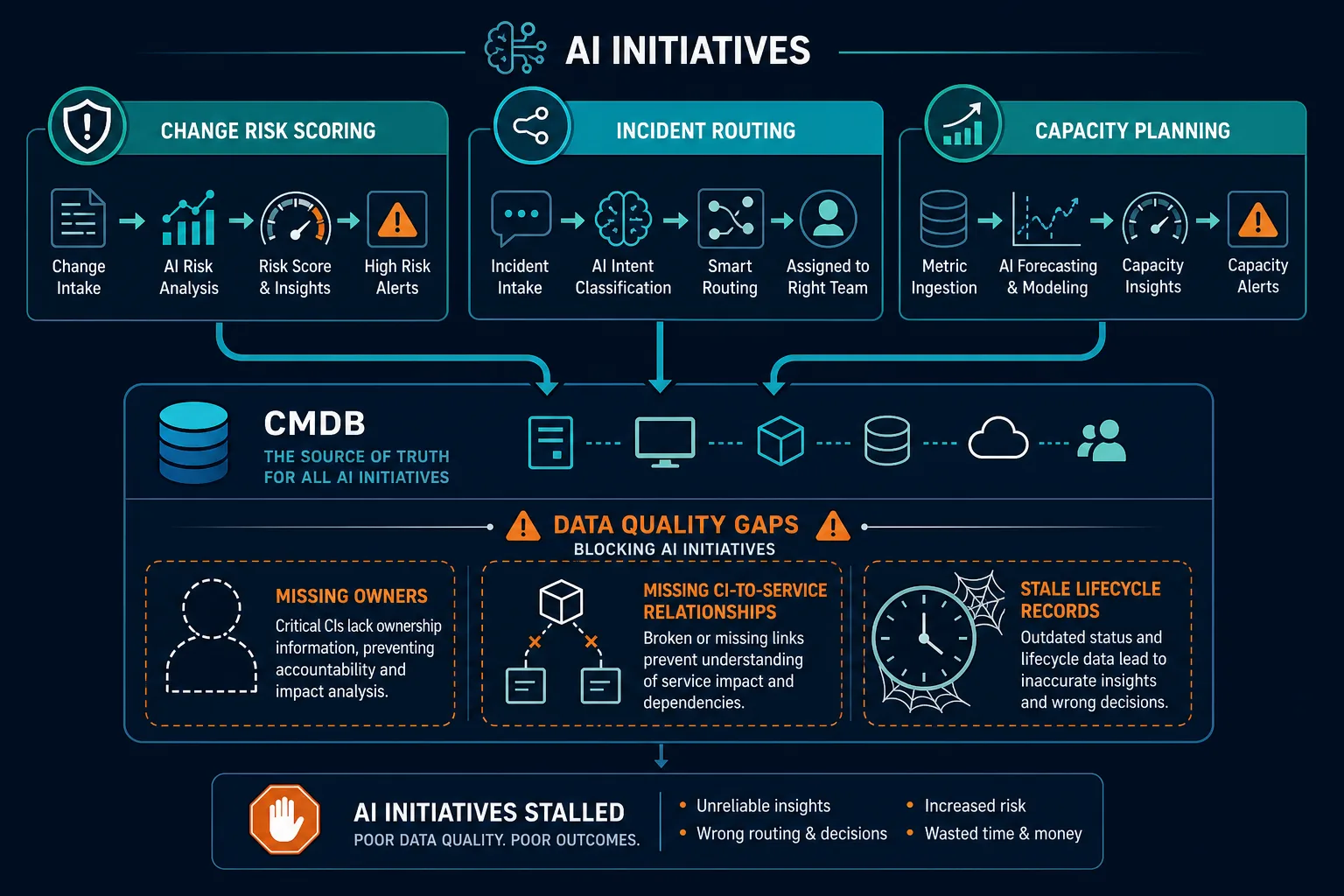
For AI change risk scoring, the model required accurate asset ownership and dependency mapping. An audit found 61% of CIs in scope had stale or missing owner records. The model assigned ownership-weighted risk calculations. For the majority of changes, those weights were either wrong or absent. The model wasn’t broken. The CMDB data underneath was.
For automated incident routing, the model needed CI-to-service mapping. 38% of the relevant CI population had no service relationship recorded. In testing, the automation worked fine — the test set happened to include well-mapped assets. In production, unmapped CIs surfaced immediately, and the routing failed for nearly two out of five incidents.
For predictive capacity planning, the model analyzed hardware utilization history. The audit revealed 44% of server CIs hadn’t been updated in 180 days or more. The model was generating forecasts that included decommissioned hardware and excluded active servers. It was predicting capacity for a phantom estate.
| AI Initiative | CMDB Field Dependency | Data Quality Failure | Outcome |
|---|---|---|---|
| Change risk scoring | CI owner records | 61% stale or missing | Risk weights wrong for majority of changes |
| Incident routing | CI-to-service relationships | 38% unmapped | Routing failed for nearly 2 in 5 incidents |
| Capacity planning | Server lifecycle data | 44% not updated in 180+ days | Forecasts included phantom estate |
Running into the same pattern? See how Virima measures CMDB field completeness before your next AI pilot kicks off.
The one project that worked — and why
The fourth initiative — AI alert correlation — succeeded from day one. It didn’t read the CMDB at all. It operated on fresh discovery scan data instead, bypassing the CMDB entirely.
That bypass was not elegant architecture. It was a workaround that happened to reveal the real problem. Every failed initiative was reading CMDB records. The successful one was reading live, discovery-sourced data.
Discovery-sourced data is updated in real time; CMDB records are only as current as the last manual or scheduled sync. That gap is what continuous automated discovery closes.
Virima’s approach to IT discovery keeps this data current without manual intervention. The CMDB is only as valuable as the freshness of the data within it. When discovery populates and refreshes it continuously, AI models have access to ground truth.
The reframe that changed the budget conversation
After the data audit, the CIO stopped asking, “How do we improve the AI?” He started asking, “Do we have Trusted Runtime Truth?” This distinction matters because it shifts the problem from AI vendor selection to data governance.
According to Gartner’s 2025 research on IT operations and AI adoption, data quality ranks as the top barrier to AI project success in IT ops — ahead of model selection, integration complexity, and organizational change management. McKinsey’s 2024 global AI survey found fewer than 30% of AI pilots reach full-scale deployment, with data quality cited as the primary barrier. The CIO had been looking at the wrong layer.
Once the problem was reframed, three things changed in how the organization evaluated AI investments.
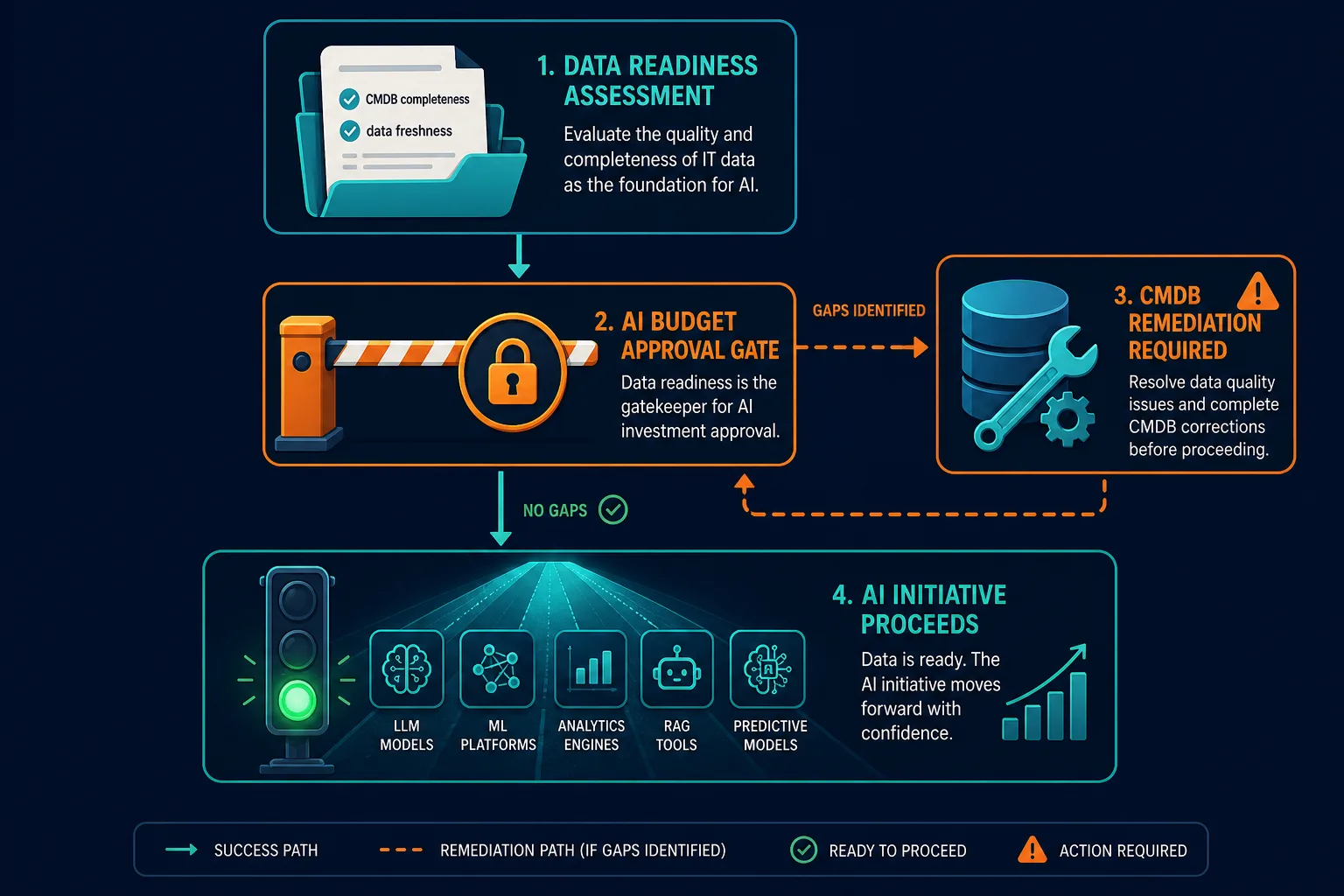
First, data readiness became a prerequisite rather than a parallel track. CMDB remediation was no longer “nice to have” — it became a gate. No data audit, no AI budget.
Second, the budget conversation changed shape. Instead of comparing AI vendors and licensing costs, the team evaluated CMDB accuracy by CI category, IT discovery coverage by infrastructure segment, and service relationship completeness by business service. These became the real cost drivers.
Third, new AI initiatives required a data readiness assessment before approval. Treat this as a gate: audit the CMDB fields your AI initiative will read, measure completeness and freshness, and require remediation before budget approval. That gate prevented repeat failures.
Virima’s CMDB combined with ViVID™ service maps provides the two data layers most commonly required by IT AI initiatives: asset records and their service relationships. IT asset management adds the third layer — lifecycle tracking, which AI models use for capacity and change-impact predictions. Virima integrates with ServiceNow, Jira Service Management, Ivanti, and Xurrent, so your AI platform reads data from the CMDB that already feeds your ITSM tools. Virima integrates directly with ServiceNow to enrich your CMDB with discovery-sourced ground truth — not to replace it.
What Trusted Runtime Truth means in practice
Discovery-sourced ground truth is live, governed data that reflects the actual state of your IT environment at the moment an AI agent queries it. It’s not a product. It’s a data readiness standard that gates AI investment. As IT operations move toward agentic automation, this agentic IT data foundation is no longer optional — AI agents acting on stale CMDB records cause the same failures at machine speed.
Three concrete signals indicate whether your organization has it:
Continuous discovery
Continuous discovery means new assets are found automatically and decommissioned assets are retired without a manual ticket — no gap between what’s in your environment and what’s in your CMDB. Virima runs agentless, agent-based, and API-based scans across on-premises, cloud, and edge infrastructure on a defined schedule. No manual CI maintenance required.
Field completeness metrics
You measure and report CMDB field completeness for each critical category: CI ownership (the percentage of CIs with a non-empty owner field), CI-to-service relationships (what percentage of CIs are mapped to a service), and lifecycle data (how many servers have current decommissioning dates). These metrics guide remediation and give AI models a reliable signal on which fields to trust.
Freshness SLAs
You define and enforce freshness targets for each field. For example: asset owner records updated within 60 days; service relationships refreshed quarterly; hardware lifecycle data current within 90 days. When a field drifts, discovery refreshes it automatically.
One structural change most organizations make when this framework succeeds: appoint a CMDB data owner — a named role, not a committee — accountable for field completeness reporting on a monthly cadence. Without ownership, freshness SLAs drift regardless of the tooling in place.
When these three are in place, AI models operating on CMDB data have access to live operational context — not yesterday’s record, but today’s. That’s the difference between three stalled projects and one that runs successfully.
From pilot purgatory to AI at scale
The standard budget conversation around AI in IT operations often looks like this: identify a use case, select a model or vendor, run a three-month pilot, evaluate results, then decide whether to scale.
The pattern at this financial services firm suggests a revision:
- Audit data readiness — Measure CMDB completeness and freshness for the fields your AI initiative will read. If any field is below 85% completeness or hasn’t been updated in 90+ days, flag it.
- Implement continuous discovery — If your discovery tool isn’t running automatically, set it up. Schedule discovery scans to cover your entire hybrid environment — on-prem, cloud, and edge.
- Define field freshness SLAs — For ownership, relationships, and lifecycle data, set explicit freshness targets and measure compliance monthly.
- Then run the AI pilot — Once you’ve confirmed Trusted Runtime Truth readiness, the AI initiative has a real chance of succeeding.
This sequence prevented repeat failures and turned the CIO’s budget conversation from “which AI vendor” to “is our data ready.” The shift in framing changed the outcome.
Frequently Asked Questions
Why do AI initiatives in IT operations fail on data rather than model quality?
What CMDB fields most commonly cause AI project failures?
How should IT leaders audit data readiness before approving AI investment?
How does Virima’s automated discovery prevent CMDB staleness?
Does Virima work alongside existing ITSM platforms like ServiceNow or Jira?
Before your next AI initiative kickoff, audit the three CMDB fields your use case will read: CI ownership completeness, CI-to-service relationship coverage, and asset lifecycle freshness. Virima’s CMDB health reporting surfaces these metrics automatically. When you’re ready to see it in your environment — schedule a demo.