Vulnerability Management Tools: How to Choose What Actually Reduces Risk

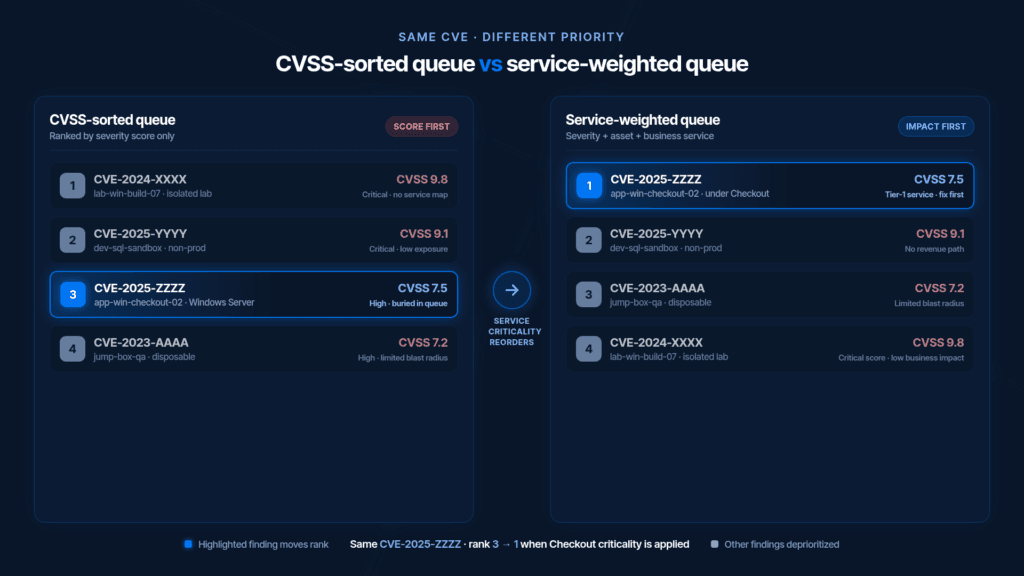
Your scanner queue hit four figures again this morning. Half the “critical” items sit on lab boxes nobody uses in production. The one that should have been fixed last week lives on a Windows application server under a revenue service, and nobody ranked it that way because the tool only saw a CVSS number.
That gap is why buying another vulnerability management tool rarely fixes the program. Scan volume keeps rising. In 2025 alone, 42,000 CVEs were published, about 130 new disclosures per day on average, according to the National Vulnerability Database of NIST. Only a thin slice of findings ever gets exploited, yet teams still sort work as if every high score deserves the same sprint. The buyers who improve outcomes treat vulnerability management software as a stack: detection engines, asset truth, service criticality, and a remediation workflow that ITSM can execute.
This guide is for teams selecting or re-scoping vulnerability management tools. It covers what the category must do, how a cybersecurity vulnerability assessment should run, evaluation criteria that separate noise from risk, vulnerability management best practices, and a practical shortlist of widely evaluated platforms.
What vulnerability management tools are responsible for
A vulnerability management tool is software that finds weaknesses in systems you operate, tracks them over time, and supports fix or accept decisions. In practice, the category splits into several jobs that vendors bundle differently.
- Discovery and coverage: The tool must see the estate it claims to protect: servers, endpoints, network gear, containers, and cloud workloads. Gaps in coverage create false comfort. Undiscovered assets never enter the queue.
- Detection: Engines match configurations, packages, and services against known weakness databases, proprietary research, and often misconfiguration checks. Many platforms lean on the NIST National Vulnerability Database (NVD) and CVE identifiers as a shared language across vendors.
- Assessment and scoring: Raw findings need severity, exploitability signals, and asset attributes. CVSS is the common baseline. Mature programs also pull in known exploitation evidence, such as entries in CISA’s Known Exploited Vulnerabilities (KEV) catalog.
- Prioritization and workflow: Lists must become tickets, owners, SLAs, exceptions, and verification scans. Without workflow, the platform is a report generator.
- Reporting and evidence: Auditors and leadership want trend lines, aging criticals, and proof that high-risk items closed.
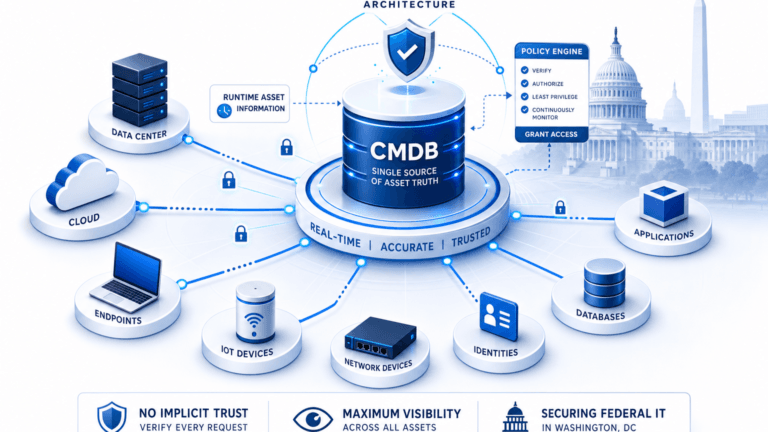
When people say “vulnerability management software,” they often mean one commercial platform that tries to own most of those jobs. Large enterprises often assemble a stack instead: one or more scanners, a CMDB or asset system of record, ITSM for change and incident, and a prioritization layer that understands business services.
Why CVSS-only queues break hybrid IT
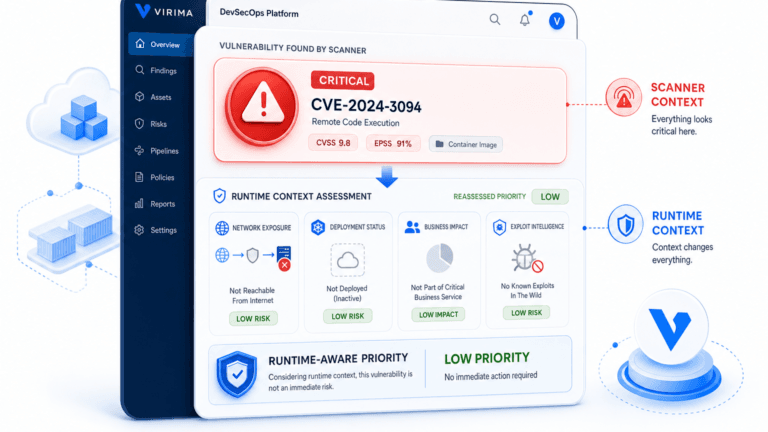
Hybrid estates break simple scoring. A CVSS 9.8 on an isolated test host is not the same problem as a CVSS 7.5 on a Windows host that sits under checkout or claims. Scanners are good at the first half of that sentence. They are weak at the second unless something else supplies ownership, relationships, and service weight.
OpenSSF’s runtime-context piece makes the prioritization problem explicit: most published vulnerabilities will never be exploited against you, so the core challenge is focus, not raw patch throughput. Static findings without runtime or business context inflate backlogs and burn trust between security and operations.
Breach economics still punish slow, unfocused response. IBM’s 2025 Cost of a Data Breach analysis reported a global average cost of USD 4.44 million, with faster identification and containment credited as a major driver of the year-over-year decline. Tools that shorten time-to-decision on the right assets matter more than tools that only enlarge the finding list.
Core capabilities to demand from vulnerability management software
Use this checklist when you score vendors or open-source stacks. Every row should map to a proof demo, not a slide.
Authoritative asset inventory feed.
If the scanner builds its own partial inventory and never reconciles to your CMDB, you will fight duplicate hostnames, stale IPs, and shadow cloud projects forever. Prefer products that ingest or export clean asset identity.
Multi-method detection.
Agent, agentless, API/cloud connector, and container image scanning each cover different blind spots. Ask which methods apply to Windows, Linux, network OS, and major clouds you run.
Exploit and exposure signals beyond CVSS.
KEV membership, active exploit intel, internet exposure, and privilege context change urgency. A tool that cannot show why item A beats item B will lose the CAB argument.
Risk scoring you can explain.
Black-box “risk scores” fail change boards. You need transparent inputs: severity, asset criticality, service mapping, compensating controls, and exception state.
Bidirectional ITSM integration.
Findings should open, update, and close tickets in ServiceNow, Jira Service Management, or your ITSM of record, with CI linkage intact.
Exception and risk-acceptance workflow.
Not every item patches on the SLA clock. The tool must record who accepted what, until when, and which control justifies the delay.
Verification and regression.
After a change window, the same finding ID should re-test cleanly. Manual “we think it’s fixed” notes are not a control.
Role-based views.
SecOps needs queue health. Platform owners need “my servers.” Leadership needs aging criticals by service line.
If a platform fails inventory quality or explainable prioritization, no amount of dashboard chrome saves the program.
How a cyber security vulnerability assessment should run
A cyber security vulnerability assessment is the structured pass that turns raw detection into ranked action. Treat it as a repeating operating cycle, not an annual project.
- Scope: Define in-scope networks, cloud accounts, and CI classes. Explicitly list out-of-scope segments and why.
- Inventory lock: Confirm the assessment population against discovery or CMDB counts before scanning. If the scanner sees 12,000 hosts and the CMDB holds 9,400 active CIs, stop and reconcile before you trust percentages remediated.
- Scan and validate: Run authenticated scans where credentials exist. Flag credential failures as coverage defects, not clean bills of health.
- Enrich: Attach owner, environment, data class, and business service. This is where many pure scanners stall and where configuration data earns its keep.
- Prioritize: Combine severity, KEV or exploit evidence, exposure, and service impact. Publish a short “fix first” list operations can finish in the next change window.
- Remediate or accept: Patch, config-change, isolate, or formalize risk acceptance with an expiry date.
- Verify and report: Rescan, close tickets, and report aging and reopen rates.
Teams that skip inventory lock and enrichment produce impressive slide decks and weak risk reduction.
What should a cybersecurity vulnerability assessment include?
A complete assessment scopes assets, locks inventory against a system of record, runs authenticated detection, enriches findings with ownership and service context, prioritizes with exploit and business signals, drives remediate-or-accept decisions, then verifies closure with a rescan and auditable reporting.
Vulnerability management best practices that still work in 2026
These practices separate programs that shrink exposure from programs that only grow ticket volume.
Practice 1: Cover before you optimize. You cannot prioritize what you never scanned. Drive authenticated coverage on production tiers first, then expand.
Practice 2: Separate detection tools from systems of record. Let scanners detect. Let the CMDB hold identity, relationships, and ownership. Fighting two conflicting host lists wastes every sprint.
Practice 3: Rank by blast radius, not only severity.Service maps and dependency data change which “high” you fix this week. A medium on a shared directory service can outrank a critical on a disposable jump box.
Practice 4: Align SLAs to exploitation reality. KEV-listed items and internet-facing criticals deserve tighter clocks than theoretical highs on isolated lab gear.
Practice 5: Make owners obvious. Every finding needs a team, not a shared mailbox. CI ownership in the CMDB is the practical source for that assignment.
Practice 6: Measure outcomes, not scan counts.Track mean time to remediate by severity band, percent of KEV items open past SLA, reopen rate after “fixed,” and coverage percent of in-scope CIs.
Practice 7: Keep exceptions time-boxed.Permanent exceptions become shadow policy. Review them on a calendar, not when an auditor asks.
Practice 8: Pair human process with tooling.CAB language, patch windows, and vendor freeze periods belong in the runbook next to the console.
For a deeper process view of why incomplete inventory collapses this cycle, see Virima’s guide on why IT discovery is critical for vulnerability management. For foundational definitions, start with what vulnerability management is.
Top vulnerability management tools in 2026
Most mature teams stop asking which single product “does vulnerability management” and start asking which layer owns each decision. Detection platforms find and track weaknesses. Discovery, CMDB, and service maps supply ownership and business criticality so the fix list matches blast radius. If you want the category framing behind live, explainable operational context, read Trusted Runtime Truth.
This is not a paid ranking or a claim that these products cover every estate. Six scanners and platforms below show up repeatedly on enterprise shortlists for hybrid scanning, cloud posture, and endpoint-linked vulnerability views. Virima follows as a seventh entry for the discovery, CMDB, and service-map layer that pairs with those tools rather than competing as another multi-OS detection engine.
Qualys VMDR
Qualys VMDR combines vulnerability management, detection, and response in a cloud-delivered model many large estates already know. Strengths usually include broad authenticated scanning, continuous assessment options, and mature reporting for compliance audiences. Evaluate API cost, agent footprint, and how cleanly host identity syncs to your CMDB before you treat Qualys inventory as system of record.
Tenable Vulnerability Management
Tenable (including Nessus-class scanning in many deployments) remains a default enterprise scanner for hybrid infrastructure. Buyers choose it for depth of plugins, network device coverage, and prioritization features that go beyond raw CVSS. Pressure-test credential success rates on your Linux and Windows tiers, and confirm how findings land in ServiceNow or Jira with stable CI keys.
Rapid7 InsightVM
InsightVM is frequently shortlisted where security teams want live dashboards, remediation projects, and integration into broader Rapid7 detection workflows. It suits organizations that already standardize on InsightIDR or similar pieces of the Rapid7 stack. Ask for proof of authenticated coverage on your golden images and for exception workflows that survive audit review.
Microsoft Defender Vulnerability Management
Microsoft Defender Vulnerability Management fits Microsoft-heavy estates that want vulnerability signal next to endpoint and cloud security controls already under Defender. It reduces agent sprawl when devices already run Defender for Endpoint. Validate non-Windows and non-Azure depth before you retire a dedicated multi-OS scanner that still covers network gear or third-party Linux fleets.
CrowdStrike Falcon Spotlight
Falcon Spotlight surfaces vulnerabilities through the CrowdStrike agent many organizations already deploy for EDR. The appeal is unified endpoint visibility and prioritization adjacent to threat detection. Confirm server and non-endpoint coverage expectations, because Spotlight’s value tracks where the Falcon agent already runs rather than replacing a full network vulnerability assessment program.
Wiz
Wiz is a common shortlist pick for cloud-native vulnerability and risk visibility across AWS and Azure workloads, identities, and misconfigurations. Teams adopt it when container and cloud posture findings outpace traditional network scanners. Check how Wiz assets reconcile to CMDB CIs and on-prem systems your hybrid services still depend on.
Virima
Virima is not another multi-OS vulnerability scanner competing head-to-head with Qualys, Tenable, or Rapid7 for plug-in depth. It belongs on the shortlist when your gap is asset truth, ownership, service criticality, and service-weighted prioritization inputs those scanners and your ITSM still need.
Most vulnerability programs stall after detection because ownership, relationships, and service weight live outside the scanner. Virima closes that gap for the layers that turn findings into defendable work.
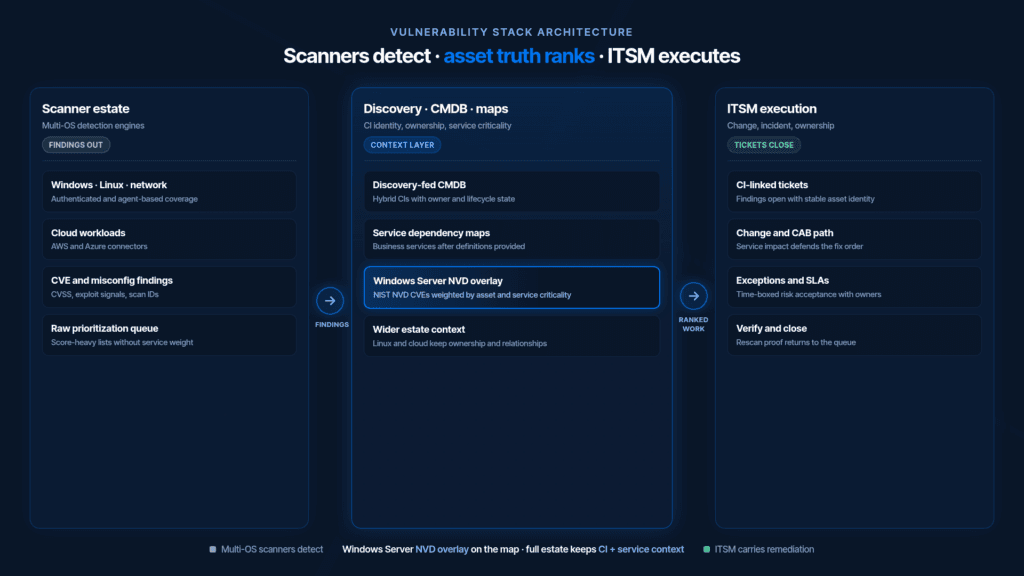
- Discovery-fed CMDB. Agent and agentless discovery populate configuration items across hybrid estates so security and ops share one asset backbone rather than spreadsheet inventories. When scanner findings land, they can match against CIs that already carry owner, environment, and lifecycle state.
- Service maps with operational overlays. Once service definitions are provided, ViVIDTM service mapping builds dependency maps from discovery-backed relationships. The same maps can show ITSM context such as incidents and changes, so teams see blast radius before a change window and during incident response. That is how a medium finding on a shared tier can outrank a higher CVSS item on an isolated lab host.
- NIST NVD vulnerability insights on Windows Servers. Virima overlays NIST NVD–sourced CVEs on affected Windows Server assets and weights remediation attention using asset and business service criticality from the map. For that Windows Server population, prioritization follows service impact, not raw severity alone. In mixed estates, Windows Servers often account for roughly 30-40% of CIs; discovery and maps still cover the wider estate so Linux, cloud, and other workloads keep ownership and dependency context when dedicated scanners return findings for those platforms. For how findings become ranked intelligence rather than a raw CVE list, see vulnerability intelligence explained.
- CSAM-oriented visibility. Cybersecurity asset management capabilities help teams know what exists, who owns it, and how it connects before scanner output becomes the only narrative of risk.
Together, purpose-built vulnerability management tools detect across the estate, and Virima places Windows Server NVD insights plus the wider CI estate in a CMDB and service map operators trust when they choose what to fix first.
How does Virima support vulnerability prioritization?
Virima supplies discovery-backed CMDB identity and service maps, then overlays NIST NVD CVEs on Windows Server assets weighted by asset and business service criticality. Teams use that service impact context with findings from dedicated scanners so remediation order follows what the business runs, not CVSS alone.
For the CMDB-to-CVE linkage pattern in more depth, see CMDB and vulnerability management: linking CVEs to IT assets.
Evaluation scorecard for your shortlist
Score each vendor 1-5. Weight the rows to match your estate.
- Coverage proof on your OS mix (Windows, Linux, cloud images, network).
- Authenticated scan success rate in a pilot segment.
- CMDB / asset sync quality (match rate, duplicate rate).
- Explainable prioritization using criticality you define.
- ITSM round-trip (create, update, close with CI).
- KEV / exploit signal latency.
- Exception governance.
- Reporting your CISO will reuse without rebuild.
- Total cost including agents, cloud connectors, and professional services.
- Operational load on the team that runs scans weekly.
Run a 30-day pilot on one business service, not a slideshow POC. Require a joint review with SecOps, platform engineering, and the CMDB owner. If the pilot cannot produce a ranked fix list that operations accepts, the tool failed the only test that matters.
Putting it together: a practical operating model
A durable model looks like this:
- Discovery keeps CI inventory and relationships current on a scheduled cycle (not mythical continuous magic you cannot support operationally).
- Vulnerability management tools scan in-scope populations with credentials and cloud connectors.
- Findings enrich against CMDB identity and, where available, service maps.
- Windows Server NVD overlays inside Virima add service-weighted insight for that OS class on the map.
- ITSM carries remediation, change, and exceptions.
- Metrics review weekly: coverage, aging KEV, MTTR by service tier, reopen rate.
That model respects specialist scanners and still fixes the failure mode most programs share: brilliant detection attached to weak asset and service truth.
If you want to see how discovery, CMDB, and ViVIDTM maps present Windows Server vulnerability context beside change and incident overlays, schedule a Virima demo.
Choosing tools is choosing how you decide
Vulnerability management tools earn their license fee when they improve decisions under volume pressure. Detection alone is table stakes in a year that published tens of thousands of CVEs. The programs that reduce real exposure combine scanners with inventory you trust, service criticality you can defend in CAB, and workflows that close the loop.
Buy coverage for every OS you run. Demand prioritization you can explain. Keep Virima in the conversation as the discovery and CMDB layer that holds estate truth and, for Windows Servers, overlays NIST NVD insights on service maps so remediation order follows business impact. Pair that layer with strong scanners in the stack, and the queue finally starts to shrink for the right reasons.
Want to talk through your stack or try Virima in your environment? Contact Virima or start a free trial.
FAQs
Does Virima replace vulnerability management tools?
No. Virima adds discovery-backed CMDB data, ViVIDTM service maps, and NIST NVD overlays for Windows Servers weighted by service criticality. Keep multi-OS scanners for detection; use Virima so asset truth shapes fix order.
What is the difference between a vulnerability scanner and vulnerability management software?
A scanner detects weaknesses on in-scope hosts, images, or apps. Vulnerability management software adds tracking, prioritization, ITSM workflow, exceptions, and reporting so findings become owned work, not a static report.
How often should we run a cybersecurity vulnerability assessment?
Run authenticated assessments on a fixed cadence matched to change velocity, often weekly on production tiers, plus after major releases. Reconcile inventory each cycle so coverage percent stays honest.
Which vulnerability management best practices improve prioritization fastest?
Authenticate coverage on production services first. Enrich findings with CI owners and business service criticality. Elevate known-exploited items such as CISA KEV entries ahead of theoretical highs on low-impact hosts.
Why do service maps matter if we already have scanner severity scores?
Severity describes the weakness. Service maps show what breaks if the asset fails. That context changes which ticket enters the next change window when two CVEs share similar scores under different services.