40 Business Services Audited: 12 Had Upstream Dependencies Nobody Had Mapped

Unmapped service dependencies are production infrastructure relationships that exist in your environment but are absent from your CMDB service definitions. When an IT operations team ran undocumented service dependencies discovery across 40 business services, 12 of them (30%) had active upstream dependencies that no service definition documented. Specifically, shared infrastructure, vendor-managed APIs, and M&A legacy integrations were the three root causes.
The audit methodology: discovery vs. documented
| The audit compared active infrastructure relationships found by Virima’s IT discovery against the CI relationships recorded in each service definition. First, discovery scanned every application server in scope and mapped outbound connections via network traffic analysis. Next, each connection not listed in the service definition was reviewed to confirm it was an active, necessary production relationship. As a result, 12 services had confirmed upstream dependency gaps. |
- The team ran Virima’s IT discovery across all 40 services at the same time. First, discovery scanned every application server in each service’s documented scope. Then it mapped outbound connections via network traffic analysis. Every CI those servers communicated with was identified. As a result, this built a relationship model for each service from live production data.
- The comparison was direct. Every CI in the discovery-built relationship model that did not appear in the service definition became a candidate dependency gap. Next, teams reviewed each candidate to confirm it represented an active, necessary dependency. However, transient or incidental connections were excluded.
- After review, 12 services had confirmed upstream dependency gaps. These fell into three categories. First was shared infrastructure that multiple teams used but no team fully documented. Second was vendor-managed components that appeared in production but not in any internal service definition. Third was legacy integrations inherited from mergers and acquisitions.
The discovery vs. documented comparison
The ViVID™ service maps built from discovery data made the comparison visible. Specifically, each service map showed two layers. The first was the documented service definition layer. The second was the discovery-built relationship layer. Where those layers diverged, a dependency was missing from the service definition.
Of the 40 services audited, 28 matched their documented definitions within expected tolerances. However, the 12 with confirmed gaps ranged from a single missing middleware component to a full secondary database tier. No service definition acknowledged that secondary tier.
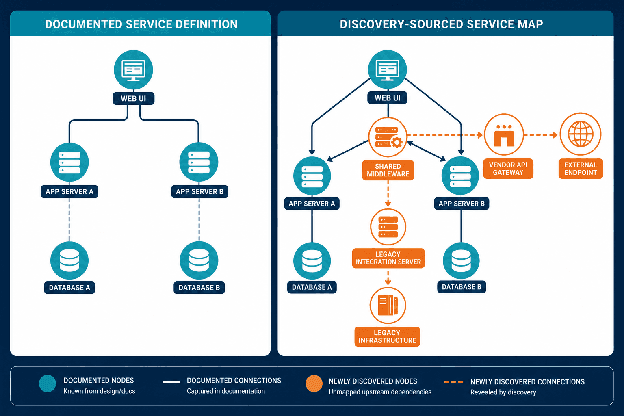
Conceptual diagram showing a side-by-side comparison of a documented service definition versus a discovery-sourced service map, with highlighted gaps indicating unmapped upstream dependencies.
| Undocumented service dependencies discovery compares active infrastructure relationships found by IT discovery against the CI relationships recorded in service definitions and the CMDB. When a component communicates with a service’s application servers but is not listed as a dependency in the service definition, it represents an undocumented upstream dependency. In a 40-service audit, this comparison identified 12 services with confirmed dependency gaps that posed change management risk. |
Category 1: Shared infrastructure nobody fully documented
Seven of the 12 services shared infrastructure components that crossed team ownership boundaries. For example, the most common were shared middleware layers, shared message queues, and shared load balancer clusters. Infrastructure teams provisioned them. Meanwhile, application teams used them. However, neither team documented the cross-team dependency.
The root cause was a gap between documentation models. Infrastructure teams documented managed services from their own perspective. In contrast, application teams documented their application components, not the infrastructure beneath them. As a result, shared components fell outside the scope of both teams’ service definitions.
Any change to the shared middleware affected all seven services at once. However, only the changes the infrastructure team classified as impacting their managed services appeared in change impact analysis. Therefore, the application teams’ services were invisible in the impact assessment. The CMDB carried relationship records for the shared middleware’s infrastructure context but not for its application service dependencies.
Database and middleware tiers in the dependency gap
Four of the seven shared infrastructure cases involved database tiers. Specifically, discovery-built relationship data showed application servers from multiple services connecting to database clusters that appeared in a single service definition or in none at all. The CMDB auto-discovery approach found these relationships by reading active database connections, not by querying any service definition.
Three cases also involved shared middleware: API gateway layers, message brokers, and service mesh components used by multiple services but listed in only one definition or none. In discovery-built maps, they appeared as high-frequency connection targets from multiple service application stacks. That pattern, therefore, indicates a shared dependency with operational risk across all connected services.
| Shared infrastructure dependencies are undocumented when application teams and infrastructure teams document from different perspectives. Infrastructure teams document managed components as infrastructure assets. Application teams document their application stack. Shared components that cross this boundary appear in neither team’s service definition, creating CMDB gaps that only undocumented service dependencies discovery can surface by mapping active connections between both teams’ systems. |
Category 2: Vendor-managed components nobody tracked internally
Why vendor-managed components create documentation gaps
- Three of the 12 services had unmapped dependencies on vendor-managed components. These included SaaS platform APIs, payment processor gateways, and cloud-native services from public cloud providers. However, they were absent from internal service definitions. Teams assumed vendor-managed components were not their documentation responsibility.
- That assumption created a concrete gap in change coverage. For instance, when a vendor-managed component undergoes maintenance, the vendor notifies the account holder. However, the IT operations team managing the dependent internal service receives no notification. As a result, components missing from service definitions slip through change impact analysis. The change advisory board, therefore, will not see the affected service during maintenance windows.
- Discovery found these dependencies by mapping outbound connections from internal application servers to external endpoints. The connections were active, consistent, and traceable to specific service functions. Consequently, all three service definitions were updated after the audit to include the vendor components.
SaaS integrations and external APIs in the dependency chain
SaaS integrations are now one of the most common categories of unmapped dependencies. This is especially true in organizations running more than ten SaaS platforms. As organizations adopt SaaS platforms for specific business functions, internal services integrate through APIs. The integrations work. The service functions. However, the SaaS platform does not appear in any CI record because it is not an internal asset.
Internal ITAM processes track internal assets and their licenses. However, vendor-managed SaaS endpoints fall through the gap. Discovery closes that gap at the network layer instead. Outbound connections from internal servers to SaaS endpoints appear in the discovery-built relationship model regardless of whether any internal CI record exists for the SaaS platform.
| Vendor-managed components create undocumented service dependencies because internal IT teams do not typically include external SaaS platforms, vendor APIs, or cloud-native services in internal service definitions. Discovery finds these dependencies by mapping outbound connections from internal application servers to external endpoints, surfacing the vendor dependency in the service map regardless of whether any internal CI record exists for the external component. |
Category 3: Legacy integrations from M&A activity
- Two of the 12 services were carrying legacy integrations from merger and acquisition activity. When organizations acquire other companies, the acquired company’s IT systems are often integrated before full IT rationalization is complete. As a result, integration connections made during the M&A transition may outlast the integration project team that built them.
- Years after an acquisition, internal services may still communicate with acquired company infrastructure through integration layers that no current team member knows about. Meanwhile, the teams that built the integration have moved on. Documentation exists in project files that nobody maintains. As a result, the connection runs in production while the service definition lists only components the current team knows about.
- Discovery found both legacy M&A integrations by mapping outbound connections from current services. Specifically, the connections led to systems in the acquired company’s IP ranges or systems using its naming conventions. The dependencies were active and processing real operational traffic. However, they were completely absent from both services’ current definitions and from the CMDB relationship records.
Inherited dependencies from acquired systems
M&A legacy integrations are among the most operationally dangerous dependency gap types. They are least likely to surface through normal service review processes. In addition, the teams that manage the dependent services inherited them after integration work was complete. Therefore, when the acquired company’s infrastructure undergoes decommissioning, dependent services can go offline without warning.
Run a discovery-validated service dependency audit before M&A IT rationalization starts. It is one of the most reliable ways to surface inherited dependencies before decommissioning cuts off the integration points those services rely on. For this reason, Virima integrates directly with Jira Service Management and ServiceNow to enrich your CMDB with discovery-sourced ground truth before rationalization decisions are made.
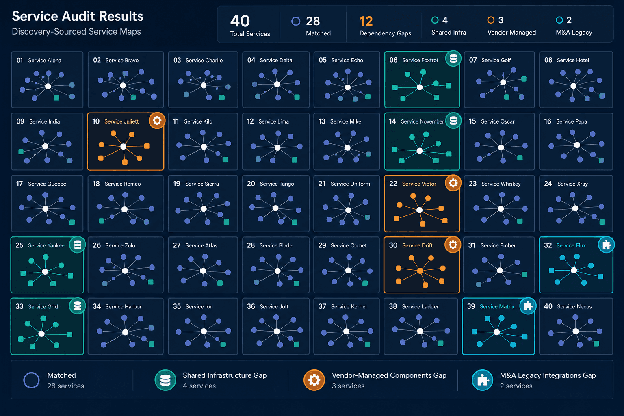
Illustrative example of a discovery-sourced service audit result showing 40 service map thumbnails in a grid, with 12 highlighted to indicate confirmed upstream dependency gaps.
| M&A legacy integrations create undocumented service dependencies when integration connections built during acquisition transitions outlast the teams that built them. Current service owners inherit systems without inheriting documentation of the integration architecture. Discovery surfaces these dependencies by mapping all active connections from current service systems, including outbound connections to systems from acquired company infrastructure that no current service definition acknowledges. |
What a 30% dependency gap rate means for change management
| Twelve of 40 services with upstream dependency gaps is a 30% rate. When change management relies on CMDB relationship data to calculate impact, roughly one in three service impact analyses works with incomplete information. As a result, the change advisory board approves changes with an incomplete picture for one in three services in scope. Running undocumented service dependencies discovery before planned changes is the most direct way to lower that risk. |
- Twelve of 40 services with upstream dependency gaps is a 30% rate. When change management relies on CMDB relationship data to calculate impact, roughly one in three impact analyses works with incomplete information. As a result, the change advisory board approves changes with an incomplete picture for one in three services in scope.
- The stakes are measurable. According to Google’s 2024 DORA State of DevOps Report, elite teams achieve change failure rates below 5%. In contrast, low-performing teams see rates exceeding 15%. Incomplete dependency coverage in the CMDB is, therefore, one of the leading drivers of that gap between performance benchmarks.
- For the infrastructure upgrade that prompted the audit, the 12 services required remediation before the upgrade could proceed safely. First, service definitions were updated. Then, CMDB relationship records were populated with discovery-built CI relationships. Finally, the upgrade plan was revised to include all discovered affected services in the impact assessment.
- The upgrade cycle completed without unplanned outages or cascading failures. As a result, undocumented service dependencies discovery made the difference. The team planned against Trusted Runtime Truth rather than an incomplete picture of 30% of the affected service estate.
The change advisory board gap
When service definitions omit upstream dependencies, the change advisory board sees an incomplete impact picture. The board can approve a change that looks low-risk based on documented service scope. However, the unmapped shared infrastructure, vendor component, or M&A legacy integration sits entirely outside that scope. As a result, the change proceeds, the missed component fails, and services cascade.
This is not a rare failure pattern. Instead, it is a structural consequence of relying on team-authored documentation without discovery-validated confirmation. Therefore, the CAB cannot flag what the CMDB does not reflect.
Building a discovery-validated service definition baseline
The audit result surfaced a structural truth. When 12 of 40 services have dependency gaps, the documentation process is not the problem. Instead, the assumption that documentation alone can capture production reality is the problem.
The right baseline for a service definition is the one that IT discovery validates. Teams author the initial definition. Then discovery audits it against what runs in production. Where the two diverge, the service definition gets updated. As a result, the CMDB reflects what exists rather than what was known at documentation time. If you want to build a CMDB that supports accurate change management, discovery-validated service definitions are, therefore, the foundation.
Discovery-validated audits are most critical before major infrastructure changes, M&A IT rationalization, and annual compliance reviews. Specifically, these are the points where an incomplete dependency picture creates real exposure.
| See how Virima surfaces dependency gaps before they drive change failures.Explore Trusted Runtime Truth |
Close Dependency Gaps Before Your Next Change Window
Get live, explainable runtime truth across your entire estate, without platform lock-in. As a result, when every service definition reflects what discovery finds in production, your change advisory board sees the complete impact picture.
| See how ViVID™ service maps surface shared infrastructure, vendor-managed, and M&A legacy dependencies across your environment. Schedule a demo |
Frequently Asked Questions
What is undocumented service dependencies discovery?
Undocumented service dependencies discovery is the process of comparing active infrastructure relationships found by IT discovery against the CI relationships recorded in service definitions and the CMDB. When a component communicates with a service’s application servers but is not listed as a dependency in the service definition, it is an undocumented service dependency. As a result, this process surfaces hidden dependencies before they create change management failures or unplanned outages. ServiceNow, Ivanti, Halo, Jira service management, Hornbill, Xurrent.
Why do 30% of services commonly have undocumented dependencies?
Service definitions depend on team-authored documentation, which captures what teams know they own. However, shared infrastructure, vendor-managed components, and legacy integrations from M&A activity all fall outside the documentation scope of individual application teams. As a result, these three categories are consistent patterns in environments that rely on manual service definition processes without discovery-validated confirmation.
What are the most dangerous categories of undocumented service dependencies?
The three most dangerous categories are shared infrastructure (database tiers and middleware used by multiple services but fully documented by none), vendor-managed components (SaaS APIs and external payment processors not listed in internal service definitions), and M&A legacy integrations (integration connections built during acquisition transitions that outlast the teams that documented them). In each case, the dependency is active in production but invisible to change management.
How does a service dependency audit differ from a standard CMDB review?
A standard CMDB review checks the accuracy of existing CI records against known baselines. In contrast, a service dependency audit using discovery compares documented service definitions against live infrastructure relationships found by scanning the actual network. As a result, the audit identifies components that are active in production but absent from service definitions, surfacing dependencies that a CMDB review of existing records would miss entirely.
How does Virima’s ViVID™ support service dependency auditing?
ViVID™ builds service maps from discovery-sourced relationship data and compares them against documented service definitions. When Virima’s IT discovery maps an active connection between a service’s application servers and a component not listed in the service definition, the gap appears in the ViVID™ service map as an unmapped relationship. As a result, teams can review these anomalies across all services in scope and update service definitions before those dependencies create change management failures.
Does Virima’s discovery integrate with ServiceNow or Jira Service Management?
Yes. Virima integrates with ServiceNow and Jira Service Management, enabling discovery-sourced dependency data to feed directly into change impact analysis and approval workflows. As a result, when a service dependency audit surfaces unmapped relationships, those CI records and relationships can be pushed to the CMDB and reflected in change advisory board impact assessments before the next change window.