Network Topology Mapping: Benefits & Types

Network topology mapping gives IT teams a visual picture of every device, connection, and path in their infrastructure. With the right mapping software, administrators can document what’s connected, how it’s connected, and where the weak points are.
A solid network mapper typically offers:
- On-demand, multi-level network discovery
- Near-real-time mapping updates through recurring scheduled scans
- Asset inventory reports tied to a CMDB
Mapping records which nodes sit on the network. It doesn’t dig into user identities, running services, or open ports. That job belongs to enumeration.
Why do you need a network topology map?
A topology mapper helps IT teams build detailed network diagrams of every server, router, firewall, and switch in the environment. When an overloaded link or routing bottleneck causes a slowdown, a current network topology map points your team to the source faster than manual troubleshooting ever could.
Topology maps also expose unauthorized or malicious connections by showing how devices relate to each other. Pair that with network performance monitoring, and your operations team gets the structural view and the health metrics they need to act fast.
If you’re evaluating which tools to add to your stack, our guide to network management software compares the top platforms by discovery breadth, ITSM integration, and topology accuracy.
There’s a compliance angle too. Auditors in regulated industries expect a documented view of your network’s structure. Without one, proving compliance turns into a manual, error-prone process.
A topology mapper helps your team:
- Gain end-to-end visibility across on-premise, cloud, and hybrid environments
- Monitor network changes through scheduled discovery scans
- Troubleshoot issues with a clear view of dependencies
- Discover assets across multiple environments automatically
- Keep tighter control over network security posture
How does network topology mapping help with incident response?
When a service goes down, the first question is always “what else is affected?” Without a current topology map, your incident response team is guessing at dependencies and tracing connections manually while the blast radius grows.
An accurate map changes that picture completely. Operators can immediately see which devices and services sit upstream and downstream of the failure point, cutting mean time to resolution (MTTR) by a wide margin. Virima’s service mapping takes this further by mapping application dependencies and business service relationships. Your team knows the business impact of an infrastructure failure before the first escalation happens.
What is the cost of not having a network topology map?
The cost hits three places: longer incident response times, failed audits, and surprise outages from unknown dependencies. Organizations without current topology data often discover critical dependencies only after something breaks. That delay increases both recovery time and business impact.
Change advisory boards reviewing requests without accurate dependency data are essentially approving changes blindly. One miscalculated change window can quickly cascade into hours of unplanned downtime. Without visibility, even small updates can trigger large failures.
Automated network topology mapping removes that guesswork by keeping your infrastructure view current through recurring scans. This allows you to assess dependencies before making changes, reduce risk, and avoid costly disruptions.
Types of network topology maps
Several types of topology maps serve different needs. Here are the four most common.
Physical network maps
Physical network maps document the layout of every physical component: desktops, printers, servers, switches, and the cables connecting them. Technicians use these maps to:
- Identify faulty connections or cabling issues
- Plan efficient cable routing to reduce congestion
- Locate specific hardware during troubleshooting
- Plan equipment deployments and hardware upgrades
For teams managing large data centers or multi-site environments, a physical map is the baseline reference that keeps hardware troubleshooting on track.
Layer 2 and layer 3 network maps
Layer 2 maps show the data link connections between devices: the paths traffic can take, available bandwidth, and potential congestion points. Layer 3 maps scan for device IP addresses and map them to their networks and subnets, which helps isolate routing protocol issues and IP addressing problems.
These maps let IT professionals:
- Catch network changes as soon as scheduled scans detect them
- Adjust configurations to improve performance
- Track traffic levels per device to prevent overloads and dead zones
- Monitor connectivity status across the full infrastructure
Logical flow network maps
Logical network maps trace data routing and communication paths from device to device. Where physical maps document what’s physically connected, logical maps provide an abstract view of how data actually moves through the system.
A typical logical map covers subnets, routing protocols, and firewall configurations. These are the elements that control data flow across your network. IT administrators use these diagrams to detect misconfigurations and bottlenecks that could create security gaps or performance issues.
Automated live network topology maps
Automated topology maps pull from recurring discovery scan data to give you an up-to-date view of the network. Manually drawn diagrams go stale within weeks. Automated maps reflect the actual state of the infrastructure.
They help IT teams:
- Monitor each device’s status, connections, and performance metrics
- Spot security risks before they escalate
- Make informed decisions about upgrades and troubleshooting
- Cut the manual effort of maintaining network documentation
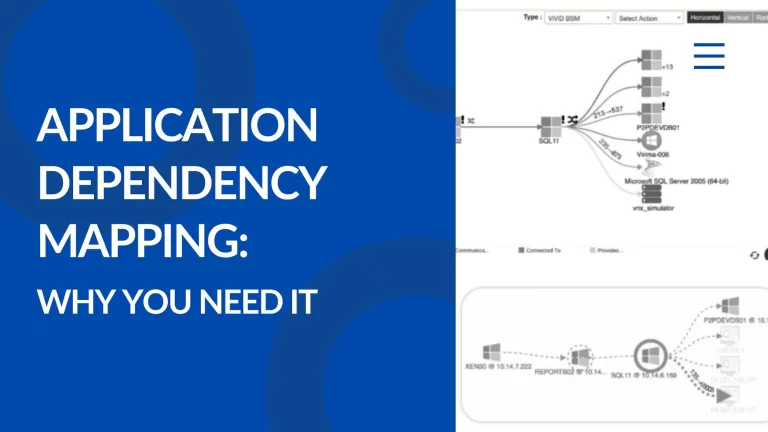
Virima’s IT discovery runs automated scans to locate assets across your network and feeds that data into your CMDB. ViVID™ (Virima Visual Impact Display) then overlays ITSM incidents, change records, event management alerts, and NIST NVD vulnerabilities onto the service maps built by Discovery and Service Mapping. Asset managers get both an accurate inventory and a near-real-time operational picture of what’s happening across their environment.
Network topology mapping methods
Three common methods power network topology mapping. Each works differently, and the right choice depends on your environment and what you need the data for.
Simple Network Management Protocol (SNMP)
SNMP is an Internet protocol for collecting and managing information from network devices. It lets administrators query and modify system variables across IT assets.
SNMP relies on the Management Information Base (MIB), a database that stores data about each managed device. This data feeds into topology representations for infrastructure analysis.
SNMP has three core components:
- Managers retrieve information from and send commands to agents
- Agents collect and report data from their managed devices
- MIBs provide the database of object definitions that give structure to the collected data
SNMPv2 added a proxy-agent component that bridges SNMP entities across different networks. For SNMP to work well, managers need to define which objects each agent monitors through MIBs so the returned data is structured and usable.
Active probing
Active probing sends probe packets into the network and uses the response data to build a topology map. It gives you detailed performance metrics:
- Bandwidth utilization
- Packet loss rate
- Latency and delay measurements
- Topology changes over time
Probing also lets administrators document how the topology shifts over time, making it easier to detect emerging issues with links or nodes before they cause outages.
The trade-off is that active probing needs specialized tools and expertise. That’s why most teams use it for diagnostics rather than continuous network topology mapping.
Route analytics software
Route analytics software discovers devices automatically using Layer 2 and Layer 3 data. It provides near-real-time monitoring and analytics covering route history, fault detection and isolation, performance diagnostics, traffic analytics, and bandwidth management.
For operational teams, route analytics delivers three things:
- Visibility into traffic paths and vulnerable network segments
- Detection of anomalies and potential threats before they cause damage
- Diagnosis of problematic devices or links that need modification or replacement
How does network topology mapping improve security? Network topology mapping is your first line of defense against shadow IT and unauthorized devices. You can’t secure what you can’t see. An automatically updated topology map surfaces every device on the network, including assets that were never formally provisioned. This visibility is critical. Gartner research has found that up to 30% of purchased IT assets are never entered into the system of record, and nearly a quarter of organizations haven’t verified their asset inventory in the past five years. When topology maps are paired with vulnerability data, security teams can see exactly where exposed assets sit relative to critical services. That changes remediation from a severity-score exercise into a business-impact decision. Virima integrates NIST NVD vulnerability data at no extra cost, and ViVID™ overlays that data onto your service maps alongside ITSM incidents and change records. Your security team can see which assets carry known vulnerabilities and how those assets connect to business services, so remediation gets prioritized by actual operational risk rather than generic severity scores. That kind of visibility moves your team from reactive patching to proactive risk reduction. Instead of discovering shadow IT assets after an incident, automated discovery surfaces them during routine scans, giving you a chance to assess and secure them before they become a problem. |
Turn network visibility into operational confidence with Virima
Network topology mapping gives IT teams the structural understanding to troubleshoot faster, plan changes confidently, and stay compliant. As networks grow more complex across hybrid and multi-cloud environments, automated mapping moves from nice-to-have to a requirement.
Virima’s IT discovery provides full visibility into on-premise assets and cloud resources through agentless IP-based scanning and optional Discovery Agents for Windows, macOS, and Linux. With 100+ probes and integrations with cloud providers like AWS and Azure, Virima discovers assets across your entire infrastructure and syncs them to your CMDB. Virima also integrates with leading ITSM platforms, including ServiceNow, Ivanti, Jira Service Management, HaloITSM, Xurrent, and Hornbill.
ViVID™ overlays ITSM incidents, change records, event management alerts, and NIST NVD vulnerabilities onto the service maps built by Discovery and Service Mapping. That gives your operations team a near-real-time, dependency-aware view of the infrastructure. You can assess change impact, prioritize incidents by business service, and maintain IT asset management accuracy without manual inventory work.
Ready to map your network? Book a demo with Virima and see how automated discovery and network topology mapping work in your environment.
FAQ
What is the difference between physical and logical network topology?
Physical topology maps show where devices sit and how cables connect them. Logical topology maps show how data actually flows between those devices, regardless of the physical layout. A logical map includes subnets, routing protocols, and firewall rules, representing the data paths that determine how traffic moves.
You need both. Physical maps help with hardware troubleshooting and cable management. Logical maps help with routing optimization, security policy enforcement, and spotting data bottlenecks that the physical layout alone wouldn’t reveal.
How often should you update your network topology map?
Manual updates go stale fast. Most IT environments change weekly with new assets, decommissioned hardware, configuration changes, and cloud instances spinning up and down. If your topology map only reflects last quarter’s state, it’s a liability rather than a resource.
Automated discovery solves this with recurring scheduled scans that catch changes as they happen. Virima’s agentless scanning runs on configurable schedules per subnet, keeping your topology data current without manual effort. For most organizations, daily or weekly scans hit the right balance between accuracy and scan overhead.
What role does enumeration play in network mapping?
Enumeration goes a step further than mapping. It probes connected nodes for usernames, groups, active services, and open ports. Mapping shows you the shape of the network. Enumeration tells you what’s happening inside each node.
When you combine both, administrators get a full view of the network’s structure and what’s running on it. That’s the foundation for any serious security or performance management effort.