The 4 major approaches of IT asset discovery

Hybrid estates change faster than spreadsheets and ticket notes can track. A server appears in a cloud account, a laptop rejoins after weeks offline, and a switch still shows in last quarter’s inventory with the wrong owner.
Before teams pick a product, they need a clear map of discovery approaches: what each method finds, what it misses, and how the results should feed inventory and CMDB work.
This guide defines IT asset discovery, then compares the major technical approaches practitioners actually use.
What is IT asset discovery?
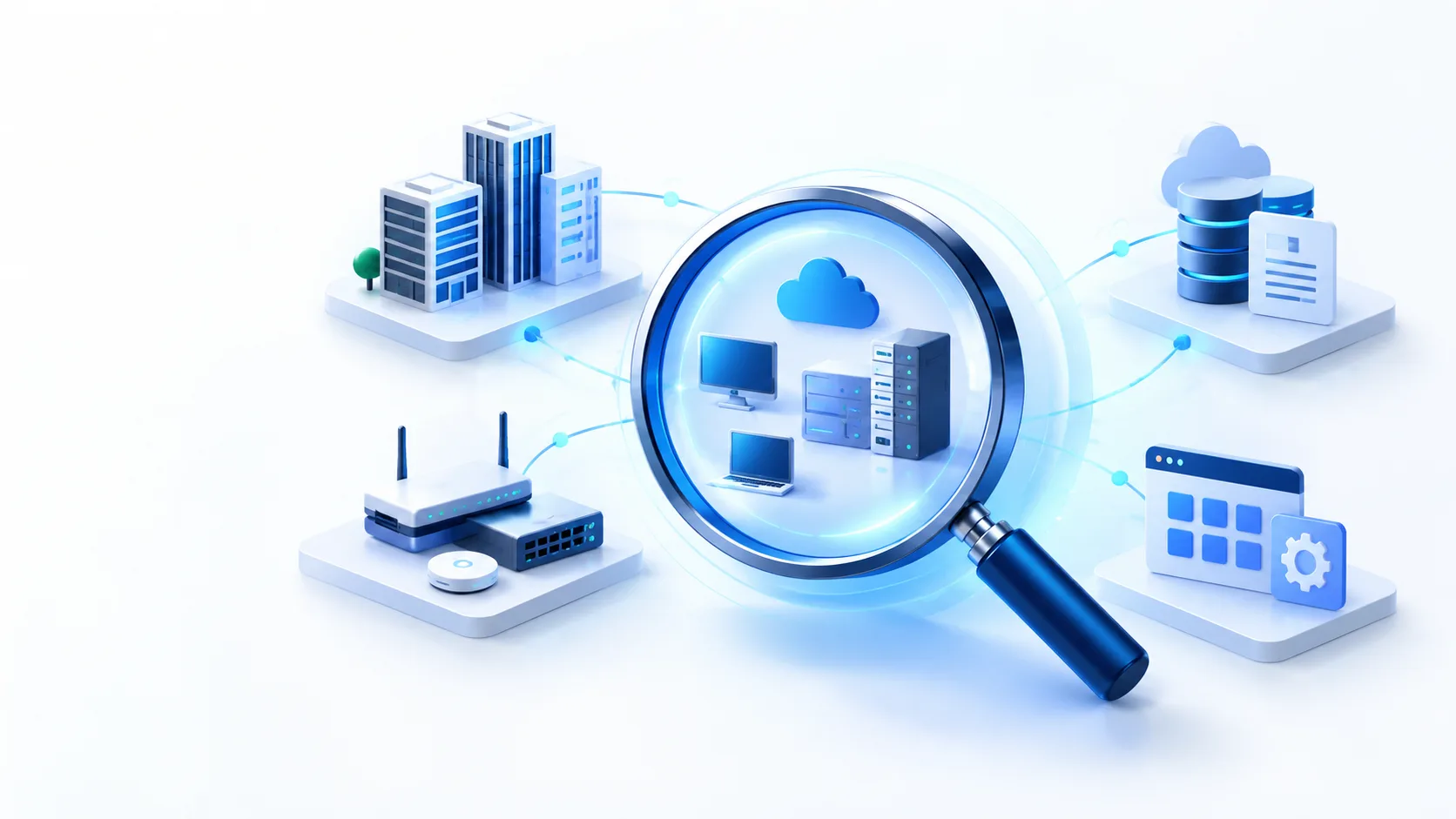
IT asset discovery is the process of identifying and cataloging hardware, software, cloud resources, and network devices across an organization’s environments. Teams use it to build and refresh an inventory that supports planning, monitoring, security coverage, and recovery, not only to list PCs on a LAN.
Asset discovery is used for several purposes:
- Planning – IT asset discovery helps you determine how many servers or other devices need to be deployed based on their roles and functions. This information can also be used when planning maintenance windows for upgrades or patches on specific hardware platforms such as routers or switches.
- Monitoring – By using asset discovery tools that collect information from both hardware and software components of systems like PCs or mobile devices, IT teams can gain insight into current conditions before problems arise so they can take action before users experience any downtime due to issues like malware infections or corrupted files that slow down performance levels over time unless addressed immediately after detection occurs through regular monitoring processes.
- Identification – IT discovery helps businesses identify those assets that are no longer useful for the company’s current operations. By identifying these assets and eliminating them from their system, companies can reduce overhead costs and increase efficiency.
- Recovery – Asset discovery is also used to help businesses recover from disaster or other issues that result in lost or damaged property.
Discovery, inventory, and CMDB are related, not identical. Discovery is how records get found and refreshed. Inventory is the catalog of what exists and how it is classified for ITAM. A CMDB stores configuration items and relationships for service and change work. Discovery should feed both inventory and CMDB, but ownership, service definitions, and relationship quality still need process discipline after the scan.
Why IT asset discovery matters
Teams need a current view of devices, software, and cloud resources on the network. Without that inventory baseline, patch coverage, license checks, and change planning run on incomplete lists.
In order for security teams and IT practitioners alike to ensure that their networks remain secure and compliant with regulations like GDPR (the European Union’s General Data Protection Regulation), it’s critical for them to have visibility into every aspect of their IT infrastructure.
Right from endpoints all the way up through applications and data centers so they can make informed decisions about where they should focus their resources toward remediation efforts when there are vulnerabilities found within an organization’s systems or networks.
Federal operational pressure has made incomplete asset visibility a formal risk theme. CISA Binding Operational Directive 23-01 directs improved asset visibility and vulnerability detection on federal networks, which mirrors what many enterprises already feel in audits and exposure programs: you cannot secure or change what you have not found.
How does IT discovery work?
IT asset discovery is a process of detecting new devices, applications, and software on a network. It’s often used in conjunction with endpoint security software to scan for vulnerabilities and make sure that your devices are patched.
Traditionally, the organization installs the application on a device or server. Then, the application scans the device or server for any new hardware or software. This scan is known as an asset inventory. It can also check for unnecessary software that might be running on the device.
The results from this scan can be stored in an inventory database. The database can then be used to detect changes on the next scheduled discovery cycle or after a triggered rescan.
IT discovery scans can review the asset or network for vulnerabilities and abnormal activity. The application scans for any new hardware or software installations, and then updates its database with this information so teams can keep an updated inventory of devices on the network after each discovery run.
IT discovery is an important part of any IT audit. It helps you get an accurate picture of the hardware and software that exists on your network, so you can make sure all of it is up to date and secure. This is especially important if you have some older devices in your infrastructure, because they are often more vulnerable than newer ones.
You can use IT discovery to scan both devices and servers for new hardware or software installations. This gives organizations a refreshed view of devices and software found during each discovery cycle. Then, they update the database containing the list of assets.
Why should you choose an automated IT discovery tool?
A practical discovery workflow
Mature programs treat discovery as a repeatable workflow, not a one-time spreadsheet exercise.
- Scope what must be found (hardware, software, network gear, cloud objects) and where (on-prem, cloud accounts, remote endpoints).
- Choose methods that match access rights and risk (agentless protocols, agents where depth is required, APIs for cloud control planes, active probes only where safe).
- Collect and normalize hostnames, IPs, OS, software, owners, and unique IDs so the same asset is not stored as three records.
- Load ITAM and CMDB systems with attributes that operations and change teams will trust.
- Schedule refresh cycles so new builds, decommissions, and cloud drift show up without waiting for the next audit scramble.
- Feed security and change with inventory that vulnerability, CAB, and incident processes can actually use.
Manual walks and ad hoc exports still help for locked segments, but they do not scale as the primary source of truth for hybrid estates.
What are the different approaches to IT Discovery?
Teams still choose between manual inventory, automated discovery, and hybrid work that mixes both. Manual walks and spreadsheets remain useful for small pockets of infrastructure, but they fall behind when cloud accounts, remote endpoints, and network gear change every week.
Automated discovery usually combines several technical approaches. The methods that matter most in practice are agent-based discovery, agentless discovery, active scanning, passive observation, and API-led cloud discovery. Network and application discovery describe what you are inventorying; the methods below describe how you collect the data.
Enterprise architecture reviews and broader data projects can inform scope (what systems matter to the business). They are not substitutes for technical discovery of live assets.
1. Agent-based discovery
Agent-based discovery installs software on endpoints or servers. The agent reports configuration, installed software, services, and other local detail on a schedule the platform defines. Depth is high when agents are healthy and permitted. Cost rises when you must deploy, patch, and prove coverage across every managed host. Agents are a poor fit for many network appliances, OT devices, and locked-down systems where install rights do not exist.
2. Agentless discovery
Agentless discovery reaches targets over the network using protocols such as SNMP, WMI, SSH, and similar remote interrogation methods. It avoids per-host agent install, which helps first-pass inventory and mixed OS fleets. Depth depends on credentials, firewall rules, and how much each protocol exposes. Security teams often require allowlists and credential vaults before agentless scans are approved.
3. Active discovery
Active discovery probes or queries targets to learn what responds and what attributes those targets return. It can build inventory quickly and refresh known ranges on a schedule. The tradeoff is traffic and potential impact on sensitive segments, so teams time windows and rate limits carefully. Active methods pair well with agentless protocol collection when credentials are available.
4. Passive discovery
Passive discovery observes traffic, logs, or management feeds instead of interrogating every host. It reduces disruption and helps surface devices that talk on the network between active scans. Quiet, offline, or isolated assets may stay invisible until something else finds them. Many programs combine passive signals with scheduled active or agentless passes rather than relying on one mode alone.
5. API and cloud discovery
API-led discovery pulls instances, services, tags, and account metadata from cloud control planes. LAN scans alone miss large parts of hybrid estates. Cloud discovery needs correct identity permissions, account scope, and ongoing runs as resources appear and disappear. Treat public cloud and major private cloud APIs as first-class methods, not optional add-ons.
Network and application scope
Network discovery maps routers, switches, firewalls, and connectivity paths so infrastructure CIs and relationships are visible. Application discovery identifies installed and running software, services, and portfolio items used for license, compliance, and dependency work. Use active versus passive discovery when you need a deeper method comparison, and keep network and application labels as inventory scope on top of the methods above.
Which approach fits which job
| Approach | How it works | Depth | Load / risk | Best fit | Weak on |
|---|---|---|---|---|---|
| Agent-based | Local agent reports | High | Deploy and maintain agents | Managed servers and endpoints | Appliances, OT, locked hosts |
| Agentless | SNMP, WMI, SSH, related protocols | Medium to high if credentialed | Credentials and firewall policy | Broad mixed infrastructure | Deep usage without rights |
| Active | Probe or query targets | Medium to high | Traffic; needs windows | Fast range inventory | Fragile or IoT segments |
| Passive | Listen to traffic or logs | Medium | Low disruption | Always-sensitive networks | Silent or offline assets |
| API / cloud | Provider and platform APIs | High for cloud objects | IAM and API governance | Public cloud control plane | On-prem without APIs |
The challenges of IT discovery Virima can help solve
Know what exists in your IT environment with Virima
Once the approach mix is clear, the next step is an inventory source that can run agent-based and agentless collection on a scheduled cadence and keep CMDB records aligned with what discovery last found.
Virima Discovery supports agentless collection plus agent-based discovery for Windows systems, and feeds ITAM and CMDB workflows with deep OS and software attributes. For how discovery-sourced runtime truth supports safer operations, start with Trusted Runtime Truth.
Learn more about Virima Discovery.
Choose approaches that match the estate you run
IT asset discovery only works when the method mix matches access rights, cloud footprint, and how often inventory must refresh. Agent, agentless, active, passive, and API approaches answer different parts of the same problem: know what exists before you change it, secure it, or bill for it.
When you want discovery that feeds CMDB and service context for safer operations, request a demo.
Frequently asked questions
What are the main approaches to IT asset discovery?
The main technical approaches are agent-based discovery, agentless discovery, active scanning, passive observation, and API-led cloud discovery. Network and application discovery describe inventory scope. Most hybrid estates combine several methods on a scheduled refresh cadence.
When should teams use agentless discovery instead of agents?
Use agentless discovery when you need breadth across mixed devices, when agent install is blocked, or when first-pass inventory must start quickly. Use agents when you need deeper host configuration, software, and service detail on managed systems that allow installation and ongoing agent health checks.
Is active discovery the same as passive discovery?
No. Active discovery probes or queries targets and can add network load, so teams often schedule it. Passive discovery listens to traffic or logs and is lower disruption, but it can miss quiet or offline assets. Many programs run both under clear change and security rules.
How often should IT asset discovery run?
Discovery should run on a scheduled cadence that matches how fast the estate changes, with extra runs after major moves, cloud account changes, or audit prep. Treat inventory as updated after each successful cycle rather than as a permanent real-time feed unless your tooling truly supports continuous collection.
How does Virima approach IT asset discovery?
Virima Discovery combines agentless collection with agent-based discovery for Windows systems and feeds ITAM and CMDB workflows with detailed OS and software attributes. Teams use it to keep inventory aligned with scheduled discovery cycles and to support service context for change and operations work. See Virima Discovery or request a demo for an environment walkthrough.