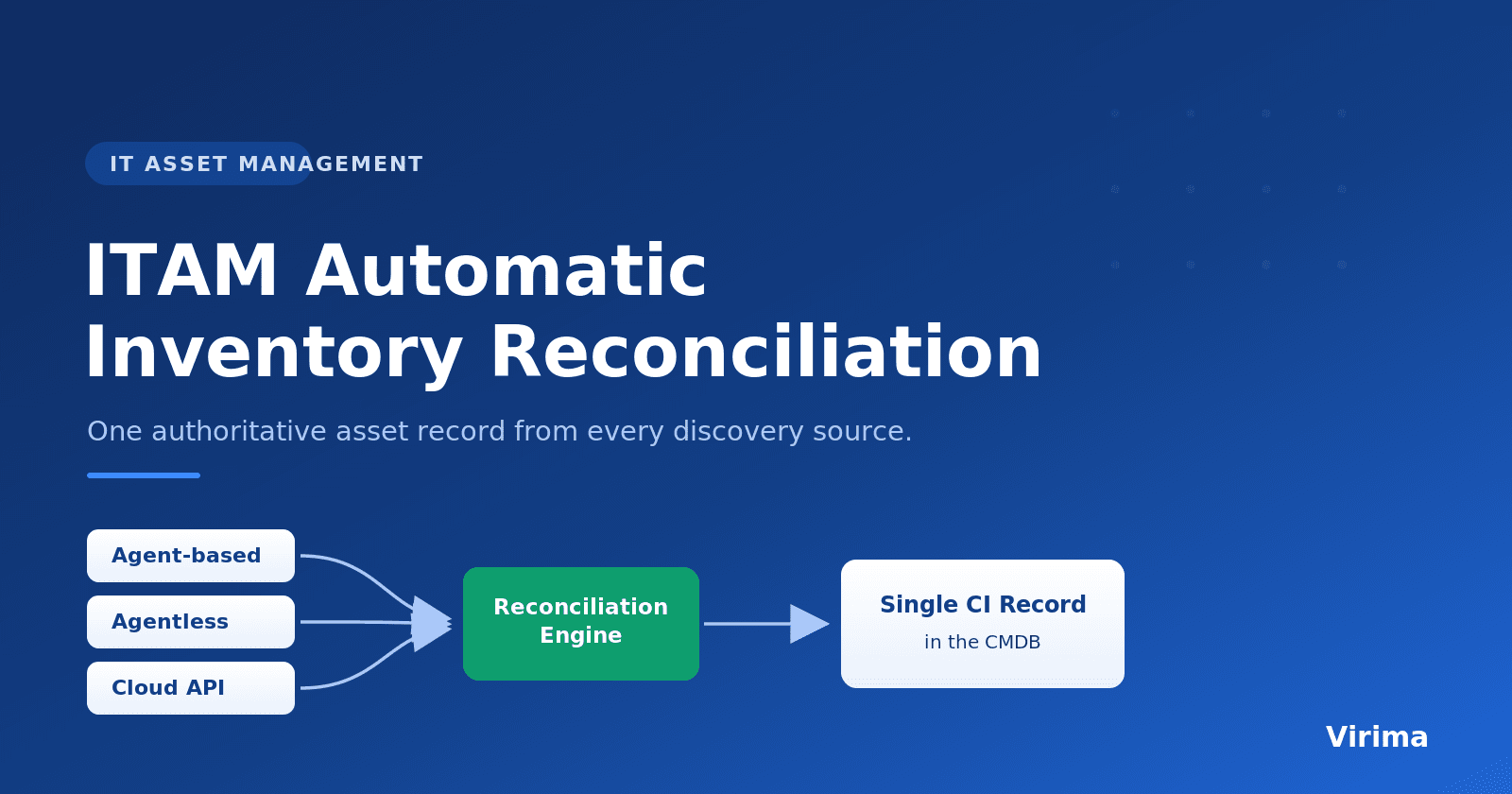
ITAM Automatic Inventory Reconciliation: How Multi-Source Discovery Works

Sooner or later, every IT team hits the same wall. An audit finds software on machines your CMDB has never seen. Cloud instances vanish after a credential change breaks a scan. Old servers still show as active months after you retired them. Almost always, one discovery method causes this, because it fails quietly at the edges of your network. ITAM automatic inventory reconciliation fixes the problem. It pulls records from many discovery sources at once, compares them, and settles conflicts. As a result, you get one trusted asset record that your team and your auditors can rely on.
Why Single-Source Discovery Produces Inventory Gaps
Every method has a weak spot. For example, agent-based scanners stop collecting data when an agent update fails. They also miss any device the supported OS list does not cover. Likewise, agentless scans drop devices behind credential changes, NAT boundaries, or quiet SNMP communities. Cloud API tools see only one account or subscription at a time. So shadow IT and cross-account assets stay hidden.
Each method captures a real slice of your environment. Still, none of them captures the whole thing. So when your IT asset management program leans on just one method, you get a split result. The inventory looks accurate for the devices that method covers well. Meanwhile, it stays blind to everything else.
The result is a messy CMDB. It fills up with ghost assets, which are retired machines still listed as active. It also hides phantom gaps, which are live assets that never show up at all. On top of that, you get clashing data when a device appears in some systems but not others.
According to Flexera’s 2024 State of ITAM Report, 53% of IT teams struggle to gain or keep full visibility of their technology. Even expert teams believe 20 to 30 percent of IT spend goes to waste because asset data is wrong. ITAM automatic inventory reconciliation picks up exactly where single-source discovery stops.
| Why Does Single-Source Discovery Fail at ITAM Reconciliation?Every discovery method has its own blind spots. For example, agent-based tools miss unmanaged devices. Agentless scans drop assets behind credential failures. Cloud API tools miss shadow accounts. So when one method is your only source of truth, its blind spots turn into permanent gaps. Those gaps then drive audit failures and wasted spend. |
What ITAM Automatic Inventory Reconciliation Actually Does
So what does reconciliation actually do? First, it compares records from many data sources. Next, it spots the conflicts between them. Then it applies attribute-level precedence rules to decide which value wins. Finally, it writes one trusted CI to your CMDB. In an ITAM workflow with frequent discovery cycles, all of this runs on its own, with no manual work from you.
The pipeline works in five steps:
- Collect: Discovery cycles run across every active method (agent, agentless, and API) on their own schedules.
- Normalize: The engine standardizes the raw data from each source, such as publisher names, hardware IDs, and OS version strings.
- Match: The engine lines up records from different sources using common IDs, like serial number, MAC address, or cloud resource ID. This way, it spots the same asset across many feeds.
- Reconcile: When sources disagree on a field, a clear precedence rule decides which source wins.
- Write: The engine writes one merged CI record to the CMDB and keeps the source for each attribute.
In the end, this pipeline gives you an asset record built from the best data across all your sources. It no longer relies on whatever one method happened to catch in its last scan.
| What Does ITAM Automatic Inventory Reconciliation Do?It collects asset records from many discovery sources. Then it normalizes and deduplicates them. Finally, it writes one trusted CI record to your CMDB. When data conflicts, it applies attribute-level precedence rules. So the final record holds the most reliable value across all sources, with no manual cleanup or scripted merging. |
Three Discovery Methods That Drive Accurate Reconciliation
In hybrid IT environments, multi-source reconciliation relies on three discovery methods. Each one is the best source for a different class of asset.
Agent-based discovery puts a lightweight agent on managed endpoints. From there, it collects deep inventory data. This includes installed software with exact versions, hardware serial numbers, BIOS details, and patch levels. So the data is rich for what it covers. However, the limit is sharp. Anything outside your managed endpoints stays invisible.
Agentless discovery scans the network with credentials instead. It uses WMI for Windows, SSH for Linux and macOS, and SNMP for network gear. Because it needs no endpoint software, it reaches network devices, legacy systems, and hardware that cannot run agents. That said, its reach depends on valid credentials and network access.
API-based cloud discovery talks straight to the AWS and Azure management APIs. As a result, it returns cloud instances, storage volumes, serverless functions, and managed services. No on-prem scan method can reach these assets.
So each method owns a different set of devices. When you run all three and feed the results into one reconciliation engine, you get a CMDB that mirrors your real hybrid estate. For a deeper look at how agent and agentless methods stack up on their own, see our guide to agent-based vs agentless discovery.
The reconciliation pipeline that produces these attribute-level CI records is the same foundation that drives automated ITAM workflows. For a deeper look at how that pipeline feeds license compliance, audit readiness, and lifecycle management, see ITAM automatic inventory reconciliation
| How Does Multi-Source Discovery Improve Asset Reconciliation Accuracy?Multi-source discovery closes the coverage gaps that single-method tools leave behind. For instance, agent-based cycles handle managed endpoints. Agentless cycles cover network infrastructure and legacy systems. Cloud APIs surface AWS and Azure assets. So when all three feed one reconciliation engine, the CMDB mirrors your real hybrid estate. It no longer shows a partial view from one scanner. |
Virima’s Approach to Multi-Source Reconciliation
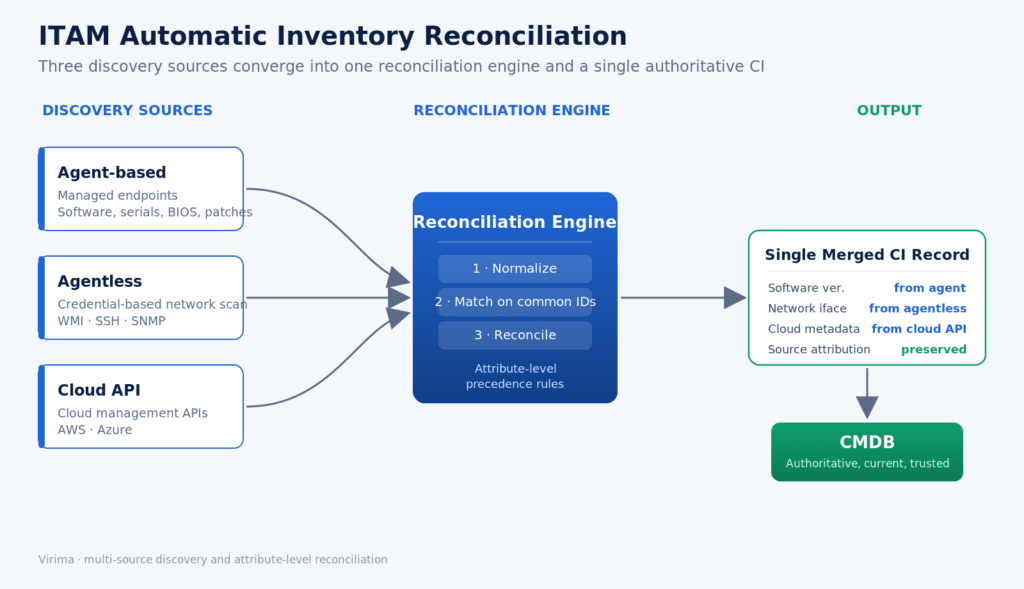
Virima runs agent-based, agentless, and API-based IT discovery natively in one platform. Each method reports to the same reconciliation engine. That engine then merges records at the attribute level, not the record level.
This difference matters a lot. Record-level merging often creates duplicate CIs. That happens when the same asset shows up under different IDs in different sources. Virima avoids this. First, it matches records on common IDs, such as serial number, MAC address, or cloud resource ID. Then it applies source precedence rules to settle each field. For instance, agent data may win for the installed software version. Meanwhile, agentless data may win for network interface details. So the final CI record pulls each attribute from its most reliable source.
At the same time, software normalization runs in the background. It cleans up publisher names, product titles, and version strings from the raw data. It does this before reconciliation writes to the CMDB. As a result, one application no longer shows up as three separate software CIs just because each source spelled its name a bit differently.
From there, the reconciled records flow straight into your IT asset management workflows. These include software license tracking, hardware lifecycle management, contract and warranty dates, and compliance reporting. Because live discovery data drives the inventory, your license gap reports and EOL/EOS alerts show what you actually run today. They no longer rely on data someone typed in by hand months ago.
See how Virima delivers Trusted Runtime Truth across your IT estate
| What Makes Virima Different in ITAM Automatic Inventory Reconciliation?Virima merges discovery data at the attribute level, not the record level. So each CI attribute draws from the most reliable source. Agent data covers installed software. Agentless data covers network interfaces. Cloud API data covers cloud resource metadata. As a result, you get one CI record with the best data from all three methods, and no duplicate CIs or manual merging. |
What Accurate Reconciliation Enables Downstream
License compliance gets accurate. Normalization removes duplicates, and reconciliation captures every deployed instance. So your license gap analysis shows your real exposure. It stops being a rough guess built on partial data.
Audit response time drops sharply. Today, many teams spend hours cross-checking spreadsheets before an audit. Instead, you can pull reconciled CMDB data directly. After all, the records already blend every discovery source, and each value still shows where it came from.
Change impact analysis gets more trustworthy. When your change management CMDB rests on discovery-driven data, each impact review reflects real relationships. It no longer leans on stale records that someone last touched months ago. To go deeper, review CMDB best practices for how reconciliation accuracy shapes downstream change workflows.
Agentic IT workflows depend on it. When AI agents take automated actions, they must know what they touch. They need to know what exists, which version runs, what connects to what, and who owns it. A reconciled, discovery-sourced CMDB gives them the Trusted Runtime Truth that keeps those actions governable. Without it, every autonomous workflow runs on guesses that may no longer match your environment.
Virima vs. ServiceNow ITAM vs. Ivanti Neurons for ITAM
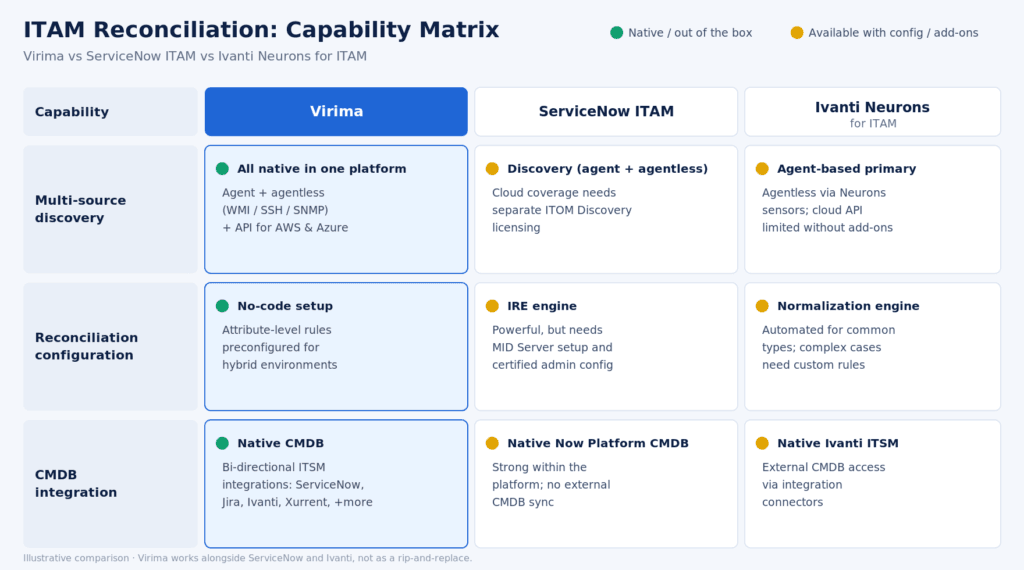
These ITAM automatic inventory reconciliation capabilities vary a lot from platform to platform. So the table below compares Virima, ServiceNow ITAM, and Ivanti Neurons for ITAM. It focuses on the points that shape reconciliation quality and time-to-value.
Keep in mind that Virima does not replace ServiceNow or Ivanti. Instead, it works alongside your existing ITSM and feeds it clean, discovery-driven asset data. So you can sharpen reconciliation accuracy without a rip-and-replace project.
Building an IT Inventory You Can Act On
In short, ITAM automatic inventory reconciliation is the foundation for every reliable ITAM workflow. License compliance, audit readiness, change impact analysis, and agentic IT automation all need the same thing. They need an asset inventory built from discovery data that shows what truly runs in your environment. A single scan method simply cannot deliver that, because it misses half your hybrid estate.
Virima’s multi-source reconciliation engine runs agent-based, agentless, and API discovery natively. It merges records at the attribute level. Then it writes a CMDB that stays current with no manual work. With Virima, you build a CMDB that tracks every asset from purchase through retirement, and every data point still shows its source. For a closer look at how active vs passive IT asset discovery methods feed reconciliation, that post walks through the trade-offs.
Schedule a Demo and see ITAM automatic inventory reconciliation in action.
Frequently Asked Questions
What is ITAM automatic inventory reconciliation?
ITAM automatic inventory reconciliation collects asset discovery data from many sources. Then it normalizes and deduplicates the records. Finally, it writes one trusted CI to your CMDB, with no manual work. When sources disagree, it applies preset attribute-level precedence rules. As a result, the final record holds the most reliable data from across every discovery method.
Why does my IT inventory have ghost assets even when discovery is running?
Ghost assets show up when one discovery method stops seeing a device, yet the CI in your CMDB never updates. This often happens when credentials expire, scan coverage shifts, or the tool does not support a device type. Multi-source reconciliation catches the gap, though. Other methods keep checking whether the asset is still there. On top of that, staleness flags appear wherever data has not refreshed on schedule.
How does attribute-level reconciliation differ from record-level merging?
Record-level merging joins two CI records for the same device. However, it may grab every value from just one source at random. Field-by-field reconciliation works differently. It applies source precedence to each attribute on its own. So the final CI takes the most reliable value for every field. For example, agent data wins for the installed software version, while agentless data wins for network interface details. In the end, you get a record built from the best data for each field, not from one source’s full record.
Does Virima require manual rule configuration for multi-source reconciliation?
No. Virima’s reconciliation engine arrives preconfigured for common hybrid IT environments, and the setup needs no code. If your environment has unusual source-authority needs, you can add custom precedence rules. Even so, the default setup handles standard agent, agentless, and cloud API sources without any manual rule building.
How does Virima’s CMDB respond when a discovery source goes offline?
When one source fails, the others keep feeding the reconciliation engine. Meanwhile, Virima holds the last confirmed data from the offline source in the CI record. On top of that, Virima’s CMDB health scoring flags any attribute that has not refreshed on schedule. So your team can see where coverage has slipped before an auditor or an automated workflow acts on stale data.