IT Asset Visibility for Swiss Financial Institutions Under the Revised Data Protection Act

A Zurich private bank received a client access request naming three product systems and one outsourced CRM. Privacy counsel asked infrastructure for every host, database, backup target, and support path still holding that client’s data. The CMDB listed the CRM as “vendor managed.” The cloud console held two leftover analytics extracts from a closed pilot, and a retired onboarding server sat undecommissioned in the ticket queue. Three days of reconciliation produced a defensible answer.
The revised Federal Act on Data Protection expects that answer to exist already. IT asset visibility for Swiss financial institutions under the revised Data Protection Act is the proof behind controller duties, proof that fails when the running estate disagrees with the register privacy, risk, and audit teams present.
What the revised FADP changed for Swiss financial institutions
The Federal Act on Data Protection (FADP) of 25 September 2020, often called the revised FADP or nFADP, has applied since 1 September 2023. The Federal Data Protection and Information Commissioner (FDPIC) explains the new role and private-sector expectations on its overview of the new law. Financial institutions already operated under banking secrecy, FINMA outsourcing rules, and client confidentiality. The revised Act adds modern controller and processor duties that depend on knowing which systems process personal data.
| Duty under revised FADP | What privacy counsel needs | What infrastructure must evidence |
|---|---|---|
| Record of processing activities (controller and processor) | Categories of data, purposes, recipients, retention | Named systems, environments, and interfaces that perform each activity |
| Accountability and technical measures | Proportionate security and documented controls | Current inventory of hosts, cloud resources, and access paths |
| High-risk processing assessment | Risk analysis before high-risk processing | Scope of systems, data stores, and third-party connections in scope |
| Cross-border disclosure | Adequacy or safeguards for foreign recipients | Which systems and processors can reach or store data abroad |
| Data subject access and correction | Complete, timely response | Every system still holding the person’s data, including shadows and leftovers |
The Act requires controllers and processors to maintain a record of processing activities. A spreadsheet of product names without verified infrastructure leaves gaps when a marketing warehouse, test clone, or vendor sub-processor still holds client fields. Institutions that treat the RoPA as a legal document only, never joined to discovery-sourced asset truth, rebuild the same list under pressure.
What does the revised Swiss FADP require from financial institutions beyond a privacy policy?
Controllers and processors must maintain records of processing activities, apply proportionate technical measures, assess high-risk processing, manage cross-border disclosures, and answer data subject requests. Those duties need a current map of systems that process personal data, not only policy text.
Why privacy registers break without IT asset visibility
Privacy teams describe processing in business language. Operations teams change infrastructure through tickets, pipelines, and cloud consoles — and the join fails when hostnames, cloud instance IDs, serial numbers, and ownership fields never land in one authoritative record. A 2024 IBM Cost of a Data Breach Report found that breaches involving shadow data — personal data sitting outside a tracked, managed inventory — took longer to contain, pushing the global average cost to $4.88 million, a 10 percent rise over the prior year.
Three failure modes show that shadow data problem playing out repeatedly in Swiss FS estates.
A wealth desk trials a portfolio analytics SaaS tool, then closes the pilot. A support account and a nightly extract remain, and the RoPA still lists only the core banking platform — so a subject access request has no line for the extract path.
A production client database is cloned for performance testing. The clone outlives the test window, and backup retention outlives the decommission ticket. The privacy register shows deletion; the storage estate still holds recoverable copies.
A CRM processor adds a sub-processor for ticket enrichment. Contracts update slowly; infrastructure sees traffic to the new endpoint, but without dependency mapping tied to named CIs, the RoPA recipients list lags the live path.

These gaps are inventory problems before they are legal theory problems. Swiss institutions need a privacy-specific join: which CIs process personal data, who owns them, when discovery last verified them, and which external interfaces touch them.
What good IT asset visibility looks like under the revised FADP
Good IT asset visibility for Swiss financial institutions under the revised Data Protection Act means every processing activity in the RoPA can point to verified configuration items, carrying owners, environments, last-verified timestamps, and dependency links to processors and internal consumers.
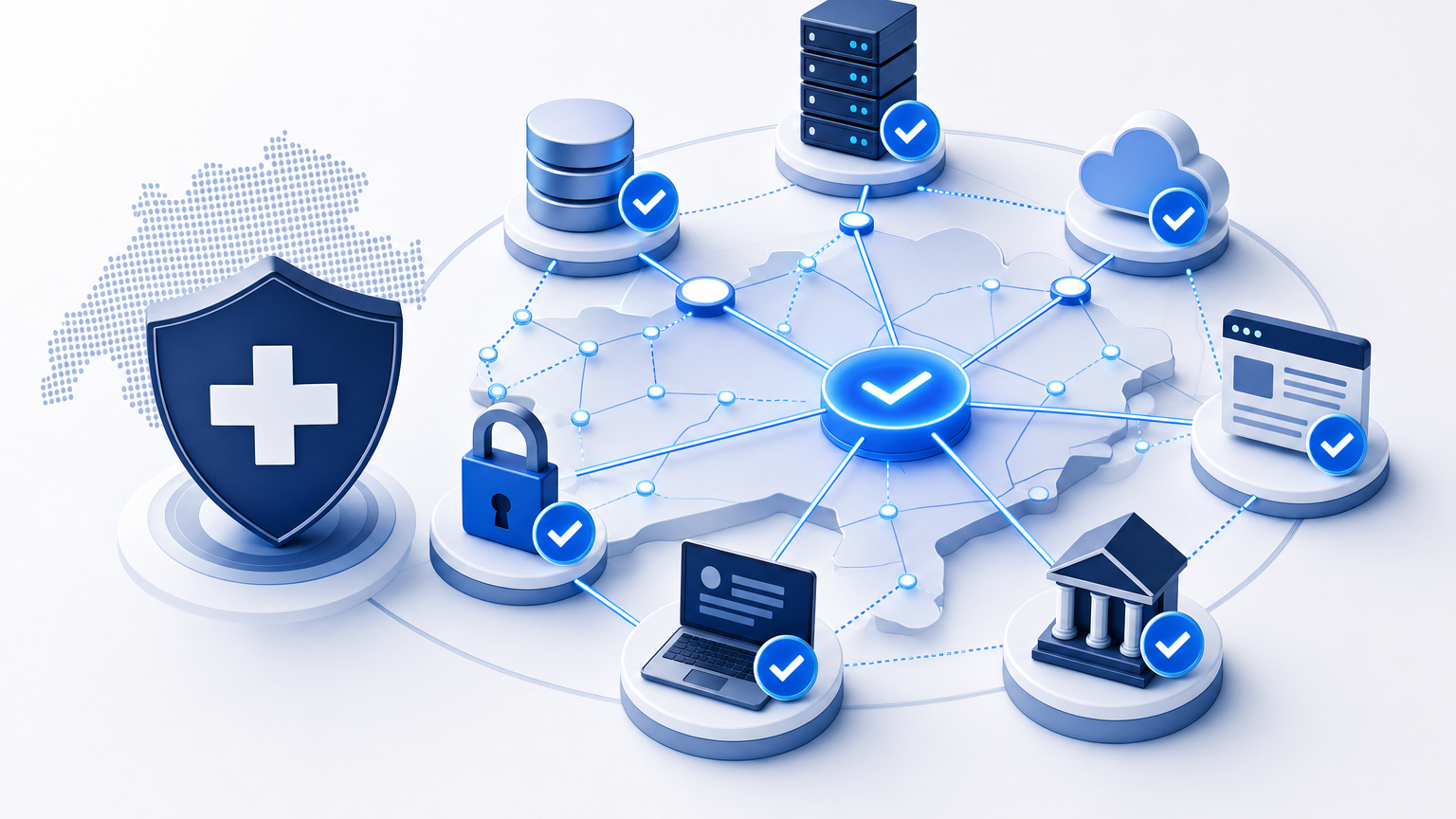
A workable nFADP asset inventory joins five layers.
- Processing activity → business service. Privacy names the activity. Service owners name the service composition (core banking module, client portal, CRM, KYC workflow).
- Business service → infrastructure CIs. Discovery populates hosts, cloud resources, databases, and middleware with durable identifiers such as serial numbers or cloud instance IDs. Hostnames alone are not durable join keys across rebuilds.
- CI → personal-data flag and classification owner. Data governance marks which systems are in personal-data scope. The CMDB stores the flag and the owner who must keep it accurate.
- CI → external interfaces. Processor and sub-processor connections appear as dependencies with verification dates, not only as PDF contract names.
- CI → lifecycle state. Decommissioned systems leave the active processing map only after owned retirement of data, credentials, and network paths.
Without that join, a RoPA is a static document; with it, it becomes a claim infrastructure can prove on demand. For a Swiss bank, data protection CMDB evidence means verified hosts, owners, and interfaces — not a vendor’s promise of visibility. Explore Trusted Runtime Truth for discovery-sourced evidence of what exists, how it connects, and who owns it, so privacy answers match the running estate.
How does IT asset visibility support a Swiss RoPA under the revised FADP?
A RoPA lists processing activities, purposes, and recipients. IT asset visibility supplies the verified systems, environments, and interfaces that perform those activities. Together they let controllers show which assets process personal data and when those records were last confirmed.
Where Virima fits: discovery-fed CMDB without claiming to be the DPO desk
Virima does not replace legal counsel, the DPO function, or a full GRC privacy module. Discovery and CMDB records supply the infrastructure and dependency evidence those functions need to defend processing under the revised Act.
Scheduled Virima Discovery runs across hybrid estates — agentless probes, an optional agent, and API connectors for cloud accounts, with credentials staying on the institution’s own Discovery App server — catching new instances, drifted clones, and forgotten lab systems between privacy reviews. Discovered items land as authoritative CI records in the Virima CMDB with multi-source reconciliation, ownership, and history, so privacy and risk teams can require last-verified dates the same way change managers require them before production windows.
Once the bank defines service composition, ViVID™ service maps build dependency maps across on-premises systems, AWS, Azure, and connected platforms, showing downstream jobs and external interfaces before a change is approved.
Banks often keep ServiceNow, Jira, Ivanti, HaloITSM, or Xurrent as the system of engagement. Virima synchronizes discovered truth into those workflows through the integrations hub.
Encryption, key custody, consent, lawful basis, and DPIA narrative stay with security engineering and privacy; review of the CMDB shows where processing runs and what connects to it. That separation keeps audit conversations clean, per Virima’s broader CMDB compliance and risk guidance.
nFADP is not GDPR with a Swiss stamp, and not FINMA residency alone
Swiss financial institutions often run parallel programs that look similar from a distance and fail when merged into one slide.
| Framework | What it governs | How it differs from revised FADP work |
|---|---|---|
| EU GDPR | Controller/processor accountability, records of processing, cross-border rules under EU law | Shares vocabulary with the revised FADP but differs in statute, authority (FDPIC, not an EU DPA), and enforcement path — reusing GDPR guidance as “Swiss compliance” misstates the law. See Virima’s GDPR and ITAM piece for the EU framing. |
| FINMA operational resilience | ICT asset inventories, critical data locations, and external interfaces banks must know for resilience and outsourcing oversight | A residency and location story, not a substitute for privacy-law asset visibility — keep both linked in the same CMDB so one discovery cycle covers both. FINMA’s Circular 2023/1 expects similar ICT asset inventories, for a different audience. |
SecOps needs complete inventory for exposure and response; privacy needs the subset and relationships that process personal data, plus processor paths. Cybersecurity IT asset visibility via CMDB serves the security lens. Institutions also carry AMLA retention duties that can pull against FADP erasure principles — treat conflicts as a named CI exception, not RoPA silence.
A 30-day operating sequence privacy and infrastructure can share
Swiss financial institutions that want IT asset visibility under the revised Data Protection Act can run a joint sprint without boiling the ocean.
| Week | Infrastructure and privacy actions |
|---|---|
| 1 — Scope | List processing activities touching personal data and map each to a candidate business service. Exclude market-data pipes only once a named owner confirms no personal data. |
| 2 — Discover | Run discovery on-premises and across connected AWS/Azure accounts, reconcile using durable IDs, and flag ghost CIs still marked “active” after retirement. |
| 3 — Tag | Tag personal-data CIs, attach owners, and map processor interfaces — e.g., a CRM’s sub-processor endpoint as its own CI, not a contract PDF line. Align RoPA recipients to records with verification dates. |
| 4 — Wire runbooks | Require CMDB checks before changes touching tagged systems, publish a subject-access runbook starting from the service map, and set discovery cadence to match change volume. |

Institutions with EU-facing entities also maintain DORA registers and NIS2 obligations — one discovery-fed CMDB can feed multiple registers when ownership and purpose tags stay explicit, rather than collapsing every European rule into a generic “compliance inventory” page.
What to ask vendors and internal platform teams
Before the next privacy committee, ask for evidence rather than assurances.
- Which personal-data systems were last verified by discovery, and on what date?
- Which durable identifiers join CMDB records to cloud and hardware sources?
- How are test clones and backup targets represented for systems in RoPA scope?
Approaches relying on annual workshops lose accuracy between cycles; scheduled discovery and owned CIs stay current.
Close the gap between the RoPA and the running estate
The revised Data Protection Act raised the bar for Swiss financial institutions that process personal data at scale. Legal registers without infrastructure truth create delay, inconsistent answers, and supervisory follow-up. Discovery-fed IT asset visibility for Swiss financial institutions under the revised Data Protection Act gives privacy, risk, and operations a shared map of systems, owners, and processor paths.
Schedule a demo to walk a hybrid estate map against a sample personal-data service list and see how verification dates support the next access request or processing review.
Frequently Asked Questions
When did the revised Swiss Federal Act on Data Protection enter into force?
The Federal Act on Data Protection of 25 September 2020 has applied since 1 September 2023. Record-keeping and technical measures are ongoing duties, not a one-time go-live project.
What does a Swiss FADP record of processing need to include?
Controllers and processors must each maintain a record of processing activities covering categories of data, purposes, recipients, and retention — tied to real systems and interfaces, not outdated product lists.
Is a CMDB the same as a Swiss RoPA, and can Virima’s CMDB feed one?
No. A RoPA is a privacy register of processing activities, purposes, and recipients; a CMDB holds configuration items, relationships, owners, and verification history. Virima’s CMDB does not author the RoPA — it exports verified CI lists and last-verified dates for the RoPA or GRC platform of record.
How is this different from FINMA data residency inventory work?
FINMA-oriented residency work focuses on where critical data sits and which external parties can reach it under operational resilience rules. Revised FADP work focuses on personal-data processing accountability, RoPA completeness, and subject rights. Both benefit from the same discovery-fed map with different tags and owners.
Can Virima replace the bank DPO or privacy GRC tool?
No. Virima provides discovery, CMDB, and service-mapping evidence for systems and dependencies. Legal basis, DPIA narrative, consent, and formal RoPA wording remain with privacy counsel and GRC processes that consume that evidence.