IT Asset Visibility for Retail Operations in New York

A payment processor flags an untracked POS terminal in a Midtown flagship during peak season, and register lines stall while engineers assemble hardware lists from phone calls. Retail operations in New York run on thin margins and fast foot traffic, leaving little room for unrecorded devices on store networks. Central IT teams often assume store profiles match corporate baselines, yet store managers adopt local tools to keep checkout counters moving. Disconnected spreadsheets and quarterly physical counts cannot track rapid device swaps across dozens of locations. This guide explains why IT asset visibility for retail operations in New York protects revenue, and how scheduled discovery eliminates operational blind spots across omnichannel estates.
Omnichannel retailers based in the New York metropolitan area operate complex environments linking regional stores, central distribution centers, and distributed cloud backends. When corporate provisioning processes take days, store managers deploy third-party stock apps, local reporting tools, and backup card terminals to keep queues short. Those unmanaged cloud services and rogue endpoints remain invisible to central administration until database synchronization fails or auditors request terminal receipts. Point-of-sale failures, inaccurate inventory displays, and payment compliance flags stem from the same underlying absence of verified infrastructure data.
What is IT asset visibility in retail operations?
IT asset visibility in retail operations is the automated identification and monitoring of every connected hardware, software, and cloud asset across a store network. It covers POS endpoints, warehouse management systems, and e-commerce platforms, and tracks the dependencies between them so teams catch stock divergences, audit failures, and checkout outages before customers do.
What is IT asset visibility for retail operations in New York?
IT asset visibility in retail operations is the automated ability to identify, catalog, document, and monitor every IT asset operating across an omnichannel estate. This footprint includes register terminals, barcode scanners, handheld stock units, warehouse management servers, cloud accounts, and corporate back-office infrastructure. Complete visibility requires mapping the active dependencies and operational data paths linking these components together.
Maintaining reliable operations across distributed retail sites requires actionable data rather than static hardware registries:
- Current visibility into asset location, operational state, and business ownership across physical and virtual retail channels
- Documented technical dependencies connecting physical store terminals, regional distribution warehouses, and cloud commerce applications
- Automated data reconciliation across public cloud accounts, distributed retail subnets, and local store registers
- Tamper-resistant change logs and operational histories that answer payment scope boundaries and inventory synchronization audits
The hidden challenge
| Retail scenario | Without asset visibility | With asset visibility |
|---|---|---|
| New store opening | IT assumes a standard terminal blueprint, while store staff install unrecorded card readers for faster lines. Payment processors later flag unauthorized devices during compliance reviews. | New store infrastructure is cataloged during scheduled network discovery cycles. Terminal hardware validates against approved payment standards, and unauthorized cloud tools are resolved before opening day. |
| Cloud service adoption | A store supervisor signs up for an unapproved SaaS inventory scanner to track local storeroom counts. Unprotected customer purchase details land on third-party cloud infrastructure. | The unauthorized cloud integration is detected through regular discovery checks. Security leads assess data classification and integration controls before consumer data is exposed. |
| Inventory visibility gap | Distribution center inventory records diverge from digital storefront listings. Stockouts occur during multi-channel sales promotions, leading to widespread customer cancellations. | Dependency maps trace data connections between distribution software and e-commerce platforms. Configuration changes on either side trigger automated operational alerts in change control. |
| Multi-location audit | Engineers spend three weeks calling individual store managers to confirm local register configurations. Field examiners identify untracked card terminals running unsupported firmware versions. | Scheduled discovery maintains an auditable index of all payment hardware, terminal models, and operating system builds. Compliance reports are compiled and verified within hours. |
Why asset visibility matters for omnichannel retail
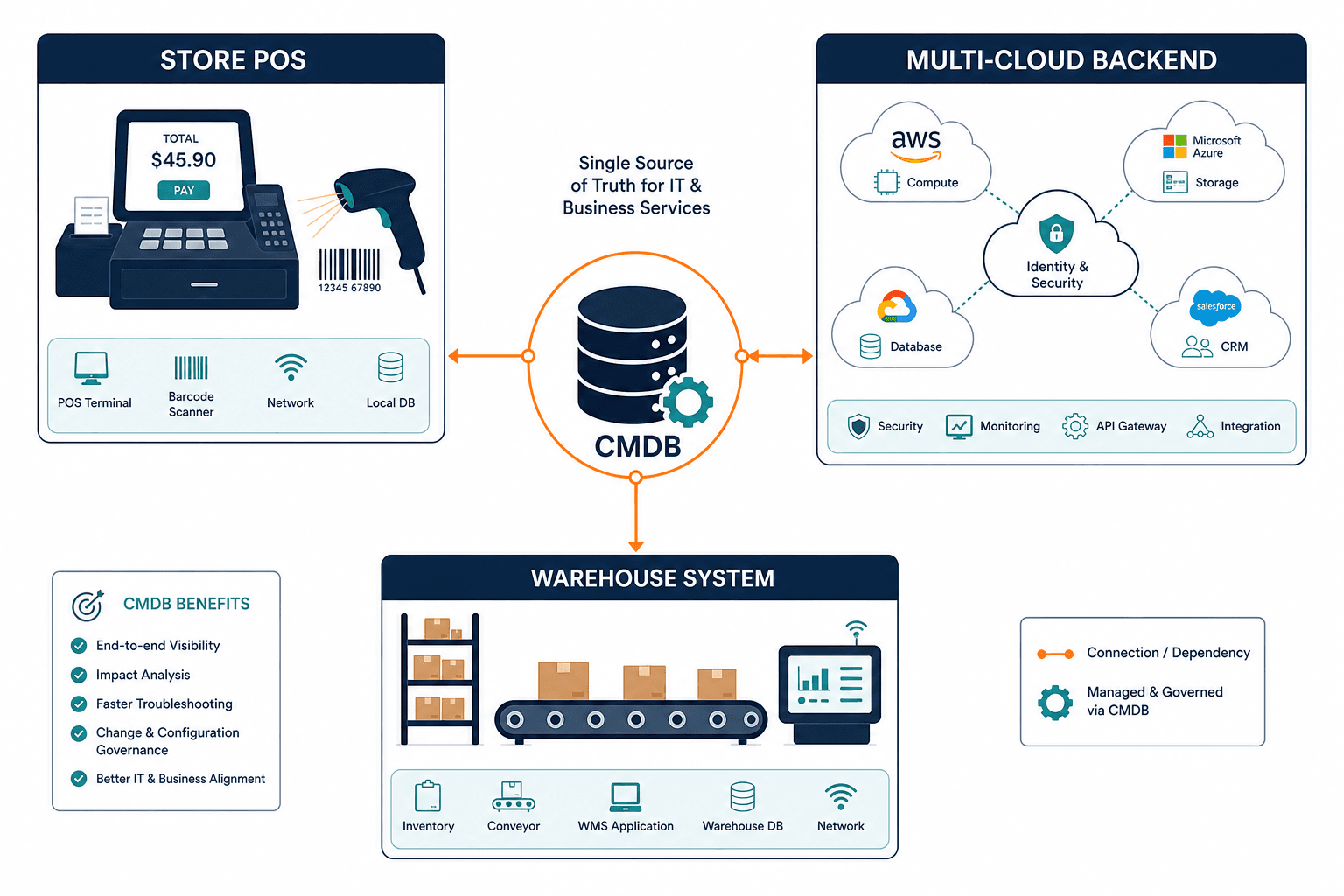
Modern omnichannel retail architecture relies on synchronized customer databases and shared stock visibility across brick-and-mortar storefronts, regional fulfillment centers, and web applications. Services like buy-online-pickup-in-store (BOPIS) depend on synchronized transactions across these distinct environments. Every one of these workflows depends on runtime truth: an accurate, current picture of what’s actually deployed rather than what a network diagram assumes is deployed. When underlying infrastructure remains unmonitored, core operational workflows experience unpredicted failure points. That exposure is not theoretical: Verizon’s 2026 Data Breach Investigations Report retail snapshot found system intrusion driving the majority of confirmed retail sector breaches, as unmonitored infrastructure gives attackers more entry points to reach stored credentials and business data. Getting ahead of that exposure requires omnichannel retail infrastructure visibility across NYC’s store, warehouse, and cloud footprint instead of a single-channel view.
Regulatory frameworks and corporate governance standards mandate precise device records across retail networks:
- PCI DSS Requirements: Retail enterprises must preserve an accurate, verifiable inventory of every system component touching cardholder data environments. This scope covers registers, merchant gateways, and connected internal networks, as outlined in official PCI SSC document resources.
- Omnichannel Transaction Health: Coordinated fulfillment across curbside pickup, drop-ship suppliers, and physical storefronts requires verified integration endpoints and known server health.
- SOX IT General Controls: Publicly traded retail organizations must maintain rigorous documentation and change logs for financial reporting systems and inventory valuation databases.
- Consumer Privacy Protection: Customer loyalty programs and store marketing applications collect consumer profiles that demand auditable data boundaries and access controls. New York’s SHIELD Act requires businesses holding NY residents’ private information to maintain reasonable administrative, technical, and physical safeguards — which starts with knowing exactly which store registers, cloud tools, and back-office systems touch that data.
Why does PCI DSS require automated IT asset discovery in multi-store retail?
PCI DSS requires an accurate, defensible inventory of every system that stores, processes, or transmits cardholder data. In distributed retail chains, store managers frequently swap payment terminals or attach unauthorized cloud tools without informing IT. Scheduled discovery catalogs those changes automatically, giving auditors timestamped evidence instead of reconstructed paper trails.
Four common blind spots
Retail shadow IT detection starts with knowing where these four blind spots typically form:
- Unauthorized cloud services in stores
Local store supervisors often subscribe to specialized shift scheduling tools, rogue messaging platforms, or external stock trackers without corporate IT authorization. These consumer-grade cloud services store sensitive transaction records and workforce details beyond corporate governance boundaries. The result: critical business data becomes vulnerable to credential theft, and IT leadership cannot answer statutory data sovereignty inquiries during external audits. - Incomplete POS and payment terminal inventory
Large regional retail brands operate hundreds of physical checkout lanes across the tri-state area. Local repairs and unrecorded hardware replacements create POS system visibility gaps where outdated, vulnerable firmware versions linger on active store subnets. Verizon’s 2026 DBIR retail snapshot found that system intrusion accounts for 61% of confirmed retail sector breach patterns, with attackers increasingly pivoting toward stored credentials and business data rather than payment cards alone. The result: unpatched card readers expose retail brands to skimming attacks, contractual processor fines, and checkout delays when uncataloged terminals break down. - Omnichannel infrastructure fragmentation
Digital storefronts, enterprise resource databases, fulfillment systems, and store checkout registers often run on separate infrastructure layers without unified architectural tracking. An unannounced configuration tweak on a warehouse database can break inventory reconciliation across all consumer channels. The result: high-demand promotional events generate ghost orders, customer satisfaction collapses, and companies suffer direct revenue losses from unfulfilled orders. - Siloed asset data across departments
Store operations tracks cash registers in procurement records, corporate engineering monitors cloud instances, and security manages endpoint software through individual portals. None of these records reconcile automatically or reflect current operational status. The result: audit preparation consumes hundreds of staff hours across departments, and leadership cannot present a defensible infrastructure record to examiners.
Does PCI DSS scope change when a store swaps a POS terminal?
Yes. PCI DSS scope changes the moment a store swaps a payment terminal or reroutes network traffic, even without a formal change request. In multi-location retail, undocumented terminal swaps are the most common way a store unknowingly expands its cardholder data environment. Scheduled discovery flags the change before the next assessment, not after.
See it before it becomes an incident. Explore Trusted Runtime Truth to see how discovery-sourced data closes these blind spots before they reach a register line or an auditor’s desk.
What happens when you do not have asset visibility
For retail IT directors
Retail IT leaders carry executive responsibility for digital availability across retail stores and digital shopping portals. When a register bank halts during peak holiday traffic, engineering teams must rapidly determine whether the root cause involves hardware defects, software bugs, local Wi-Fi drops, or unauthorized terminal adjustments. Lacking a central multi-site asset register, incident response requires hours of phone calls between central engineers and store employees.
As a retail footprint expands beyond 50 regional locations, manual tracking of barcode readers, manager tablets, digital signs, and checkout stations breaks down. Shadow hardware spreads across branch networks unchecked, and without dependable device inventories, engineering teams cannot trace dependencies between local register applications, warehouse systems, and cloud infrastructure — which increases the probability of change-related store disruptions.
For retail operations managers
Store operations leadership depends entirely on technical infrastructure to fulfill omnichannel retail promises. When store registers, inventory management software, and e-commerce platforms fall out of alignment, inventory quantities diverge, leading to failed curbside pickups and missed ship-from-store delivery windows.
Every new physical retail opening introduces complex technical dependencies, including network cabling, payment gateways, and inventory mobile terminals. When organizations manage this deployment through decentralized spreadsheets, store openings suffer from missed timelines and configuration discrepancies. Peak holiday shopping cycles introduce seasonal staff and temporary registers, amplifying technical friction across unmonitored store networks.
For retail compliance and audit
Regulatory compliance mandates that all hardware and software components within payment boundaries remain documented and monitored. A single unrecorded payment terminal identified during a processor inspection produces formal compliance penalties. For high-volume retail chains, point-of-sale failures translate into direct revenue losses, making continuous operational knowledge of every deployed unit a commercial necessity.
During annual payment card assessments, IT teams often spend weeks compiling terminal serial numbers from paper receipts, merchant statements, and store managers. When these disparate sources present conflicting numbers, evaluators issue formal audit non-conformances. Remediating these audit failures requires months of unscheduled engineering labor and can result in restrictive merchant processing conditions. For a closer look at how this plays out across sprawling multi-entity retail estates, see Achieve simplified compliance mapping with Virima solutions.
Corporate budgets face ongoing scrutiny, and undiscovered infrastructure components inflate operational costs through duplicate software licenses and emergency troubleshooting. Establishing systematic asset visibility ensures digital transformation investments build scalable capabilities rather than funding recurring manual cleanup efforts.
How do enterprise retailers detect store-level shadow IT across regional locations?
Enterprise retailers detect store-level shadow IT by running high-frequency scheduled discovery scans across store subnets, gateway segments, and public cloud accounts. These scans catalog unapproved SaaS tools and unauthorized devices within days of connection, giving central IT time to act before a data exposure.
How IT asset discovery and mapping fixes this
1. Automated discovery closes multi-location inventory gaps
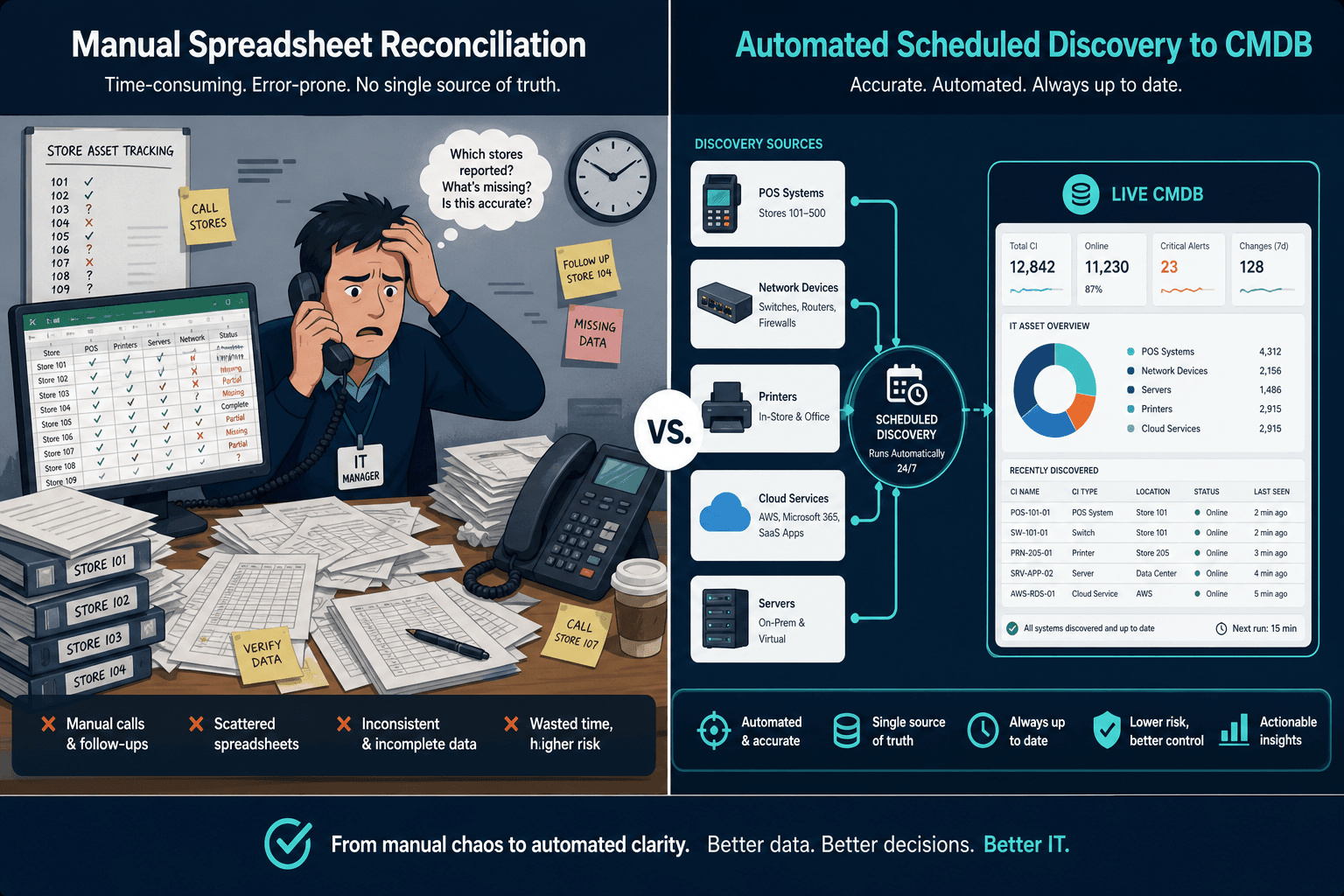
Multi-location IT asset discovery inspects physical store subnets, regional fulfillment centers, and public cloud platforms on a high-frequency schedule to inventory every active technical asset. In contrast to manual audits conducted once a year, scheduled scans operate during regular off-peak windows to identify unauthorized hardware and shadow cloud services before they create security incidents.
For enterprise IT directors, scheduled discovery provides an updated registry across all physical branches, feeding authoritative configuration records into IT service management platforms without manual data entry. For store operations, automated scans catalog checkout registers, warehouse terminals, and system endpoints supporting store fulfillment. For compliance teams, automated discovery generates timestamped records of systems handling customer transaction records, removing the need for manual record reconstruction.
Virima’s IT discovery platform scans distributed store networks alongside cloud platforms, including AWS, Azure, and Google Cloud environments, on scheduled cadences. Discovered assets populate configuration records and update downstream management tools automatically. The result is a multi-location CMDB that reflects what is actually running in every store, not what a spreadsheet says should be running.
Enterprise retailers use discovery-backed Trusted Runtime Truth to maintain an authoritative understanding of physical and virtual infrastructure before initiating production changes. For a closer look at how shadow IT accumulates undetected across large networks, see Closing the gaps: How Virima strengthens Xurrent’s CMDB with a robust discovery.
2. Service mapping reveals omnichannel infrastructure dependencies
Hardware and software visibility identifies which assets exist across an enterprise. Service mapping explains how those disparate assets exchange data and which customer transactions depend on individual nodes.
Modern retail fulfillment involves intricate data paths running from customer mobile apps through inventory platforms to store registers. For IT directors, ViVID™ service maps visualize dependencies supporting customer transactions once business service definitions are imported through spreadsheets, direct configuration, or enterprise architecture tools. If an internal database cluster experiences an outage, service maps illustrate which store locations and online fulfillment options are affected. For operations leads, dependency maps support rapid contingency routing during logistics interruptions. For compliance auditors, visual service maps document data flows through payment infrastructure with defensible technical evidence.
Service maps update automatically as infrastructure changes across scheduled discovery cycles, keeping operational dependencies aligned with current network configurations without requiring ongoing manual documentation.
3. Integration with existing retail systems
Asset intelligence produces measurable business value only when operations and support personnel can access it through daily management tools. Centralized discovery data integrates directly into established enterprise IT service platforms.
For technical teams, asset context enriches change review boards by highlighting dependent store systems before planned warehouse software updates go live. For store managers, current infrastructure dependencies reduce inventory divergence between warehouse shelves and online shopping carts. For internal audit departments, historical change logs and verified asset inventories reside within unified configuration databases.
Virima coordinates asset data with ServiceNow, Jira Service Management, Ivanti, HaloITSM, Xurrent, and Hornbill through an enterprise integrations platform. Bi-directional synchronization keeps configuration items accurate across operational systems without manual data reconciliation. Virima integrates directly with ServiceNow to enrich your CMDB configuration items with discovery-sourced data, working alongside your existing ITSM platform rather than replacing it.
How does service mapping prevent omnichannel retail outages during promotions?
Service mapping visualizes the technical dependencies connecting store POS registers, warehouse management systems, inventory databases, and e-commerce checkout engines. When stock diverges during buy-online-pickup-in-store promotions, service maps reveal the exact failing network link or database sync job within minutes, preventing revenue loss and order cancellation cascades across regional store networks.
Manual versus automated comparison
| Operational process | Manual tracking approach | Automated discovery and mapping |
|---|---|---|
| Multi-store asset inventory | Periodic physical inspections and decentralized spreadsheets create outdated records that miss newly opened stores and disconnected endpoints. | Scheduled network scans discover connected devices across all locations simultaneously, keeping asset records accurate through automated updates. |
| Payment register auditing | Staff maintain static registers manually, allowing unapproved card readers and modified configurations to slip past internal reviews. | Discovery scans catalog all active card terminals, network controllers, and payment software builds for immediate audit verification. |
| Store-level shadow IT detection | Corporate teams uncover unapproved cloud software and local utilities only after data leaks or external compliance penalties occur. | Discovery cycles highlight unfamiliar cloud connections and unmanaged software shortly after introduction, enabling timely security reviews. |
| Omnichannel dependency mapping | Engineers rely on hand-drawn architecture diagrams that grow obsolete whenever systems receive minor software or network patches. | Dynamic service maps rebuild dependency links based on confirmed service models and active infrastructure data across every discovery run. |
| Regulatory audit preparation | Personnel spend weeks gathering conflicting device records and receipts from store managers under tight examination deadlines. | Validated asset inventories, system relationship diagrams, and historical configuration changes are exported as audit-ready evidence in hours. |
IT asset visibility in practice: NYC retail scenarios
Store expansion: the new location problem
A New York fashion retailer opens 15 retail storefronts across Manhattan, Brooklyn, and northern New Jersey. Each physical branch requires point-of-sale registers, guest Wi-Fi networks, inventory handhelds, and cloud order connections.
Without centralized asset visibility, each store launch requires days of manual on-site configuration by dispatched technicians. Store personnel frequently adopt non-standard payment hardware or temporary cloud spreadsheets to accelerate sales, leaving corporate engineering uninformed about active store infrastructure until network outages occur.
With scheduled discovery and dependency mapping, engineers include local branch IP subnets in scheduled discovery profiles prior to grand openings. Within initial discovery cycles following go-live, all POS terminals, network switches, and cloud tools register in central databases. Service maps confirm data connectivity between store registers and digital warehouse catalogs, establishing an audit-ready baseline from day one.
Omnichannel outage: mystery inventory divergence
During a regional holiday retail promotion, online shoppers select items for in-store pickup, only to have local store associates cancel orders due to empty store shelves. Retail operations suffer reputational damage and lost sales while technical teams investigate the breakdown.
Without dependency visibility, engineers waste hours inspecting individual store inventory servers while operations assumes the e-commerce application contains defective logic. The actual root cause, an unmonitored proxy server misconfiguration disrupting data transmission between the distribution warehouse and store databases, remains undetected throughout peak shopping hours.
With service mapping in place, operations teams examine an end-to-end service model linking online checkout, warehouse inventory, and local store terminals. Technical leads identify communication latency at the warehouse proxy link within minutes, restoring inventory synchronization and protecting promotional sales volume.
Payment processor audit: the compliance discovery
An acquiring bank initiates an unannounced payment security audit, requesting an exhaustive inventory of all devices handling consumer cardholder data across a 120-store retail chain.
Without automated discovery, central IT scrambles to consolidate data from store receipts, supplier invoices, and local manager logs. The resulting submission omits several replacement card terminals installed by store supervisors, producing an audit violation for untracked payment infrastructure and triggering a mandatory remediation program.
With scheduled discovery running across store networks, the configuration database contains an accurate, timestamped index of all active payment terminals, gateway appliances, and operating systems. IT leaders generate defensible compliance documentation within hours, demonstrating rigorous governance and avoiding regulatory penalties.
How Virima powers IT asset visibility for retail operations in New York
Virima delivers scheduled automated discovery across retail branch subnets, regional fulfillment centers, and cloud infrastructure environments. Rather than relying on fragile manual records, Virima’s discovery engine updates configuration databases on configurable schedules, capturing new store locations, virtual workloads, and infrastructure changes as retail operations evolve. For a broader look at how retail and logistics IT estates accumulate this kind of inventory debt, see Elevate your IT operations: Transforming the future with Virima CMDB.
Immediate operational impact
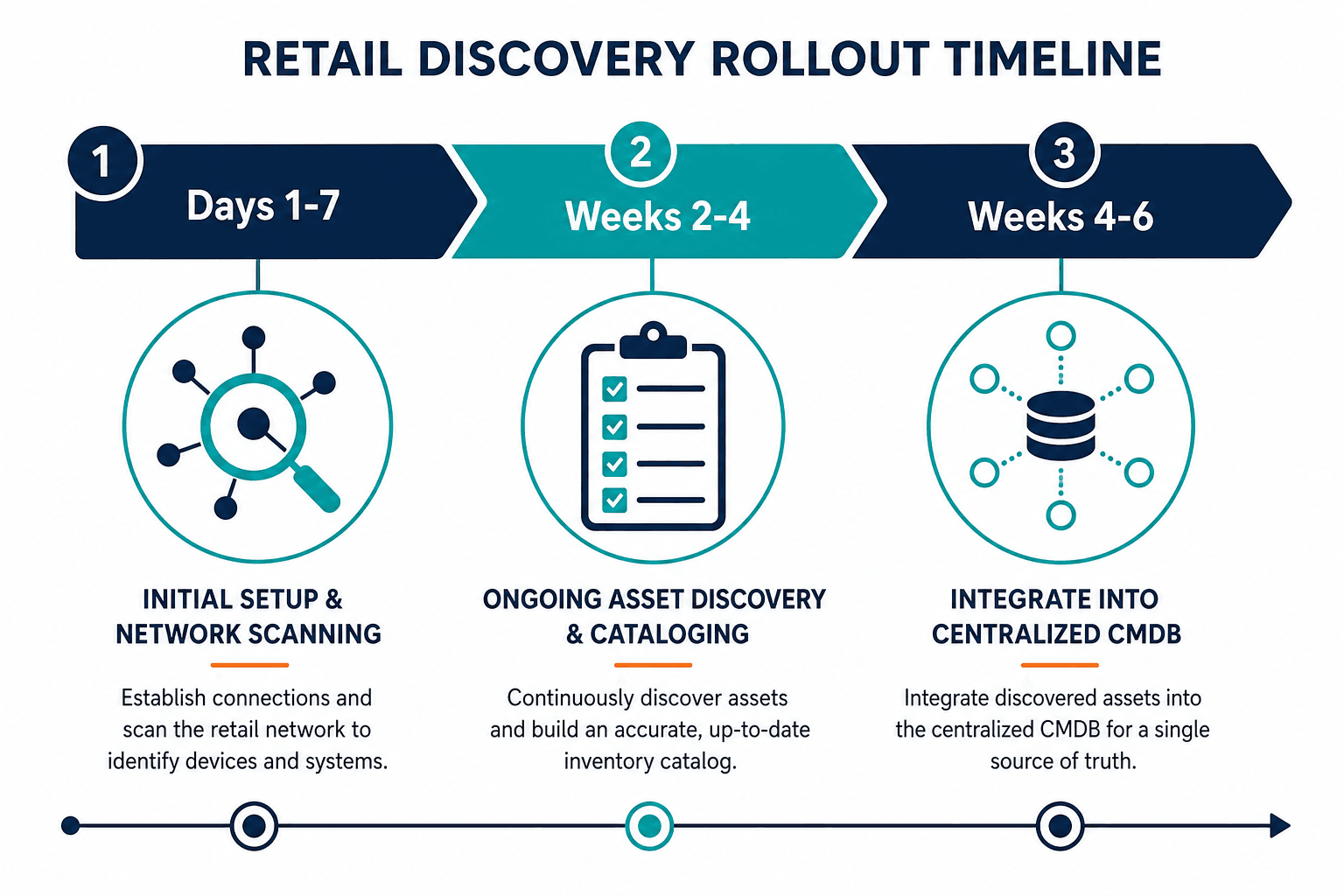
Enterprise retail implementations follow structured deployment milestones:
- Days 1 to 7: Scheduled network scans detect uncataloged hardware, unapproved cloud tools, and rogue store devices across retail locations.
- Weeks 2 to 4: Service maps establish clear dependency paths across omnichannel fulfillment applications once business service components are defined.
- Weeks 4 to 6: Pre-built connectors synchronize discovery intelligence with enterprise IT service management platforms to automate operational workflows.
Retail IT directors achieve complete multi-site visibility across previously disconnected branch networks within weeks. Support engineers troubleshoot store disruptions using live asset context rather than manual inquiry calls. Operations leaders gain dependable dependency tracking across physical and digital sales channels, while store opening teams validate technical readiness against verified configuration baselines.
Long-term compliance readiness and audit defense
Sustainable regulatory compliance requires asset records that encompass all retail locations, reflect current operating conditions, preserve detailed change trails, and refresh through consistent scheduled cycles. High-frequency scheduled discovery maintains these standards without requiring continuous manual administrative labor. When financial processors or payment auditors examine retail infrastructure, configuration records supply verifiable, timestamped proof of system controls.
Audit documentation preparation shifts from weeks of cross-departmental coordination to rapid reporting from verified data. Audit discrepancies stemming from unrecorded store devices drop significantly when infrastructure is discovered and governed systematically. Store operations avoid administrative holds because technical verification artifacts are compiled during everyday operations.
Integration with retail systems and omnichannel workflows
Virima acts as an authoritative asset intelligence layer supporting existing enterprise retail management platforms. Discovered configuration items and relationships update central CMDB systems automatically, eliminating manual data entry. Technical teams evaluate proposed infrastructure updates alongside visualized dependency maps to prevent store-level outages, while complete asset registries and change histories export directly into compliance reporting packages. ViVID™ ingests service definitions through manual entries, structured spreadsheets, or enterprise modeling tools, and builds dependency maps from the discovered network nodes automatically.
Virima enriches existing point-of-sale, warehouse, and e-commerce investments by providing verified configuration visibility across distributed retail networks.
Moving from blind spots to complete multi-location visibility
| Strategic capability | Current state (blind spots) | Target state (complete visibility) |
|---|---|---|
| Asset inventory accuracy | Manual physical audits and unlinked spreadsheets result in stale records that degrade over time. | Scheduled multi-site discovery captures hardware, software, and cloud assets on a predictable cadence. |
| Shadow IT governance | Unrecorded cloud software and store devices emerge only during security investigations or compliance audits. | Unapproved services and foreign devices surface through scheduled scans for timely security evaluation. |
| Multi-store management | Every store launch and system modification requires manual coordination by dedicated support personnel. | Standardized discovery profiles catalog infrastructure across all regional branches through centralized controls. |
| Regulatory preparedness | Teams assemble fragmented evidence across departments under imminent audit deadlines. | Defensible compliance documentation exports on demand from timestamped configuration records. |
| Omnichannel dependency tracking | Application linkages are assumed, leaving systems vulnerable to unexpected change-induced breakdowns. | Dynamic service maps illustrate active data paths, supporting change management and fast incident triage. |
Operational efficiency
Transitioning to automated discovery replaces manual inventory verification with structured exception reviews. Technical staff recover valuable time to focus on strategic omnichannel enhancements, retail security initiatives, and vendor optimization. Support personnel isolate store outages by examining contextual dependency maps rather than conducting lengthy phone interviews.
Compliance and audit defense
When external auditors or payment acquiring banks request infrastructure documentation, retail organizations export complete reports detailing hardware classifications, geographical locations, configuration histories, and management authorizations. This operational rigor helps prevent compliance non-conformances tied to unverified branch devices.
Retail operational agility
Automated discovery empowers retail brands to accelerate new store deployments using reusable network profiles. Omnichannel promotions execute over documented infrastructure dependencies, minimizing order fulfillment breakdowns. Store managers detect unauthorized tools early, preventing security exposures while ensuring physical stores support buy-online-pickup-in-store and real-time inventory promises.
Getting started in five steps
- Audit current inventory workflows. Document how your organization currently catalogs store registers, handheld scanners, warehouse infrastructure, and cloud accounts, identifying where records diverge.
- Define discovery boundaries. Establish scanning ranges across store subnets, payment gateways, fulfillment centers, and public cloud platforms, ensuring payment systems receive priority tracking.
- Configure scheduled discovery. Establish scan credentials and scheduling intervals, implementing weekly discovery cycles as a foundation before increasing frequency.
- Model omnichannel dependencies. Import business service definitions to enable ViVID™ to construct and maintain visual dependency maps across physical stores, distribution centers, and cloud backends.
- Connect operational platforms. Integrate discovered configuration items with enterprise service management platforms, triggering automated reviews whenever new cloud tools or unregistered payment devices appear.
Frequently Asked Questions
How do you discover IT assets across multiple retail store locations at once?
Virima connects to store subnets, corporate data centers, and cloud environments using secure, configurable credentials. High-frequency scheduled scans inspect distributed locations concurrently, automatically cataloging active devices, installed software, and configuration modifications without requiring manual store visits.
Does Virima help with PCI DSS compliance for our POS systems?
Virima discovers active register terminals, payment gateway controllers, and connected cardholder systems to maintain a defensible inventory. Timestamped configuration records provide verified evidence of deployed infrastructure when acquiring banks or payment card auditors conduct annual security assessments.
How do you map dependencies between e-commerce, warehouse, and store systems?
Once business service definitions are provided, ViVID™ constructs dynamic dependency maps across application layers, databases, and physical store networks. These service maps illustrate failure impact paths and update automatically as scheduled discovery scans register infrastructure modifications.
Why do manual asset tracking tools fail in multi-location retail?
Manual asset tools rely on barcode scans and spreadsheets that degrade as store equipment changes. Virima conducts automated scheduled discovery across distributed retail networks, populating configuration databases and mapping dependencies so compliance data reflects current operational reality.
How long does it take to see results from Virima multi-location discovery?
Initial discovery results appear within hours of credential configuration and network scanning. Unapproved cloud tools and unrecorded store devices surface within the first week, while complete service management integration typically operationalizes within four to six weeks.