IT Asset Audit Preparation: Close Inventory Gaps Before They Cost You

Security teams treat one unknown device as a live risk for a reason. In 2026, DHS OIG found an intelligence component could document only 11 percent of the mobile devices its enterprise asset system said it owned. That gap is the same class of failure that cost NASA about $35 million in 2023 when software inventory could not support license truth (NASA OIG IG-23-008). IT asset audit preparation is how you close that gap before an auditor, a publisher, or an attacker forces the recount. Auditors do not grade on brand prestige. If inventory cannot be defended at NASA scale, it will not be defended in your estate either.
See how discovery-sourced inventory becomes Trusted Runtime Truth you can hand an auditor.
What an IT asset audit actually checks
An IT asset audit tests whether records match reality. Auditors compare what you claim you own, run, and are entitled to use against what discovery, procurement, and lifecycle systems can prove.
They usually examine six evidence classes:
- Hardware and instances. Servers, endpoints, network gear, cloud instances, serials, location, owner, lifecycle state.
- Software installs. What is deployed where, including version and edition data that drive license metrics.
- Entitlements and contracts. Licenses purchased, metrics (user, device, core, CAL), true-up history.
- Usage and assignment. Who or what consumes each entitlement when the contract requires it.
- Process proof. How assets enter, move, and leave the estate, with owners for exceptions.
- Exit proof. Retirement, disposal, wipe, unenrollment, and billing stop, not a status field alone.
Audit labels vary. A publisher license review builds an effective license position. Internal audit samples inventory controls. Security and framework work treats inventory as a control input. Finance may tie hardware to the fixed-asset ledger. The prep work is shared across all of them: one reconciled inventory with clear lineage.
A pass is not a clean spreadsheet. A pass is an inventory you can export, explain, and defend under sampling.
What is IT asset audit preparation?
IT asset audit preparation is the work done before a formal review starts: scoping entities and asset classes, refreshing discovery, reconciling multi-source inventory into one authoritative record, assembling entitlement and lifecycle evidence, and running a dry-run export so owners can answer sampling questions without a war room.
Why prep fails
Most audit pain starts months before the notice. The inventory story is already broken.
Split systems of record. One team holds a local list. Another holds the enterprise asset system. A third holds mobile device management (MDM) or cloud billing. When those lists disagree, nobody owns the delta. The DHS finding followed that pattern: component records covered a fraction of devices the enterprise system showed as issued.
No usage versus purchase reconciliation. Installs and entitlements live in different tools. Nobody regularly compares them. Over-purchase hides as “safe.” Under-purchase hides until a publisher script runs.
Overbuy when inventory is untrusted. When leaders cannot defend install counts, some organizations buy more licenses instead of fixing discovery. That reduces short-term audit fear and raises long-term waste. The NASA OIG narrative described that dynamic around Oracle risk and weak software asset management visibility.
Ghost lifecycle. Devices sit retired in one system and active in another. Phones leave inventory but stay enrolled. Lines stay billed with no use. Disposal happens without verified wipe. Auditors treat those gaps as control failures, not paperwork nits.
None of these require malice. They require two systems, no owner on the exception queue, and no scheduled reconcile.
What weak prep costs
Cost shows up as cash, risk, or both.
NASA’s 2023 software asset management audit is the clearest public cash case. The OIG estimated about $15 million on unused licenses over roughly five years, plus more than $20 million in fines and overpayments in the same window, about $35 million combined. The report also described decentralized, ad hoc software lifecycle practices and the absence of a centralized tool to discover, inventory, and track license data as policy required.
DHS OIG’s 2026 mobile device work shows the security and operations side. An intelligence component’s inventory held 84 of 746 devices recorded in the enterprise asset system, 11 percent. Related findings included devices outside MDM control, retired devices still enrolled, and disposal without verified sanitization. The hard dollar line in that report was smaller (carrier overages), but the control message was not: unaccounted devices raise unauthorized access and data exposure risk.
| Tracking gap | What breaks | Outcome type |
|---|---|---|
| No single install inventory | License position cannot be defended | True-up, fines, forced buys (NASA-scale path) |
| Component list ≠ enterprise asset system | Ownership and sampling fail | Failed inventory control (DHS-scale path) |
| Retired still enrolled or billed | Access and spend outlive the asset | Security exposure + waste |
| Disposal without wipe proof | Exit control fails sampling | Compliance and data risk |
| Usage never matched to purchase | Silent over- or under-license | Budget burn or audit shortfall |
Private publisher settlements often stay under NDA. Public OIG cases still teach the same prep lesson: if you cannot prove what exists, you pay in money, risk, or both.
IT asset audit preparation checklist
Treat prep as a standing program, not a two-week scramble after the letter.
- Scope. Legal entities, geographies, asset classes (hardware, software, cloud, mobile), and the time window the auditor will use.
- Map systems of record. Discovery, configuration management database (CMDB) or asset database, MDM, procurement, finance fixed assets, cloud billing, carrier feeds. Name the owner of each source.
- Refresh discovery. Run agent-based and agentless coverage where each fits. Cover network, virtual machines, and cloud accounts in scope. Write down known blind spots before the auditor finds them.
- Reconcile to one authoritative record. Merge multi-source data. Open an exception queue with named owners and due dates. Do not leave conflicts as “both are true.”
- Build license position inputs. Normalize publisher and product names. Match installs and editions to entitlements under the correct metric. Flag hot vendors first (high spend, complex metrics, recent true-up history).
- Close the lifecycle loop. Issue → enroll → transfer → retire → wipe or unenroll → stop billing. Sample retired and disposed assets every cycle.
- Assemble the evidence pack. Exports, owners, change history, contracts, disposal proof, and a short RACI where two organizations share inventory duties.
- Dry-run the audit. Pick a product family and a hardware sample. Produce the pack in five business days. Fix what breaks before a third party asks.
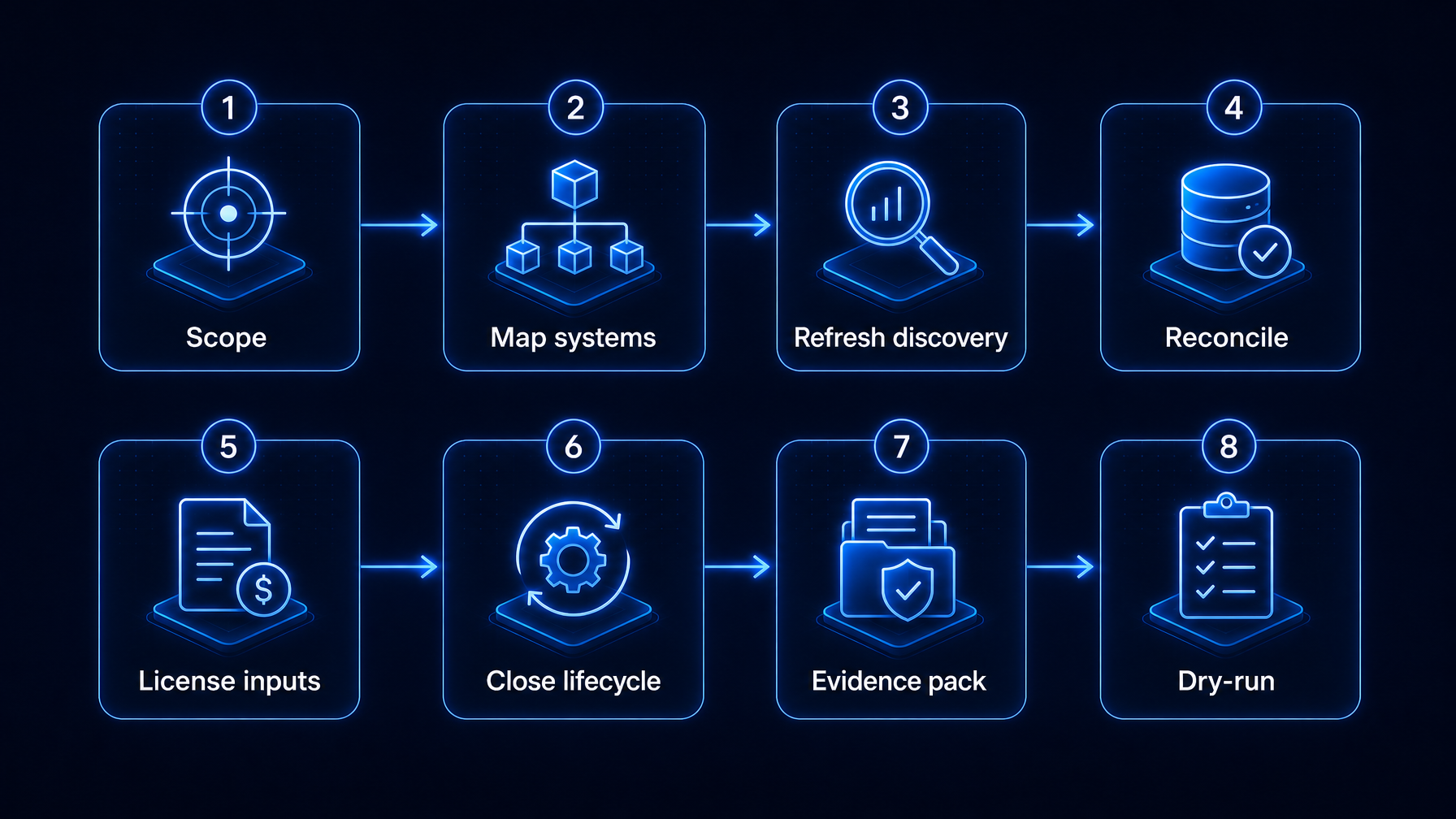
What is the minimum IT asset audit preparation checklist?
Minimum prep is eight moves: lock scope, map every system of record, refresh discovery with blind spots listed, reconcile to one authoritative inventory, match installs to entitlements, close lifecycle exits, assemble exportable evidence with owners, and dry-run a sample pack before any external notice arrives.
Evidence auditors actually ask for
Expect requests in plain formats, often CSV or tool export, with a cut-off date.
- Full inventory export: unique IDs or serials, hostname, location, owner, status, last discovery date.
- Software inventory with publisher, product, version, edition, and install count by host or user.
- Normalization notes if product names were cleaned.
- Purchase orders, contracts, and entitlement summaries for products in scope.
- MDM or management enrollment list versus active inventory (the delta is a finding magnet).
- Cloud and virtualization topology when metrics depend on cores, sockets, or clusters.
- Disposal and sanitization records for retired assets in the window.
- Change or audit-trail extracts showing who edited critical fields and when.
Good enough means a named owner can walk the lineage from purchase to install to retire in one sitting. War-room scramble means three tools disagree and legal is drafting cover language.
30 / 60 / 90 day prep plan
Days 1-30. Freeze scope for the next likely audit window. Finish the system map. Assign exception owners. Close the worst discovery blind spots on high-value segments (data center, identity-linked endpoints, top software publishers by spend).
Days 31-60. Complete a full reconcile pass. Build license inputs for the top vendors by risk. Clear zombie lifecycle cases: retired still active, active still billed, disposed without wipe proof. Publish a weekly exception aging report.
Days 61-90. Run a dry-run evidence pack for one publisher family and one hardware sample. Set a recurring discovery and reconcile cadence. Confirm ITSM or CMDB sync only moves authoritative records downstream. Brief leadership on residual risk in writing.
Do not restart the full checklist each quarter. Update deltas, re-age exceptions, and re-export the pack.
How Virima supports audit-ready inventory
Audit prep needs evidence, not another silo spreadsheet. Virima is built as a discovery-sourced inventory and configuration layer teams can reconcile, explain, and export.
| Prep need | How Virima helps |
|---|---|
| Find what exists | Agent-based and agentless discovery, network device discovery, AWS and Azure cloud asset discovery, virtual machine inventory, software inventory, OS and hardware fingerprinting |
| One authoritative record | Multi-source data reconciliation into a single CI or asset record, CMDB health scoring for completeness and staleness |
| Relationships and impact context | CI relationship mapping; service dependency maps once service definitions are provided |
| License readiness inputs | Software inventory, software normalization, license compliance reporting, end-of-life and end-of-support flags |
| Lifecycle and proof | Hardware lifecycle tracking, contract and warranty records, audit trail on record changes, custom reporting and export |
| Hand-off into ITSM | Integrations including ServiceNow, Jira Service Management, Ivanti, HaloITSM, Xurrent, and Hornbill |
Virima does not replace every publisher’s full license negotiation model on its own. It supplies the install, hardware, relationship, and lifecycle truth those positions require. Discovery runs on scheduled cycles, not passive continuous event streams. That is enough to stop the “three tools disagree” failure mode that turns a notice into a crisis.
How does discovery support IT asset audit preparation?
Discovery supplies the independent count of hardware and software that auditors sample against. Without a recent discovery baseline, entitlement files and spreadsheets cannot prove what is installed, so effective license position work and inventory control tests start from contested data instead of shared facts.
Make audit prep a standing control
One untracked asset is enough to open a security path. One unreconciled install count is enough to open a true-up path. DHS inventory splits and NASA’s software asset losses are different audits with the same root: no trusted, explainable inventory when pressure arrives.
Build the map, refresh discovery, reconcile exceptions, close exits, and keep an evidence pack ready. That is IT asset audit preparation done as operations, not theater.
Request a demo to see how Virima turns discovery-sourced inventory into audit-ready Trusted Runtime Truth.