How Virima Service Mapping Jira Service Management ITSM processes

Jira Service Management (JSM) handles incidents, changes, and service requests well. But it doesn’t include native service mapping — the ability to see how IT services, applications, and infrastructure depend on each other. That gap makes it harder to diagnose incidents, assess change risk, or track vulnerabilities across your environment.
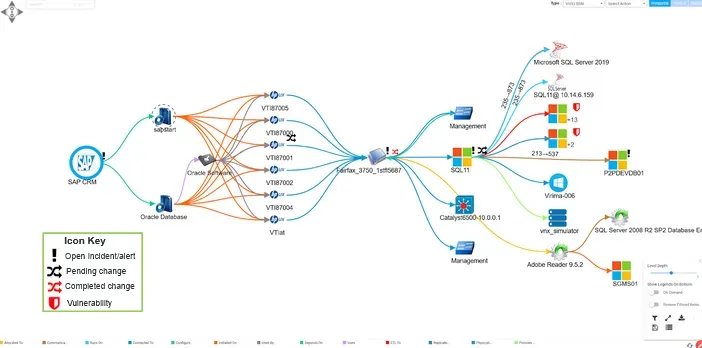
Virima fills that gap. It gives JSM customers a live, visual view of their IT environment: what connects to what, where services run, and what breaks when something changes. ViVID™ overlays display incident, change, and vulnerability data directly on the maps, turning JSM into a context-aware ITSM platform instead of just a ticketing system. Here’s how Virima brings service mapping to Jira Service Management.
What is service mapping in ITSM?
Service mapping documents every IT service and its underlying components (servers, applications, databases, network devices, cloud instances) along with the dependencies between them. The output is a visual map showing exactly how each element supports a business service.
Today’s IT environments span on-prem data centers, multiple cloud providers like AWS, Azure, and GCP, plus remote endpoints. Without service mapping, teams fall back on spreadsheets, tribal knowledge, or outdated diagrams. That slows down every ITSM process from incident response to change planning.
When both IT and non-IT stakeholders can see the same dependency chain, collaboration gets faster and finger-pointing drops off.
Why service mapping matters for JSM ITSM processes
Service mapping strengthens every core JSM ITSM process:
- IT visibility: Teams see the full infrastructure, every dependency and connection, instead of working from incomplete information. That helps them spot bottlenecks and allocate resources where they matter most.
- Faster root cause identification: When an incident hits, service maps let teams trace the affected service back through its dependency chain to the source. No more guessing or blind escalation.
- Proactive problem detection: Studying service workflows and application dependencies reveals weak points before they cause outages, rather than just reacting after something breaks.
- Accurate change impact assessment: Every infrastructure change carries risk. Service maps show exactly which services an update, migration, or decommission will affect, giving change advisory boards the context to approve confidently.
How Virima service mapping enhances JSM ITSM processes
Incident management
When an incident gets logged, the first question is always: what changed? ViVID™ overlays answer that immediately by highlighting recent changes, pending changes, and known vulnerabilities right on the service map. Responders see context before they even start diagnosing.
The maps themselves show the full dependency chain for the affected service: which servers it runs on, which databases it reads from, which APIs it calls. Instead of chasing symptoms across disconnected tools, the incident team sees everything in one view, pinpoints the root cause faster, and prioritizes response based on actual business impact.
Change management
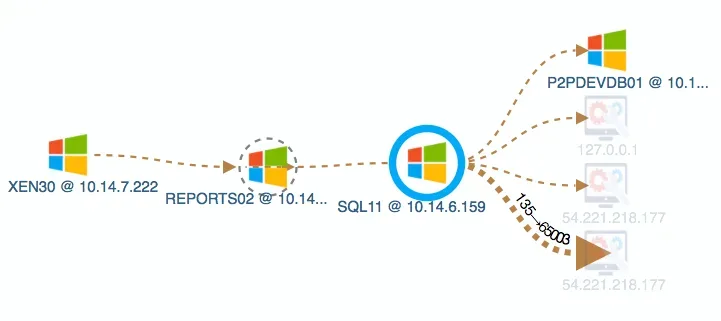
JSM’s change management workflows move fast, but only if the change advisory board can quickly assess impact. Virima’s service maps show every upstream and downstream dependency for the component being changed: where it’s installed, which server it runs on, which applications exchange data with it, and which business services depend on it.
That turns change impact assessments from guesswork into a visual exercise. Stakeholders see the blast radius of a proposed change on the map, identify who needs to be notified, and approve or reject with full context. The result: fewer failed changes and fewer unplanned outages.
Problem management
Incident management treats symptoms. Problem management finds the disease. Virima’s service maps give problem managers the visibility to trace recurring incidents back to a shared root cause.
Here’s a real scenario: three different teams report performance issues on different services. The service map reveals all three share a single overloaded database server. Without that map, each incident gets treated separately and the underlying problem keeps generating tickets.
Project management
IT projects like migrations, upgrades, and decommissions need careful planning around infrastructure dependencies. Virima’s service maps work as the planning tool: project managers see exactly which services a change will affect, build implementation plans that avoid disruption, and confirm the cutover went clean afterward.
Collaboration and communication
ITSM processes rarely stay inside one team. Incident response pulls in network, application, and infrastructure groups. Change reviews involve stakeholders across the business. Virima’s visual maps give every participant the same view of dependencies and impact, with no translation needed between teams.
ViVID™ overlays keep everyone current. When a new incident is logged, a change gets approved, or a vulnerability surfaces, the overlay updates on the map. Cross-team alignment happens from the map itself rather than through Slack threads and status meetings.
Service request management
JSM serves teams across the business (Legal, HR, Finance, Engineering) for service requests. Virima’s maps give service desk agents a clear view of which business services connect to which teams and infrastructure. When requests come in, agents can identify the affected service faster and route tickets correctly, reducing misrouted requests and speeding up fulfillment.
Vulnerability management
ITSM teams increasingly support vulnerability management and cybersecurity efforts. Service managers often understand service configurations and dependencies better than the security team. Virima’s service maps make that knowledge visible — ViVID™ overlays NVD vulnerability data directly onto the maps, showing which assets carry known vulnerabilities and how those vulnerabilities connect to business-critical services. Teams can prioritize remediation based on both vulnerability severity and the criticality of the affected service.
ViVID overlays also help during change planning. Before approving a change, the team can itsm jira service management check whether the affected components have open vulnerabilities or unresolved incidents, reducing the risk of introducing new security issues.
Virima’s integration with Jira Service Management
Virima offers out-of-the-box integration with Jira Service Management. Setup takes a few steps. Once connected, JSM customers get automated CMDB population through Virima’s discovery engine, dynamic service maps that update as infrastructure changes, and ViVID™ overlays that bring incident, change, and vulnerability context directly into their ITSM workflows.
The result: a JSM environment that makes every ITSM decision with full infrastructure context, not just ticket data.
Book a demo today to learn more about Virima service mapping integrations to Jira Service Management.
FAQ
What is the difference between service mapping and dependency mapping?
Dependency mapping focuses on technical relationships between infrastructure components which server talks to which database, which app calls which API. Service mapping goes further by tying those technical dependencies to the business services they support. For ITSM teams using JSM, service mapping is the more actionable view because it connects technical incidents directly to business impact.
Does Jira Service Management have built-in service mapping?
No. JSM includes Jira Assets for basic asset and configuration management, but there’s no automated service mapping or dependency discovery. Teams have to manually create and maintain asset relationships, a process that’s slow and loses accuracy quickly. Virima solves this with a direct JSM integration that provides automated IT discovery and dynamic service mapping. Virima’s agentless discovery populates the CMDB, and mapping a service is as simple as naming it and pointing to a starting point — Virima auto-populates the rest.
How does service mapping reduce MTTR?
Service mapping cuts mean time to resolution by eliminating diagnostic guesswork. Without a map, responders spend a significant chunk of their time figuring out what’s affected and who owns it. With Virima’s service maps in JSM, the dependency chain is already visible teams jump straight to root cause, assign the right team, and resolve faster.
What are the benefits of automated IT discovery for ITSM?
Automated IT discovery keeps service mapping reliable. Without it, CMDBs lose accuracy quickly — Virima identifies manual processes as the top reason CMDB efforts fail. Discovery scans your environment on a schedule you set and updates configuration items, relationships, and dependencies with each cycle, so every ITSM process works from current data.