How Does Asset Management Software Reduce Costs? 5 Levers

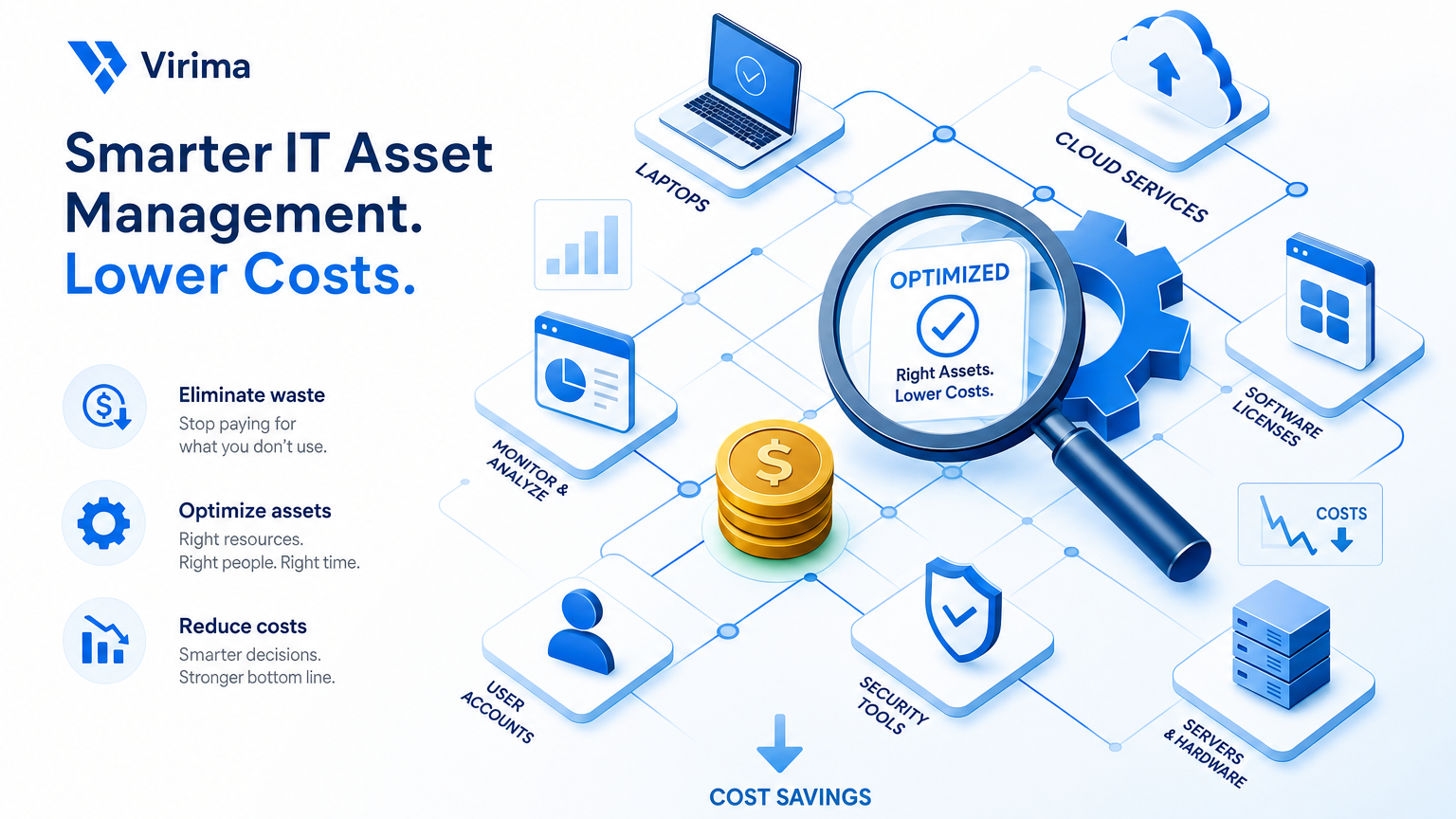
A 2,000-asset IT estate bleeds money quietly. Seats nobody opened this quarter still renew at full price, idle laptops sit in storage while a new refresh order goes out anyway, and a vendor audit lands before anyone can reconcile installs against purchases. That gap is why teams ask how asset management software reduces costs: it reconciles license entitlements with usage, redeploys idle hardware, times refreshes against warranty data, and keeps audit evidence in one record.
Flexera’s 2026 State of ITAM report shows where the money sits. Optimizing software spend is the top software asset management priority, and 43% of organizations report significant savings from license reuse.
How does asset management software reduce costs?
Asset management software reduces costs by reconciling license entitlements with installs and usage, redeploying idle hardware, planning refreshes by warranty dates, and keeping audit evidence in one record. Teams reclaim unused seats before renewal and avoid emergency purchases.
5 ways asset management software reduces costs
Each lever below follows the same pattern: a source of waste, the record that exposes it, and the action that turns it into savings.
1. Unused licenses and duplicate subscriptions
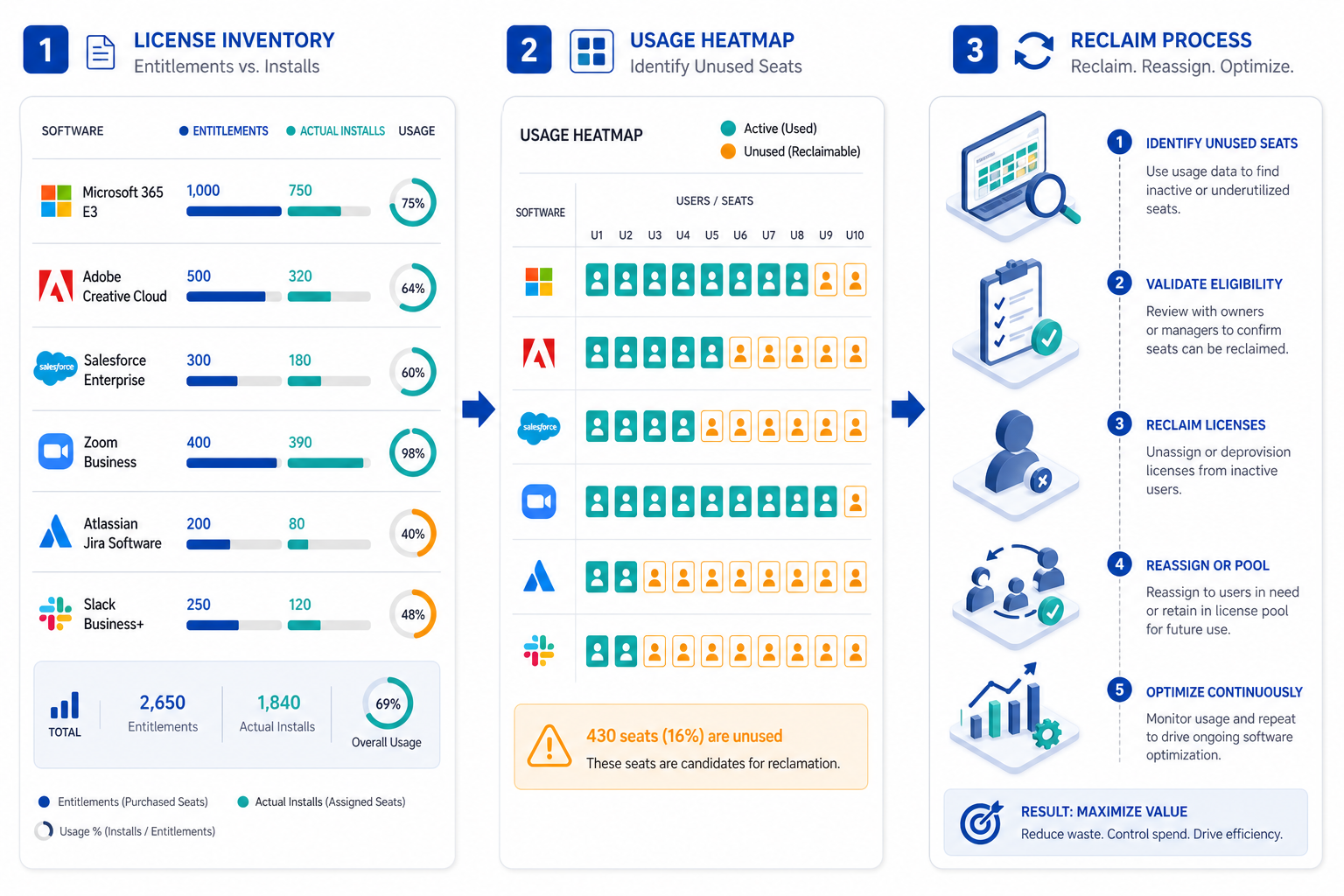
Seats that sit unopened still renew every year. Asset management software compares license entitlements with installs and usage, so the team sees which seats have gone quiet before the renewal date. Reclaiming licenses from rarely used software follows four steps: find the unused titles, notify the users, remove the software, and return the license to the pool.
Virima’s IT asset management tracks entitlements against installs down to the device and its owner, and software metering reports show actual usage. Each license key record captures the key, seat count, license type, dates, vendor, and compliance status, and links to the software it covers and the hardware it runs on. That chain shows exactly which seats to reclaim and from whom.
Duplicate subscriptions appear when several teams buy the same tool. Finding them takes a combined view of contracts, financial records, and sign-in data, and Flexera lists several SaaS discovery methods for that job. Virima’s guide to software license management covers the full process.
2. Longer hardware life
Replacing laptops on a fixed calendar retires devices that still work. Asset records with age, condition, and warranty status let teams replace on evidence, and idle devices in stock can be redeployed before anyone buys a new one.
Virima’s ITAM supports configurable lifecycle statuses such as requested, ordered, production, and decommissioned, plus automatic warranty lookup by serial number for HP, Dell, and Lenovo devices. Virima’s ITAM guide lists six lifecycle stages: request and procurement, discovery and registration, assignment and classification, maintenance and lifecycle tracking, reconciliation, and retirement and disposition. Lifecycle statuses make idle stock visible, and warranty dates show which devices approach the end of coverage.
Every redeployed laptop removes a purchase from the budget. A named owner for each device keeps these decisions moving, because someone must confirm that a device is idle before it is reassigned.
3. Fewer emergency purchases
When vendor support for a product ends, options narrow quickly. Microsoft ended support for Windows 10 on 14 October 2025. Its Extended Security Updates program costs $61 per device for Year One, and the price doubles every year for a maximum of three years.
Coverage is cumulative, so buying in Year Two also means paying for Year One. A team that counted its Windows 10 devices a year ahead could schedule refreshes inside the normal budget cycle. Teams that find those devices late may pay the premium or buy hardware at short notice.
Warranty and end-of-support dates stored in the asset record turn each deadline into a planning input.
4. Lower audit exposure
Vendor audits carry real cost. The same Flexera report found that 48% of organizations were audited in the past year, and 64% of those audited reported Microsoft audits. It also found that 44% of organizations spent more than $1 million on software vendor audits over three years. Asset management software narrows the gap between installed software and purchased licenses and keeps the usage evidence in one place.
Reconciling installs against entitlements before each renewal shows over-licensing and under-licensing while there is time to correct them. Virima’s software asset management guide describes the process in more detail.
5. Less manual effort
Spreadsheet counts take hours and age quickly. Scheduled discovery writes devices, software, and cloud resources into one inventory, so staff time goes to reviewing exceptions and acting on findings.
Virima’s IT discovery runs recurring scheduled scans, using agentless probes, a lightweight agent for Windows, macOS, and Linux, and API connectors for AWS and Azure. The reporting engine adds KPI dashboards for inventory, licensing, and financial governance. Time saved is the hardest lever to prove, so the example below values it with a stated assumption.
Platform features that drive each saving
Each lever depends on a specific feature. Use this table to check that a platform covers the lever before you count on the saving. The last column shows how Virima handles each one.
| Lever | Feature to check | How Virima handles it |
|---|---|---|
| Unused licenses | License entitlements compared with installs and usage | Entitlements are tracked against installs down to the device and owner, and software metering reports help reclaim underutilized licenses. |
| Longer hardware life | Lifecycle statuses and warranty data | Configurable statuses cover requested, ordered, production, and decommissioned, with automatic warranty lookup by serial number for HP, Dell, and Lenovo. |
| Fewer emergency purchases | Warranty and end-of-support dates in the asset record | The ITAM page lists assets that are out of warranty, out of support, and due for renewal. |
| Lower audit exposure | Installs reconciled with entitlements, plus reporting | Each license key record carries a compliance status, and the reporting engine produces KPI dashboards. |
| Less manual effort | Scheduled discovery across hardware, software, and cloud | Recurring scheduled scans run with agentless probes, a lightweight agent, and AWS and Azure connectors. |
Savings only hold when the underlying record stays current, because stale data sends each of these levers back to guesswork. That record is the discovery-sourced inventory that feeds every table and renewal decision in this guide.
See which installs do not match your entitlements before your next vendor audit.
Where software waste is growing fastest
Knowing where waste is rising tells you which contracts to review first. Flexera’s 2026 survey asked organizations whether wasted spend increased over the past year, by software category:
- AI software: 59% of organizations reported an increase.
- Public cloud software: 44% reported an increase.
- SaaS: 43% of organizations reported an increase.
- IaaS and PaaS: 41% reported an increase.
- Data center software: 25% reported an increase.
- Desktop software: 23% reported an increase.
The same report found that nearly one-third of total ITAM time goes to software optimization, and that negotiating SaaS contract terms rose 14 percentage points compared with 2025. Usage data from the asset record supports those negotiations, because a renewal quote can be checked against how many seats people actually use. Start the review with the categories where waste is rising, and the renewal date is closest.
Worked ROI example: 500 laptops and 2,000 assets
This IT asset management ROI example follows one company with 500 laptops and 2,000 assets in total. Every input is an assumption, so replace each one with your own prices and counts before sharing the result.
| Lever | Assumptions | Year-one result |
|---|---|---|
| Idle laptops redeployed (cost avoidance) | 5% of 500 laptops sit idle, which is 25 devices at $1,200 each | $30,000 once |
| Hardware refresh deferred (cost avoidance) | 500 laptops on a 3-year cycle means about 167 refreshes a year; extending 10% by a year defers 17 devices at $1,200 | $20,400 once |
| Windows 10 support premium avoided (cost avoidance) | 50 devices refreshed on plan, which avoids Extended Security Updates through Year Two at $183 each ($61 plus $122) | $9,150 |
| Unused software seats (cash saving) | 600 seats at $20 a month is $240 a seat a year; 12% unused is 72 seats | $17,280 a year |
| Duplicate subscriptions canceled (cash saving) | 3 duplicates at $5,000 a year each | $15,000 a year |
| Staff time on manual counts (cash saving) | 120 hours a year at $60 an hour | $7,200 a year |
| Total benefit | Cash savings of $39,480 plus cost avoidance of $59,550 | $99,030 |
| First-year cost | Assumed platform cost of $5,000 a year plus 40 hours of implementation at $75 an hour | $8,000 |
Net benefit equals total benefit minus first-year cost, which gives $91,030 in this example. Cash savings and cost avoidance stay separate in the table because finance teams treat them differently. Cash savings reduce a budget line directly. Cost avoidance prevents a purchase that was planned or likely, and most of it happens once.
The total leaves out audit penalties, because any figure would be speculative. Virima’s Business Pro plan is sized for environments around this scale; confirm current asset limits and pricing with your Virima contact before using them in a business case, and use your own quote for the platform line.
Mistakes that overstate savings
A business case loses credibility when one inflated line is found. Six errors appear often in savings calculations:
- Budget confusion: treating a purchase that was avoided as a reduction in the budget.
- Double counting: counting one reclaimed seat under both license savings and audit exposure.
- Yearly repetition: repeating a one-time redeployment saving in every year of the forecast.
- List prices: valuing licenses and devices at list price when the contract price is lower.
- Incomplete costs: leaving implementation time and training out of the first-year cost.
- Unrecorded baseline: claiming a reduction when the starting point was never written down.
Each error has the same fix. Tie every line to a recorded count and a price that finance has approved.
Metrics to track: unused seats and shelfware rate
Savings only count if they can be measured. Record each metric before go-live to create a baseline, then review it every quarter against that baseline.
| Metric | Definition | What it shows |
|---|---|---|
| Unused seats | Licensed seats with no use in a set period, such as 90 days | Seats to reclaim before renewal |
| Shelfware rate | Unused licenses divided by licenses owned, by publisher | Share of license spend with no user |
| Idle device count | Devices in stock or assigned with no recent activity | Hardware to redeploy before a purchase |
| Assets without an owner | Records with no named owner | Where reclaiming and retirement stall |
| Devices near end of warranty or support | Count by model and date | Refreshes to plan and budget |
| Hours to answer an audit request | Time from request to a finished evidence pack | Manual effort saved over time |
Shelfware means licenses held by people who never or rarely use a title. The threshold for rarely is a team choice, so write it down and apply it the same way every quarter. Shelfware rate by publisher also shows which renewals deserve the most attention. Virima’s reporting engine provides KPI dashboards for inventory, licensing, and financial governance, which gives finance a shared view of the same numbers. For a broader set of year-over-year benchmarks beyond these six metrics, see Virima’s roundup of IT asset management statistics.
Expected payback timeline
The ITAM payback period in months equals first-year cost divided by monthly recurring cash savings. Using the example above, cash savings run at $39,480 a year, or $3,290 a month. At that full rate, an $8,000 first-year cost pays back in about 2.4 months.
A conservative case assumes that only half of the cash savings arrive in year one. That gives $19,740 a year, or $1,645 a month, and payback takes about 4.9 months. Cost avoidance adds to the benefit on top of both figures.
Timing depends on the order in which savings land. A practical sequence looks like this:
- Baseline and first scan: run discovery, load the license entitlements, and record the metrics above.
- First reclamation list: identify seats and devices that sat idle for a set period, and assign an owner to each decision.
- Renewal calendar: software savings arrive at renewal dates, so right-size each contract before it renews.
- Quarterly review: compare the metrics with the baseline and report cash savings and cost avoidance separately.
Your renewal calendar sets the pace more than any other factor, so start with the contracts that renew soonest.
If the first quarterly review shows lower savings than planned, check three things. First, confirm that reclaimed seats were removed from the contract as well as from user accounts. Second, confirm that redeployed devices came out of the purchasing plan. Third, confirm that each decision has a named owner and a date. A gap in any of those three areas can explain a shortfall against the forecast.
How do teams prove asset management ROI to finance?
Teams prove asset management ROI by recording a baseline before go-live, separating cash savings from cost avoidance, and pricing every line with finance-approved purchase prices. Quarterly reviews compare unused seats, idle devices, and audit response time against that baseline.
How to build the business case for leadership
A business case lands when every number traces to a source leadership already trusts. Six steps keep the business case defensible:
- Count first: record licenses owned, seats in use, devices in stock, and devices near end of warranty.
- Price each lever: use finance’s own purchase prices and contract values for every line.
- Separate the types: report cash savings and cost avoidance in different columns.
- Show a range: present a conservative case and a full run-rate case side by side.
- Name owners: assign a person to each reclamation, renewal, and refresh decision.
- Set a review date: compare results with the baseline every quarter and report the difference.
Leaders respond to a short table with stated assumptions more than to a single large percentage. A range with its inputs visible invites questions that the team can answer, and answered questions build the trust that keeps the program funded.
Bring your renewal calendar and idle device list. We will rebuild this savings example with your numbers.
The fastest IT asset management cost savings come from the lever closest to your next renewal date, not the biggest number on the page. Virima’s IT asset management ties entitlements, installs, and warranty data to a named owner, so reclaiming a seat or redeploying a laptop is a two-minute decision instead of a spreadsheet hunt — a practical answer to how asset management software reduces costs once the record stays current.
Frequently asked questions
How much money can IT asset management save?
Savings depend on your starting point: how many licenses sit unused, how many devices sit idle, and how often purchases are rushed. Flexera’s 2026 report found that license reuse produces significant savings for 43% of organizations.
What is license harvesting in IT asset management?
License harvesting, also called software license reclamation, means reclaiming licenses from people who rarely or never use a software title and returning them to the pool. The reclaimed license covers the next request or lowers the next renewal.
Does ITAM reduce hardware spend over the asset lifecycle?
Yes, through three actions: redeploying idle devices, planning refreshes by age and warranty status, and scheduling replacements before support ends. Each action removes a purchase or moves it into a planned budget cycle.
How do we prove ITAM ROI to the CFO?
Record a baseline before go-live, separate cash savings from cost avoidance, and use finance’s own prices for hardware and licenses. Review the metrics each quarter against the baseline and report the net benefit with its assumptions.
Can asset management software prevent software audit penalties?
Asset management software narrows the gap between installed software and purchased licenses and keeps usage evidence in one place. Reconciling before each renewal lets teams correct gaps early, though the audit outcome depends on the vendor contract terms.