Drive efficiency with Virima’s IT operations management services

Virima’s IT operations management services bring discovery, CMDB, ITAM, and ViVID™ service mapping together in one platform. The result is sharper visibility, faster incident response, and IT operations that stay ahead of risk instead of reacting to it.
What IT Operations Management Services Actually Do
IT operations management (ITOM) is a framework that keeps IT infrastructure stable, observable, and aligned with business goals. It covers the tools and processes your team uses to manage, monitor, and optimize IT resources, so you prevent downtime instead of just responding to it.
An effective ITOM strategy combines asset visibility, discovery-driven workflows, and current monitoring. For a closer look at the foundational components, Virima’s guide to key components of an IT operations management framework covers how each one works in practice.
Key components of IT operations management services include:
IT Asset Discovery and Tracking
ITOM uses high-frequency discovery cycles to find and track all IT assets. This builds an up-to-date inventory of hardware, software, and cloud resources. With this visibility, IT teams allocate resources efficiently and manage costs without guesswork.
Configuration Management
ITOM maintains a configuration management database (CMDB) that documents IT components and their relationships. Every asset, on-premises or in the cloud, is identified and documented so your team works from an accurate, discovery-sourced record.
Service Mapping and Monitoring
IT operations management services map services to their underlying infrastructure. This provides current visibility into dependencies and performance. Monitoring helps IT teams detect issues early, which prevents disruptions before they affect users.
Risk Management
ITOM tools run high-frequency discovery cycles across IT assets, detecting misconfigurations, outdated software, and unauthorized changes. Organizations reduce threats and maintain business continuity by assessing risks and applying targeted security measures.
What are IT operations management services?: IT operations management services (ITOM) are tools and processes that manage, monitor, and optimize IT infrastructure. They cover asset discovery, CMDB maintenance, service mapping, and compliance monitoring. Together, they keep IT systems stable, visible, and aligned with business goals.
Common IT Operations Management Challenges
Most organizations run into the same roadblocks when managing IT operations. Understanding them is the first step to solving them.
Siloed IT Systems
Fragmented IT tools, such as ITSM, ITAM, and security platforms, often work independently. This lack of integration makes it hard to share data across teams, which creates blind spots and slows down issue resolution.
Manual IT Processes
Outdated manual workflows hold IT teams back. Without discovery-driven processes, teams deal with slow response times, more human errors, and limited scale. Manual work creates inconsistencies in incident management, asset tracking, and service delivery.
As enterprises adopt agentic AI to handle routine decisions, teams still running manual workflows fall further behind on speed, accuracy, and reliability.
Lack of Visibility
Limited insight into IT dependencies makes it harder to monitor service health and identify risks early. Poor visibility complicates troubleshooting, which increases downtime and disrupts business continuity.
Change Management Risks
Poor impact analysis leads to unplanned disruptions. Without understanding how changes affect connected systems, organizations face unexpected outages, service delays, and higher operational risk.
Compliance and Security Gaps
Governance, risk, and compliance (GRC) requirements shift constantly. Poor IT operations management can expose vulnerabilities, trigger non-compliance findings, and reduce control over assets and policies.
Addressing these challenges improves efficiency, reliability, and cost control. Virima’s ITOM platform is built to tackle each one directly. For a deeper look at how ITOM compares to ITSM and where they overlap, the ITOM vs. ITSM guide walks through both frameworks side by side.
What are the biggest IT operations management challenges?: Common challenges include siloed systems, manual workflows, limited visibility into IT dependencies, poor change impact analysis, and compliance gaps. Solving them requires discovery-sourced asset data, integrated CMDB records, and service dependency mapping that keeps pace with your environment.
Virima IT Operations Management Services: Core Features
Virima ITOM addresses these challenges with high-frequency discovery cycles, current monitoring, and intelligent insight that improves IT visibility and control. See the full Virima ITOM platform for the complete feature set.
1. ViVID™ Service Mapping
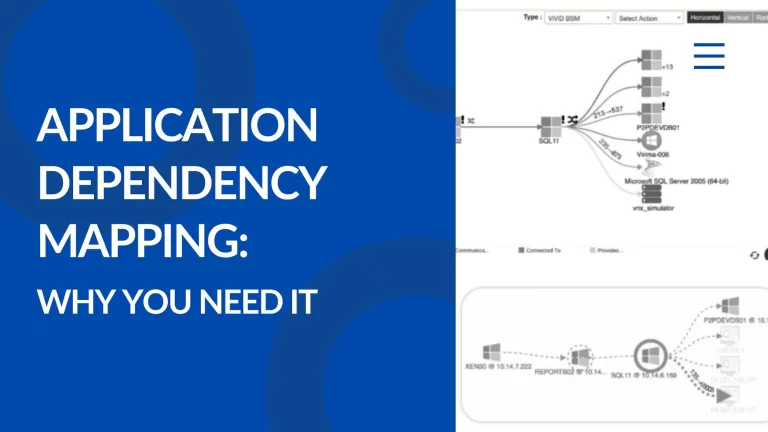
ViVID™ gives your team a current, interactive view of IT infrastructure and services. Once you define service components, ViVID™ builds dynamic dependency maps that reflect infrastructure relationships across servers, network devices, and endpoints.
These maps show:
- Application dependencies that reveal how software components interact.
- Host-to-host communication flows and traffic bottlenecks.
- Service impact when an incident or change occurs.
Teams use these visualized maps to assess service impact, analyze blast radius, and troubleshoot outages faster. Learn more about how ViVID™ service mapping works across complex environments.
2. Advanced IT Asset Discovery
Virima’s discovery engine runs high-frequency discovery cycles across your IT environment. Every asset, on-premises or in the cloud, is identified and documented without manual data entry.
- Agentless and agent-based scanning options provide deployment flexibility.
- Cloud discovery integrations with AWS and Azure ensure visibility into cloud assets.
- Configurable scan parameters let you focus on specific subnets or device types.
This is where Trusted Runtime Truth begins: discovery-sourced data that reflects your environment as it actually exists, not as a spreadsheet last updated six months ago.
Want to understand how discovery-sourced data powers every ITOM decision? Explore Trusted Runtime Truth at Virima to see how Virima keeps your IT environment accurate, explainable, and ready for agentic IT.
3. Configuration Management Database (CMDB)
Virima’s CMDB tracks the full picture of your IT environment:
- Hardware and software configurations across data centers, cloud, and IoT environments.
- Configuration item (CI) relationships that link assets to the services they support.
- Historical audit data so your team can trace every change over time.
Virima also ensures ITIL-compliant Service Asset and Configuration Management (SACM), which helps teams maintain accurate, discovery-sourced CI records. For context on how the CMDB connects ITSM and ITOM workflows, see Your CMDB: Your ITSM-ITOM Connection.
4. Dynamic Dashboards and Reporting
Virima provides customizable dashboards that deliver current insight into IT operations:
- Asset tracking based on location, configuration, and software inventory.
- Service impact analysis using ViVID™ service maps.
- Compliance reporting to support audits and governance requirements.
5. Flexible API Integrations
Virima’s IT operations management services connect to a wide range of IT management tools, including:
- ITSM platforms such as ServiceNow, Ivanti, Halo, Jira Service Management, and Xurrent.
- Security and vulnerability management solutions.
- Event and system monitoring tools that synchronize alerts and logs.
By connecting to these systems, Virima gives your team a full view of IT operations from a single source of truth. For more on the ServiceNow integration specifically, see how Virima enhances ITOM modules in ServiceNow.
How does Virima support IT operations management?: Virima supports IT operations management through high-frequency IT asset discovery, a discovery-sourced CMDB, ViVID™ service mapping, and flexible ITSM integrations. These capabilities work together to improve asset visibility, speed up incident response, and reduce compliance risk across on-premises and cloud environments.
Benefits of Virima IT Operations Management Services
1. Better IT Stability and Change Management
Planned changes can trigger unexpected disruptions. Virima reduces this risk through current dependency mapping, stakeholder identification before a change window opens, and historical change tracking that helps managers prevent recurring issues.
Before a change, your team has the full blast radius in view. Every CI in scope is visible, so there are no surprises during the maintenance window.
2. Faster Incident Response and Less Downtime
When IT issues occur, Virima accelerates troubleshooting through ViVID™-powered root cause analysis, service dependency data that helps teams anticipate cascading failures, and incident tracking integration that ensures every issue is logged and resolved.
Reducing MTTR means restoring services faster and avoiding disruptions that cost the business. For more on how Virima applies this in practice, see the guide on IT operations management functions.
3. Optimized Asset and Compliance Management
Accurate IT asset inventory is foundational for security and compliance. Virima’s IT operations management services provide discovery-driven tracking of software licenses, which reduces non-compliance risk. Certificate expiration monitoring prevents security gaps from outdated SSL/TLS certificates.
4. Scalability for Growing IT Environments
Whether you manage a small IT setup or a large enterprise, Virima scales with your needs. Cloud and hybrid IT compatibility ensures visibility across all environments. A modular approach makes it straightforward to expand capabilities as your IT environment grows.
What are the benefits of Virima IT operations management services?: Virima ITOM improves IT stability through discovery-sourced CMDB data, speeds up incident response with ViVID™ dependency maps, reduces compliance risk through discovery-driven asset tracking, and scales across on-premises and cloud environments. Teams gain a single, trusted view of their entire IT landscape.
How IT Ops Teams Use Virima Day to Day
Virima’s ITOM capabilities fit into the workflows your team already runs:
- Before a change: check the ViVID™ service map to identify which CIs are in scope and who owns them.
- During an incident: use dependency data to trace the root cause instead of checking each component manually.
- At audit time: pull discovery-sourced CMDB records and compliance reports directly from Virima dashboards.
- After an outage: review historical change data to identify what triggered the disruption and prevent recurrence.
For organizations running unified IT operations management, Virima ties discovery, CMDB, service mapping, and ITSM integrations into a single operational layer.
How does Virima improve incident response?: Virima improves incident response by giving IT teams ViVID™ service maps that show dependencies in context. When an incident occurs, teams trace the root cause using current dependency data instead of checking components manually. This shortens mean time to resolution (MTTR) and reduces the risk of cascading failures.
Frequently Asked Questions
What is the difference between ITOM and ITSM?
ITOM manages the infrastructure, such as servers, networks, and cloud resources. ITSM manages the services running on that infrastructure. Both need accurate, discovery-sourced CMDB data to work well together. The ITOM vs. ITSM guide walks through how they align and where they differ.
Does Virima support cloud environments?
Yes. Virima’s discovery integrations cover AWS and Azure through API-based discovery, giving you asset visibility across on-premises and cloud environments from a single CMDB.
How does Virima help with change management?
Virima uses ViVID™ service maps and CMDB dependency data to show the potential impact of a change before it happens. IT teams can identify affected CIs, notify stakeholders, and reduce the risk of unplanned disruptions during change windows.
How does Virima keep CMDB data current?
Virima runs high-frequency discovery cycles that refresh CMDB records without manual data entry. This keeps CI data discovery-sourced and accurate, so your team is working from trusted information when it matters most.
What ITSM platforms does Virima integrate with?
Virima integrates with ServiceNow, Ivanti, Halo, Jira Service Management, and Xurrent, with bidirectional data sync to keep CMDB and ITSM records aligned.
Turn IT Operations Into a Strategic Advantage
Virima’s IT operations management services give your team the asset visibility, dependency context, and CMDB accuracy to move faster and resolve issues before they escalate. Discovery-sourced data, ViVID™ service maps, and flexible ITSM integrations form a foundation for stable, well-governed IT operations.
Ready to see it in action?
Schedule a demo today. Request your Virima demo and walk through how discovery-sourced ITOM works in your specific environment.