Reclaimable Software Spend: Which Savings You Can Defend, and Which You Can’t

A software savings figure can disappear from the forecast when procurement cannot substantiate the proposed reduction. An installation count may identify candidates, but finance still needs usage evidence, contract rights, and an owner who accepts the change.
The financial stakes are visible in a federal example. In a March 2026 statement, the U.S. Government Accountability Office reported that the Department of Veterans Affairs had previously reported approximately $65 million in savings over three years from analyzing one software license.
Separately, GAO found that VA had not regularly compared licenses in use with purchase records. In its May 2025 testimony, GAO also said VA did not provide documentation supporting certain reported usage and purchasing analyses. Those findings do not establish that the earlier savings were unsupported.
The distinction matters for commercial organizations too. A reclaimable software spend estimate needs evidence that supports the specific amount and the period in which a reduction is available.
Can You Defend Reclaimable Spend and Audit Posture With Discovery Data?
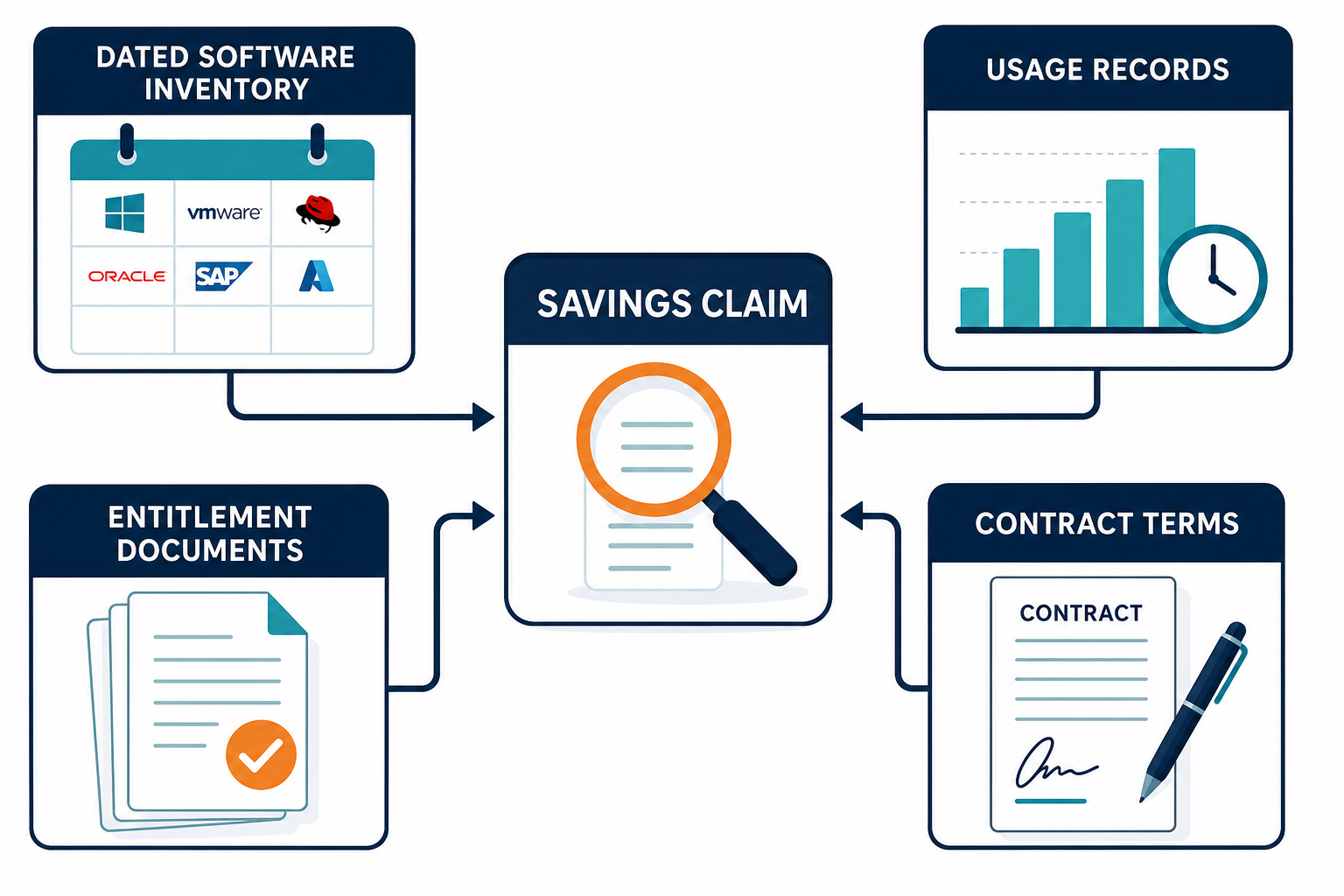
Discovery data supports part of the case. A dated inventory can show installations found within the discovery scope. Usage records can add evidence about activity, when the appropriate metering is available.
Purchase records and contract terms establish different facts: what the organization owns, how the license is counted, and when commitments can change. An ITAM owner then reconciles those records, while procurement and finance review the proposed action.
The strongest claim connects those sources to a named decision owner. Any missing coverage or unresolved contract term remains visible in the estimate.
What Makes a Savings Claim Defensible
A defensible claim identifies the software, the relevant population, and the date of the evidence. It also connects the proposed reduction to an entitlement and a contract provision.
Five details give reviewers a starting point:
- A defined scope: Identify the product, edition, contract, entities, and devices or users included.
- Dated observations: Record when inventory and usage evidence were collected, including known coverage gaps.
- A matched entitlement: Compare the evidence with the contract’s applicable license metric.
- An available action: Confirm the reduction right, deadline, notice requirement, and price effect.
- An accountable owner: Name the person responsible for validating the operational change and its financial treatment.
The evidence should also withstand the intended review. Under PCAOB AS 1105.10, auditors using company-produced information evaluate its accuracy and completeness, along with its precision for the audit. The standard applies to relevant financial statement audits; a software publisher may request different evidence.
| Reviewer | What they may test | Evidence to prepare |
|---|---|---|
| Software vendor | Contract metric, deployment scope, and applicable reporting requirements | Entitlement records, contract terms, and required deployment reports |
| Budget owner | Whether the proposed reduction is operationally acceptable | Usage evidence, affected users or devices, and business-owner confirmation |
| Finance or internal audit | How the amount was calculated and whether supporting data is reliable | Dated source records, assumptions, calculation, approvals, and known exclusions |
Acceptance depends on the contract, the review, and the evidence provided. Confirm each reviewer’s requirements before treating a report as sufficient proof.
Where Reclaim Estimates Lose Their Footing
Three common gaps can change the amount procurement can defend.
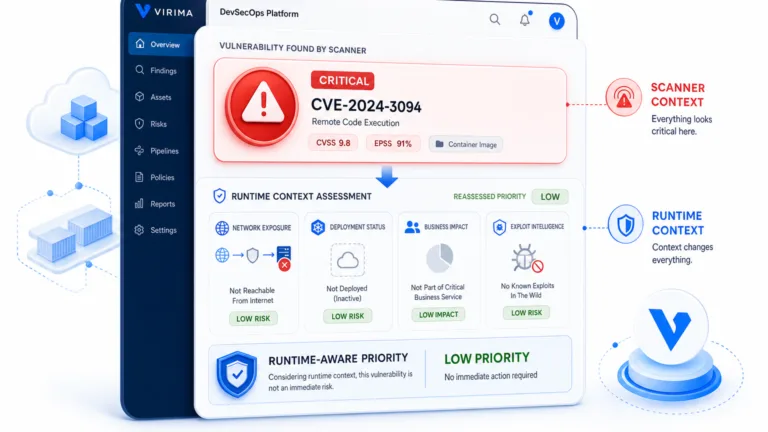
- Last-seen is treated as non-use. A laptop may be outside the discovery scope, offline, or awaiting its next successful collection. A last-seen date describes an observation, not the user’s activity after that date. Result: The proposed reclaim remains uncertain until usage and device status are checked.
- Installations are matched to the wrong metric. A contract may count named users, devices, processor capacity, or another measure. An installation total alone cannot establish the licensed quantity under every metric. Result: The apparent surplus may shrink or disappear after the correct contract calculation.
- Savings are counted before the contract allows a reduction. An unused assignment may be available for reassignment. The agreement may still require payment until its anniversary or another permitted change date. Result: The operational opportunity and the forecasted reduction may fall in different periods.
The installation source and entitlement record each need separate review before the quantities are compared.
What an Unsupported Number Costs Each Reader
For a CFO, an unverified reduction can weaken the forecast. If the assumed change cannot be exercised this period, finance may need to revise the expense outlook. The original estimate may also obscure a separate exposure that needs attention.
For a CPO, weak evidence can limit negotiating leverage. A vendor may ask which products, users, or devices support the requested reduction. Procurement needs an answer that aligns with the agreement and can be checked against its records.
For the IT leader, the immediate cost is rework. Teams may need to revisit discovery coverage, confirm ownership, and reconcile duplicate records under a deadline. A user may also lose access if a license is removed before business need is confirmed.
The risk is different for each reader, but the remedy starts with the same evidence trail. Show which facts are established, who checked them, and which assumptions remain open.
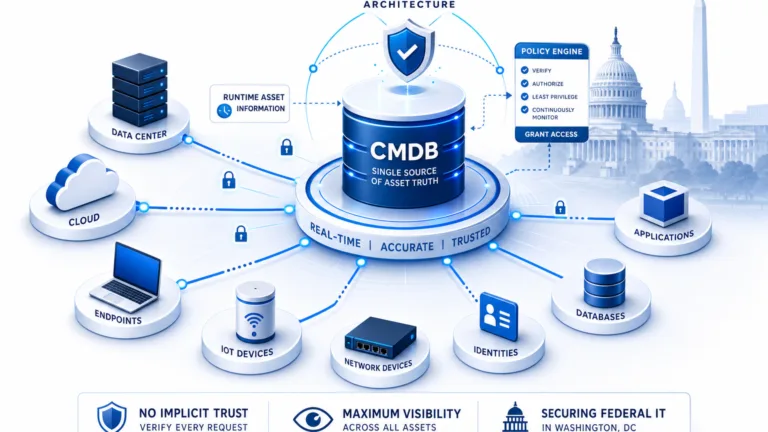
A dated discovery record can contribute to Trusted Runtime Truth: an understanding of what exists, how it connects, what changed, what could break, and who owns it. Contract and financial records remain necessary to evaluate the proposed savings.
How to Grade a Reclaim Claim Before It Reaches the Forecast
Use three tests before a proposed amount reaches finance: dated, matched, and owned.
- Dated means the evidence has a collection date and a known scope. Note failed scans, excluded networks, and devices that have not reported recently. A recent date alone does not establish complete coverage.
- Matched means the installation or usage evidence corresponds to the correct product and license metric. The entitlement record should include relevant purchases, amendments, and assigned rights. Procurement should confirm the change window and any minimum commitment.
- Owned means someone can explain the calculation and authorize the operational action. ITAM may validate the inventory, while the budget owner confirms the business need. Procurement checks the contract, and finance decides the forecast and accounting treatment.
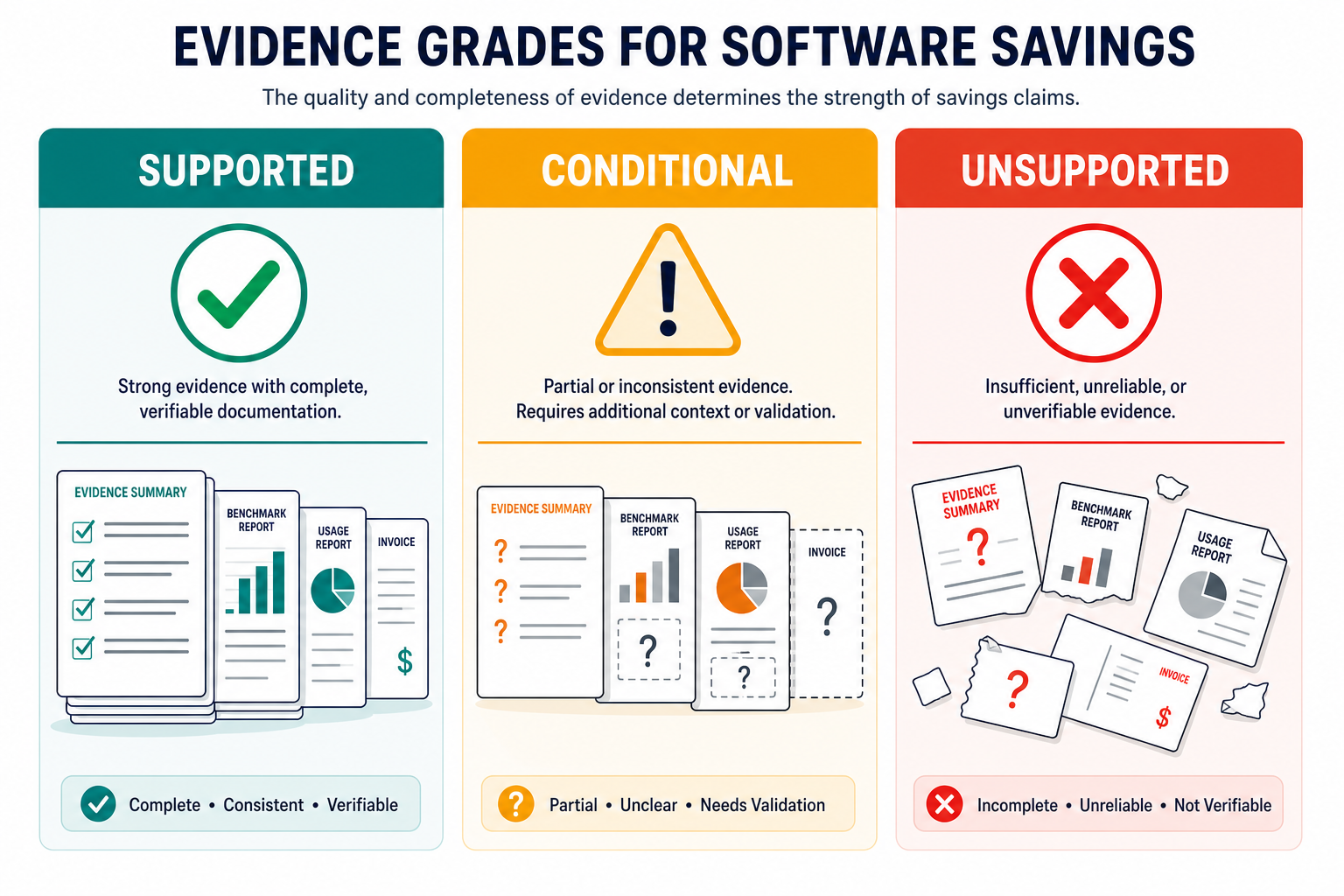
| Grade | Evidence condition | Forecast treatment to consider |
|---|---|---|
| A: Supported | Evidence is dated, matched to the correct metric, contract rights are confirmed, and owners approve the action. | Submit the amount and effective period to finance for forecast approval. |
| B: Conditional | The opportunity is plausible, but a defined gap remains, such as incomplete device coverage or an unconfirmed reduction right. | Show a range or conditional scenario, with assumptions and an owner for the outstanding work. |
| C: Unsupported | The calculation lacks reliable scope, entitlement matching, contract terms, or an accountable owner. | Exclude the amount from the forecast until the evidence is sufficient. |
An A grade supports a forecast discussion; it does not itself authorize an accounting entry. Finance determines recognition under the organization’s policies and applicable accounting requirements.
Audit posture also needs a range when the population is incomplete. Report the confirmed exposure supported by reconciled records, then describe possible additional exposure associated with missing or uncertain data.
For example, an ITAM team may confirm a gap for a known device population while a separate group of laptops has not reported recently. The second group needs its own estimate and assumptions. If there is no reasonable basis to quantify it, state that the potential additional exposure is unquantified.
Record what would narrow the range: successful collection from missing devices, validated entitlement records, or a vendor-approved metric calculation. Assign each outstanding item to an owner and retain the date of the next review.
Reclaimable Spend and Audit Posture Examples
The following examples are illustrative. Contract terms, evidence requirements, and accounting treatment vary.
- Unused desktop seats: Usage records identify several candidates before renewal. The application owner confirms access needs, and procurement checks whether the contract permits a lower quantity.
- An off-network laptop: The device has an old last-seen date. Its assigned license remains a candidate for review until the device and user’s activity are checked.
- An anniversary reduction: A contract permits a quantity reduction only at its anniversary. Finance evaluates the impact in the eligible period, after procurement confirms notice requirements.
- IBM sub-capacity: An inventory shows installations on virtualized servers. IBM’s sub-capacity requirements call for its License Metric Tool, or another approved validated tool for applicable deployments. Check the agreement and eligible environment before relying on a capacity calculation.
What Virima Supplies, and What Finance Still Signs Off
Virima’s scheduled discovery cycles collect hardware and software inventory within the configured scope. The resulting records give ITAM teams a basis for reviewing installations and investigating gaps.
Virima ITAM tracks software licenses against installations and supports records for devices and their owners. Teams still need to maintain entitlement information and check that the comparison matches the agreement’s counting rules.
Virima also offers software usage metering through its Windows Discovery Agent. Metering coverage depends on deployment and configuration, so a team should confirm which devices and applications contributed evidence before concluding.
Discovery can help identify the software and devices involved in a claim. Procurement supplies and interprets the contract terms, including the applicable reduction window. The business owner confirms whether a proposed change meets operational needs.
Finance then reviews the calculation, period, and accounting treatment. An inventory report can support that review, but it cannot establish a contract right or make the decision for the organization.
For the wider contract process, procurement needs to assemble asset evidence before making a renewal decision.
A Five-Step Way to Put a Defensible Number in the Forecast
Start with a manageable group of renewals where a reduction could affect the forecast. For each one, work through the evidence in sequence.
1. Select the contracts for review. Identify the products, agreement dates, spending commitments, and people responsible for each renewal. Keep separate contracts separate when their terms differ.
2. Collect dated inventory and usage evidence. Record the discovery scope, collection dates, and known failures. Obtain usage evidence where available, and identify devices or users outside its coverage.
3. Match the evidence to entitlements. Reconcile product names and editions against purchase records. Apply the contract’s counting metric before calculating a surplus or shortfall.
4. Confirm the reduction right. Procurement checks notice deadlines, minimum quantities, pricing, and the effective date. The application owner confirms that the proposed reduction will meet business needs.
5. Grade the claim and record ownership. Assign an evidence grade, document assumptions, and name the owner of unresolved questions. Finance can then decide whether to include the amount, show a range, or leave it outside the forecast.
Keep the calculation with the records used to produce it. If an entitlement changes or missing devices report later, the owner can update the claim without rebuilding its history.
Bring One Renewal to the Table
Choose one upcoming agreement and review its inventory, entitlement, and reduction terms together. Request a Virima demo to discuss the asset evidence your team needs for that review.
Frequently Asked Questions
How can we defend reclaimable software spend to finance?
Connect dated inventory and usage evidence to the correct entitlement and contract terms. Document the proposed reduction, effective date, calculation, and accountable owner. Finance can then assess the forecast and accounting treatment.
Can discovery data alone prove software license compliance?
Discovery can provide evidence about installations within its configured scope. A compliance assessment also needs entitlement records, the applicable license metric, contract terms, and any publisher-required reports. An owner must review the reconciliation.
How should we report software audit exposure when data is incomplete?
Separate the confirmed exposure from possible additional exposure associated with missing data. State the assumptions and coverage gaps. If the additional exposure cannot be reasonably estimated, identify it as unquantified and assign follow-up work.
Does Virima treat a last-seen date as proof of non-use?
A last-seen date shows when a device was observed, rather than proving subsequent inactivity. Review device status and available usage evidence before deciding whether its software access can be removed.
What does Virima contribute to a software savings review?
Virima provides discovery-sourced software inventory, license tracking against installations, and Windows agent usage metering when deployed. Procurement verifies contract rights, business owners approve operational changes, and finance determines the financial treatment.