Decoding Atlassian CMDB: Getting the facts straight

What “Atlassian CMDB” Actually Means
Atlassian does not sell a standalone Atlassian CMDB product. What they offer is Assets — a structured asset and configuration management module built into Jira Service Management. This module acts as your CMDB inside the Jira platform: a place to store configuration items (CIs), track their attributes, and map how they relate to your IT services.
That distinction matters. When your team searches for an “atlassian cmdb,” you are looking at a built-in capability, not a separate license or deployment. Everything runs inside Jira Service Management, which is a strength when your ITSM processes are already there — and a constraint when your environment grows beyond what the native module handles.
What is Atlassian CMDB?
“Atlassian CMDB” refers to the asset and configuration management capabilities built into Jira Service Management through the Assets module. Atlassian does not offer a standalone CMDB product. The module lets IT teams track configuration items, map CI relationships, and connect asset data to incidents, changes, and service requests — all inside the Jira platform they already use.
What the Atlassian CMDB in Jira Service Management Offers
The Assets module gives IT teams four core capabilities:
Centralized asset inventory. Build a structured record of your IT assets — servers, software, network devices, and other CIs — in one location. Any team member can search and access CI details without digging through spreadsheets or separate tools.
Discovery-connected data population. Jira Service Management connects with external discovery tools. When linked, those tools populate your Atlassian CMDB with asset data, reducing the need to enter records by hand. The quality of your CMDB reflects the frequency and coverage of your discovery runs.
Configuration tracking. Track software versions, OS settings, network configurations, and other CI attributes. This gives your team a consistent reference when investigating incidents or reviewing change risk.
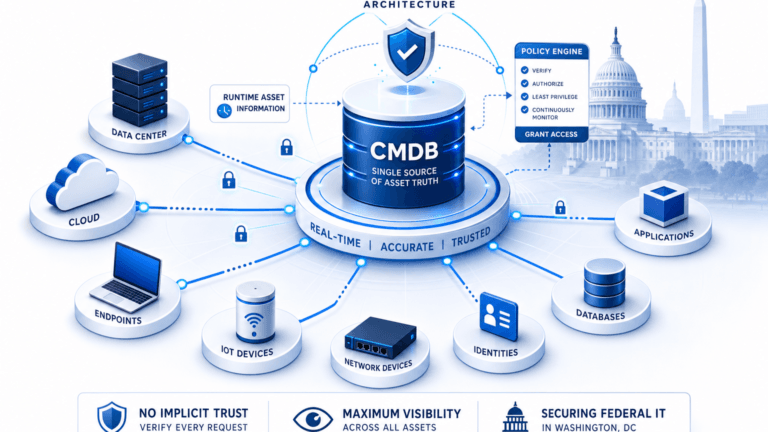
Relationship mapping. Assets lets you map how CIs depend on one another — which servers support which applications, which network devices connect to which services. This dependency layer is what makes a configuration management database useful for scoping incidents and assessing change impact before you commit.
Jira Service Management also connects to other Atlassian tools such as Jira Software, so your team can link assets directly to issues and projects. This creates a tighter ITSM workflow without switching platforms.
The Real Benefits of Using a Jira CMDB
Running your configuration management practice inside Jira Service Management has concrete operational advantages:
Faster incident resolution. When an incident comes in, your team pulls up the related CI, sees its attributes and relationships, and traces the problem faster. Less time hunting for asset data means shorter resolution times.
More informed change decisions. Before you commit to a change, check the CI’s dependencies and understand what else might be affected. This lowers the risk of disruptions that were predictable but unseen.
Reduced manual data entry. Connecting discovery tools to your CMDB removes the step of maintaining asset records by hand. Your team focuses on work that requires judgment, not data re-entry.
Tighter ITSM integration. Because the CMDB lives inside Jira Service Management, asset data connects directly to incidents, changes, and service requests with no separate bridge required.
Is the Built-in Atlassian CMDB Enough?
For organizations already on Jira Service Management with relatively contained environments, the Assets module is a solid starting point. It handles the basics well and fits naturally into existing Jira workflows.
Two gaps appear as environments grow.
Data freshness. Assets depends on connected discovery tools or manual input to stay current. If discovery runs infrequently or covers only part of your infrastructure, your Atlassian CMDB reflects a point in time rather than the current state. In fast-moving environments, that gap compounds quickly.
Relationship depth. As environments expand — hybrid cloud, third-party services, dynamic workloads — building and maintaining accurate relationship maps becomes its own workload. The module tracks relationships you define, but keeping those definitions current as the environment changes takes significant effort.
If your team needs deeper discovery coverage, richer dependency context, or CMDB data that holds up under scrutiny from change managers, security teams, or auditors, the native Assets module will likely fall short.
What are the limitations of the Atlassian CMDB in Jira Service Management?
The Assets module in Jira Service Management relies on connected discovery tools or manual input to stay current. In large or hybrid environments, this creates CI drift as assets change faster than data collection runs. Building and maintaining detailed relationship maps at scale also requires ongoing manual effort that grows with environment complexity.
How Virima Extends Your Atlassian CMDB
Virima integrates directly with Jira Service Management to address the gaps most Atlassian CMDB deployments encounter as environments scale.
High-frequency discovery cycles. Virima uses agentless IP-based scans and API integrations to run discovery across your data center, network, edge, AWS, and Azure cloud resources. Results flow directly into your Jira CMDB, keeping CI records close to current state without manual data entry from your team.
Discovery-driven relationship data. Beyond individual CI records, Virima discovers and maps the relationships between assets. You see which servers support which applications, which network devices connect to which services, and where your dependencies run deep. Your CMDB gains the relationship layer it needs to support complex, fast-changing environments.
Blast radius visibility with ViVID™ Service Mapping. Virima’s ViVID™ Service Mapping builds dynamic dependency maps from discovered relationship data. Once you define your service boundaries, ViVID™ builds the map and keeps it current. Before any change, you see the full blast radius — the scope of what could be affected — before you commit.
Connected ITSM workflows. Because Virima integrates with Jira Service Management, discovery-sourced CI data becomes available directly inside your incident, change, and problem workflows. Your team works with accurate context inside the tools they already use.
How does Virima improve Atlassian CMDB data quality?
Virima integrates with Jira Service Management and runs high-frequency discovery cycles using agentless IP-based scans and API connections. This pushes current asset and relationship data into your Atlassian CMDB without manual data entry, reducing CI drift and giving your team a more accurate foundation for incident response and change management decisions.
► Schedule a demo today — see discovery-sourced CI data transform your Jira CMDB.
Why CMDB Data Drifts and How to Stop It
Most organizations find their IT infrastructure management CMDB is accurate right after implementation. Over time, as the environment changes — devices added, software updated, cloud instances spun up and down — CI records fall behind. Teams making decisions from stale data work from a picture of the environment that no longer exists.
The answer is not rebuilding from scratch. It is pairing your existing CMDB with a discovery engine that runs at the cadence your environment demands. Virima’s high-frequency discovery cycles, combined with multi-source data ingestion from Intune, SCCM, AWS, and Azure, keep your CI data close to current state without adding workload to your team.
Can Virima integrate with Jira Service Management?
Yes. Virima has a dedicated Jira Service Management integration that pushes discovery-sourced CI data and relationship maps directly into your CMDB. This keeps asset records current and connects discovery data to your ITSM workflows — without requiring manual updates from your team.
From Static Snapshot to Discovery-Sourced Truth: Making Your Atlassian CMDB Work Harder
Your Atlassian CMDB is most valuable when it reflects how your environment actually looks today. That requires a discovery process running at the right cadence, and a relationship layer that shows you how assets connect — not just that they exist. Without both, even the best service mapping capability is working from incomplete data.
Virima provides both. It extends your Jira Service Management CMDB with discovery-driven data and ViVID™ service maps that give your team the operational context to make faster, safer IT decisions.
► Ready to give your Atlassian CMDB the discovery foundation it needs? Schedule a demo today.