Cryptographic Inventory for PQC Migration: What to Record, Where to Look and How to Prioritise

Consider an illustrative scenario where executive leadership asks an infrastructure team a direct question: where across our enterprise environments are we using RSA? The team opens their operational tracking sheet, but it only contains public certificate expiration dates and commercial certificate authorities. It does not record asymmetric algorithms, key sizes, elliptic curves, cipher suites, or the business services dependent on those credentials. Tracking expiration dates prevents unexpected outages, but post-quantum cryptography migration requires knowing the exact mathematical primitives securing your systems. Building an effective cryptographic inventory demands structured visibility into algorithms, storage locations, system owners, and data exposure horizons before deprecation deadlines arrive.
Understanding your current certificate posture through certificate lifecycle management best practices remains essential for operational stability. However, post-quantum planning requires cataloging the underlying encryption mechanics embedded across infrastructure, custom software, databases, and network sessions. Organizations must expand certificate management into comprehensive cryptographic visibility to identify obsolete algorithms before standards mandate their removal.
What NIST’s Final Timeline Means for Your Cryptographic Inventory
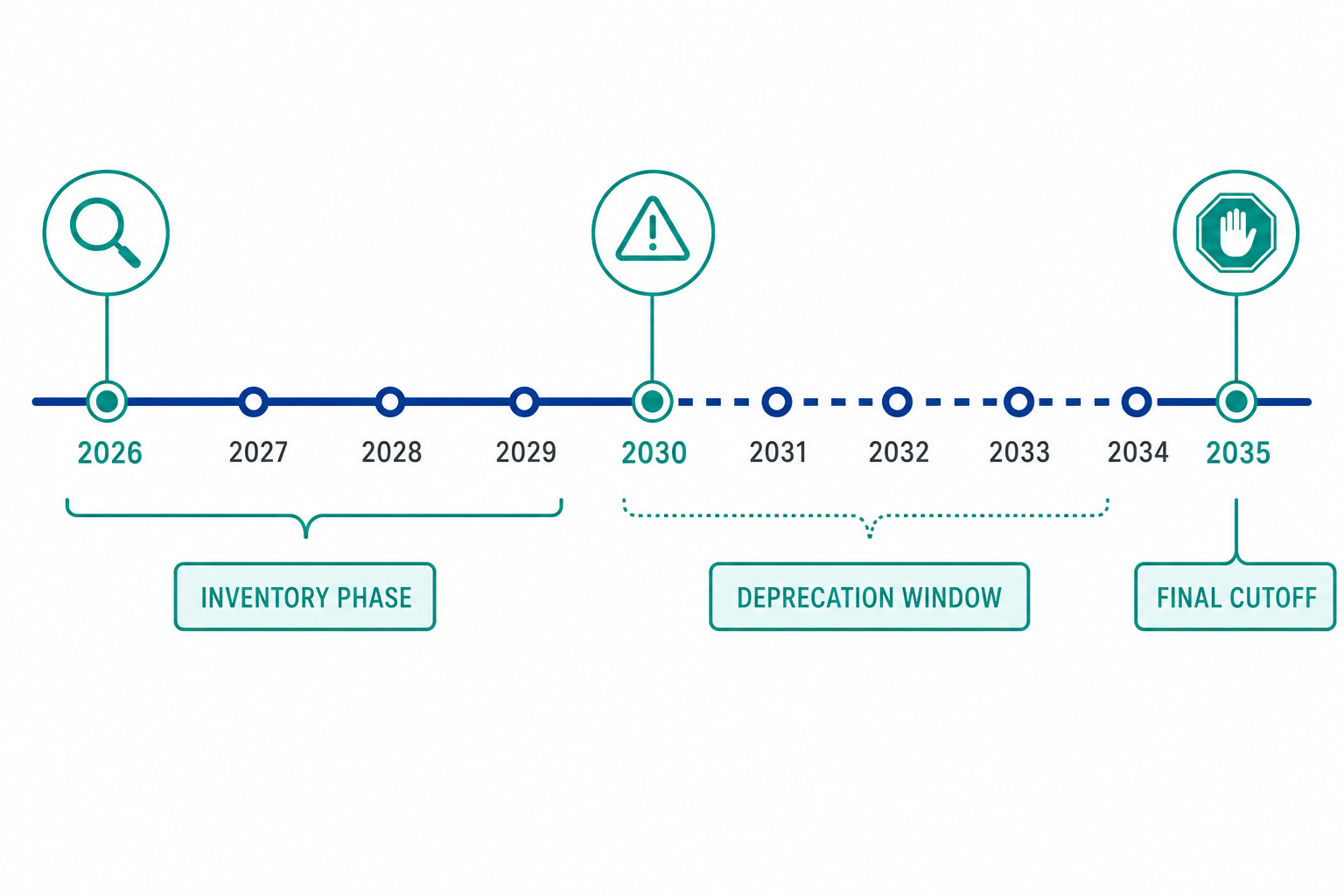
On October 27, 2026, the National Institute of Standards and Technology released the final publication of NIST IR 8547, establishing transition guidance for quantum-vulnerable cryptography. This definitive document confirms that classical public-key algorithms, including RSA, ECDSA, EdDSA, and Diffie-Hellman variants, face structured phase-outs across federal information systems. Specifically, NIST designates these vulnerable algorithms as deprecated after 2030 and completely disallowed after 2035 within federal standards and associated guidelines.
The publication places inventory creation at the absolute beginning of organizational preparation. NIST states directly on page 1 that transition efforts require beginning with cryptographic inventories, migration planning, and early deployments. Furthermore, page 13 emphasizes that systems unable to support post-quantum cryptography should be identified and prioritized for remediation. While NIST deadlines formally govern federal agencies, commercial enterprises face equivalent pressure from enterprise customers, cyber insurance underwriters, and industry regulators. Developing an accurate inventory represents the prerequisite step before testing post-quantum algorithms or deploying hybrid key-exchange mechanisms.
A Certificate List Is Not a Cryptographic Inventory
Operational certificate inventories are designed to solve an availability problem rather than an architectural migration challenge. Standard certificate tracking captures common names, Subject Alternative Names, issuing certificate authorities, serial numbers, validity windows, and server bindings. These operational details allow system administrators to renew certificates prior to unexpected application downtime. Migration planning requires different technical attributes to evaluate algorithm durability against quantum mathematical attacks.
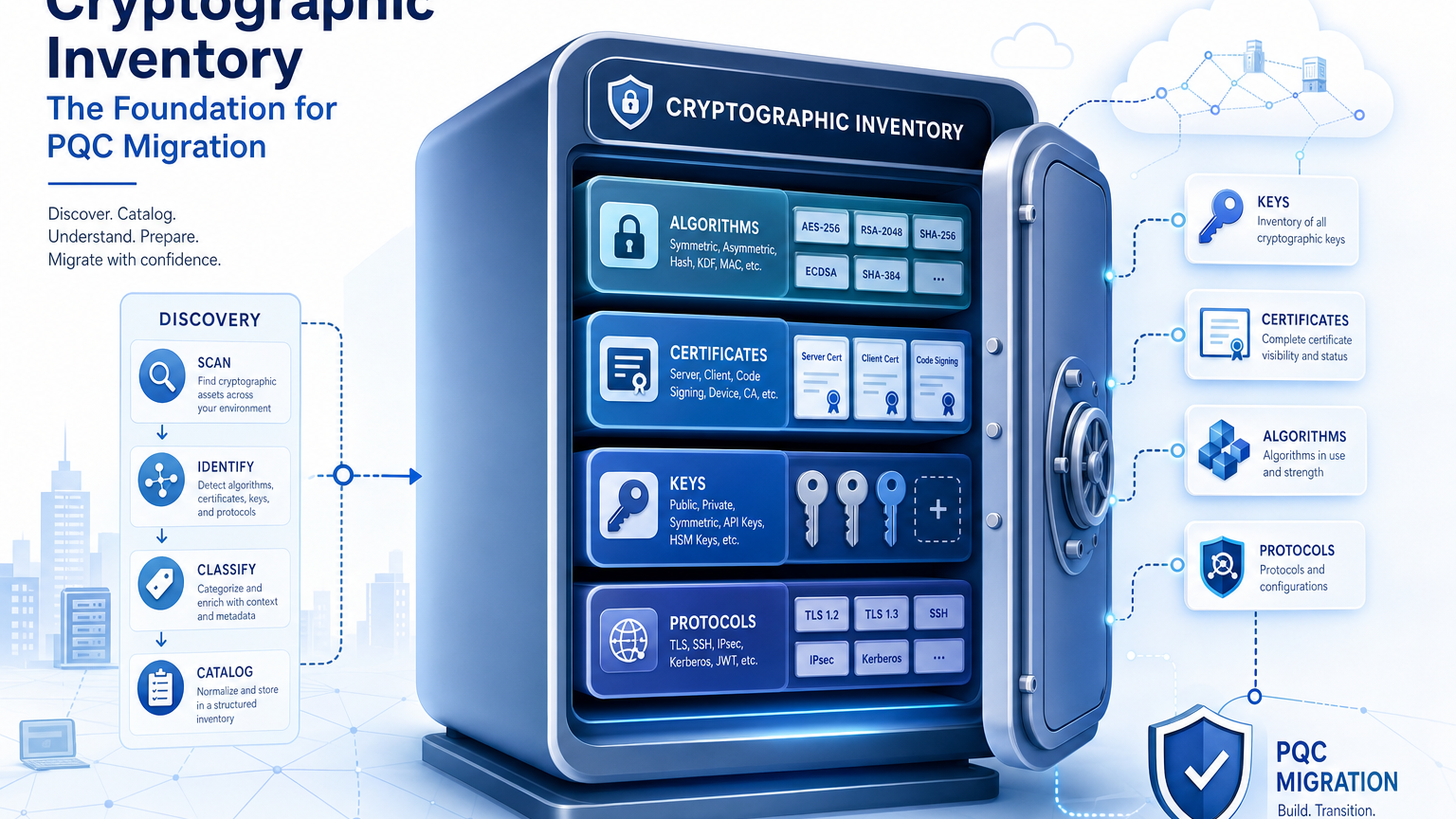
Post-quantum preparation requires capturing the cryptographic algorithm, modulus length or elliptic curve parameters, digital signature scheme, and supported protocol versions. Teams must also record the business applications relying on each credential, designated application owners, and the confidentiality lifespan of protected information. The CycloneDX standard addresses this structural requirement through its specification for a Cryptographic Bill of Materials (CBOM). CycloneDX defines a CBOM as a structured method to document algorithms, keys, protocols, and certificates across software ecosystems.
| Cryptographic Data Field | Technical Purpose in Migration | Primary Discovery Source |
|---|---|---|
| Public-key algorithm and key size | Identifies classical RSA or ECC parameters requiring replacement | Certificate parsing or TLS endpoint handshakes |
| Signature algorithm | Reveals intermediate and root hashing and signing schemes | X.509 certificate metadata extraction |
| Protocol and negotiated cipher suites | Pinpoints legacy TLS or SSH versions lacking modern suites | Network protocol inspection and configuration audits |
| Host and business service mapping | Establishes operational dependency context and blast radius | Centralized configuration management database |
| Technical and business asset owner | Assigns testing, vendor outreach, and upgrade responsibility | Asset inventory and directory service records |
| Data retention confidentiality requirement | Determines urgency based on harvest-now, decrypt-later risks | Information classification registers and data owners |
| Post-quantum algorithm compatibility | Determines whether hosting platforms require code or OS upgrades | Vendor documentation and laboratory compatibility testing |
Industry guidance, including frameworks from Encryption Consulting, recommends assessing cryptography across six operational dimensions: what primitives exist, where they execute, when they expire, who manages them, why they exist, and how easily teams can replace them. Evaluating these questions establishes whether an organization can remediate exposed cryptography before regulatory enforcement begins.
Where Cryptography Actually Lives Across the IT Estate
Cryptographic algorithms operate throughout every tier of modern enterprise technology architectures. Discovery workflows must inspect public and internal certificate authority issuances, TLS termination endpoints, load balancers, secure web gateways, and API proxies. Beyond standard web traffic, classical public-key cryptography protects administrative SSH host keys, code-signing operations, virtual private networks, and IPsec tunnels. Data storage platforms incorporate public-key mechanics within database column-level encryption keys, storage area network credentials, hardware security modules, and key management systems.
Enterprise applications present complex discovery challenges because cryptographic libraries reside inside compiled binaries, container images, scripts, and legacy firmware. The Cybersecurity and Infrastructure Security Agency outlined these operational boundaries in its Strategy for Migrating to Automated PQC Discovery and Inventory Tools. CISA explicitly noted that it has not been able to confirm the full scope of cryptographic algorithm detection across automated toolsets. Algorithms embedded in custom software packages may evade network scanners, and several mandatory inventory fields lack automated collection capabilities.
Because automated scanners cannot capture custom internal implementations or standalone operational technology firmware, engineering organizations must incorporate developer attestations and formal supplier questionnaires. Relying exclusively on automated network probes leaves legacy background scripts and third-party commercial applications invisible during migration planning.
What specific data fields belong in an enterprise cryptographic inventory?
A complete cryptographic inventory records the algorithm type, key length or elliptic curve, signature scheme, protocol version, and certificate expiration. It also links each credential to its hosting server, parent business service, system owner, and the confidentiality shelf-life of the protected data.
Build the Cryptographic Inventory in Structured Layers
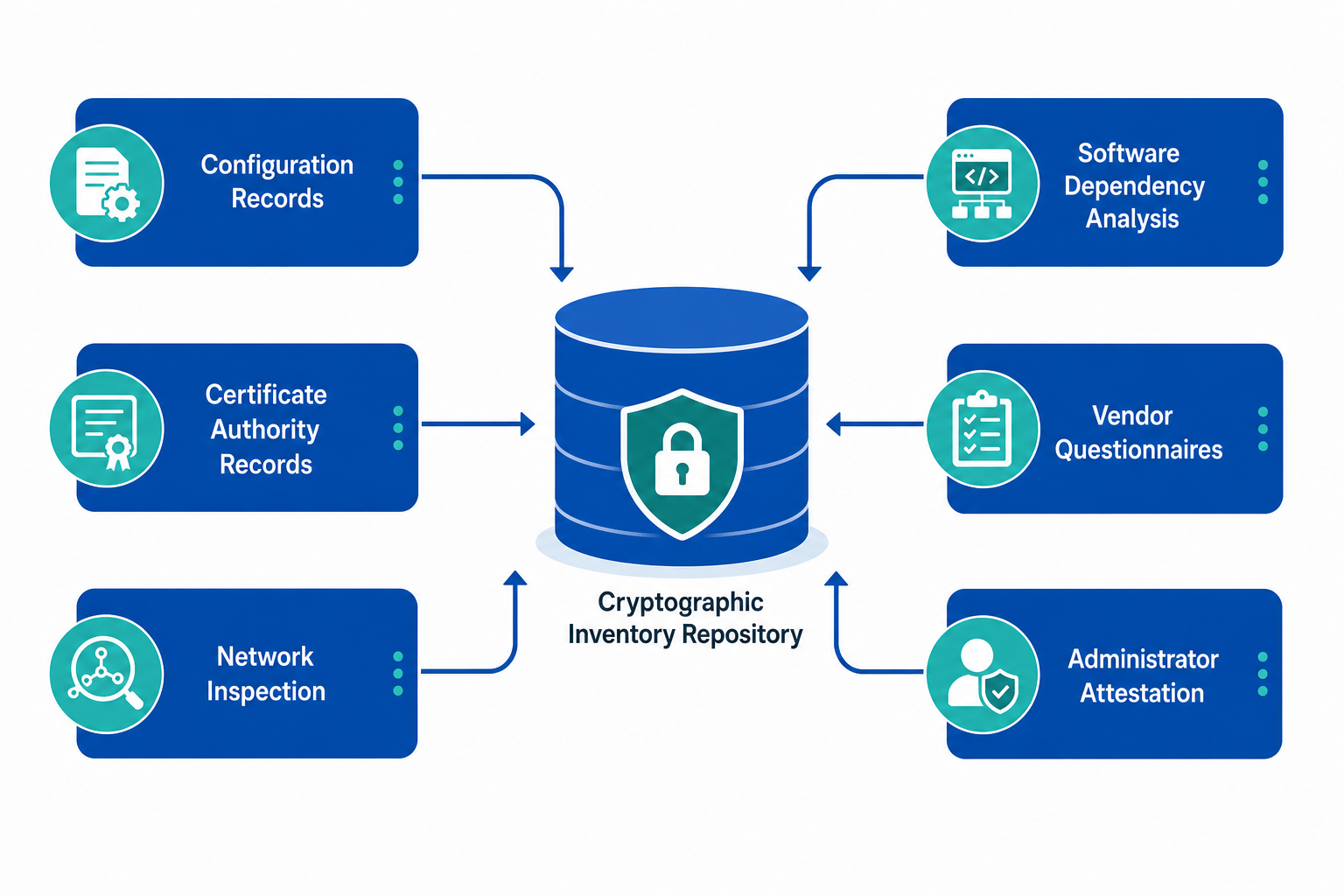
Attempting to scan an entire technology estate with a single utility invariably yields incomplete visibility and excessive false positives. Mature engineering teams assemble their cryptographic inventory by combining complementary organizational data sources into structured tiers.
- Existing configuration and asset management records: Technology asset repositories, configuration databases, and service catalogs provide the foundation for tracking. These platforms contain operational infrastructure records, application topologies, business service dependencies, and verified system owners. Attaching cryptographic findings directly to known infrastructure prevents unassigned findings from stalling remediation workflows.
- Certificate authority records and operational stores: Exports from internal Active Directory Certificate Services, cloud certificate managers, and external certificate authority portals reveal active certificates. Analyzing public Certificate Transparency logs identifies external corporate assets that bypassed standard internal procurement procedures.
- Network inspection and protocol handshake scanning: High-frequency network discovery captures actual negotiated TLS versions, cipher suites, and presented certificates across enterprise subnets. Handshake verification uncovers legacy SSL and TLS protocols running on non-standard ports or unmanaged virtual appliances.
- Static and dynamic software dependency analysis: Source code analyzers, software composition tools, and software bills of materials identify hardcoded encryption keys and third-party libraries. These tools flag classical algorithm calls embedded inside enterprise application repositories.
- Third-party software and SaaS vendor questionnaires: Commercial software providers must formally document the algorithms securing their proprietary packages and disclose their post-quantum roadmap timelines. Structured questionnaires capture implementation details for managed cloud platforms where customer vulnerability scanners face source code visibility boundaries.
- Application owner and system administrator attestation: Application leads and database administrators review cataloged entries, confirm business criticality, and document legacy hardware constraints. Owner confirmation bridges information gaps where automated discovery utilities encounter environmental access restrictions.
Combining configuration records, protocol handshakes, and developer verification provides comprehensive visibility across both cloud infrastructure and legacy on-premises workloads. Each inventory entry should store the discovery source, initial identification date, assigned asset owner, and data confidence score.
Prioritise Systems by Harvest Risk and Architectural Complexity
Organizations cannot upgrade thousands of cryptographic keys, certificates, and libraries simultaneously. Security teams must prioritize assets based on business exposure, data sensitivity, replacement complexity, and algorithm longevity.
Adversaries currently capture encrypted enterprise network traffic to store until cryptanalytically relevant quantum computers emerge, a tactic known as harvest-now, decrypt-later. Consequently, systems transmitting data requiring confidentiality past 2030 represent the highest remediation priority. Long-lived certificates and root credentials that secure critical infrastructure for decades require immediate architectural evaluation. Conversely, public web certificates present less operational migration friction. Under CA/Browser Forum Ballot SC-081v3, public TLS certificate maximum validity periods decrease from 398 days to 47 days between March 2026 and March 2029. Because teams rotate public certificates frequently, updating their algorithms aligns with existing renewal cadences.
| Priority Tier | Typical Technical Assets | Primary Migration Risk Factor | Recommended Initial Action |
|---|---|---|---|
| Critical (Immediate) | Root and intermediate internal CAs, firmware signing keys, VPN gateways, core banking transactions | Decades-long trust anchors, hardware constraints, harvest-now decrypt-later vulnerability | Commission CBOM reviews and plan hybrid algorithm testbeds |
| High (2027 to 2029) | Database encryption keys, healthcare records repositories, enterprise single sign-on tokens | Extended confidentiality lifespan exceeding ten years | Upgrade cryptographic libraries and enforce modern TLS cipher suites |
| Medium (2030 to 2032) | Public web servers, ephemeral internal microservices, edge routing proxies | Short data shelf-life and automated 47-day certificate rotation schedules | Validate vendor platform updates and rotate to quantum-resistant public certificates |
| Low (Monitor) | Isolated test networks, temporary development environments, non-sensitive telemetry | Minimal business risk and negligible persistent confidentiality requirements | Document exceptions and review during scheduled configuration audits |
When systems cannot support updated post-quantum algorithms due to hardware constraints, security leads must log formal exceptions. Each documented exception must assign an accountable asset owner, evaluate compensating controls, and set scheduled review milestones.
Keep the Inventory Current Through Continuous Operations
A static cryptographic inventory depreciates quickly as engineering teams deploy cloud resources, update microservice dependencies, and reconfigure network proxies. Maintaining accurate visibility requires embedding cryptographic discovery into existing change management and procurement operations.
Technology teams must enforce scheduled re-scan cadences calibrated to individual environment risk profiles. Establishing rigorous scheduled discovery cadences to keep your CMDB accurate ensures newly introduced endpoints and shadow certificates surface systematically. Whenever software teams modify dependencies or introduce external APIs, continuous integration pipelines should inspect build artifacts for cryptographic changes. Furthermore, procurement teams should require enterprise hardware and software suppliers to supply updated cryptographic bills of materials before contract renewals.
Why must modern enterprises build a cryptographic inventory before 2030?
NIST IR 8547 deprecates classical public-key cryptography, including RSA and elliptic-curve schemes, after 2030. Adversaries already execute harvest-now, decrypt-later attacks, meaning sensitive data with multi-year confidentiality lifespans must transition to quantum-resistant encryption before practical quantum computers become operational.
The Common Counter-Argument: Our Vendors Will Handle Migration
Infrastructure directors sometimes assume that commercial software providers and cloud hyperscalers will resolve post-quantum migration automatically through routine platform updates. While enterprise technology vendors will release quantum-resistant software versions, relying entirely on third parties without internal visibility creates severe compliance vulnerabilities.
Enterprises cannot determine which supplier updates require urgent installation without an accurate baseline of active algorithm deployments. Furthermore, CISA highlighted that commercial software inventories exhibit variable fidelity because third-party vendor reporting remains inconsistent across the software market. If an enterprise does not know which internal business workflows depend on vulnerable vendor modules, technical teams cannot budget migration timelines, schedule integration testing, or enforce contractual remediation deadlines. Internal cryptographic visibility provides the objective benchmark required to validate vendor compliance claims.
Discovering Certificates and System Dependencies in a CMDB
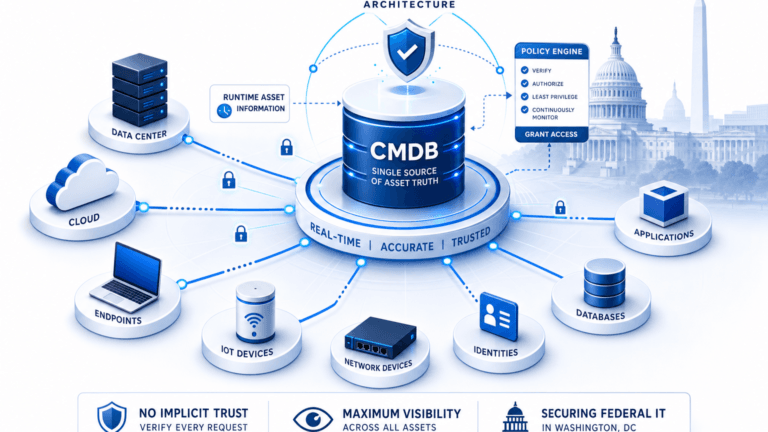
Managing cryptographic assets requires connecting technical discoveries directly to enterprise infrastructure topology. Automated discovery engines bridge this gap by linking credentials to physical hosts, virtual machines, cloud instances, and dependent business applications.
Within enterprise environments, IIS SSL and TLS certificate discovery reveals critical bindings across web servers. Deep host discovery methods identify digital certificates utilized in IIS HTTPS bindings, extracting issuer details, thumbprints, subject names, and expiration parameters. Furthermore, agent-based discovery across Windows systems captures certificate metadata located within local certificate stores, mapping each credential directly to its parent configuration item.
Connecting certificate discovery into a centralized configuration management database provides the operational context necessary for complex migrations. While host discovery tools inspect local certificate stores and bindings, enterprise asset systems record which teams own the host, which business services rely on the application, and which downstream databases process connected transactions. Establishing this dependency mapping ensures that when security teams schedule algorithm migrations, infrastructure leads can evaluate service impact, prevent application outages, and verify operational health.
To establish authoritative operational context across your enterprise infrastructure and dependencies, explore Trusted Runtime Truth to maintain verified visibility across critical business assets.
When your organization prepares to modernize legacy infrastructure, inventory enterprise assets, and structure your migration milestones, schedule a demo to evaluate your technology dependencies and plan your post-quantum transition.
Frequently Asked Questions About Post-Quantum Cryptographic Inventories
What information does a cryptographic inventory contain?
A cryptographic inventory is a structured technical catalog documenting where encryption operates across an enterprise. It records active algorithms, key lengths, digital signature schemes, certificates, cipher suites, protocol versions, hosting systems, and assigned asset owners.
When does NIST officially deprecate RSA and elliptic-curve cryptography?
Under the final NIST IR 8547 publication, classical public-key algorithms including RSA, ECDSA, EdDSA, and Diffie-Hellman variants become deprecated after 2030 and completely disallowed across federal information systems after 2035.
What is an enterprise Cryptographic Bill of Materials?
A Cryptographic Bill of Materials, or CBOM, is a machine-readable specification that documents the cryptographic assets, algorithms, keys, and protocols embedded within software components, as formalized within standards like CycloneDX.
Can automated discovery scanners detect all enterprise cryptography?
Automated discovery utilities cannot detect every cryptographic instance. CISA emphasizes that automated tools miss custom software algorithms and offline systems, necessitating developer attestations and formal supplier questionnaires to achieve complete coverage.
Where should our organization begin post-quantum inventory planning?
Organizations should begin by auditing existing configuration management databases to identify mission-critical business services. Teams can then attach certificate discoveries, network handshake scans, code analyses, and vendor declarations to those documented assets.