Where to Start a Post-Quantum Migration: The Asset Inventory Your Crypto Scan Depends On

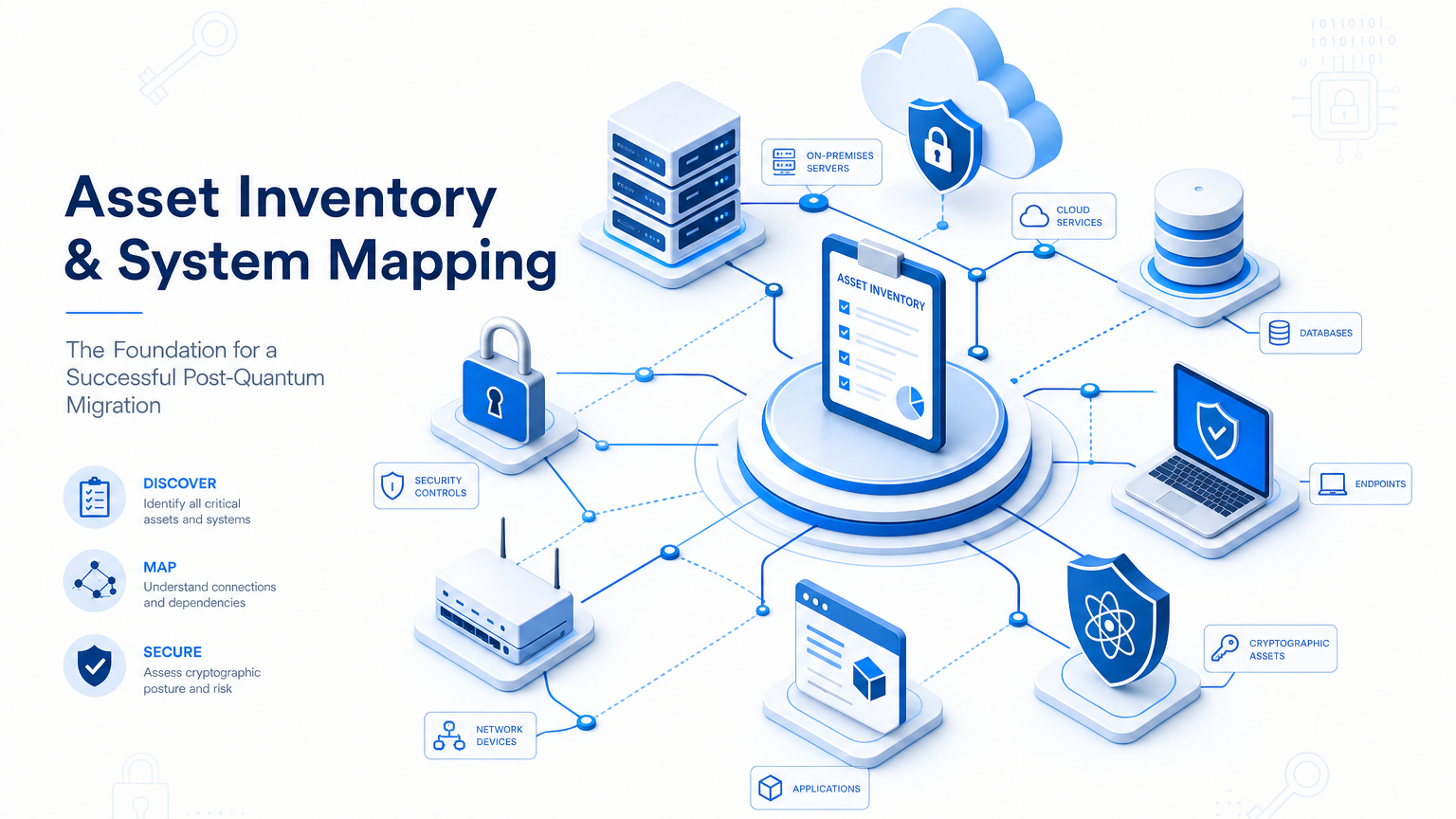
A post-quantum migration can stall when security findings reach systems without confirmed owners. Teams may have scan results, yet lack an agreed list of systems to check. They also need to know which services depend on those systems before planning changes. A post-quantum migration asset inventory gives the programme a starting boundary, named contacts, and a way to track coverage.
Consider an illustrative programme manager asked to begin the transition. Their first meeting identifies several systems holding sensitive data, but the application list and cloud records disagree. Some owners are missing, and nobody can confirm whether a shared gateway belongs in scope. The team can still begin investigating cryptography while reconciling those records. A reliable asset baseline helps them decide where to look next and whom to involve.
For the related work of recording algorithms and certificates, see the cryptographic inventory guide. This starting plan focuses on the systems and services that support that investigation.
What NIST’s timeline asks you to start with
The National Institute of Standards and Technology published the final NIST IR 8547 in October 2026. It describes a transition away from quantum-vulnerable public-key cryptography toward post-quantum standards. The report identifies inventories, migration planning, and early deployments as starting activities.
NIST states that quantum-vulnerable public-key cryptography will be deprecated after 2030. Its use will be disallowed under NIST standards and guidelines after 2035. The report also identifies earlier requirements for certain sensitive federal systems. Organisations should check their own applicable obligations, contracts, and technical guidance rather than assume one date governs every system.
Some data may need protection for many years after transmission. NIST describes the harvest-now, decrypt-later threat, in which adversaries collect encrypted information for possible future decryption. That concern can make systems handling long-lived sensitive data an early priority.
Inventory work can start with a small service rather than the whole estate. Establish its known components, then identify the cryptography that protects their communications and data. Expand the boundary as owners identify shared infrastructure and external dependencies.
Why a crypto scan alone is not a starting point
A cryptographic scan can identify certificates, protocols, or software components within its configured reach. Its output helps security teams find places that warrant investigation. The scan results still need owners and service context before teams can plan a change.
A finding attached to a server address may leave several practical questions unanswered. Which application uses the endpoint, and which team can approve its maintenance window? Does another service depend on the same gateway? Was a second server missed because credentials failed or its network was outside the scan?
The CISA strategy for PQC discovery and inventory describes limits in automated collection. CISA notes uncertainty about the full detection scope of available tools and identifies inventory fields without known automated collection methods. Its federal inventory requirements also include information that must be obtained through other means.
An asset baseline provides a denominator for checking scan coverage within a defined scope. Compare the list of eligible systems against scan records, then investigate missing or unsuccessful results. A system marked as scanned may still contain cryptography that the tool cannot inspect. Coverage reporting should therefore state the method and its limitations.
Scanning and baseline building can happen in parallel. The important control is reconciliation: each discovery finding should have a route to an identified system or an investigation owner. Equally, each in-scope system needs a recorded scan status or a documented reason for exclusion.
What the asset layer gives the migration
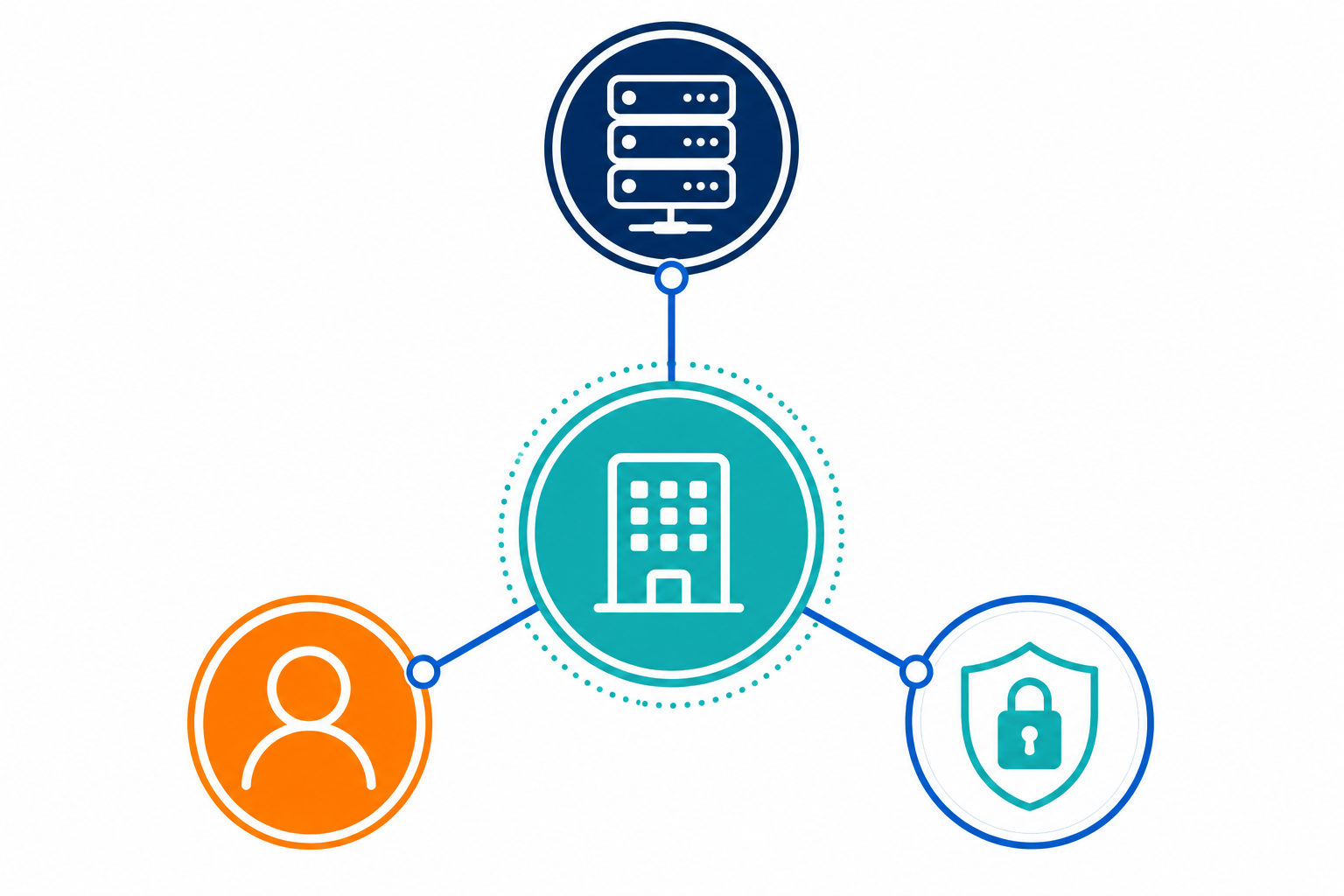
The asset layer connects technical findings to the people and services affected by change. Four practical records help the programme turn a scan into a work plan.
Scope. Define the business service and the systems supporting it. Include shared infrastructure and external services where their role is known. An illustrative payment service might depend on a gateway, application hosts, and a managed database.
Ownership. Record a responsible contact for each system and service, and confirm that person can coordinate the work. A missing owner should remain an assigned investigation, rather than a blank field treated as complete.
Dependencies. Record known connections between components and the services they support. For the illustrative payment service, the gateway owner and application owner may need a coordinated test window. A map helps teams identify those conversations, provided its relationships are verified.
Coverage. Compare eligible systems with successful scans and document exceptions. For example, a programme with 80 known in-scope systems and 60 successfully scanned systems has 75% system coverage for that method. The figure does not prove that all cryptography on those systems was found.
Lifecycle and supplier records add another planning dimension. A vendor may confirm that an older appliance needs replacement before it can support a new cryptographic implementation. That answer belongs with the affected asset, its owner, and an agreed review date.
| Programme question | Asset-layer evidence | Additional security evidence |
|---|---|---|
| What belongs in scope? | Service and system records, plus known dependencies | Findings from scans, code reviews, and supplier responses |
| Who can coordinate a change? | Confirmed system and service owners | Cryptography and security contacts for the finding |
| What has been checked? | Defined list of eligible systems and exceptions | Scan results, dates, methods, and inspection limits |
| What may be difficult to change? | Product version, lifecycle, and supplier records | Compatibility tests and supplier migration plans |
A starting sequence for the first 90 days
The following sequence is a suggested working pattern, not a deadline from NIST. Adjust the timing to the environment and the people available.
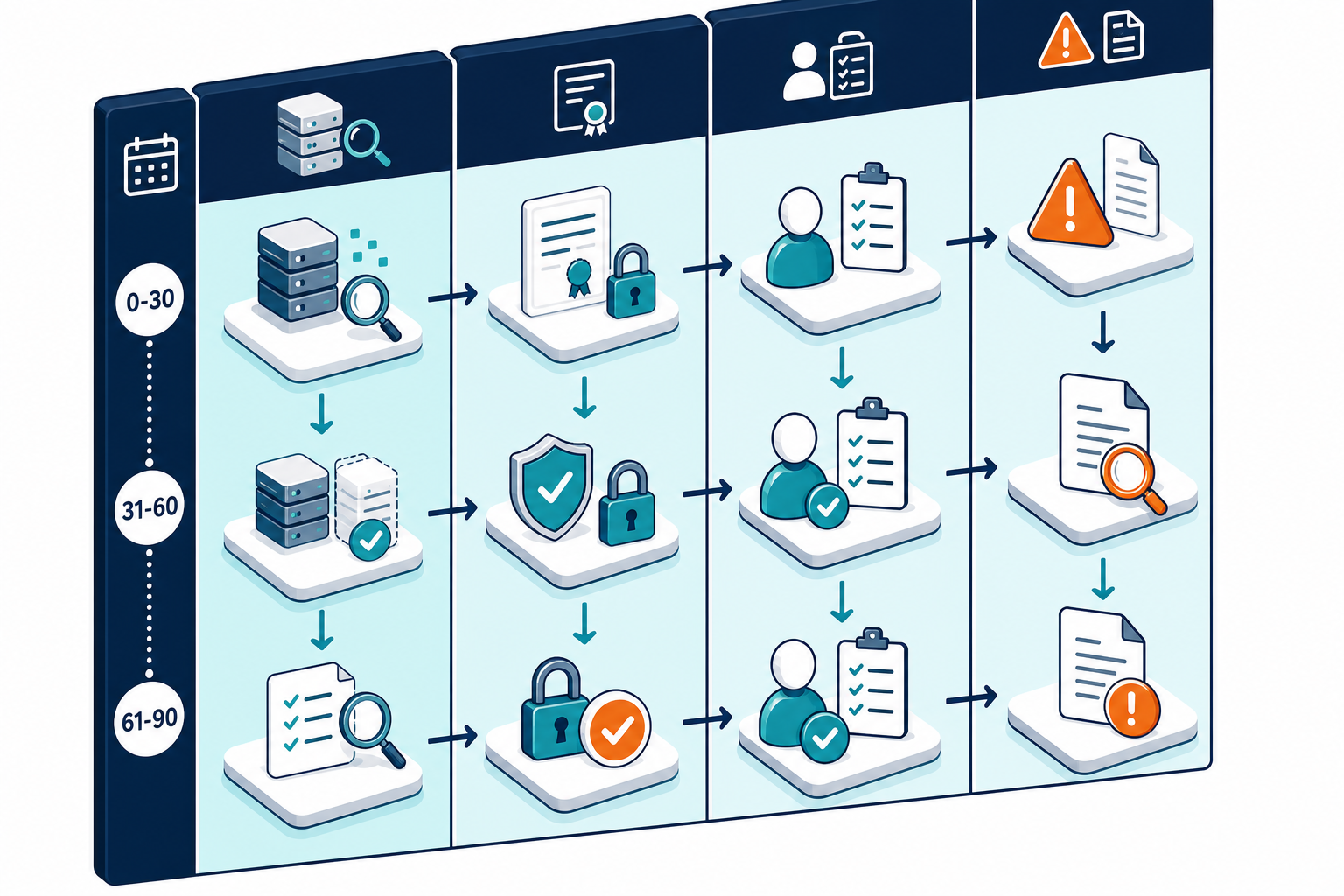
Days 1-30: Set the boundary and accountabilities
1. Name a sponsor and an inventory owner. The sponsor resolves cross-team priority conflicts. The inventory owner maintains the scope, records open questions, and coordinates updates with system owners.
2. Select a first business service. Security and service owners should consider sensitive data, confidentiality lifespan, exposure, and service importance. A service with long-lived confidential data can be a sensible first candidate. Record why it was chosen and which systems are initially included.
3. Gather existing records. Pull relevant CMDB entries, asset registers, cloud account lists, certificate records, and procurement data. Ask application teams for architecture diagrams and known supplier dependencies. Record the source and date for each list so discrepancies can be investigated.
Days 31-60: Reconcile systems and attach findings
4. Compare the lists and run discovery. The infrastructure team checks approved environments using suitable discovery methods and credentials. Match records using dependable identifiers, such as a serial number or cloud instance ID where available. Ask owners to confirm questionable matches and identify systems outside scanning reach.
5. Connect security findings to systems. The security team brings in certificate, protocol, software, and supplier findings from appropriate sources. Assign unmatched findings for investigation instead of forcing them onto a likely host. Record scan date and method alongside the result.
A team can use Trusted Runtime Truth to examine what exists, how systems connect, what changed, what could break, and who owns them. Those records give security and infrastructure teams a shared starting point for investigating migration scope.
Days 61-90: Prioritise and establish a review cycle
6. Rank the work and log exceptions. Security, infrastructure, and service owners review data sensitivity, exposure, technical constraints, and supplier plans. Record the reason for each priority, the person responsible, and the next review date. Systems that cannot yet be inspected or changed need an explicit exception and a follow-up owner.
7. Agree on a re-check cadence. Set scheduled discovery and security scans according to system risk and operational constraints. Add an inventory check to change control for new systems and material service changes. Review overdue exceptions and ownership gaps with the programme sponsor.
The result should be a usable first-service baseline, with known gaps visible. Expand to the next service using what the team learned from matching, access requests, and supplier responses.
Where asset inventories fall short
An asset record identifies a system and may describe its owner, location, software, and relationships. It does not establish which cryptographic algorithms are used unless that information has been collected separately. Certificate discovery also provides only part of the picture.
Shadow infrastructure can sit outside approved cloud accounts or network ranges. Supplier-managed services may expose limited technical details to customers. Embedded devices and operational technology may require special handling, and scanning them without approval can disrupt operations. Custom code can contain cryptographic implementations that a network scan cannot inspect.
Treat these gaps as separate work items. Ask suppliers for supported migration plans, request application-owner attestations, and agree on safe inspection methods with operational teams. A claimed owner should confirm the record, especially where a system has changed hands.
Inventory freshness also requires a process. New deployments, retirements, and changes to service dependencies can make a baseline incomplete between scheduled reviews. Record when a source was checked, include changes in the next reconciliation, and investigate stale or conflicting entries. A current timestamp on one source does not verify every attribute in a combined record.
Can a crypto scanner be the first purchase?
A dedicated cryptographic scanner can accelerate discovery and help security teams work at scale. CISA’s strategy supports greater use of automated collection while acknowledging gaps in available methods.
Teams can evaluate scanning tools while building their asset baseline. Before treating a scan report as programme coverage, compare its configured scope and successful results with known systems. Include access failures, unsupported systems, and assets awaiting supplier information in the same review. Owners can then decide which gaps need another method and which can be accepted temporarily.
Why Virima for the asset layer
Virima provides agent-based, agentless, and API-based discovery methods for supported environments. Scheduled discovery can collect asset information for reconciliation in its configuration management database. Teams can use those records to review discovered systems and their known relationships.
Virima also supports service dependency mapping through ViVID™. The customer supplies service definitions, and the platform builds maps from those definitions and discovered relationships. Owners should validate the resulting context before using it to plan a migration window.
Virima’s release notes describe Deep Host Scans that detect SSL and TLS certificates used in IIS HTTPS bindings. The documented details include issuer, validity, and expiration. Windows agent scans also capture certificate information. These capabilities support certificate visibility within their stated scope.
The documented asset and certificate features do not establish a complete cryptographic inventory or a post-quantum assessment. Security teams still need appropriate cryptographic discovery, code analysis, testing, and supplier information. Confirm how findings will be matched to asset records before adopting a workflow.
Choose one service and begin
Select a business service, confirm its owner, and assemble its known supporting systems. Mark which systems have successful cryptographic scan results and which need another inspection method. Give unmatched findings and inaccessible systems named owners and review dates.
To evaluate the asset and dependency records behind that process, schedule a demo with Virima. Bring a service boundary and a sample inventory so the discussion can focus on your environment.
Frequently Asked Questions
Why start PQC migration with an asset inventory?
An asset inventory establishes a working list of systems and responsible owners. Teams can compare that baseline with scan results, identify systems awaiting inspection, and use service dependencies to coordinate migration work.
Is an asset inventory the same as a cryptographic inventory?
An asset inventory records systems and associated operational details. A cryptographic inventory adds information about the algorithms, keys, certificates, and protocols those systems use. Teams can connect the two records for planning.
When does NIST deprecate quantum-vulnerable public-key cryptography?
NIST IR 8547 states that quantum-vulnerable public-key cryptography will be deprecated after 2030 and disallowed under NIST standards and guidelines after 2035. Certain sensitive federal systems have earlier migration requirements.
Can Virima identify every system using RSA?
Virima’s documented asset and certificate discovery capabilities do not establish complete RSA detection. Teams need suitable cryptographic inspection methods and supplier information, then can relate confirmed findings to the relevant systems.
Can Virima help teams review migration dependencies?
Virima can map relationships among discovered configuration items. After customers provide service definitions, ViVID™ builds service dependency maps that owners can review when planning changes and coordinating testing.