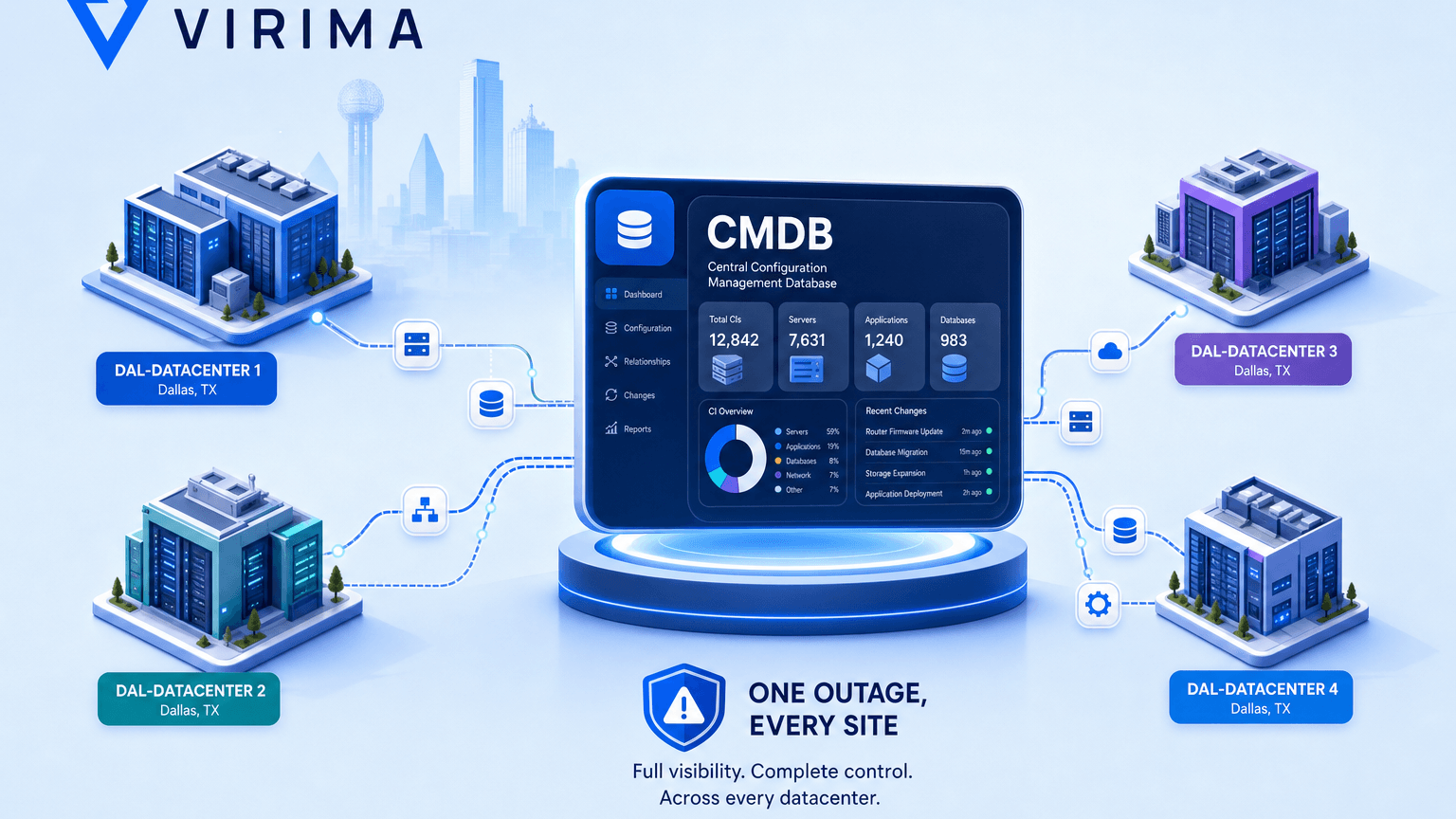
CMDB for Multi-Datacenter IT Management in Dallas: One Outage, Every Site

On February 22, 2024, a routine overnight maintenance change on AT&T’s wireless network took the entire service down in about three minutes. The FCC investigation report documented more than 125 million devices disconnected, about 92 million blocked calls, and more than 25,000 failed attempts to reach 911, with full restoration taking roughly twelve hours. AT&T is headquartered in Dallas, where CMDB for multi-datacenter IT management in Dallas is now a board-level concern, not a compliance afterthought. The FCC pointed to inadequate peer review and insufficient testing before the change reached production. That is a failure to see, in advance, everything the change touched. This event gives a clear picture of what configuration blindness costs when a large, multi-site estate cannot show cross-system impact before a change ships.
That class of risk is no longer rare in North Texas. Cushman & Wakefield’s 2026 Global Data Center Market Comparison ranked Dallas-Fort Worth the number one primary data center market in the world, ahead of Atlanta, Northern Virginia, and Columbus. Industry sizing from Mordor Intelligence on the Dallas data center market places capacity near 2.01 GW in 2025 with a path toward about 2.55 GW by 2031. That growth spreads across submarkets such as the Stemmons Corridor, the Richardson Telecom Corridor, Plano, Irving, Garland, and Grand Prairie. More large corporate estates now run production, DR, and colo capacity across several physical facilities inside the same metro. Building a durable CMDB for multi-datacenter IT management in Dallas means treating cross-site inventory and dependency maps as operational infrastructure, not a pre-audit spreadsheet exercise.
What is a CMDB for multi-datacenter IT management?
In ITIL 4 practice language, a configuration management database is the system of record inside service configuration management. It holds configuration items and the relationships between them. A configuration item is any component that must be managed to deliver an IT service. That definition is standard across industry explainers; operators should still align wording to their licensed ITIL materials when they write policy.
A multi-datacenter CMDB has to do work a single-site register often skips:
- Record which facility each CI physically or logically sits in
- Maintain cross-site relationships (an application in Site A depends on a database in Site B)
- Reconcile CI records when two sites or two tools disagree
- Preserve ownership and change history with site context attached
The hidden problem
| Situation | What happens |
|---|---|
| Primary site has a mature CMDB; DR site does not | Failover plans are built against infrastructure nobody has verified exists in the current year |
| A CI lives in Site A’s spreadsheet, not Site B’s ITSM instance | The same asset carries two records, two owners, and no reconciliation path |
| Cross-site dependency is assumed, never mapped | A change approved at Site A breaks a service running out of Site B with no CAB warning |
| Two companies merge, two CMDBs, two data centers | Nobody can produce one clean, current inventory across both estates for months |
What is a CMDB for multi-datacenter IT management?
A multi-datacenter CMDB is a configuration management database that tracks configuration items and relationships across every physical or logical facility or cloud region in the estate. Dependencies between locations stay visible for change, recovery, and audit work, not only at one site.
Why multi-datacenter management matters for large corporate IT estates
Large enterprises run complex estates that already span multiple facilities and often multiple regions. Market research on data center infrastructure management from Global Market Insights frames large enterprises as the principal buyers of full DCIM deployments because they operate multi-site estates. These estates need interoperability across facilities, service management, and governance workflows. That is external confirmation that multi-facility complexity is a large-estate problem first, not an SMB edge case.
Uptime Institute’s 8th Annual Outage Analysis (May 2026) reported that 57 percent of major outages now cost more than $100,000 and that one in five exceeds $1 million. The institute identified the rising number of services that depend, directly or indirectly, on a single data center or availability zone as a contributing factor in those rising costs. That is a dependency problem dressed as an outage-cost problem. For CIOs, the board question is whether the estate can show those dependencies before the next change window, not only after the post-incident review. Establishing trusted runtime truth across multi-facility estates is the operational baseline those board conversations need.
Four multi-datacenter IT blindspots
- Dependency blindness across facilities. A change looks safe in isolation at the primary site and breaks a service two sites away, so the outage shows up after the fact instead of at the change advisory board stage where it could have been caught and hours of recovery avoided.
- Shadow CI records from mergers and consolidation. The same asset appears under different names in different systems after an acquisition, with no single owner and no consistent reconciliation, so migration budgets get scoped against inflated numbers, decommissioning efforts double-count work, and audit evidence fragments across tools. A practical CIO-level account of decisions that change once discovery data is trusted sits in Virima’s piece on three decisions made differently with trusted discovery data.
- Untested failover assumptions. The DR site’s inventory was never reconciled against what the primary site actually runs this year, so failover plans still reference two-year-old lists, and a real failover discovers those gaps only after the outage the plan was supposed to contain is already underway.
- Audit scope gaps across multi-site facilities. One location is well governed; another is not, so samples across the estate show strong evidence at one facility and weak evidence at another, and compliance officers must disclose material control weaknesses tied to a single site even when the rest of the estate looks sound.
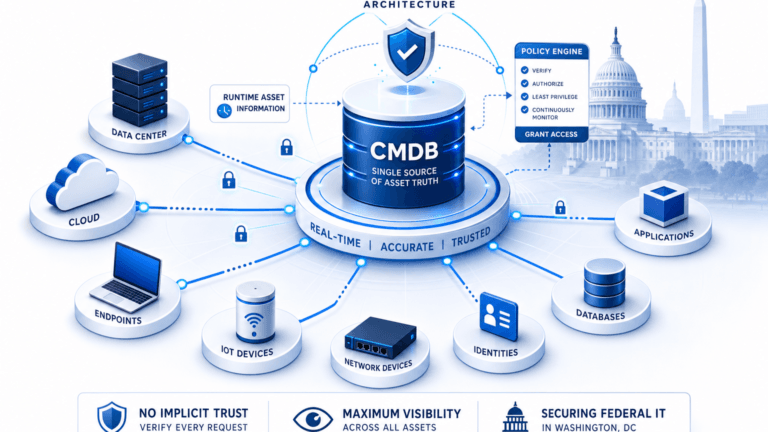
Enterprise CMDB for large IT estates is not a nicer single-site register. It is the only practical way to keep ownership, criticality, and relationship context honest when the physical footprint keeps expanding.
Why do large enterprises need a CMDB across multiple data centers?
Large enterprises run infrastructure across several facilities. Without one reconciled CMDB, each site’s data drifts independently, and a change at one facility can break a service running out of another without warning at the change board.
Where multi-datacenter asset blindness costs the most
For IT leadership
Risk exposure rises when infrastructure data gaps span multiple facilities. M&A due diligence built on incomplete asset lists understates integration cost. Budget cycles allocate against phantom capacity that only exists on a slide. The CIO owns accurate risk posture to the board across the whole multi-site estate, which is why reporting and auditing use cases matter as much as discovery itself. Boards do not accept “Site A is clean” when Site B still cannot export a defensible inventory. Multi-site blindness shows up in board packs as unexplained downtime, delayed integrations, and audit findings that cannot be scoped to a single owner. Leadership that treats inventory as a local facilities problem keeps rediscovering the same gaps every quarter.
For operations teams and configuration managers
Teams that reconcile site-by-site records by hand before every audit typically report burning fifteen to twenty hours per cycle in mid-to-large estates. Across monthly and quarterly reviews, that labor compounds into hundreds of hours a year that document the environment without improving controls. Scanners still return IP addresses. Someone still has to attach owner, team, and site context before the record is useful under an incident clock.
This is under-credited work. A multi-datacenter CMDB does not remove judgment from the configuration manager. It removes the weekly ritual of stitching three tools into one spreadsheet the night before the sample request lands. When two sites disagree on the same hostname, the configuration manager becomes the tie-breaker with incomplete history and incomplete ownership.
For regulated large enterprises
SOC 2, ISO 27001, PCI DSS, and HIPAA programs all expect complete asset inventory across every facility in scope. Evidence must hold when the auditor samples any site, not only the best-governed campus. When one facility’s CMDB is mature, and others are stale, compliance posture is inconsistent by design. Change programs feel the same fracture: a change ticket that cannot see cross-site dependents is a policy problem waiting for a production window. That is the operational reason change management use cases sit next to inventory work in multi-site estates. Regulators and external assessors sample evidence; they do not accept a story that only the primary campus is in scope when production traffic already spans three buildings.
Dallas market-scale challenge
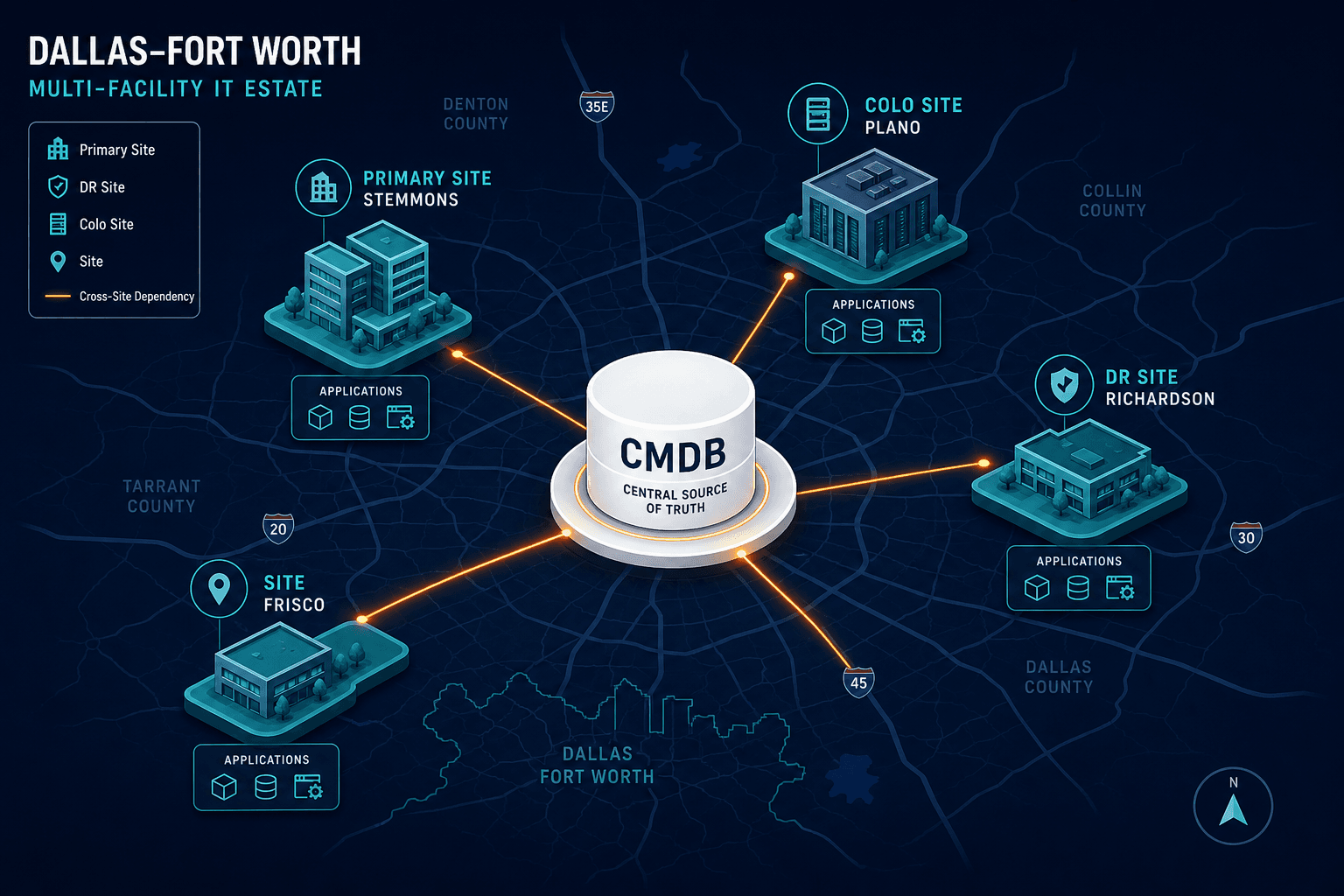
The Dallas-Fort Worth number one ranking is not only a commercial real estate headline. Enterprises are expanding across Stemmons Corridor, Richardson, Plano, and Grand Prairie at the same time. What used to be a single campus pattern is now multi-facility inside one metro: primary capacity at one address, DR at a second, colo or edge capacity at a third. That pattern is the operational norm for many large DFW estates, which is why CMDB for multi-datacenter IT management in Dallas is a local operating requirement, not a branding flourish. Capacity growth without configuration governance multiplies the places where a single unowned CI can hide until the next change window or DR drill.
How a discovery-driven CMDB fixes multi-site blind spots
Closing multi-site inventory gaps means moving from point-in-time documentation to discovery-driven configuration management. Three mechanisms map to verified platform capabilities.
High-frequency scheduled discovery across every site
Agent-based and agentless discovery covers on-premises servers, network devices, cloud instances on AWS and Azure, and virtual machines. Discovery runs on configurable schedules rather than one-time snapshots. New and retired assets at any facility should appear in the CMDB within days, not at the next annual cleanup. See how IT discovery supports that estate-wide cadence so Site B is not left on a different inventory clock than Site A. Consistent schedules reduce the gap between provisioning and first appearance in the system of record. Decommissioning decisions made by a named architecture lead still need discovery confirmation that the CI left the network, or the DR plan keeps a ghost host forever.
ViVID™ service maps for cross-site dependency visibility
After teams provide service definitions manually, by spreadsheet, or through architecture tools, ViVID™ builds application-to-infrastructure dependency maps. That map is what lets a change advisory board see the Site-A-to-Site-B blast radius before approval. Service mapping is the mechanism behind CMDB dependency mapping across data centers when the real pain is relationship blindness, not a missing hostname list. Maps stay useful only when service definitions stay current, and infrastructure under those services continues to refresh from discovery. CAB members stop guessing which historian, middleware tier, or remote access path sits downstream of a host scheduled for patching.
Source-of-truth reconciliation when sites or tools conflict
Multi-source reconciliation designates which feed is authoritative per attribute instead of letting the last write win silently. A CMDB that can merge discovery sources into one governed CI record is what keeps M&A and dual-tool estates from carrying two owners and two truths forever. Attribute-level authority rules matter more than a single “golden” spreadsheet. When ServiceNow, a local DCIM export, and network discovery disagree on environment or owner, the CMDB should surface the conflict and resolve it by policy, not by whoever saved last.
| Task | Manual multi-site reconciliation | Discovery-driven multi-site CMDB |
|---|---|---|
| Cross-site dependency visibility | Reconstructed after an incident from memory and chat threads | Maintained as a current map after service definitions are supplied |
| Conflicting CI records across sites | Last write wins, often silently | Conflicts surface; attributes resolve to a designated authoritative source |
| Discovery cadence per site | Whatever each local team manages, inconsistently | High-frequency scheduled discovery under one estate policy |
| Audit evidence across facilities | Assembled manually, site by site, before the window | Exported from reconciled CMDB records with last-verified context |
Scope boundary (product-accurate): Discovery and CMDB work here cover infrastructure CIs, relationships, ownership, and change context. They do not classify the content of data flowing between sites (that is DLP), and they do not themselves enforce network segmentation or failover policy. Those controls still live in security and network platforms. The CMDB shows what exists, how it connects, and who owns it so those platforms and the people who run them can act with fewer surprises.
What are examples of multi-datacenter CMDB use cases?
Common use cases include data center consolidation after a merger, validating disaster recovery failover against real inventory, assessing cross-site change impact before approval, and producing one audit-ready asset record that covers every physical site in scope.
Multi-datacenter CMDB in practice
These patterns reflect common large-estate operating rhythms. They are not named customer case studies.
Data center consolidation or M&A integration
Two CMDBs and two facilities rarely merge cleanly on paper. Discovery-fed reconciliation is how teams produce one inventory before leadership decommissions a facility after architecture and business owners approve retirement. For migration-shaped work, operators often start from the migrate apps or data centers use case. Field lessons on avoiding stragglers during data center migration still apply when the second CMDB never absorbed shadow hosts. Data center consolidation CMDB work fails when either side keeps a private source of truth through cutover.
How does data center consolidation after a merger affect CMDB records?
Data center consolidation after a merger typically starts with two separate CMDBs describing two separate facilities, often with conflicting records for the same asset. Reconciling both into one governed inventory, before a facility is decommissioned, is what lets architecture and business owners retire capacity without losing dependency or ownership history.
DR and failover validation
Confirm the failover site’s CI inventory matches what the primary site runs now, before a real event tests the plan. Untested assumptions are still the most expensive way to learn which hosts never made it into the DR register. A drill that only validates network paths without validating CI ownership and last-verified dates still leaves configuration managers explaining gaps after the bridge call ends.
How do you validate disaster recovery readiness across multiple data centers?
Validating disaster recovery readiness means confirming the failover site’s configuration records match what the primary site actually runs today, not what a DR plan assumed two years ago. Untested inventory gaps are typically discovered only when a real failover event is already underway, turning a recovery exercise into an unplanned discovery exercise.
Cross-site change approval
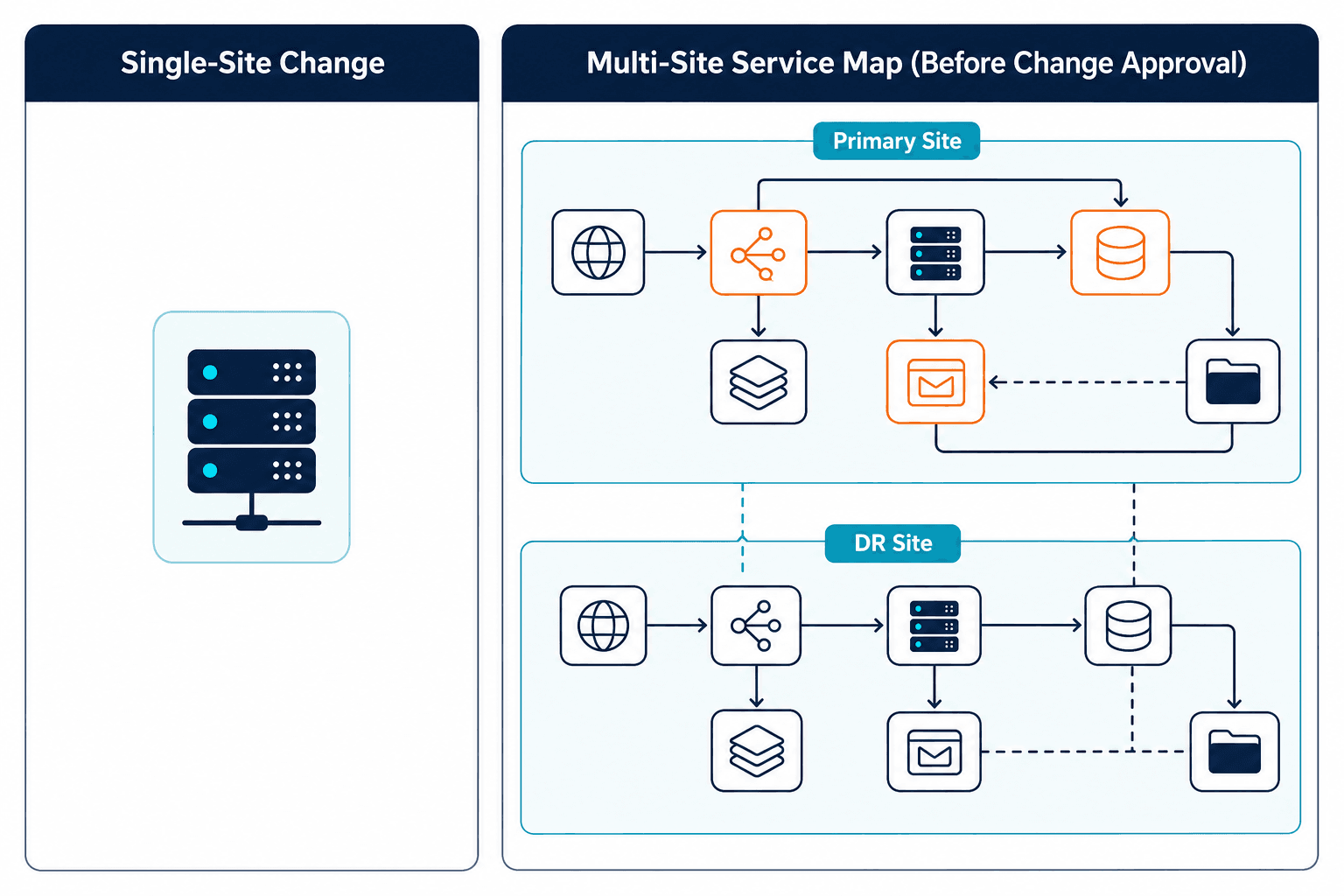
A change advisory board should assess blast radius across facilities, not only the room where the change is scheduled. Service maps with site context turn that review from memory into evidence. Approvers need dependents, owners, and criticality on the ticket path before the window opens.
Audit across multiple physical sites
Produce one clean, current inventory that holds when the auditor samples any facility. Uneven maturity across sites becomes a single control narrative problem, not three separate local excuses.
How Virima supports multi-datacenter IT estates
Virima does not replace your ITSM platform or certify your compliance program. It supplies discovery-sourced inventory, configuration history, and dependency context that large estates use inside their own change, incident, and assessment workflows.
Immediate operational impact
Discovery reach covers every facility in the estate, not only the primary campus. Agentless scanning for on-premises infrastructure, cloud API integrations for AWS and Azure, and optional agents for deeper endpoint detail all feed one reconciled CMDB. Teams query by site, criticality, and owner instead of opening three spreadsheets the week before the audit letter. The same export path supports internal assurance teams and external assessors who ask for last-verified dates, not reconstructed slides.
Long-term classification integrity
As facilities are added, consolidated, or decommissioned after named architecture leads approve the move, reconciliation governance has to hold. Source-of-truth attribution per attribute keeps conflicts from silently corrupting the record. That long-horizon baseline is how operators keep trusted runtime truth durable after the first migration wave ends, not only during the cutover war room.
Integration with existing workflows
Through the integrations hub, Virima exchanges verified runtime data with platforms many large estates already run, including ServiceNow, Jira Service Management, and Ivanti. Discovered assets and relationships can enrich incident, change, and configuration records so multi-site context travels in the same consoles teams already use. Partner names stay plain text; the hub is the single integration destination. Ticket workflows do not need a second CMDB UI per site when runtime data already lands where the change and incident teams work.
Moving from site-by-site spreadsheets to one map-driven CMDB
| From | To |
|---|---|
| Per-site manual tracking with inconsistent tools and cadence | One reconciled CMDB with a consistent discovery policy across every site |
| Dependency knowledge held in individual engineers’ heads | A maintained cross-site service dependency map after service definitions are supplied |
- Faster cross-site incident response: ownership, criticality, and dependents are already on the CI when the bridge call starts.
- Defensible audit evidence across every facility: exports carry last-verified dates and site context instead of a week-long reconstruction.
- Confident consolidation planning: M&A and facility exit plans start from discovery data rather than assumed capacity.
Getting started
- Deploy discovery across every facility and AWS/Azure account on an initial schedule (weekly for core systems, longer intervals for stable segments). Methodology detail lives in Virima’s data center discovery best practices whitepaper.
- Baseline the CMDB by reconciling first-pass discovery with existing IT asset records under clear authority rules per site.
- Populate ownership and criticality through structured owner outreach so each CI carries remediation and change context.
- Map dependencies with ViVID™ after service definitions are provided; feed maps into change and architecture review across facilities.
- Set review cadence ahead of audit and DR tests: monthly completeness checks, quarterly ownership updates, pre-event verification of failover inventory.
Maturity is a multi-quarter journey. Good multi-site inventory reduces change and audit friction. It does not erase every control gap on its own.
Build one inventory that holds across every Dallas facility
Large corporate estates in Dallas-Fort Worth now treat multi-facility footprints as normal operations. Spreadsheet compliance creates the appearance of control until a cross-site change, a failover drill, or an auditor’s sample exposes the gap. Operators who anchor CMDB for multi-datacenter IT management in Dallas in discovery-sourced records walk into those moments with ownership, site context, and dependency maps already attached.
Cross-site visibility is the foundation. Confident change, recovery, and audit work is the outcome. See your own cross-site blast radius mapped before your next change window. Schedule a demo when you’re ready to evaluate it against your multi-facility environment.
Frequently Asked Questions
What is a CMDB for multi-datacenter IT management?
A CMDB for multi-datacenter IT management tracks configuration items and their relationships across every physical or logical facility or cloud region in an estate. Dependencies between locations stay visible for operations and audit, not just at one site.
Why do large enterprises need a CMDB across multiple data centers?
Large enterprises run infrastructure across several facilities, often in different regions. Without one reconciled CMDB, each site’s data drifts independently, and a change at one facility can break a service running out of another without warning.
What are examples of multi-datacenter CMDB use cases?
Common use cases include data center consolidation after a merger, validating disaster recovery failover against real inventory, assessing cross-site change impact before approval, and producing one audit-ready asset record that covers every physical site.
How does Dallas’s data center market affect enterprise IT strategy?
Dallas-Fort Worth is now the world’s number one primary data center market. As enterprises expand across metro submarkets, more of them run production infrastructure across multiple facilities in the same region, making cross-site visibility an operational necessity.
How does Virima reconcile CMDB data when two sites or tools disagree?
Virima’s source-of-truth reconciliation designates an authoritative feed per attribute. When ServiceNow, a local DCIM export, and network discovery disagree on environment or owner, the conflict surfaces and resolves by policy instead of by whichever system saved last.