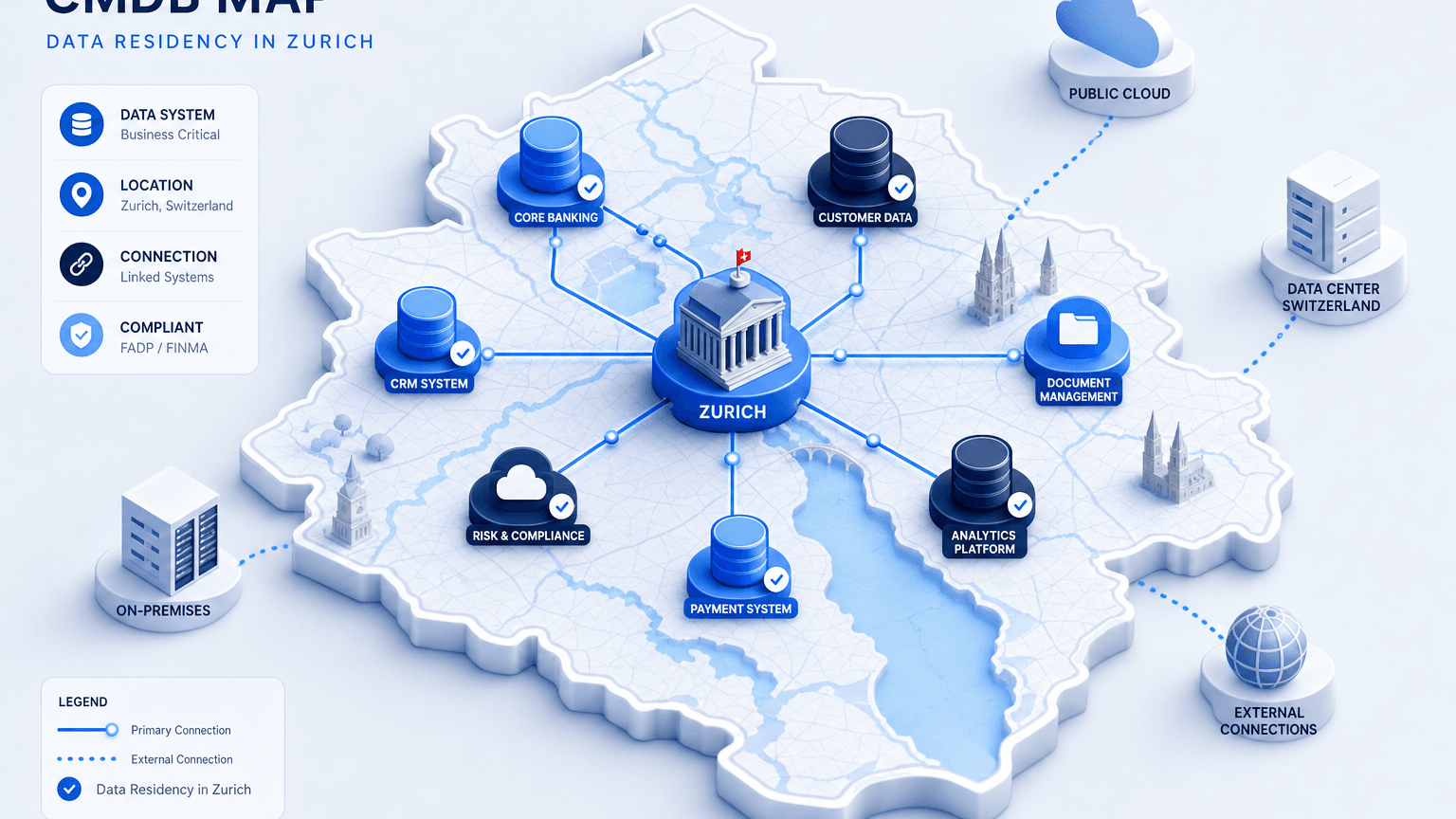
CMDB for Data Residency in Zurich Banks: Don’t Lose the Map

Consider a familiar scenario at a Zurich bank: a risk officer asks which databases holding critical data were reachable from outside Switzerland. The infrastructure team opened three spreadsheets, a cloud console, and a contract folder. The answers disagreed on owners, regions, and backup targets.
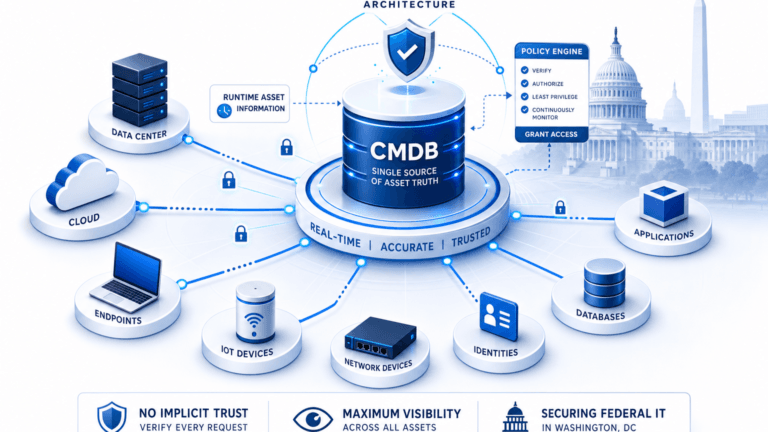
The team spent weeks reconciling the records before the risk officer received a defensible answer. Modernization had moved workloads faster than the register tracking them. A CMDB for data residency in Zurich banks closes exactly that gap: it is the discovery-fed system of record that shows where critical-data systems run, what connects to them, and how current that evidence is.
On 24 November 2025, the Swiss data protection commissioners in privatim set a clear condition for public bodies using international SaaS for sensitive data: the body must encrypt the data itself, and the provider must hold no key. Banks in Zurich face the same underlying question under banking supervision, framed through operational resilience and outsourcing oversight rather than data-protection law.
Where critical data sits is a FINMA ICT asset inventory question for Swiss banks
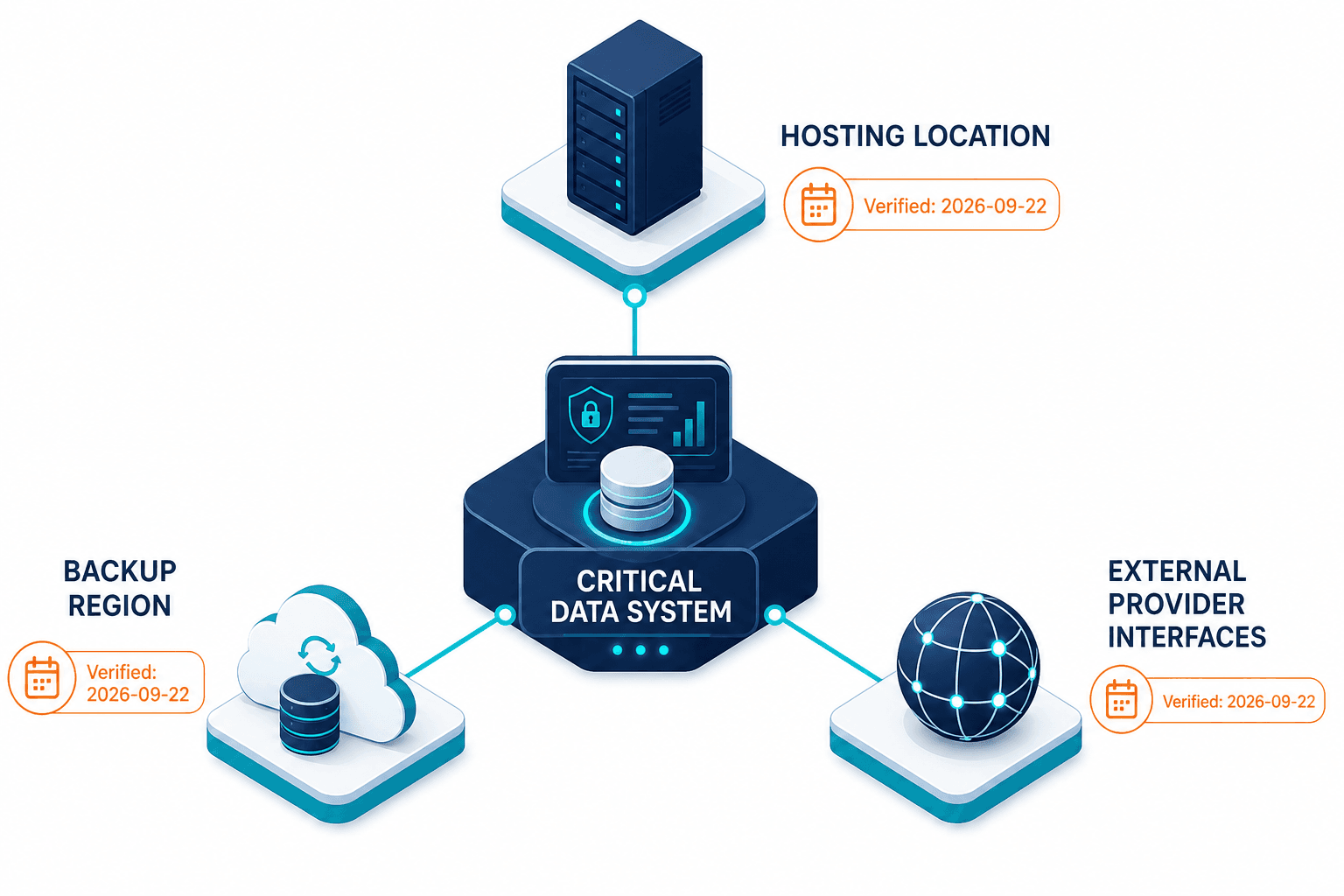
FINMA Circular 2023/1 on operational risks and resilience has applied since January 2024. The circular sets out banks’ FINMA ICT asset inventory requirement: maintain an inventory of ICT assets that records storage locations for critical data alongside dependencies and interfaces to significant external providers. The same framework asks banks to identify critical data stored outside Switzerland or accessible from abroad, then mitigate and monitor the resulting risk. The rule focuses on identified risk and documented controls rather than a blanket requirement to keep all data inside Switzerland.
| Requirement | Circular topic | What the inventory must show |
|---|---|---|
| ICT asset inventory with data locations | ICT asset management | Each critical-data system mapped to hosts, storage, regions, and verified dates |
| Dependencies and external interfaces | ICT operations and outsourcing | Upstream and downstream connections plus interfaces to significant providers |
| Cross-border critical data risk | Data protection within operational risk | Which critical data sits abroad or remains reachable from abroad, with mitigations |
The background paper on the FINMA circular from KPMG Switzerland explains how the circular consolidates technology, cyber, and outsourcing expectations into one supervisory text. The full text of Circular 2023/1 sets the authoritative requirement for the inventory and the cross-border provisions. Swiss data protection law runs alongside this framework, since cross-border transfer rules permit disclosure abroad where the destination provides adequate protection or appropriate safeguards apply.
Why hybrid estates make residency answers harder to keep current
Most banks now run hybrid estates spanning mainframes or virtualized data centers, private cloud, and multiple public cloud accounts. The 2026 State of Cloud findings from Flexera report that 73% of organizations run hybrid environments. Each additional platform adds accounts, regions, backup policies, and integration paths that affect where data physically resides.
Local cloud regions don’t settle data residency in Switzerland on their own
Zurich now has local cloud capacity from major providers. AWS opened the Europe Zurich region in late 2022, Microsoft operates Switzerland North in Zurich with data residency commitments described in its residency and compliance paper, and Google lists Zurich among its global cloud locations. A local region helps architects place primary workloads inside Switzerland. The region alone does not keep replicas, backups, logs, and analytics extracts inside the same boundary.
Three failure modes that break the residency record
Three failure modes recur in hybrid banking estates. Each one breaks the link between the approved design and the running estate.
A reporting database migrates to a new platform during a modernization wave. The primary lands in Zurich while an older replica keeps syncing to another European region. The migration ticket closes before anyone updates the register. Result: the risk report shows Switzerland while the replica still exposes critical data abroad.
Another failure mode looks different: a marketing analytics tool connects to the data warehouse through an integration approved for aggregated extracts. The vendor later adds a sub-processor for processing support. The contract addendum sits in procurement while infrastructure records show only the original vendor. The consequence: the dependency chain presented to risk omits a party with potential access.
A third gap shows up in decommissioning: a retired loan origination server stays powered off in a rack for eleven months. The decommissioning task never received a named owner or a completion date. The register still lists the host as active infrastructure holding customer records. What risk sees: an inventory that overstates the estate and misdirects scoping work toward a dead system.
Stale records slow incident response too
Incident timelines sharpen the cost of stale records. FINMA expects prompt notification after significant cyber events, with preliminary notice within a short window and a fuller report to follow. Scoping which critical-data hosts were affected depends on knowing current locations, owners, and connections.
The 2026 IBM breach findings put the global average breach cost at 4.99 million dollars, which gives boards a financial reason to care about scoping speed. Banks that can isolate affected systems quickly contain both operational disruption and supervisory follow-up. For background on keeping hybrid records trustworthy, see the guide on whether cloud estates still need a CMDB.
What a CMDB settles, and what it leaves to other controls
A CMDB earns trust by staying inside a defined scope. The CMDB records where each system runs, what each system connects to, who owns each record, and when each record was last verified against discovery. Data classification, access authorization, encryption design, and key custody belong to data governance, identity, and security engineering. The CMDB shows the map that those controls defend.
| Question the bank must answer | Answered by the CMDB | Answered by adjacent controls |
|---|---|---|
| Which hosts and cloud resources support this critical-data system | System-to-infrastructure mapping with region and verification date | Data governance confirms which data qualifies as critical |
| Which external providers connect to the system | Dependency and interface records for significant providers | Procurement and outsourcing confirm contract terms and audit rights |
| Who owns the accuracy of each record | Named ownership plus last-verified timestamps | Change management enforces updates during approved changes |
| Whether the data itself is protected | Location and connection facts that focus protection work | Security engineering owns encryption, keys, and access enforcement |
Data classification and DSPM (data security posture management) tools answer what the data is and how sensitive it is; the CMDB answers where the system holding that data runs and what it connects to. The two categories are adjacent, not overlapping.
This separation keeps audit conversations productive. Risk and audit teams receive location evidence from the CMDB while data owners and security teams provide classification and protection evidence from their own systems. The combined record satisfies the inventory expectation without asking the CMDB to perform duties assigned to other controls. Virima describes this posture in its overview of CMDB support for compliance and risk.
CMDB for data residency in Zurich banks: how discovery keeps the record current
A CMDB for data residency in Zurich banks stays useful only when discovery refreshes the record on a defined schedule. Manual registers decay because engineers update infrastructure through consoles and pipelines while documentation waits for a quarterly review. Discovery-fed records stay aligned because scheduled probes read the estate directly and timestamp every change.
Discovery methods that keep pace with the estate
Virima Discovery combines agentless probes, an installed agent where deeper visibility is required, and API connectors for cloud accounts across on-premises infrastructure and cloud platforms. Credentials remain on premises, encrypted on the Discovery App server that the bank controls. Schedules run frequently enough to catch migration drift, replica changes, and new integrations between governance reviews. The approach is described in the IT discovery overview and the records land in the Virima CMDB.
Evidence age matters as much as coverage
Each discovered configuration item carries an attribute-level source record and a last-verified timestamp, so evidence age becomes as visible as evidence coverage. A risk reviewer can see that a database host was observed in a Zurich virtual network last Tuesday rather than entered manually two years ago. Stale records surface through age-based review queues so owners refresh or retire them deliberately.
From records to decisions: dependency mapping
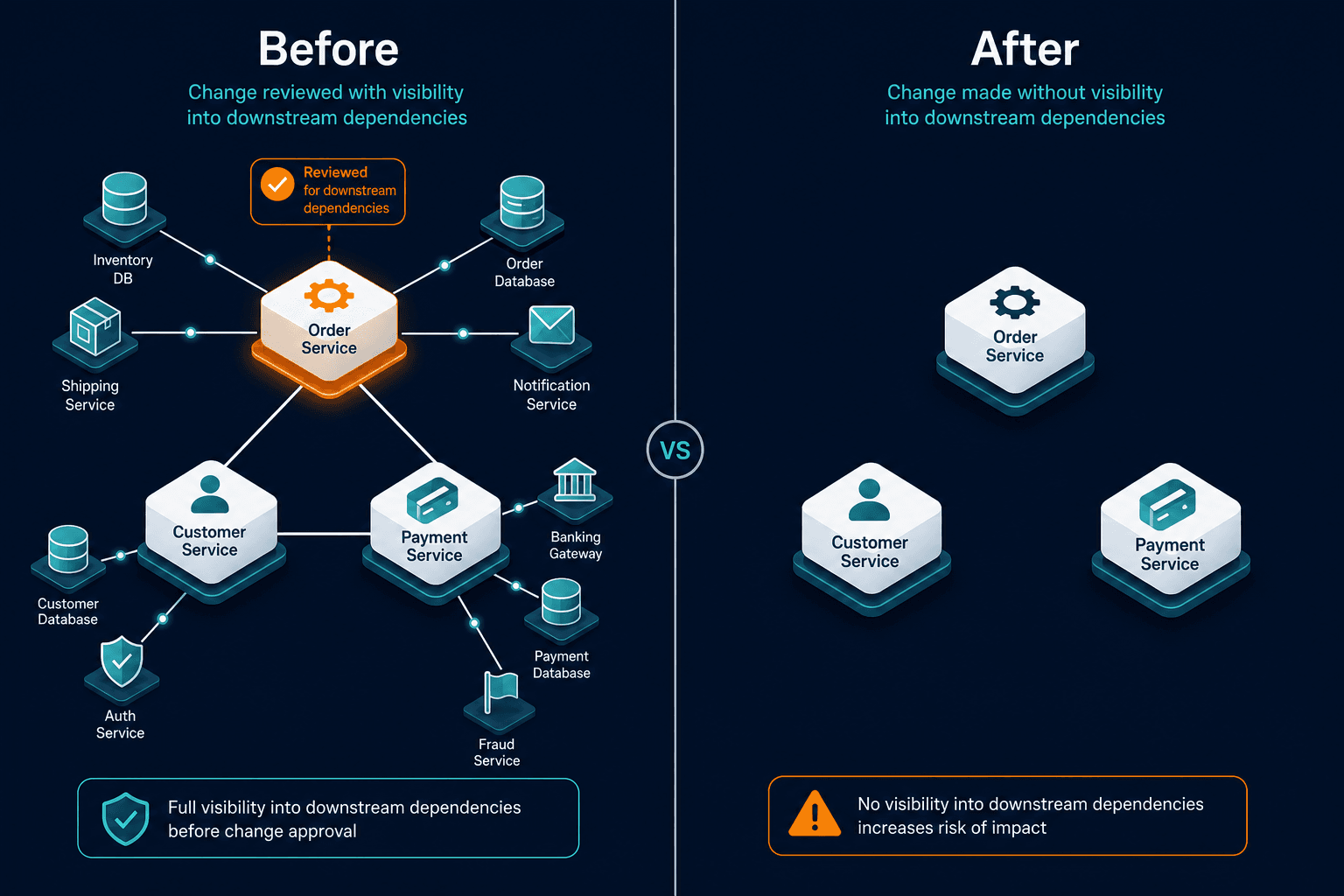
ViVID™ service maps turn those records into decisions. Once services are defined from imports or integration data, Virima builds maps across on-premises systems, AWS, Azure, SaaS connections, and container platforms. A change manager reviewing a replica move sees downstream consumers, backup targets, and external interfaces before approving the change. The visualization layer is covered in the service mapping overview.
| Residency evidence | Manual register | Discovery-fed CMDB |
|---|---|---|
| Hosting region for each critical-data host | Entered once during onboarding, rarely revisited | Observed by probes and cloud APIs on a scheduled cadence |
| Backup and replica targets | Tracked in separate backup consoles | Linked to the system record with verification dates |
| External provider interfaces | Listed in contracts disconnected from infrastructure | Mapped as dependencies tied to specific hosts and services |
| Retired systems | Linger until someone remembers to delete them | Flagged by age and reconciled through owned decommissioning |
Integration and scope limits
Integration keeps the map inside existing workflows. Virima synchronizes bidirectionally with ServiceNow so residency attributes flow to the platform where change and incident teams already work. Connections to Jira, Ivanti, Halo, and Xurrent are available through a single integrations hub, with product names referenced here as plain text per Virima convention.
Scope limits deserve plain language. Discovery covers network-connected infrastructure and connected cloud accounts within its configured credentials and permissions. Browser-side content, data viewed inside third-party web sessions, and records held entirely outside reachable infrastructure require evidence from data governance and vendor attestations. A CTO reviewing this architecture should treat the CMDB as authoritative infrastructure evidence feeding broader governance.
Changing a critical-data system without losing the map
A change walkthrough: moving a reporting database
Consider an illustrative walk-through rather than a customer account. A Zurich bank plans to move a regulatory reporting database to a new replica topology. The primary will remain in Zurich while the team evaluates a second replica for resilience. Risk asks for confirmation that critical data will remain inside approved boundaries after the change.
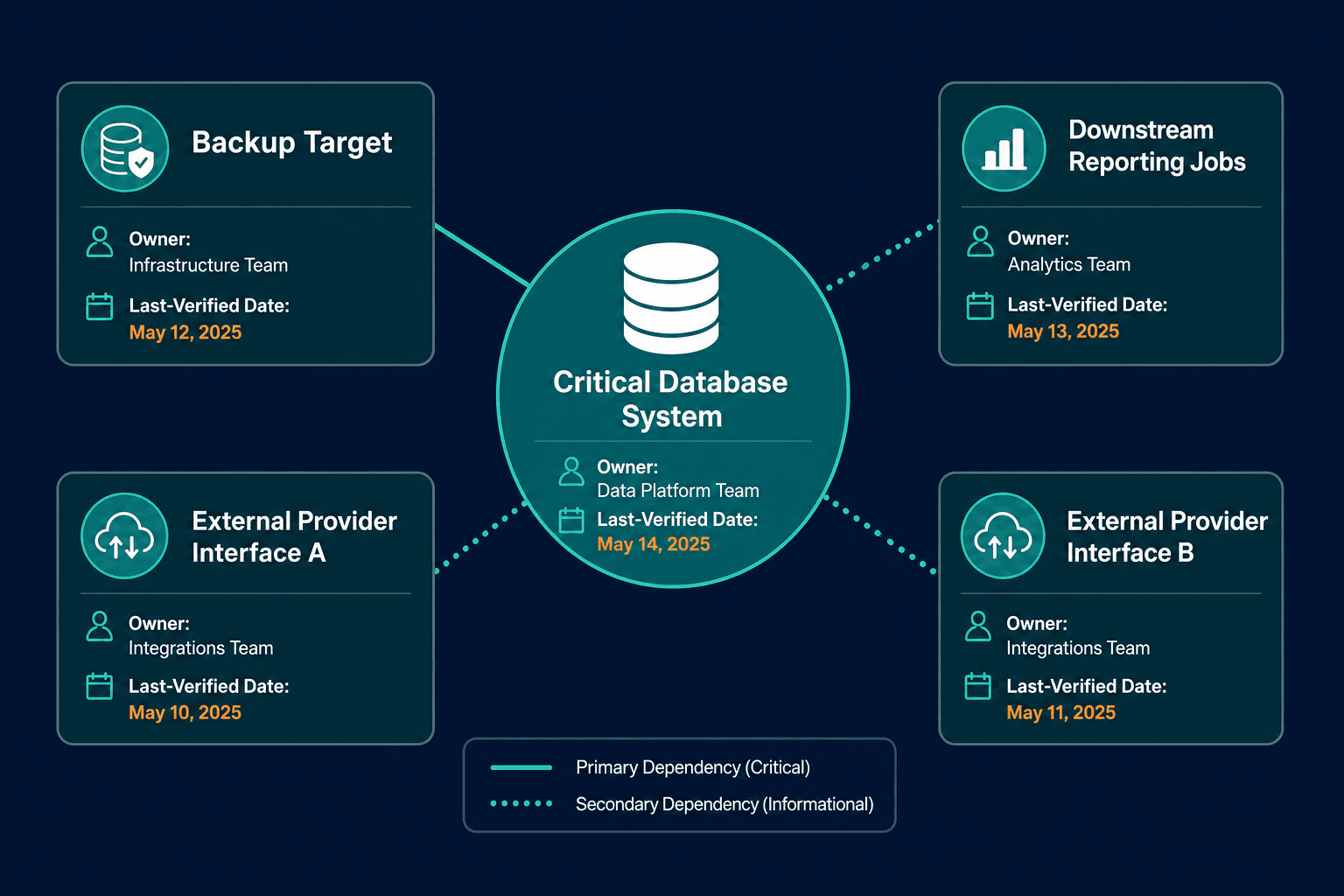
The change manager opens the ViVID™ service map before approval. The map shows the primary database, the existing replica, the backup target, three downstream reporting jobs, and two external interfaces that consume extracts. Each node shows an owner and a last-verified date. The blast radius is visible before any engineer touches production.
The approved change proceeds during the maintenance window. The next scheduled discovery cycle observes the new replica, records its region and network location, and updates the system record. The old replica remains listed until a named infrastructure owner retires it deliberately, including removal of data and closure of network paths. Decommissioning becomes an owned step with a completion date instead of an assumption buried in a ticket.
Five steps to formalize the discipline
Banks formalize this discipline through five practical steps that turn a hybrid cloud CMDB for banks from a one-time project into an ongoing control. The sequence fits naturally into existing change governance and outsourcing oversight.
- Agree the critical-data system list with data owners and risk, so discovery has a defined scope tied to supervisory expectations.
- Run discovery across on-premises estates and connected cloud accounts using credentials scoped to the agreed systems.
- Reconcile discovered records against the existing register and resolve conflicts by observed evidence.
- Map dependencies including external provider interfaces, backup targets, and log destinations.
- Set the refresh cadence, assign record ownership, and review stale configuration items on a defined cycle that feeds change management.
Ghost records deserve attention during reconciliation. Hosts that were retired without a formal removal step inflate the estate and confuse scoping. The CMDB audit guide explains how age-based review and ownership assignment clear those records systematically.
Deploying the CMDB itself raises questions worth settling early
Banks evaluate any new platform with the same rigor applied to their own systems. Virima operates as SaaS with multi-region AWS hosting and SOC 2 Type II controls, while on-premises arrangements are considered case by case. This article makes no claim about Swiss hosting for the Virima platform itself, since that deployment detail sits outside the confirmed sources used here.
The bank data protection officer decides how infrastructure metadata fits the bank classification scheme. A CMDB record typically includes hostnames, network locations, software versions, dependency links, verification dates, and owner names. Each bank assesses that combination against its own policies before connecting discovery to production estates. Deployment options and administrative controls are summarized in the Virima FAQs.
See the residency map before the next change
Banks that can show current system locations, external connections, and verification dates enter modernization reviews with facts ready.
See the dependency map before your next residency review — trace every critical-data system to its hosts, backups, and external interfaces.
Frequently Asked Questions
What is a hybrid cloud CMDB for a bank?
A hybrid cloud CMDB records bank systems across data centers and cloud accounts with owners and verification dates. It links each service to hosts, regions, and external interfaces for review.
How do data residency and data sovereignty differ?
Residency describes where data is stored and processed geographically. Sovereignty describes which legal jurisdiction governs access to that data through applicable laws and provider obligations.
How often should a bank run discovery to keep residency records current?
Banks should run discovery on a defined scheduled cadence tied to change volumes and risk appetite. Each cycle should refresh locations, dependencies, and verification timestamps for critical-data systems.
Does Virima’s discovery scope cover Swiss on-premises data centers as well as cloud accounts?
Virima Discovery combines agentless probes, an installed agent, and API connectors to cover on-premises data centers and cloud accounts including AWS, Azure, and Google Cloud. Credentials stay on premises, encrypted on the Discovery App server the bank controls.
Can Virima CMDB work alongside ServiceNow at a Swiss bank?
Virima synchronizes bidirectionally with ServiceNow so residency attributes appear where change and incident teams already work. Discovery evidence feeds existing workflows without requiring a platform replacement.