Retail and Logistics IT Operations via CMDB

Ahold Delhaize is one of the world’s largest grocery retailers — €92 billion in annual revenue, 2,017 stores across 23 US states operating under the Food Lion, Stop & Shop, Giant, Hannaford, and Giant Food banners, serving 63 million customers every week. On November 6, 2024, a ransomware group gained unauthorized access to its internal US business systems. It took eight months and three separate public disclosures for Ahold to fully establish the scope of what had been touched. Each disclosure expanded the picture. The final update, issued June 26, 2025, confirmed that people’s data had been compromised. Disclosure filed with the Office of the Maine Attorney General puts the number of affected individuals at 2,242,521.
Ahold Delhaize could afford that timeline. Headquartered in Zaandam, the Netherlands, and listed on Euronext Amsterdam, it operates outside SEC jurisdiction. For a US-listed retailer, the SEC’s cybersecurity disclosure rule requires a materiality determination — and once that determination is made, Form 8-K has to be filed within four business days.
The reason eight months was not available to a US-listed retailer is an infrastructure problem. To determine whether a breach is material — the legal trigger for the disclosure clock — a company must first establish preliminary scope: which systems were hit, what data they held, what the operational impact is, what investors would reasonably need to know. None of that is answerable without a continuously maintained, accurately discovered asset inventory across every location in the estate.
Retail and logistics IT environments are among the hardest estates to maintain that kind of visibility across. A mid-sized grocery chain running 300 stores operates point-of-sale (POS) terminals, pharmacy systems, e-commerce infrastructure, distribution center warehouse management systems (WMS), cold chain monitoring, and corporate IT — simultaneously, across hundreds of physical locations, each one provisioning new assets, retiring old ones, and generating configuration drift every day. A third-party logistics provider (3PL) operating 50 fulfillment centers runs WMS, conveyor automation controllers, RFID readers, handheld scanners, dock management systems, and cloud-connected inventory platforms — across facilities that change hands, scale up for peak season, and absorb acquired operations mid-year.
This article covers what retail IT estates actually look like operationally in 2026, how they accumulate asset inventory debt faster than almost any other sector, what that debt costs when change management fails or an incident hits, and what the infrastructure layer that closes the gap delivers across both operations and security.
What Retail and Logistics IT Estates Actually Look Like in 2026
A single grocery store location runs more IT infrastructure than most small businesses. At the front end: 8 to 20 POS terminals, each running payment processing software, loyalty program integrations, and network-connected receipt systems. Behind the counter: pharmacy dispensing systems with their own compliance requirements, self-checkout kiosks, digital shelf label controllers, and in-store WiFi infrastructure serving both associates and customers. In the back: receiving systems connected to the distribution center, cold chain temperature monitoring sensors, security cameras on networked digital video recorders, and a store server running local applications. Above all of it: a corporate WAN connection back to headquarters, a firewall, and network switches connecting every device in the building.
Multiply that by 300 stores. Then by 2,000.
Ahold Delhaize’s US estate alone spans 2,017 locations across 23 states. Walmart operates more than 5,200 US stores. Each location carries a version of this technology stack, localized by store format, region, acquisition history, and renovation cycle. No two stores are identical. A Food Lion in rural Virginia runs different hardware generations than a Stop & Shop in suburban New Jersey. A Walmart Supercenter carries a materially different IT footprint than a Walmart Neighborhood Market. In the Southeast, Atlanta concentrates this complexity further — home to UPS global headquarters, one of the country’s densest regional distribution networks, and a retail infrastructure footprint that makes the CMDB challenges facing Atlanta-based IT teams a subject in their own right.
The logistics side compounds this further. A distribution center (DC) serving a mid-sized grocery chain runs WMS software managing inbound receiving, putaway, picking, packing, and outbound shipping — connected to transportation management systems (TMS) that coordinate carrier dispatching, route optimization, and delivery confirmation. On the warehouse floor: conveyor systems with programmable logic controllers, RFID readers at dock doors, handheld scanners for every picker, automated sorters with embedded firmware, and cold storage monitoring systems running independently of the main WMS. GXO Logistics, the world’s largest pure-play contract logistics provider, operates more than 1,000 facilities totaling over 200 million square feet globally. Amazon runs more than 200 fulfillment centers in the US alone. The highest concentration of logistics infrastructure in any single US metro sits in Memphis — home to the FedEx global SuperHub and the world’s busiest cargo airport — where the IT asset management challenges of high-velocity logistics operations are felt at a scale that warrants dedicated treatment. FedEx’s FY2025 10-K discloses that approximately 59% of its owned assets are invested in transportation and information system infrastructures — across more than 5,000 facilities worldwide.
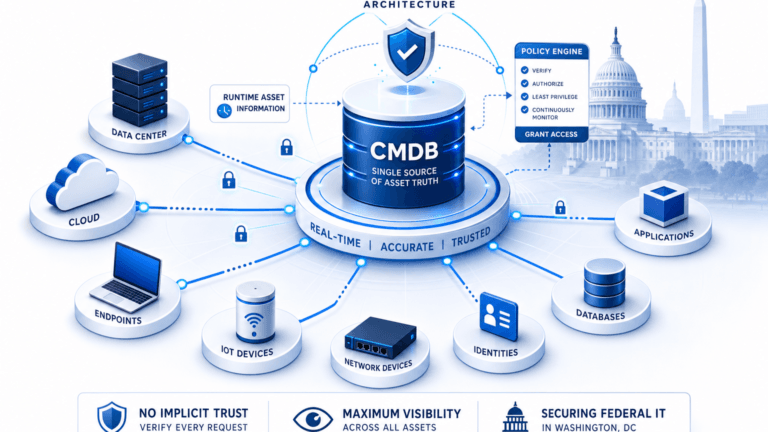
Every one of these locations is an IT estate in miniature. Every store opening, DC buildout, acquisition, and peak season expansion adds assets to the estate. Each new asset needs to be a configuration item (CI) in the organization’s configuration management database (CMDB) from the moment it goes live. A CMDB updated manually, quarterly, or by exception is not a source of operational truth — it is a historical record that diverges from reality a little further every day.
How Distributed Retail Estates Accumulate Asset Inventory Debt
Asset inventory debt is the predictable output of operational velocity applied to a distributed physical estate.
A 2023 study published on arXiv examining asset ownership failures in large distributed IT environments identified six root causes that appear consistently across organizations managing hundreds of locations: legacy naming conventions that predate current systems and create duplicate or unresolvable CI records; cloud resource provisioning that happens outside IT workflows, leaving assets undiscovered at creation; acquisitions that bring inherited estates with no discovery baseline; IP subnet complexity that makes network-based discovery incomplete; employee turnover that severs institutional knowledge linking assets to their owners; and siloed tooling that produces overlapping, contradictory asset records across teams.
Each of these failure modes is structurally amplified in retail and logistics environments.
Legacy naming conventions are a permanent feature of any retail estate that has grown through acquisition. When Ahold and Delhaize merged in 2016, two large grocery organizations — each with their own IT history, their own asset taxonomies, their own discovery tools — had to rationalize a combined estate spanning thousands of locations across two continents. That rationalization takes years. During that period, CI records from legacy organizations coexist with records from the merged entity, creating exactly the naming fragmentation the arXiv study identifies as a primary driver of asset ownership failure.
Cloud provisioning without records is endemic to retail because the pressure to move fast is constant. A store systems team standing up a new e-commerce integration, a loss prevention team deploying a cloud-connected camera analytics platform, a supply chain team provisioning a new WMS module in AWS — each creates cloud assets that may never enter the CMDB unless discovery is automated and continuous. The Deloitte 2026 Retail Industry Outlook, based on surveys of 330 retail leaders conducted in late 2025, found that only 30% of retailers currently use artificial intelligence for supply chain visibility — a gap that widens further when applied to IT asset visibility specifically.
Acquisitions are the single largest driver of sudden asset inventory debt in retail and logistics. A grocery chain acquiring a regional competitor inherits not just the stores but every IT asset inside them — POS hardware across dozens of locations, network infrastructure, back-office servers, pharmacy systems, loyalty program databases — none of which are in the acquirer’s CMDB. The NRF 2026 Top 50 Global Retailers report, compiled by Kantar based on 2025 revenues, identifies continued consolidation as a structural feature of global retail. Every deal that closes creates an asset visibility gap on day one.
Peak season is the logistics equivalent of the acquisition problem, compressed into a shorter timeframe. A 3PL scaling up for Q4 volume deploys hundreds of additional handheld scanners, portable RFID readers, temporary conveyor extensions, and seasonal workforce endpoints — often across a span of weeks. Assets provisioned for peak season routinely outlast the season: contracts extend, volumes sustain, and the decommissioning process that would remove these assets from the network never executes because nobody has an accurate record of what was added. Assets that are not in the CMDB are invisible to change management, vulnerable to security gaps, and absent from incident response workflows.
Change Management at Scale — POS Rollouts, WMS Upgrades, Network Changes
Seventy percent of IT outages are caused by IT changes. That figure comes from research published at ICSE-SEIP in April 2026 by researchers from ING Bank and TU Delft, examining how CMDB accuracy determines change risk assessment quality in large distributed IT environments. The research found that change risk scoring built on manually maintained CMDB data achieves an area under the curve (AUC) of 0.55 — statistically indistinguishable from random prediction.
In a retail environment, the consequences are direct.
A POS firmware update rolling out across 500 stores is a change event with dependencies that span every store in scope. The firmware version must be compatible with the payment terminal hardware generation installed at each location — and hardware generations vary by store age, renovation cycle, and acquisition history. If the CMDB does not accurately reflect which hardware generation is running at which location, the change planner has no reliable basis for scoping the rollout. The update goes out. At a subset of stores, the new firmware is incompatible with the installed hardware. POS terminals stop processing payments. Stores cannot complete transactions.
A WMS version upgrade across 20 distribution centers is a change event with dependencies spanning every system integrated with the WMS at each DC — TMS connections, carrier EDI feeds, inventory management APIs, cold chain monitoring integrations, and corporate enterprise resource planning (ERP) connections. If the CMDB does not accurately reflect the integration topology at each DC, the upgrade team cannot model the impact of the version change. An upgrade runs at a DC where the CMDB shows a standard integration set. The actual integration set includes a custom EDI feed not in the CMDB. The feed breaks. Outbound shipments stop flowing for hours.
A network segmentation change at a logistics hub affects every device on the segments being modified. If the CMDB does not accurately reflect which devices sit on which segments, the network team cannot confirm what will be impacted before the change window opens. A conveyor automation controller provisioned during a peak season expansion two years ago — and never entered into the CMDB — sits on a segment that gets reconfigured. The controller loses connectivity. A conveyor line stops.
The ING Bank research frames the underlying problem precisely: when CMDB data quality is low, change risk assessment cannot distinguish high-risk changes from low-risk ones. In a retail or logistics environment processing thousands of change events per month across hundreds of locations, that inability compounds. Changes that should be flagged for additional review proceed without it. Incidents that should have been preventable become operational losses. In environments where IT and operational technology (OT) systems run on the same network — as they do across the Dallas-Fort Worth logistics corridor, where industrial enterprises and 3PLs manage both IT infrastructure and OT-connected automation systems — the change management stakes are higher still, and the CMDB scope broader.
Incident Response in Distributed Retail — When Systems Go Down Across Locations
When a system fails at a single store, the incident affects that store. When a system fails across a shared service that hundreds of stores depend on, the incident affects the entire estate simultaneously — and the clock starts immediately.
On November 6, 2024, Ahold Delhaize’s internal US business systems came under attack. Pharmacies across Food Lion, Giant Food, Hannaford, and Stop & Shop locations stopped processing prescriptions. E-commerce operations went down. The company took systems offline as a containment measure, compounding the operational impact of the breach itself. Stores remained open but with degraded capability across large portions of the estate.
The incident response challenge in a distributed retail environment is informational as much as technical. The first question any incident response team asks when a system goes down is: what else does this touch? In a well-maintained CMDB, that question has an answer in minutes — a service dependency map showing every CI connected to the affected system, every downstream service that depends on it, every location where impact is likely. In a CMDB carrying asset inventory debt, that question triggers a manual investigation: which systems are actually connected, which locations are actually affected, which integrations are live versus deprecated.
Distributed IT estates in retail and logistics are structured around organizational boundaries, not operational ones. Store systems teams, DC infrastructure teams, corporate IT, and security teams each hold partial visibility into different portions of the estate, and those boundaries rarely align with how incidents propagate. Gartner has consistently noted that cross-team coordination failures, not technical complexity alone, are the primary driver of extended MTTR in distributed environments. Without a shared CMDB providing a unified asset and dependency view, incident response becomes a coordination problem as much as a technical one.
Continuously maintained CI records with accurate service dependency mapping compress that investigation timeline by making the estate legible before an incident occurs rather than during one. The systems affected, the data at risk, the downstream dependencies — all of it is answerable from the CMDB rather than reconstructed through forensic archaeology.
New Store Onboarding, Acquisitions, and Peak Season — Three Moments Where Asset Visibility Determines Outcomes
Retail and logistics IT estates do not grow linearly. They grow in events — store openings, acquisitions, and seasonal scale-ups — each of which introduces new assets at a rate that manual CMDB processes cannot match.
A new store opening is an asset provisioning event. In the weeks before a store opens, IT teams deploy and configure the full technology stack: POS hardware and software, payment terminals, network switches, firewalls, wireless access points, back-office servers, security cameras, digital signage controllers, pharmacy systems where applicable, and the connectivity infrastructure tying all of it back to the corporate network. At minimum, this is 40 to 80 individual assets — each of which needs a CI record in the CMDB before the store goes live, because from day one that store will generate change requests, incident tickets, and support interactions that depend on accurate CI data. Without those records, the store IT environment is invisible to the organization’s IT operations processes from the moment it opens.
An acquisition is the same problem at a different scale. When a retail organization acquires a competitor, it inherits the acquired estate immediately. The acquired stores are open, serving customers, running IT infrastructure that the acquiring organization has no CI records for. Configuration management in those stores cannot be managed until those assets are discovered, classified, and loaded into the CMDB. Change management cannot be safely executed until the dependency topology of the acquired systems is mapped. Incident response in those stores will be slower and more manual than in stores the organization has operated for years.
Prologis, the world’s largest industrial real estate operator, leased 312 micro-fulfillment centers (MFCs) across the US in the four quarters ending Q4 2025. Each MFC represents a new operational node in some retailer’s or 3PL’s logistics network — a new facility with new IT infrastructure, new connectivity requirements, and new assets that need to be in the CMDB before that facility goes live. At the rate MFCs are being added, logistics IT estates are expanding physical nodes faster than any manual discovery process can track.
Peak season compounds all three challenges simultaneously. A 3PL scaling from 20 active DCs to 28 for Q4 deploys additional handheld scanners, portable RFID readers, temporary conveyor extensions, additional dock door management terminals, and seasonal workforce endpoints — across a span of weeks, with less planning runway than a planned store opening or a negotiated acquisition. The IT estate grows by 40% in operational footprint within a matter of weeks. Assets provisioned for that expansion that are never entered into the CMDB do not disappear when the season ends — they remain on the network until a change event, or incident surfaces them, at which point the cost of the original omission becomes the cost of the current outage.
The Regulatory Clock — What the SEC’s 4-Day Rule Means for US Retail IT Directors
The SEC’s cybersecurity disclosure rule, effective December 2023 for large accelerated filers, requires public companies to file a Form 8-K under Item 1.05 within four business days of determining that a cybersecurity incident is material. The rule instructs registrants to make that determination “without unreasonable delay.” An incident is material if there is a substantial likelihood that a reasonable investor would consider it important — in making decisions about the company’s stock, its financial condition, its operational continuity.
The problem is that you cannot answer “would a reasonable investor care about this?” without first answering “what did this breach actually touch?” A retailer operating 400 stores detects unauthorized access on its network. Before it can determine whether that incident is material — before the four-day clock even starts — it needs a preliminary scope: which store systems were on the affected network segment, what data those systems held, what downstream systems connected to the compromised environment, and whether operations are still running normally across the estate. Every one of those questions is a CMDB question.
Without a continuously maintained CMDB, a retailer facing this situation has two options: file within four days with no real scope — a defensive disclosure that tells investors “something happened, we don’t know what” — or delay while manually reconstructing an asset inventory through spreadsheets, network logs, and interviews, risking violation of the “without unreasonable delay” standard. Ahold Delhaize, exempt from the SEC rule, took eight months and three separate disclosures to fully establish scope across its 2,017-store US estate. That timeline is evidence of what scoping a breach in a distributed retail IT estate actually requires when asset inventory is incomplete. A US-listed retailer with the same estate complexity does not have eight months. It has the time between detection and its first defensible answer to the materiality question.
Each has disclosed its cybersecurity program governance in annual 10-K filings under Item 106 of Regulation S-K. Walmart’s FY2025 10-K names technology systems disruption as a material risk factor and discloses that its chief information security officer (CISO) and chief technology officer (CTO) provide periodic updates to the Audit Committee on cybersecurity risks. Kroger’s 10-K discloses an integrated security operations center (iSOC) and a third-party cybersecurity risk management program aligned with the NIST Risk Management Framework (RMF), Cybersecurity Framework (CSF), and ISO 27001. Costco’s 10-K discloses biannual third-party NIST CSF and CIS 18 assessments and explicitly lists configuration management tools as a component of its cybersecurity program.
Configuration management tools — in a public SEC filing. The regulator and the auditors understand that knowing what systems exist and how they are configured is a prerequisite for the cybersecurity governance the rule requires.
The CMDB is not the tool that helps a retailer file the 8-K. It is the tool that makes the materiality determination — the legal trigger for the four-day clock — possible in the first place. The retailers positioned to meet that requirement maintain a continuously updated CMDB across their entire estate. That investment was demanded by operations long before any regulation required it.
The Vendor and Third-Party Visibility Gap
The Ahold Delhaize breach entered through internal US business systems managed in part by a third-party provider. The Marks and Spencer breach — which cost the company an estimated £300 million in operating profit impact and caused a 46-day operational disruption across 1,400+ stores — entered through TCS, the IT helpdesk provider managing parts of M&S’s technology infrastructure. In both cases, the entry point was a system operated by a third party with privileged access to the organization’s environment.
Third-party vendor access is a structural feature of retail and logistics IT. POS software is typically provided and maintained by a specialist vendor with remote access to every terminal in the estate. Pharmacy dispensing systems operate under service agreements with healthcare IT vendors. DC automation systems — conveyor controllers, sorters, automated storage and retrieval systems — are typically maintained by the equipment manufacturer under service contracts that include remote diagnostic access. A 3PL managing fulfillment for a retailer may operate the WMS on behalf of that retailer, holding configuration access to systems that directly touch the retailer’s inventory and order data.
Each of these vendor relationships represents a category of IT assets that may carry no CI record in the organization’s CMDB. The vendor manages the system. The vendor controls the configuration. The organization has operational dependency on the system but may have no documented configuration state, no dependency mapping, and no record of what corporate systems connect to it.
A CMDB covering only organization-owned and directly managed assets leaves this attack surface unaddressed. Vendor-managed systems, contractor-provisioned endpoints, and third-party service platforms that integrate with internal systems all require CI records that capture their configuration state, their network connectivity, their access permissions, and their dependency relationships with internal systems. Without those records, the scope of a third-party breach is, by definition, unknown at the moment the incident is detected — exactly the position Ahold Delhaize and M&S found themselves in. At the western end of the US retail supply chain, Los Angeles adds another layer to this problem: as the country’s largest port complex and the primary import gateway for Asia-Pacific goods, the vendor and third-party IT surface facing LA-based retailers and logistics operators extends across customs brokers, freight forwarders, port IT systems, and carrier integrations — each a potential CI gap in the estate.
What Continuous Discovery Actually Means Across Hundreds of Locations
Retail and logistics IT estates change faster than any manual discovery process can track. The only architecture that keeps a CMDB current across hundreds of locations is continuous, automated discovery — scheduled at high frequency, covering every protocol layer the estate uses, and writing results directly into CI records without manual intervention in the middle.
High-frequency scheduled discovery in a retail context means running discovery cycles against every store network, every DC network, and every cloud environment on a cadence that matches the rate of change of the estate. For a grocery chain opening two to three stores per week, discovery cycles need to run frequently enough that new store assets are captured well within the first operational period of the store — before those assets generate incident or change activity that the CMDB has no record for. For a 3PL scaling up for peak season, frequent discovery cycles reduce the window during which temporary assets sit on the network unrecorded and outside change management oversight.
The protocol coverage required across a distributed retail and logistics estate is broader than in a typical enterprise data center. Store networks contain a mix of standard IT assets — servers, switches, laptops — and operational technology (OT) assets: POS terminals running embedded operating systems, pharmacy systems on proprietary hardware, RFID readers, IoT sensors, and automation controllers, some of which use proprietary protocols or firmware that does not respond to standard SNMP queries. For assets accessible via standard network protocols, agentless discovery identifies and records them directly. For OT assets that do not support standard protocols — conveyor controllers running proprietary firmware, pharmacy dispensing systems on closed platforms — passive network monitoring surfaces them by traffic pattern without active scanning, which is also the safest approach in sensitive OT environments where active scanning can disrupt operations. A discovery architecture that combines both approaches captures the broadest possible CI population across a retail or logistics estate.
Cloud assets require a separate discovery layer. A grocery chain running its e-commerce platform on AWS and its corporate applications on Azure has cloud-resident CIs — virtual machines, containers, serverless functions, managed databases, load balancers — that change at the speed of a deployment pipeline. Containers running on Kubernetes require discovery at the pod, service, and config map level — each a CI that can change with every deployment. A CMDB that captures cloud infrastructure at the account level but not at the resource level provides the appearance of cloud visibility without the operational substance.
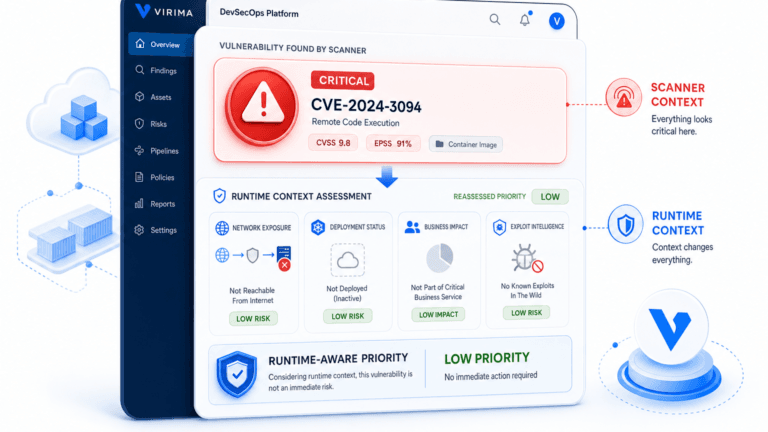
When discovery runs at the right frequency across the right protocol surface and writes results into accurate CI records with dependency relationships, the output is a service map — a live representation of how every CI in the estate relates to the services that depend on it. When a vulnerability is disclosed, the service map shows exactly which CI records match the affected software version, across every location in the estate, ranked by asset criticality and business service impact. That prioritization — combining Common Vulnerability Scoring System (CVSS) severity with asset criticality and service dependency context — converts a vulnerability list into a remediation plan that operations teams can execute against.
How Virima Delivers Runtime Truth for Retail and Logistics IT Teams
Retail and logistics IT estates require a CMDB that keeps pace with their rate of change — one that discovers assets across distributed physical locations without depending on manual updates, maps service dependencies across store, DC, cloud, and corporate infrastructure, and integrates with the ITSM platforms where IT operations work actually happens.
Virima’s discovery model runs high-frequency scheduled discovery cycles across physical, virtual, and cloud infrastructure, writing results into CI records that reflect the current state of the estate. For a retail organization managing hundreds of store locations, this means CI records capturing new store assets from the first discovery cycle after provisioning and inherited assets from acquired estates from the first cycle after network integration. For decommissioned assets, Virima maintains CI records through the full decommissioning lifecycle — with audit trails, sanitization records, and compliance evidence attached to the asset record — and flags records that have not been refreshed within a defined threshold for governance review. Decommissioning is a deliberate lifecycle step, not a passive one: CI records for assets that have gone silent require review and formal closure to prevent stale records from inflating change risk scores or producing false impact calculations.
Across cloud environments, Virima discovers resources in AWS and Azure with cloud-native depth at the resource level. Google Cloud Platform (GCP) is supported as a supplementary cloud environment. For organizations running containerized workloads — increasingly common in retail e-commerce and logistics platform operations — Virima tracks Kubernetes pods, services, and config maps as individual configuration items, providing CI-level visibility into container infrastructure that changes with every deployment.
Service dependency mapping through Virima’s ViVID service maps gives retail and logistics IT teams the visualization layer that makes CI data operationally useful. A ViVID map for a grocery chain’s e-commerce platform shows every CI in the dependency chain — application servers, databases, payment gateway integrations, CDN configuration, network infrastructure connecting the platform to store systems — as a navigable visual model. When an incident occurs, the service map is the first tool the incident response team opens. When a change is proposed, the service map is what the change planner uses to model dependencies before the change window opens.
For vulnerability prioritization across a distributed retail estate, Virima combines CVSS severity scores with asset criticality ratings and ViVID service map context to produce a prioritized remediation list operations teams can execute against. A critical vulnerability on a POS terminal at a single store carries a different remediation priority than the same vulnerability on the shared payment processing server that all 500 stores in the estate connect to. Service map context makes that distinction immediate rather than manually derived.
Virima integrates with ServiceNow, Jira Service Management, Ivanti, HaloITSM, Xurrent, and Hornbill, writing CI records and dependency data directly into the ITSM platforms where retail and logistics IT teams manage incidents, changes, and service requests. The accuracy of the CMDB is visible in the tools teams already use — not in a separate platform requiring a context switch to consult.
For retail and logistics organizations operating under SEC cybersecurity disclosure requirements, Virima’s continuously maintained CI records and service dependency maps provide the asset visibility infrastructure that makes a preliminary materiality scoping exercise operationally feasible within hours of detection.
The Estate That Knows Itself
Ahold Delhaize had eight months. The INC ransomware group had access to its internal file repositories for less than 48 hours. The asymmetry between how fast an attacker moves through an estate and how long it takes to establish what they touched is an asset visibility problem. In a retail or logistics environment spanning hundreds of locations, that visibility does not exist by default. It is built deliberately, maintained through continuous discovery, and tested against operational reality every time a store opens, an acquisition closes, a peak season starts, or a change event touches a system that was never in the CMDB. The organizations that can answer the materiality question in days are the ones that treated their asset inventory as a live operational system long before any breach gave them a reason to. That is what a runtime-accurate CMDB delivers across a distributed retail estate — and why the organizations that invest in it before an incident are structurally better positioned than those that discover its absence during one.
Frequently Asked Questions
What makes retail and logistics IT estates harder to manage than standard enterprise environments?
Retail and logistics estates span hundreds of physical locations — each running a mix of standard IT and operational technology like POS terminals, RFID readers, conveyor controllers, and cold chain sensors. Assets provision rapidly during store openings, acquisitions, and peak season scale-ups, and no two locations carry an identical technology stack. That physical distribution and operational velocity means the estate changes faster than any manual discovery process can track.
How does an incomplete CMDB create risk during a POS firmware rollout?
POS firmware compatibility depends on the hardware generation installed at each store. Hardware generations vary by store age, renovation cycle, and acquisition history. Without accurate CI records reflecting which hardware generation runs at which location, the rollout team has no reliable basis for scoping the update. An incompatible firmware version pushed to the wrong hardware generation takes POS terminals offline and stops payment processing at those stores.
What is the SEC’s four-day disclosure requirement and why does it depend on CMDB accuracy?
The SEC’s cybersecurity disclosure rule requires public companies to file a Form 8-K under Item 1.05 within four business days of determining that a cybersecurity incident is material. That materiality determination requires a preliminary scope — which systems were affected, what data they held, what downstream systems connected to the compromised environment. Every one of those questions is answered from the CMDB. Without an accurate, continuously maintained asset inventory, the materiality determination itself is delayed.
Why do peak season asset additions create long-term CMDB gaps?
Assets deployed for peak season — handheld scanners, portable RFID readers, temporary conveyor extensions, additional dock terminals — are provisioned quickly and often never formally entered into the CMDB. When the season ends, decommissioning depends on knowing what was added. Assets with no CI record have no decommissioning workflow. They remain on the network, outside change management oversight and security monitoring, until a change event or incident surfaces them.
How does vendor and third-party access expand the retail IT attack surface beyond the internal estate?
Retail environments carry significant third-party IT dependencies — POS software vendors with remote terminal access, pharmacy system providers, DC automation manufacturers with diagnostic access to conveyor controllers, and 3PLs operating WMS platforms on a retailer’s behalf. Each represents systems that may carry no CI record in the organization’s CMDB. When a breach enters through a vendor-managed system, the scope of what was touched is unknown at detection because those systems were never mapped as configuration items with documented network connectivity and dependency relationships.