Banking and Financial Services: Managing Software Licensing Across Trading and Risk Platforms

On a Monday morning, the IT asset management lead at an international investment bank receives an unannounced compliance audit notice from a major database vendor. Three weeks later, the audit findings present a $2.4 million true-up penalty.
The penalty stems from automatic cluster reconfigurations. During a period of heightened market volatility, high-frequency trading algorithms and risk analytics engines auto-scaled across virtualized host pools. The virtual machines migrated onto physical servers with higher CPU core counts and specialized hardware acceleration cards, triggering enterprise license tier upgrades across unmapped clusters.
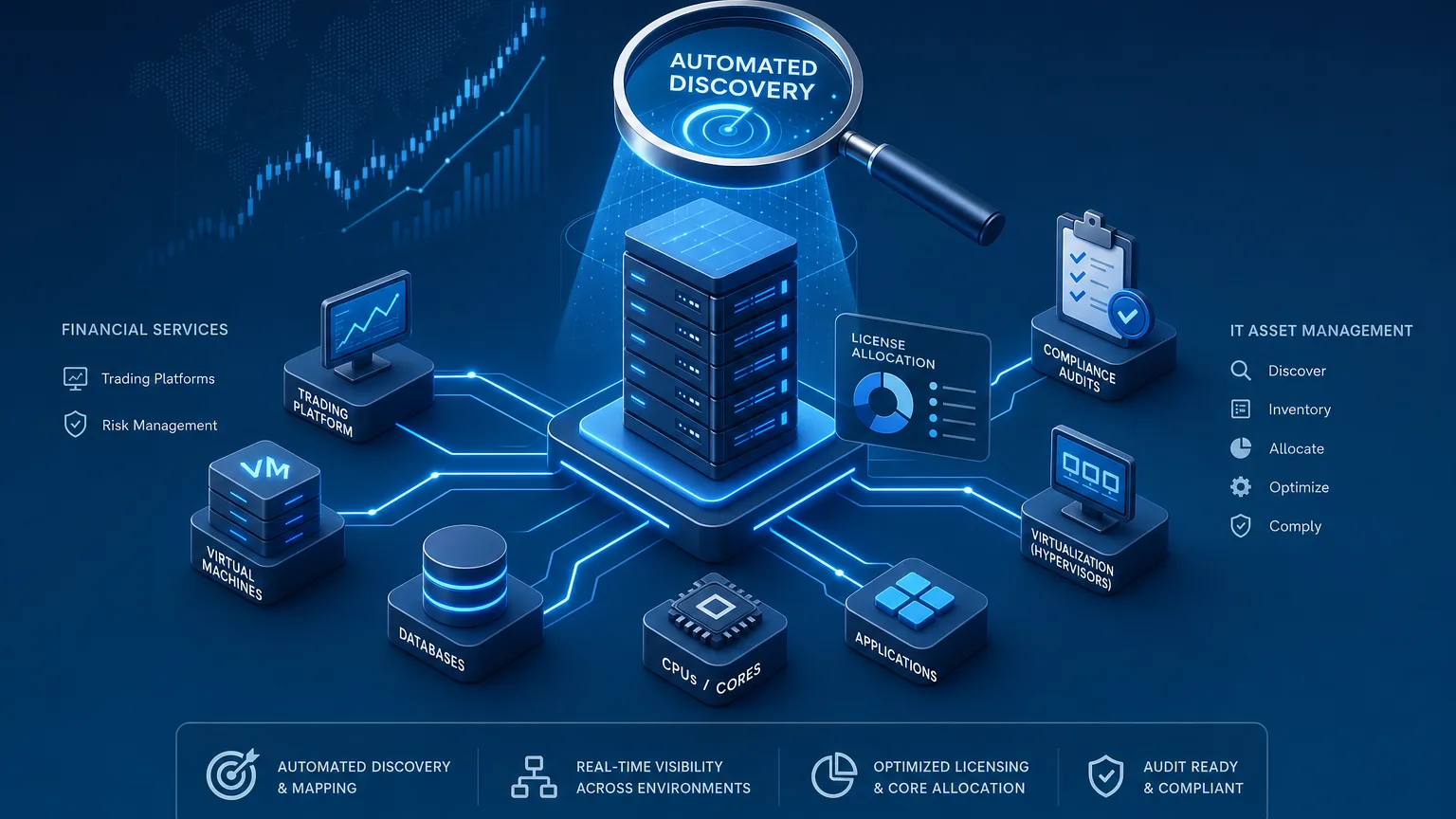
In capital markets and retail banking, ITAM managers and CMDB owners face extreme licensing complexity. Managing software licensing across trading and risk platforms requires automated discovery, core-aware configuration mapping, and an ITAM asset baseline built on actual runtime truth.
Why is software license management so difficult across trading and risk platforms?
Trading and risk systems rely on high-performance compute clusters, dynamic virtual machine migrations, and complex core-based licensing models. Without continuous automated discovery, IT asset managers lose visibility into hardware core changes, leading to severe vendor audit penalties and unbudgeted software license true-ups.
The Unique Software Licensing Challenges of Trading and Risk Infrastructure
Financial trading and risk management infrastructure operates under extreme performance requirements. Quantitative risk models, algorithmic trading engines, and market data feeds require massive computing power that scales up during trading hours and scales down overnight.
Regulatory oversight from bodies like FINRA requires financial firms to maintain rigorous recordkeeping across operational systems. While regulatory compliance focuses on transaction integrity, software vendor audits focus on processor architecture, virtualization boundaries, and user entitlements.
1. Complex Core-Based and User-Tiered Licensing Models
Commercial databases, middleware platforms, and proprietary risk modeling suites charge licensing fees based on physical CPU cores, virtual cores, or concurrent trading desk seats. Specialized financial analytics platforms often impose strict core-factor multipliers depending on host hardware architecture.
When risk models burst into hybrid cloud environments or local compute clusters to recalculate portfolio exposures before market close, physical core counts expand rapidly. If ITAM teams track these workloads using quarterly spreadsheets, license consumption outpaces recorded entitlements without warning.
2. Multi-Vendor Market Data and Analytics Feeds
Trading desks rely on real-time market data feeds, market analytics APIs, and trade execution gateways. Software licensing across these platforms involves a mix of server-side instances, individual terminal entitlements, and third-party data redistribution rights.
Because market data interfaces exist inside specialized middleware rather than standard desktop applications, traditional IT asset management scanners struggle to identify active connections. Unused terminal licenses and unmonitored data distribution feeds accumulate, draining department budgets through recurring maintenance fees.
How does virtualization drift trigger unbudgeted software audit penalties in banking IT?
Virtualization tools automatically move trading and risk workloads across physical host servers to balance performance. If a licensed application lands on a host server with more physical cores or un-isolated sub-clusters, software vendors treat the entire physical host pool as fully licensed, resulting in massive audit fines.
How Core Allocation and Virtualization Drift Trigger Millions in Audit Exposure
Software vendors regularly target financial institutions for compliance audits because financial networks feature dense virtualization, high core counts, and frequent hardware refresh cycles.
1. Hard Partitioning vs. Soft Partitioning Disagreements
Major database and enterprise software vendors enforce strict definitions regarding virtual server partitioning. Vendors frequently reject soft partitioning (such as standard hypervisor resource pools) as a valid boundary for license capping.
When hypervisors automatically balance workloads across physical cluster nodes, a database instance licensed for 16 cores can inadvertently inherit exposure to a 128-core physical host pool. Without automated discovery tools that capture exact hypervisor relationships and physical host topologies, ITAM teams cannot defend their Effective License Position (ELP) during vendor reviews.
2. Ghost Software Installs and Legacy Test Environments
Trading platform upgrades and risk engine testing require temporary staging environments. System engineers frequently clone production database instances and application servers to test low-latency execution builds.
Once testing completes, these virtual environments often remain running in secondary datacenters. Because enterprise software licenses apply to installed instances regardless of active usage, vendor audit scripts detect these ghost installations and bill the institution for full production software rights.
To eliminate software license audit risk and establish authoritative inventory, ITAM leaders implement discovery-sourced Trusted Runtime Truth.
Architecting Continuous ITAM and Discovery Across Financial Networks
Financial institutions require ITAM workflows that track software installations and hardware topology changes automatically, without impacting ultra-low-latency trading networks.
1. Agentless Hardware and Hypervisor Topology Discovery
Installing heavy monitoring agents on high-frequency trading servers is impossible due to strict latency and memory footprint constraints. Discovery mechanisms must be lightweight, non-intrusive, and highly accurate.
Agentless discovery uses native management protocols (WMI, SSH, SNMP, and hypervisor APIs) to gather system inventory during low-volume windows. Discovery tools query hypervisor managers, physical host chassis, virtual machine configurations, and installed software builds to construct an accurate hardware-to-software map.
2. Deep Process and Connection Inspection
Knowing that a server exists is insufficient for software license reconciliation. ITAM tools must verify whether installed software components are actively running, how many CPU cores are allocated, and which network ports exchange data.
Process-level discovery inspects active services, executable paths, and software build numbers. By mapping these execution details to physical host core densities, ITAM teams gain clear evidence of actual software consumption across both physical and virtual layers.
To evaluate how automated discovery integrates with enterprise ITSM platforms, explore the Virima integrations hub.
How does agentless discovery safely track software licenses on low-latency trading networks?
Agentless discovery queries hypervisor managers, host operating systems, and network switches using read-only administrative protocols during scheduled off-peak windows. It gathers exact CPU core counts, installed software builds, and active process records without injecting latency or installing software agents on production trading hosts.
Reconciling Software Entitlements with Discovery-Sourced Asset Truth
Building an audit-ready ITAM function requires joining physical discovery data with contract entitlements to establish an accurate Effective License Position (ELP).
1. Automated Core-to-Entitlement Matching
Manual reconciliation of processor core counts against complex software contracts takes weeks of spreadsheet analysis. Modern ITAM platforms automate this process by mapping discovered hardware configurations directly to contract entitlement terms.
When a hypervisor cluster expands or a host CPU upgrade occurs, the ITAM engine calculates the impact on available license pools instantly. IT teams receive immediate alerts when core consumption approaches contract limits, enabling proactive license reallocations before vendor audits occur.
2. Identifying Reclaimable Software Licenses
Over-licensing is as costly as under-licensing. In large financial institutions, thousands of software subscriptions and seat licenses remain assigned to departed employees, inactive trading desks, or decommissioned test clusters.
Discovery-sourced ITAM platforms compare active process execution data against assigned software entitlements. Unused seat licenses, idle market data feeds, and dormant database instances are flagged for harvesting, freeing up budget for high-priority technology initiatives.
Best Practices for Governing Software Licenses in Capital Markets IT
Financial IT organizations that successfully control software licensing costs follow a structured governance model that integrates automated discovery with daily IT operations.
- Map Hypervisor Boundaries Explicitly: Define hard-partitioned host clusters for high-value software, ensuring hypervisor auto-scaling rules cannot move licensed VMs onto unauthorized physical hosts.
- Run High-Frequency Core Scans: Schedule agentless discovery scans weekly across virtualized compute clusters to detect core allocation drift and unauthorized instance cloning early.
- Automate Staging and Test Environment Decommissioning: Tie virtual machine provisioning workflows to automatic expiration schedules so temporary risk-testing clusters de-allocate cleanly.
- Reconcile Effective License Positions Monthly: Compare discovered software installations and core counts against contract entitlements every month rather than waiting for annual vendor audit notices.
- Embed ITAM Data into Change Advisory Reviews: Require change management teams to review software licensing impact before approving physical host upgrades or VM cluster expansions.
Financial institutions seeking to optimize software licensing can evaluate automated discovery by requesting a Virima product demo.
Protecting Financial Budgets Through Discovery-Driven License Governance
As capital markets IT grows more complex through hybrid cloud adoption, containerized microservices, and high-speed risk analytics, manual software license tracking becomes impossible. Relying on outdated asset lists exposes institutions to millions in unbudgeted vendor audit penalties and wasteful license renewal spend.
By deploying continuous agentless discovery and core-aware ITAM workflows, banking IT leaders establish complete visibility over their software estate. They defend against vendor audits with verifiable runtime truth, eliminate ghost installations, and ensure every software dollar drives real financial performance.
Frequently Asked Questions
How does automated discovery track complex processor-core licensing models without installing intrusive agents on trading servers?
Automated discovery queries hypervisor APIs and host operating systems using read-only administrative credentials (WMI, SSH, SNMP) during low-traffic windows. It extracts physical CPU core counts, socket densities, and virtual machine assignments without placing software agents or runtime overhead on trading servers.
Why do traditional ITAM tools fail to manage software licenses across dynamic trading and risk environments?
Traditional ITAM tools rely on static asset databases and periodic agent polling that fail to capture real-time hypervisor migrations, container bursts, and core allocation changes. This visibility gap leaves unmapped software installations exposed during vendor audits.
How does Virima help financial institutions prepare for vendor license audits?
Virima maintains discovery-sourced hardware and software records that track exact physical host topologies, CPU core counts, running processes, and installed software builds. ITAM teams generate verifiable Effective License Position (ELP) reports instantly to defend against vendor audit claims.