IT Discovery in Pharma: Identifying Enterprise IT Assets for Regulatory Audit Scope

A pharmaceutical company can run thousands of enterprise IT assets across plants, labs, clinics, and corporate environments. Only some of those assets support manufacturing, quality, laboratory work, clinical activity, regulated records, or validated applications. When auditors ask about relevant computerized systems, they are not asking for a dump of every device on the network.
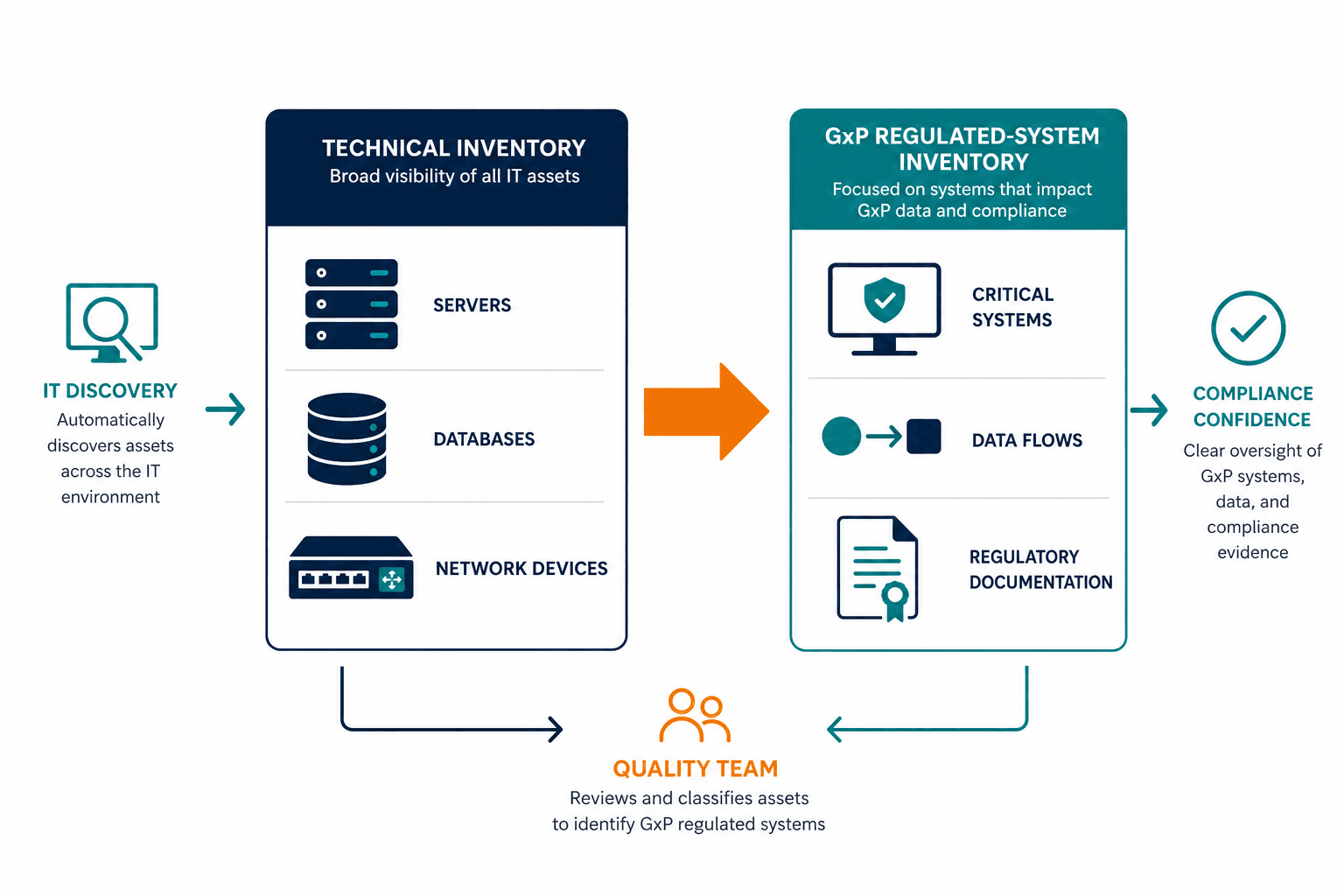
The harder problem is quieter. Teams must avoid overlooking supporting technology when they set regulatory scope. A complete technical inventory and a defensible regulated-system inventory are not the same list. IT discovery in pharmaceuticals earns its role by establishing the technical estate from which defensible GxP scope decisions can be made. Quality and system owners decide which systems matter.
Regulatory Scope Starts with Computerized Systems, Not Hardware Categories
EU GMP Annex 11 focuses on computerised systems used in GMP activities. It expects an up-to-date inventory of relevant systems and their GMP functionality. For critical systems, it also expects current descriptions of physical and logical arrangements, data flows, interfaces, hardware and software prerequisites, and security measures. That framing starts with regulated systems and function, not with a blanket list of every computer in the company.
The FDA Part 11 Scope and Application guidance takes a related risk-based path. Part 11 centers on electronic records created, modified, maintained, archived, retrieved, or transmitted under applicable requirements. FDA recommends assessing computerized systems against their impact on regulated requirements, record integrity, product quality, and safety, rather than treating every computer the same way.
A server is not GxP-relevant because it is a server. Relevance follows a chain: what the asset hosts, which process that system supports, which records it creates or maintains, and which requirements apply. Hardware category alone does not answer those questions.
Does every enterprise IT asset in a pharma company fall under GxP scope?
No. Regulatory scope follows computerized systems and electronic records that support regulated processes, not every device on the network. EU GMP Annex 11 (EudraLex Volume 4) expects an up-to-date inventory of relevant systems and GMP functionality. FDA Part 11 guidance favors documented risk assessment based on impact to regulated requirements, quality, safety, and record integrity, not a blanket computer inventory.
A Regulated Application Sits on Non-Obvious Infrastructure
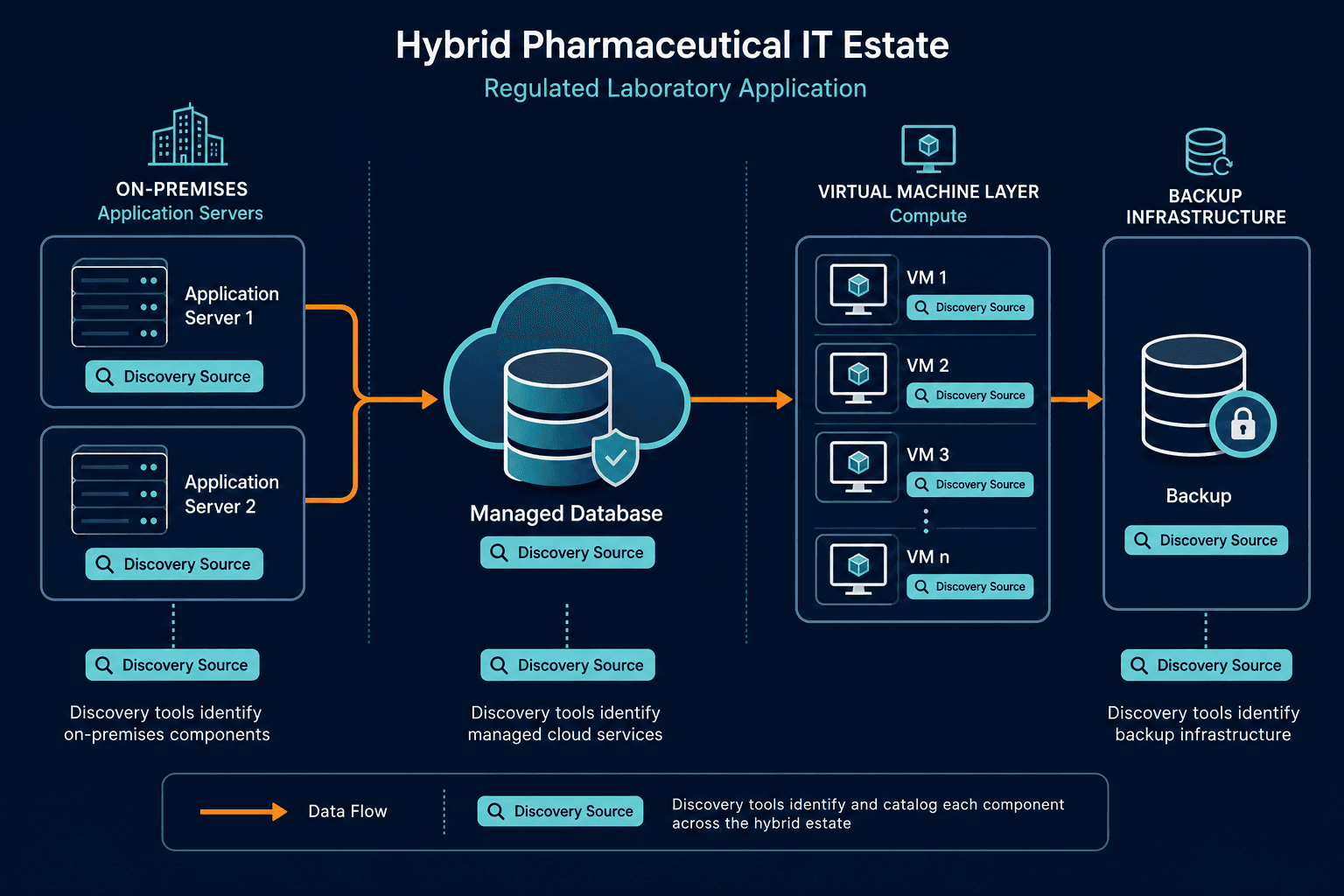
A validated laboratory, manufacturing, or quality application rarely lives on a single box. It usually depends on application servers, databases, virtual machines, storage, network paths, identity services, middleware, cloud resources, and backup platforms. Some of those components sit well outside the application team’s day-to-day view.
Annex 11’s expectations for critical-system descriptions make that dependency chain explicit. Physical and logical arrangements, data flows, interfaces, and hardware or software prerequisites are all part of how a regulated system is understood. Regulatory relevance can therefore propagate downward from the validated application into supporting infrastructure.
Exact regulatory treatment still depends on the organization’s documented risk assessment. Pharmaceutical IT asset discovery can surface candidate infrastructure. It does not replace that assessment.
The Application Inventory and the Technical Estate Can Drift Apart
A validated-system register may state that an application runs on a defined set of hosts, databases, and interfaces. Infrastructure does not stay still. Virtual machines migrate. Databases move. New servers appear. Cloud services replace on-premises hosts. Software versions change after patches or upgrades.
Manual system inventories can remain procedurally tidy while their technical assumptions age. Audit readiness then turns on a practical test: does documented system scope still match observed infrastructure? When the two diverge, classification and control decisions rest on incomplete technical context.
| Documented system view | What often changes underneath | Risk if left unreconciled |
|---|---|---|
| Named application and owners | Hostnames, VM placements, cloud accounts | Scope written against obsolete hosts |
| Approved interfaces and data flows | Middleware, APIs, shared services | Dependencies missing from system description |
| Stated hardware and software prerequisites | OS builds, database versions, storage tiers | Controls assessed on stale configuration |
| Environment boundaries (prod, qual, dev) | Clones, lifts, hybrid paths | Wrong environment treated as in-scope truth |
Discovery Should Find Candidates, Not Declare GxP Scope
Automated pharma IT discovery can identify hardware, operating systems, software, databases, services, network devices, virtual resources, cloud assets, and configuration attributes. It can also record technical relationships and a last-verified state. It cannot know, on its own, that a given server is GxP-critical.
That judgment needs organizational context: intended use, process impact, record impact, and risk assessment by quality and system owners. Treating the scanner as the classifier collapses two different jobs into one tool.
| Discovery establishes | Quality / system owners establish |
|---|---|
| Asset exists | GxP relevance |
| Technical configuration | Intended use |
| Software installed | Regulatory impact |
| Location / network identity | System classification |
| Technical relationships | Criticality |
| Last verified state | Required controls |
GxP asset inventory work earns its place by populating the left column with current evidence. Classification stays firmly on the right.
Can automated IT discovery decide which pharma assets are GxP in scope?
No. Discovery identifies technical candidates: hosts, software, databases, cloud resources, and relationships. GxP relevance, intended use, criticality, and required controls come from documented risk assessment by quality and system owners. Mixing those responsibilities turns a technical inventory into an unfounded regulatory claim, and creates defensibility problems during inspection.
Unknown Assets Create an Audit-Scoping Problem
An unknown server or virtual machine is not automatically a compliance finding. The mechanism is narrower and more practical. If undocumented infrastructure supports a regulated computerized system, teams may already have made validation, access-control, backup, security, and change-control decisions without that dependency in view.
FDA’s Part 11 scope guidance points organizations toward risk assessment based on effects on regulated records, quality, and safety. Discovery for pharma regulatory audit readiness helps surface technical gaps that still need classification. It does not convert every gap into a regulatory conclusion on its own.
Cloud and Virtualization Make System Boundaries Less Visible
In older estates, one application often mapped cleanly to a small set of physical servers. Modern life-sciences platforms can span virtual machines, cloud accounts, managed databases, storage services, APIs, containers, and shared infrastructure. Physical boundaries move. Regulatory system boundaries do not disappear when the hosting model changes.
AWS guidance on Annex 11 within its Healthcare Industry Lens maps inventory expectations to detailed configuration, operating-system, software, and application information in cloud environments. The implementation detail is cloud-specific. The principle is not. Virtualization changes where components live without removing the need to know which components support regulated systems.
Audit Preparation Should Not Become an Annual Rediscovery Exercise
Rebuilding the estate only when an inspection is scheduled is a weak operating model. Annex 11 calls for an up-to-date system inventory. That language points to maintenance, not a once-a-year scramble.
Discovery for pharma IT audit readiness supports that maintenance by verifying the underlying technical environment on a schedule the organization defines. No regulation cited here dictates a universal discovery frequency. Cadence remains risk-based and local. The goal is simpler: audit preparation should confirm knowledge teams already hold, not reconstruct the estate from scratch under time pressure.
How often should pharma organizations run IT discovery for Annex 11 readiness?
Annex 11 (EudraLex Volume 4) expects an up-to-date inventory of relevant computerized systems. It does not prescribe a single discovery interval. Organizations set cadence based on risk, infrastructure change rate, and environment complexity, the goal being that audit preparation validates current knowledge rather than rebuilding the technical estate under inspection pressure.
Source and Freshness Matter When Inventory Becomes Audit Evidence
A thin inventory says only that a server exists. A useful technical record also shows how the asset was identified, when it was last verified, which source supplied each attribute, and whether sources disagree. “Server X exists” is stronger when teams can show last observation time, source method, and configuration detail alongside it.
That explainability supports later classification work. It also helps IT and quality teams reconcile competing spreadsheets, CMDB rows, and cloud consoles without pretending every source is equally authoritative.
| Question | Required context |
|---|---|
| What exists? | Hardware, VM, database, software, network, cloud |
| Where is it? | Site, environment, cloud account, network segment |
| What runs there? | Applications, services, software versions |
| What does it support? | Computerized system or application |
| How was it found? | Discovery source and method |
| When was it verified? | Freshness timestamp |
| Is it regulated? | Documented classification by the responsible team |
| Why is it regulated? | GxP, process, or record impact |
| What changed? | Current versus previous technical state |
Discovery populates existence, location, runtime software, technical relationships, source, freshness, and change. The regulated yes/no and the rationale stay with the responsible owners.
A Practical Workflow for Identifying Audit-Relevant IT Assets
A workable sequence keeps classification after context, not inside the scanning engine.
Discover. Identify enterprise infrastructure across the environments that can support regulated work.
Reconcile. Merge duplicates and resolve conflicting technical attributes across sources.
Relate. Connect infrastructure to applications and system dependencies so supporting components become visible.
Classify. Quality and system owners determine GxP or other regulatory relevance using documented criteria.
Validate. Confirm that documented system scope still matches current infrastructure.
Maintain. Repeat discovery as systems and infrastructure change, on a risk-based cadence.
MHRA GxP data integrity guidance makes a useful boundary explicit here. Systems may contain only specific GxP-applicable elements. Scope is not always synonymous with the whole platform name. Classification therefore needs both technical detail and process context, not platform labels alone.
See the technical layer behind regulated-system scope
Explore how discovery-sourced Trusted Runtime Truth gives quality and IT teams a current estate to classify against, without turning the scanner into the GxP decision engine.
Where Virima Fits Under GxP Classification
Virima sits under the organization’s GxP system classification process as the technical discovery and reconciliation layer. It does not replace quality ownership of scope.
Virima Discovery supports agent-based, agentless, and API-based collection across physical infrastructure, virtual machines, cloud resources (AWS and Azure), network devices, storage, databases, applications, and installed software. Discovered attributes carry source information and a last-verified timestamp. When sources disagree, configured authority rules reconcile attributes into a single technical record in the CMDB. Relationship context connects infrastructure to the applications and services owners define.
| Operating need | How the technical layer helps |
|---|---|
| Unknown infrastructure | Multi-method discovery (agent, agentless, API) |
| Cloud and virtual estate | Platform and API discovery across hybrid environments |
| Conflicting inventories | Source-authority reconciliation into one CI record |
| Audit preparation | Source and freshness traceability on attributes |
| Infrastructure change | Recurring, scheduled discovery cycles |
| System documentation support | CMDB relationships and configuration context |
Boundary. Virima does not determine whether an asset is GxP-regulated, validate computerized systems, or certify regulatory compliance. It provides current technical evidence that quality, validation, security, and system-owner teams use when they define and maintain regulated system scope.
European Commission materials show a 2025 stakeholder consultation on revisions to Annex 11 and related GMP texts. Until a revised annex is finalized and applicable, organizations should treat current Annex 11 expectations as the working baseline.
Keeping Technical Inventory Current Enough for Scope Decisions
Regulatory teams determine which computerized systems matter. That judgment is only defensible when IT can first show what infrastructure exists and which regulated systems depend on it. Pharmaceutical IT asset discovery establishes candidates and freshness. Classification assigns regulatory meaning. Reconciliation and relationships keep the two views from drifting apart as the estate changes.
Pharma audit readiness does not begin with a broad claim about “complete visibility.” It begins with a maintained technical population, clear ownership of GxP decisions, and evidence strong enough to explain both what was found and what was judged in or out of scope.
Put current infrastructure under your classification process
Request a demo to see how Virima discovery, source tracking, and CMDB reconciliation support life-sciences teams preparing regulated-system inventories.
Frequently Asked Questions
What is the difference between a technical IT inventory and a GxP computerized system inventory?
A technical inventory lists what exists in the estate: hosts, software, databases, network devices, and cloud resources. A GxP computerized system inventory lists systems relevant to GMP or related regulated work, including functionality and, for critical systems, arrangements and interfaces expected under Annex 11. IT discovery in pharmaceuticals feeds the first. Quality and system owners produce the second through documented risk-based classification.
Why can a complete network scan still miss audit-relevant scope?
Scans find technical objects. Regulatory relevance depends on process support, records, and documented risk assessment. The same server class can host a validated lab system, a standard intranet site, or a non-regulated administrative workload. Without relating infrastructure to computerized systems and owner classification, a full scan is an incomplete basis for regulatory scope decisions.
How should pharma teams handle infrastructure that supports only part of a platform?
MHRA GxP data integrity guidance notes that systems may contain only specific GxP-applicable elements. Teams should classify based on those elements, their interfaces, and record impact, not solely on the platform brand name. Technical discovery still matters so partial dependencies remain visible before classification decisions are locked.
Does Virima decide GxP scope for pharmaceutical IT assets?
No. Virima provides multi-method discovery, source and freshness attributes, reconciliation, and CMDB relationship context. Quality, validation, security, and system owners retain GxP classification, computerized system validation, and compliance decisions. Virima supplies current technical evidence that those teams use when defining and maintaining regulated system scope.
What should life-sciences teams verify before an inspection beyond the system list?
Confirm that documented hosts, interfaces, and prerequisites still match observed infrastructure. Verify that discovery sources and last-verified timestamps are explainable. Confirm that classification rationale is still owned by the responsible team. Annex 11’s up-to-date inventory expectation is harder to defend when the technical estate under the list has drifted without reconciliation.