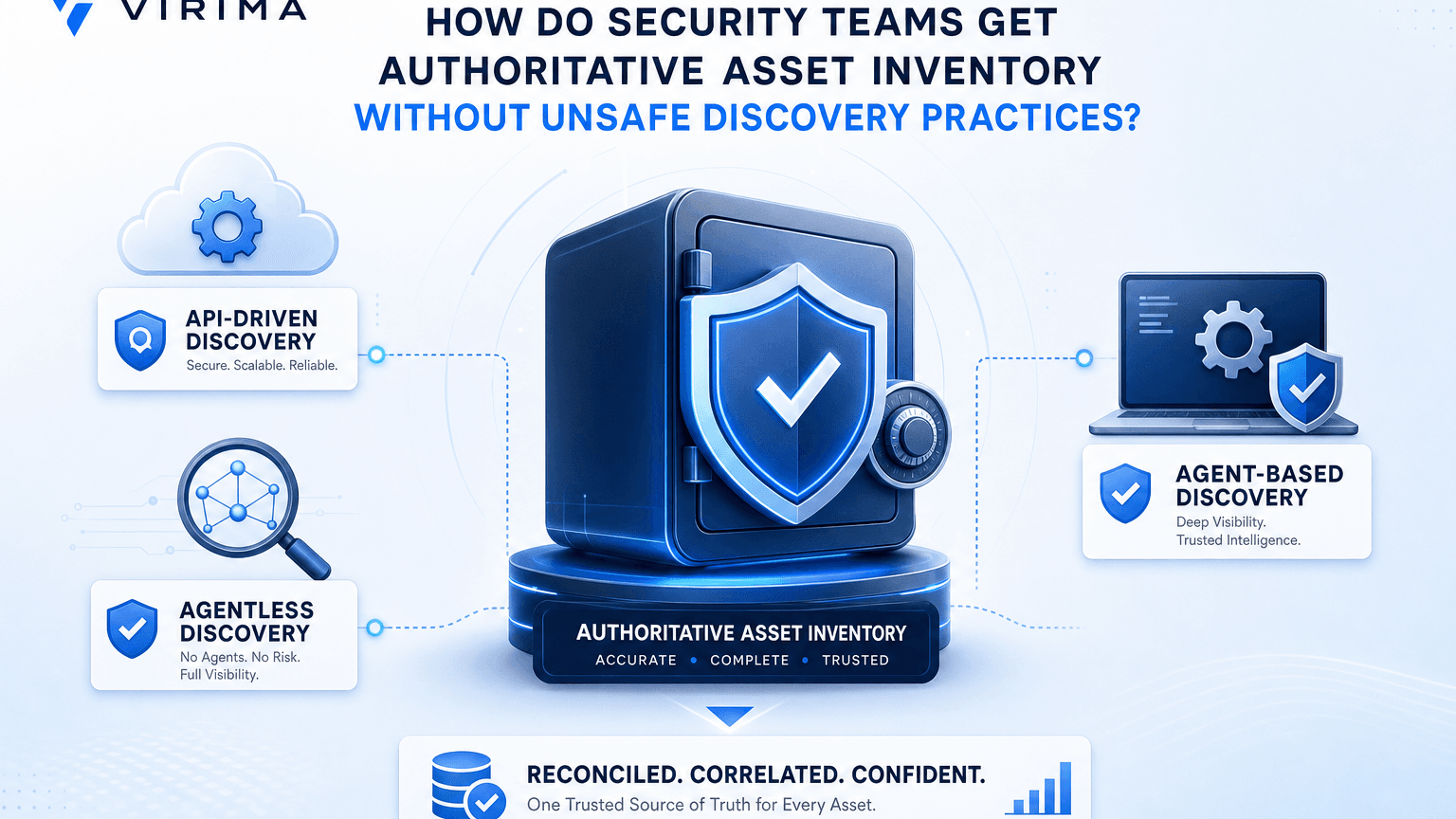
How Do Security Teams Get Authoritative Asset Inventory Without Unsafe Discovery Practices?

A vulnerability scan reaches an unpatched infusion pump on a hospital network, and the pump drops offline mid-shift. Nothing malicious happened. The device received traffic it was never built to handle, and now security owns an outage instead of a device count. That tradeoff shows up wherever active scanning meets legacy servers, industrial control systems, or IoT hardware that cannot absorb unexpected packets. Security teams get authoritative asset inventory without unsafe discovery practices by combining credential-aware agentless collection, API-driven cloud and platform integrations, and agent-based inventory where it fits. Every source then gets reconciled into one owned configuration record — no single aggressive sweep gets trusted alone.
How do security teams get authoritative asset inventory without unsafe discovery practices?
They combine agentless credentialed collection, API pulls from cloud and identity platforms, and agent-based inventory where endpoints allow it, then reconcile results into a current CMDB with owners and business function. Aggressive active scans stay scoped. Fragile OT, medical, and legacy segments use safer methods so inventory completeness does not create operational outages.
Why active scanning puts certain assets at risk
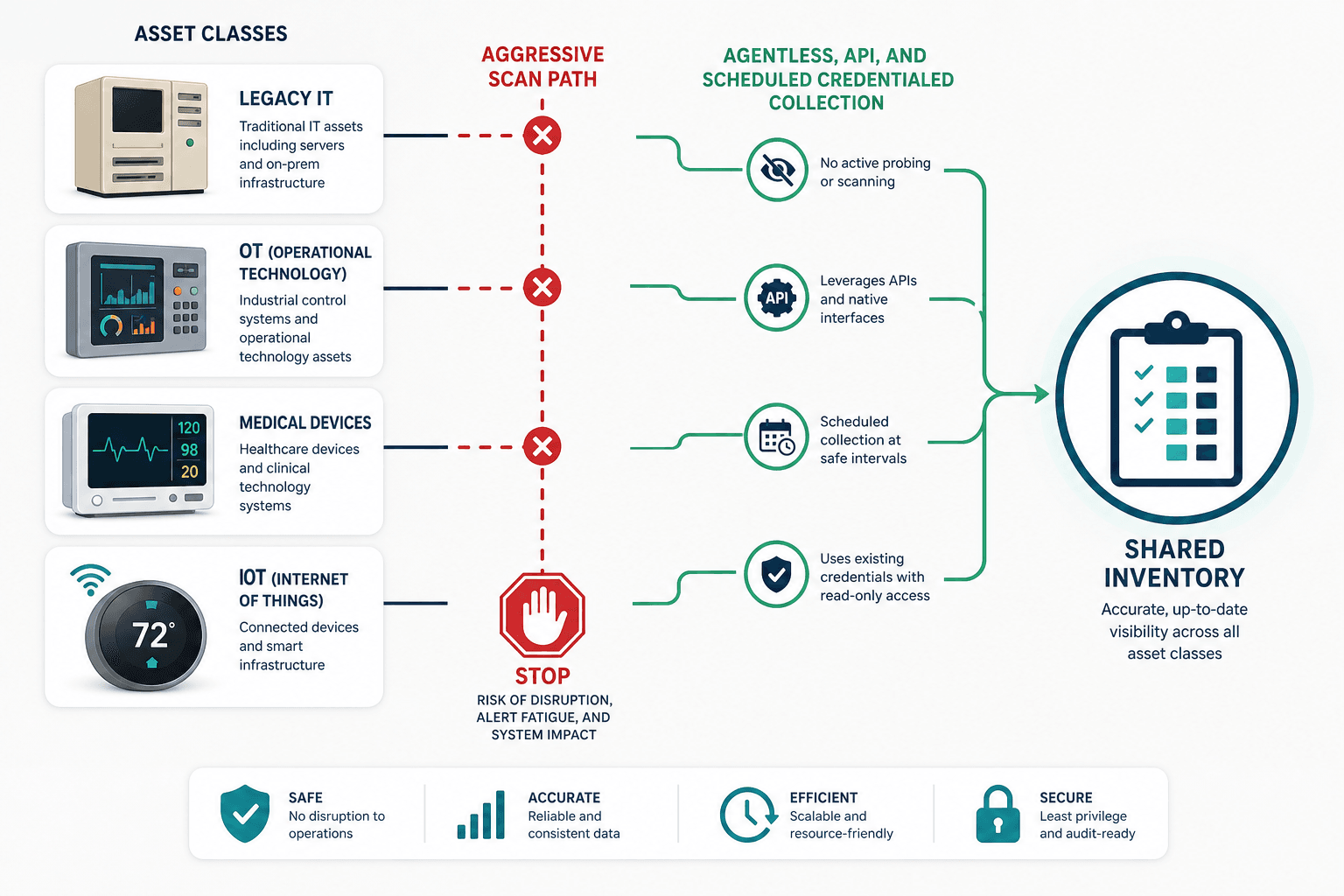
Active scanning sends unsolicited traffic at a target to provoke a response. That is useful on hardened IT segments that can absorb it. It is a different story against legacy servers, medical devices, and industrial control systems that were never built for unexpected requests.
The risk is not that the scanner is “malicious.” The risk is that the target has little capacity to handle traffic outside its design envelope. Security still needs a current, attributed inventory, so the job is to get that inventory without making discovery itself the incident.
This is not a preference for caution over accuracy. It is a design choice about which signals are safe enough for which asset classes. It is also a decision about how those signals become authoritative when no single method sees everything. Several asset classes break the basic assumption that a target can absorb unexpected traffic. For a closer look at where that assumption holds and where it breaks, see Virima’s comparison of active and passive scanning in IT environments.
Legacy servers and appliances
Many still run unsupported operating systems. Vendor patches for unexpected traffic handling never arrive. A scan profile that is routine on modern servers can overwhelm older stacks.
Industrial control and OT equipment
OT devices are engineered for stable, predictable input. NIST SP 800-82 Revision 3, the Guide to Operational Technology (OT) Security, treats OT environments as distinct from general IT. It discusses safer combinations of passive and active techniques when teams must inventory or validate configurations. The point for SecOps is practical: scan policy that is normal on a corporate VLAN can be unsafe on a control network.
Passive monitoring is often the safest single method on these segments, but it only sees traffic that actually crosses the wire — idle controllers and off-cycle equipment can stay invisible indefinitely, so passive observation alone cannot carry the authoritative bar here.
Medical devices
Regulatory and vendor constraints often freeze device software at a certified state. Unexpected interaction is unvalidated behavior for that device class. Inventory programs that treat every IP the same way push clinical equipment into failure modes IT never tested.
Passive monitoring fits many clinical segments for the same reason, but it still only counts devices that generate traffic during the window observed — an idle bedside monitor or an off-shift device can go uncounted, so passive alone isn’t authoritative here either.
IoT and embedded devices
Minimal firmware often has no graceful handling for traffic outside a narrow protocol set. The device treats every packet as expected. Active scanning breaks that design by definition.
Each category shares one property: the device was not built as a general-purpose network citizen. Active scanning against it is a change event, not a free read.
That risk compounds industry-wide: 73% of CISOs report security incidents tied to unknown or unmanaged assets, according to 2025 research from Trend Micro reported by CSO Online.
CISA’s Binding Operational Directive 23-01 puts federal agencies on the hook for accurate, timely asset visibility and vulnerability detection. Enterprise SecOps face the same pressure without a BOD number on the letterhead: boards and insurers still ask what you run and how you know. Completeness remains mandatory. Unsafe methods are optional.
What authoritative inventory actually requires
An inventory earns the word authoritative when it meets three conditions, not when it lists more devices than last quarter.
| Requirement | What it means | What it prevents |
|---|---|---|
| Current | Reflects the environment as it exists after recent discovery cycles, not a one-time baseline | Ghost assets and missed new assets |
| Attributed | Every in-scope asset has a named owner and a documented business function | Findings nobody can route or fix |
| Multi-sourced | Built from more than one discovery method and cross-checked | Blind spots locked to a single technique |
No single method satisfies all three alone. Only 43% of organizations use dedicated tools to proactively manage attack surface risk, according to the same 2025 report cited above, and that gap is exactly why single-method inventory programs keep missing things.
Agentless discovery depends on working credentials and reachable management protocols such as WMI, SSH, and SNMP. It avoids installing new software on every endpoint, yet it only sees what those credentials can reach.
API-driven discovery queries cloud providers, identity platforms, and SaaS admin surfaces for records the provider already maintains. It is authoritative for what that API exposes. It does not invent on-prem OT that never appears in a cloud console.
Agent-based discovery installs software the endpoint expects and controls. The risk profile is deployment and compatibility, not unsolicited probe traffic. Agents still miss devices you cannot or will not instrument.
For security teams specifically, the practical distinction is risk type: agentless discovery reads a device through existing management credentials without installing anything, so its risk is credential scope. Agent-based discovery installs software the endpoint runs locally, so its risk is deployment and compatibility. Neither sends unsolicited probe traffic the way active scanning does. See Virima’s breakdown of agent-based vs. agentless discovery for how the tradeoffs compare side by side.
Industry designs also use passive observation of traffic already on the wire. That can reduce probe risk on fragile segments. Passive windows miss idle devices that never speak during the observation period. Product teams still need other sources to close those gaps.
Authoritative asset inventory without unsafe discovery practices therefore means a program design, not a favorite scanner checkbox. You pick methods by asset class, throttle or exclude unsafe active techniques where they do not belong, and reconcile every source into one record security can defend.
See how teams establish trusted runtime truth so inventory stays current, attributed, and multi-sourced without treating every segment like a lab VLAN.
What makes an asset inventory authoritative for security teams?
Authority requires currency after recent discovery cycles, named owners and business function on each in-scope asset, and multi-source collection that cross-checks blind spots. A longer device list from one aggressive scan is not enough if owners are missing or fragile systems were put at risk to collect the list.
Safer method mix SecOps can defend
Scope active techniques deliberately
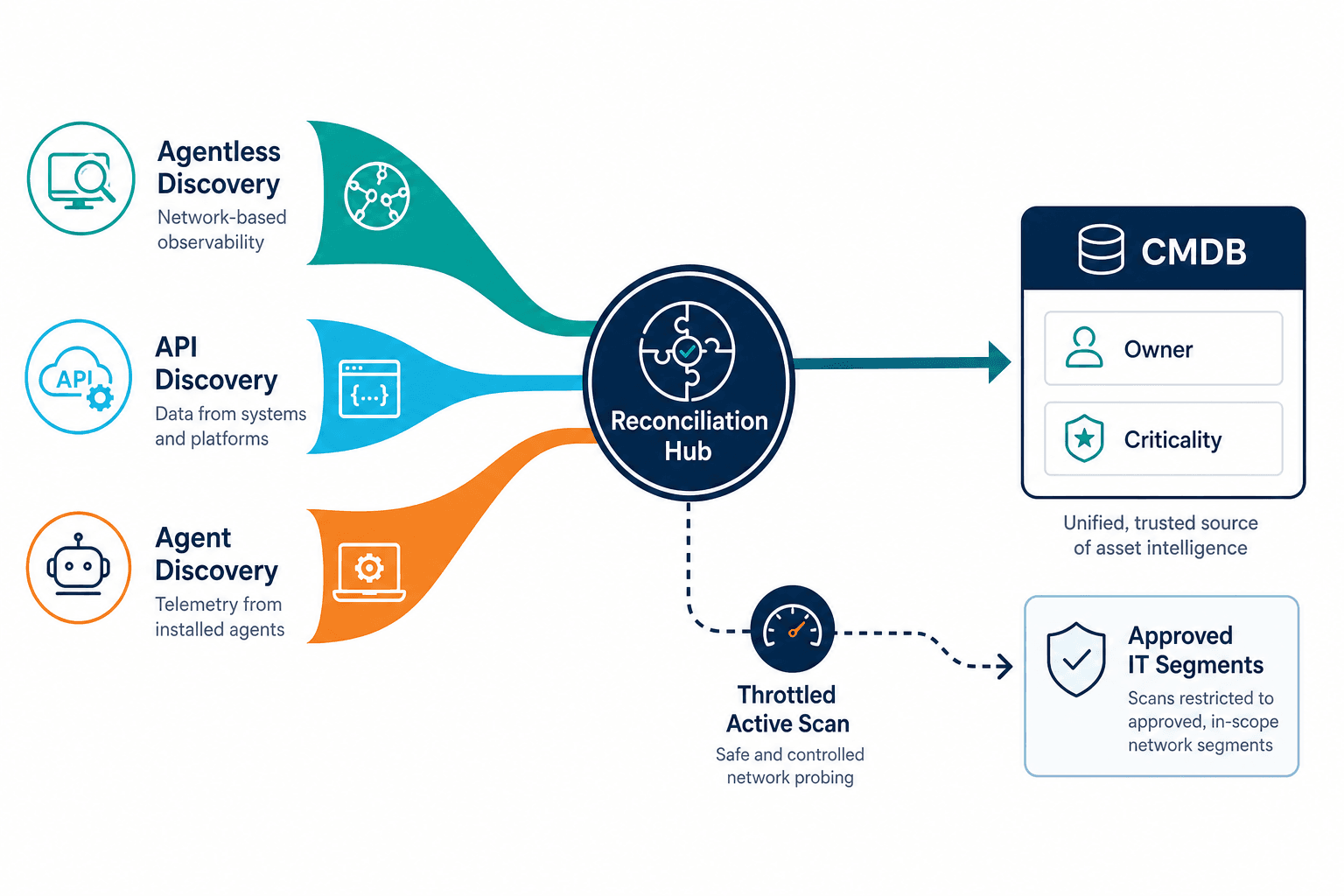
Keep aggressive port sweeps and unthrottled vulnerability probes on segments engineered for them. Document exclusions for OT, clinical, and brittle legacy zones. When active checks are required, use OT-aware tooling, maintenance windows, and vendor-safe profiles rather than copying the corporate IT scan template.
Prefer agentless and API where probes are the hazard
Credentialed agentless collection uses management channels the estate already runs. API inventory pulls authoritative cloud and SaaS state without spraying packets at every address. Together they cover large shares of modern hybrid estates without treating every IP as a scan target.
Use agents where depth beats network noise
Endpoints that can run agents report hardware, software, and configuration detail the network never fully reveals. That depth supports vulnerability and compliance workflows when the install path is approved.
Raise cadence instead of living on a weekly snapshot
The same CISA directive cited above stresses timely asset visibility, not a static annual binder. High-frequency scheduled discovery cycles repeat on a tight cadence rather than a single weekly pass. That shrinks the gap between “what we think we have” and “what is live,” without requiring constant uninterrupted probing of every fragile device.
Reconcile into a CMDB security actually queries
Raw discovery feeds are not the inventory SecOps defends to audit, IR, or insurance. Multi-source reconciliation into a CMDB creates one CI identity, ownership fields, and relationship context. Vulnerability, IR, and change teams then share the same record instead of three spreadsheets.
How Virima supports this without unsafe defaults
Virima’s IT discovery is built around agent-based and agentless collection, cloud inventory across AWS and Azure, and multi-source reconciliation into the CMDB. High-frequency scheduled discovery cycles refresh what exists without claiming continuous real-time passive monitoring. Teams tune method and credential scope by environment so fragile classes are not treated like commodity servers. See how Virima simplifies agentless asset discovery for the credential and protocol details behind that collection method.
Once service definitions are provided (manually, by import, or via architecture tools), ViVID™ builds service maps that show dependency views, so a newly found CI shows business impact, not only a hostname. ITSM connections such as ServiceNow, Jira, and Ivanti stay on one path through Virima’s integrations hub so ownership and tickets meet the same configuration item.
That stack does not replace OT-specialist passive sensors or clinical-device programs where those are required. It gives SecOps a discovery-fed authoritative layer for hybrid IT and cloud that vulnerability management, IR, and governance can share, while unsafe one-size active scanning stops being the default path to “more complete.”
Build authoritative asset inventory from agentless, agent, and API discovery cycles your fragile systems can survive. See how Virima reconciles those sources into a CMDB security can actually use.
Build authority without making discovery the outage
SecOps is scored on coverage, mean time to remediate, and whether the inventory survives the next audit or incident. Unsafe discovery practices buy a temporary device count and spend it as operational risk on the worst day.
The durable pattern is narrower: classify where active techniques are safe, fill the rest with agentless, API, and agent sources, raise discovery cadence, and reconcile into attributed CMDB records. Authoritative asset inventory without unsafe discovery practices is that program, run on purpose.
When you want that design in one discovery-fed system security already trusts for ownership and impact, schedule a demo.
Frequently Asked Questions
What counts as an unsafe discovery practice?
Any method that sends traffic a target device was not designed to receive is unsafe for that device, even if the same method is fine elsewhere. Full port scans, aggressive vulnerability probes, and unthrottled sweeps are common examples against OT, medical, and legacy IT equipment.
Does passive discovery ever miss assets that active scanning would catch?
Yes. Passive observation only sees assets that generate traffic during the monitoring window. Idle or off-schedule devices can be missed. Authoritative programs combine passive designs where used with API-driven and agentless or agent sources rather than relying on one window alone.
Is agent-based discovery the same as active scanning?
No. Agent-based discovery installs software on a device that reports its own state under local control. Active scanning sends unsolicited network traffic from outside. Agents carry deployment and compatibility risk. Active scans carry traffic-disruption risk on fragile targets.
Does Virima’s agentless discovery require installing anything on OT or medical devices?
No. Virima’s agentless collection uses existing management credentials and protocols already running on the network; nothing is installed on the endpoint. Fragile OT and medical devices can be included in the CMDB through credential-based reads or API/cloud pulls without adding software or probe traffic to the device itself.
How does Virima help security teams avoid unsafe discovery defaults?
Virima combines agent-based and agentless discovery with AWS and Azure inventory, high-frequency scheduled cycles, and multi-source CMDB reconciliation so coverage does not depend on one aggressive scan profile. Service maps build after service definitions are supplied, and ITSM tools connect through a single integrations hub.