Storage and HCI Topology Discovery in Virima 6.1

Storage underpins everything, yet without proper storage and HCI Topology Discovery, it remains the most opaque layer in modern infrastructure.
Every VM, every database, and every application ultimately writes to disk. However, despite this central role, storage is often the least visible component inside most CMDB environments.
When performance degrades, teams typically inspect compute first. When outages occur, they review application logs.
Yet when storage latency spikes or a controller fails, the impact radiates across the entire stack often without clear visibility into the underlying topology.
The issue is not storage technology itself. The issue is visibility.
Most organizations lack complete storage topology inside their CMDB. As a result, storage exists as a black box. Dependencies are unclear. Relationships are incomplete. And service maps stop at the hypervisor or server layer. Enterprise Management Associates (EMA) research published in 2025 confirms that storage infrastructure remains the most underrepresented layer in enterprise CMDBs, contributing to slower incident resolution and incomplete service maps.
Virima 6.1 addresses this blind spot directly. With Beta storage and HCI Topology Discovery, enterprises can uncover full storage topology for Nutanix, NetApp ONTAP, and HP MSA environments. They can publish those relationships into both the CMDB and Business Service Maps.
TL;DR : What storage & HCI topology discovery delivers
- Virima 6.1 introduces Beta storage and HCI Topology Discovery for Nutanix, NetApp ONTAP, and HP MSA.
- Full topology is discovered via vendor APIs and modeled in the CMDB.
- Business Service Maps now extend from the application down to the physical disk.
- With ViVID, Virima Visual Impact Display, teams can overlay live operational data onto those maps: open incidents, pending changes, recent changes, and vulnerabilities pulled from integrated ITSM platforms, displayed in context against the specific storage CI they affect.
- Storage constructs such as clusters, nodes, pools, volumes, LUNs, snapshots, and disks are visible.
- Incident response improves because teams can trace performance issues directly to storage components.
- Change impact analysis becomes safer with full dependency visibility.
- Capacity planning and disaster recovery validation become data-driven instead of assumption-based.
- Requires Discovery Application version 6.1.4023+.
In short, storage discovery eliminates one of the last major blind spots in enterprise CMDB environments.
Why storage topology gets missed (and why it hurts)
The nature of storage complexity
Storage is not a simple infrastructure.
Traditional storage arrays contain:
- Controllers managing I/O and cache
- Disk shelves holding HDD, SSD, or NVMe drives
- Storage pools aggregating capacity
- Volumes and LUNs carved from pools
- Snapshots providing point-in-time copies
Each layer depends on another. However, most discovery tools do not model this hierarchy.
Hyper-Converged Infrastructure (HCI)
HCI makes topology even more complex.
In platforms like Nutanix, each node combines compute, storage, and networking. Storage is virtualized across nodes into a distributed fabric. VMs run on the same nodes that provide their storage.
Therefore, storage and compute are tightly coupled. Dependency mapping becomes critical.
However, traditional CMDB structures assume clean separation between layers. HCI blurs those boundaries — and many CMDBs are not designed to handle that.
Without proper HCI discovery, topology becomes fragmented and incomplete.
Operational consequences of storage blind spots
Slower incident resolution
Imagine VM performance degrades. Monitoring tools show storage latency. However, the CMDB shows no storage layer.
Teams must manually trace:
VM → Datastore → Volume → Array → Disk
This manual correlation increases MTTR and introduces guesswork.
With accurate storage discovery, that chain is visible instantly.
Inaccurate change impact assessment
Consider a storage team planning to upgrade a NetApp controller or expand an HP MSA pool.
If the CMDB lacks storage topology, there is no automated way to identify:
- Which VMs rely on that volume
- Which applications depend on those VMs
- Which business services may be affected
Change approvals proceed without full understanding. Outages follow.
Poor capacity and lifecycle planning
Without centralized storage topology:
- Capacity utilization across arrays is unclear
- Over-provisioned pools remain unnoticed
- Aging hardware is not tied to business services
As a result, organizations either overspend or react too late.
Weak disaster recovery posture
Disaster recovery depends on replication, snapshots, and volume relationships.
However, if those relationships are not modeled in the storage CMDB, DR planning relies on assumptions rather than verified topology.
Testing then reveals gaps that were invisible on paper.
Why traditional discovery tools miss storage
Storage does not respond to standard server discovery methods.
- SNMP reveals limited hardware data.
- WMI and SSH expose operating system information.
- Vendor-specific APIs are required for deep topology.
Therefore, accurate storage and HCI Topology Discovery requires purpose-built API integration and awareness of storage constructs such as pools, volumes, LUNs, containers, and aggregates.
Virima 6.1 closes this gap.
What Virima 6.1 solves (Beta)
Virima 6.1 introduces Beta storage and HCI Topology Discovery for three major platforms:
- Nutanix discovery via REST API and SSH
- NetApp ONTAP discovery via ONTAP REST APIs
- HP MSA discovery via REST API v2
These capabilities require Discovery Application version 6.1.4023 or higher.
While currently in Beta, these features deliver storage topology depth that generic discovery methods cannot reach. Storage constructs are now fully modeled inside the CMDB and Business Service Maps from cluster and node down to individual disk giving teams the dependency chain they need for accurate incident response and change planning.
Nutanix HCI Discovery
Why Nutanix matters
Nutanix is a leading hyper-converged infrastructure platform used for private cloud, VDI, and enterprise workloads.
Its distributed storage fabric aggregates local disks across nodes into a unified storage pool. Therefore, understanding Nutanix topology requires deep HCI discovery, not surface-level VM detection.
What Virima discovers in Nutanix environments
Virima’s Nutanix discovery captures:
Clusters
- Cluster name and ID
- AOS version
- Health and operational status
Nodes
- Hostname, model, serial number
- CPU, memory, storage capacity
- Role (HCI vs storage-only)
Storage pools and containers
- Capacity and utilization
- Deduplication and compression settings
- Replication factor configuration
Virtual machines
- VM-to-node relationships
- VM-to-container relationships
Disks
- Disk model and type
- Capacity and health
- Disk-to-node relationships
Topology representation
Inside the CMDB:
- Cluster CIs contain Node CIs
- Nodes contain Disk CIs
- Storage Containers link to Pools
- VMs use Containers and run on Nodes
In Business Service Maps:
Business Service → Application → VM → Storage Container → Pool → Node → Disk
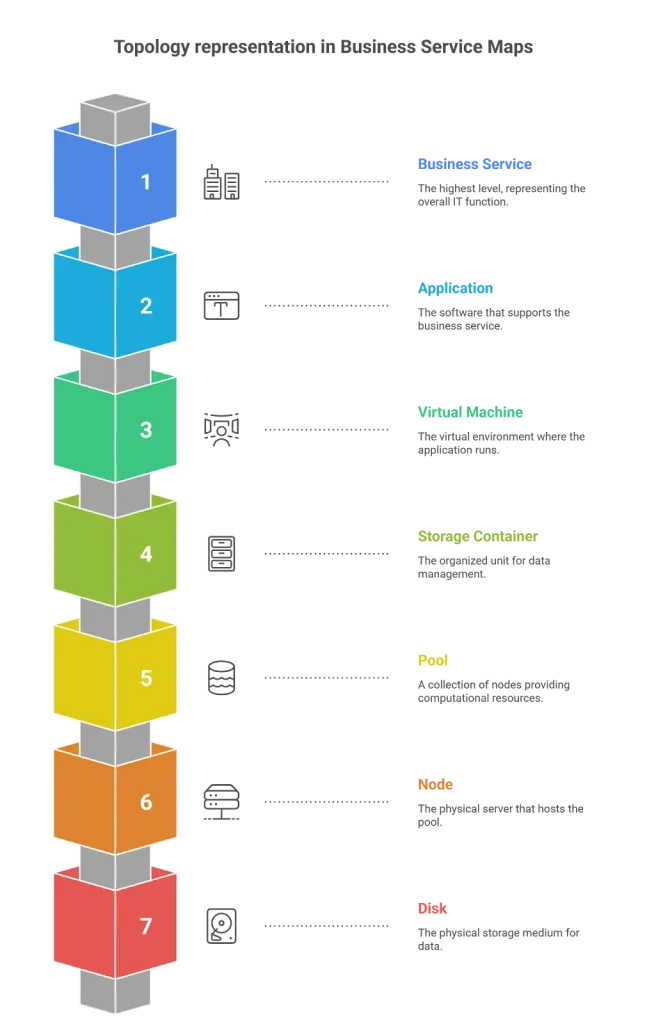
This full-stack visibility dramatically improves dependency clarity.
Operational value
With HCI discovery enabled:
- Incident triage becomes faster — node or disk failures appear flagged on the service map with open incidents visible against the specific CI, so responders see scope immediately rather than tracing it manually
- Capacity planning reflects real pool utilization drawn from discovered node and container attributes
- Change planning shows which VMs and business services depend on the affected node before a maintenance window is approved
NetApp ONTAP Discovery
Why NetApp ONTAP matters
NetApp ONTAP powers enterprise SAN and NAS environments across data centers and hybrid cloud deployments.
It supports block and file storage for databases, virtualization, and mission-critical workloads.
However, ONTAP topology is layered and complex. Without structured NetApp ONTAP discovery, CMDB visibility remains shallow.
What Virima discovers
Virima’s NetApp ONTAP discovery captures:
Clusters and nodes
- Clusters and nodes
- Cluster name and version Node model, HA pairing, status
- Node model and firmware data feed Virima’s IT Asset Management layer, where hardware lifecycle status, end-of-support dates, and refresh planning are tracked against the same CI records that appear in service maps and change workflows.
Storage Virtual Machines (SVMs)
- SVM name and protocols (NFS, CIFS, iSCSI, FCP)
- Security and operational state
Volumes
- Capacity and usage
- Snapshot reserve and configuration
LUNs and shares
- LUN size and host mappings
- Share paths and protocols
Snapshots
- Snapshot name, size, timestamp
Disks and Interfaces
- Disk health and aggregate membership
- Logical interfaces and IP configuration
Topology in CMDB and BSM
CMDB models:
Cluster → Nodes → SVMs → Volumes → LUNs/Shares → Disks

Business Service Maps show:
Business Service → Application → VM/Database → LUN → Volume → SVM → Cluster → Disk
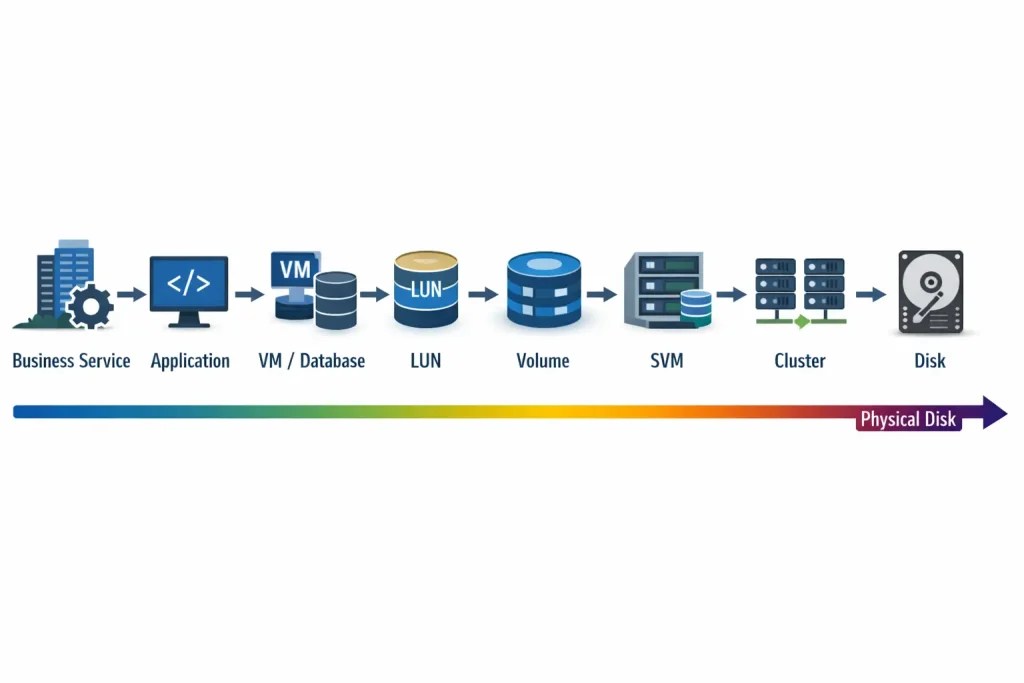
This enables complete storage dependency mapping from application down to physical disk.
Operational value
With comprehensive storage discovery and ViVID overlays active:
- Storage alerts from integrated monitoring tools appear in context on the service map, flagged against the specific volume, SVM, or node generating the alert
- Firmware upgrades include full impact analysis, ViVID shows pending and recent changes on adjacent CIs, so teams can assess cumulative risk before approving
- Capacity trends are visible at the volume and cluster level from discovered ONTAP attributes.
- Snapshot configurations are modeled as CIs, making DR validation a query rather than a manual audit
HP MSA Array Discovery
Why HP MSA matters
HP MSA arrays are common in mid-range and edge deployments. However, they are often overlooked in enterprise CMDB modeling.
Without structured HP MSA discovery, these arrays remain disconnected from service maps.
What Virima discovers
Via REST API v2, Virima captures:
Arrays
- Model and serial number
- Firmware version
- Health status
Controllers
- Role and operational state
Disks
- Model, capacity, SMART status
Volumes
- Volume name and size
- RAID level
- Host mappings
Topology representation
CMDB relationships include:
Array → Controllers → Disks → Volumes → Hosts
Business Service Maps extend:
Business Service → Application → Server → Volume → Array → Disk
Operational benefits
- Faster root cause identification
- Safer firmware upgrades
- Better mid-range storage governance
- Proactive capacity management
Requirements and deployment notes
Beta designation
Storage and HCI Topology Discovery features are in Beta.
This means:
- Functional and tested
- Recommended for early adoption
- Subject to refinement based on feedback
Version requirement
Requires Discovery Application version 6.1.4023+.
Verify version in the Discovery dashboard under system information.
API and credential requirements
- Nutanix: REST API + optional SSH access
- NetApp ONTAP: REST API (ONTAP 9.6+)
- HP MSA: REST API v2
Ensure appropriate read-only permissions.
Network considerations
Allow API access to:
- Nutanix (port 9440)
- NetApp ONTAP (port 443)
- HP MSA (port 443)
Firewall rules may need incident management updates.
Operationalizing storage discovery
Enable discovery jobs
Configure storage discovery targets with credentials and schedule recurring scans.
Integrate into service maps
Map:
Application → VM/Server → Volume/LUN → Array → Disk
Validate with storage administrators.
Build storage reports
- Capacity reports
- Health dashboards
- Dependency mapping views
Integrate with change and incident workflows
Virima syncs discovered storage CIs with ITSM platforms, including ServiceNow, Jira Service Management, and Ivanti. Before maintenance, query dependent applications and services directly from the change record.
During incidents, drill into storage topology from the ticket without switching tools. Storage CIs appear in impact analysis, change approval workflows, and incident correlation automatically once sync is configured.
From storage blind spots to full infrastructure clarity
Storage is the most critical and most invisible layer in modern infrastructure. When it fails, everything fails. Yet most CMDBs treat storage as a black box.
Virima 6.1’s Beta storage and HCI Topology Discovery for Nutanix, NetApp ONTAP, and HP MSA brings full storage topology into the CMDB and Business Service Maps.
As a result, organizations gain:
- Faster incident resolution
- Safer change management
- Better capacity planning
- Stronger disaster recovery validation
- Clearer dependency modeling
Whether running hyper-converged Nutanix, enterprise NetApp arrays, or HP MSA systems, Virima now illuminates the storage layer that has remained opaque for too long.
Want to see how Virima 6.1 discovers your storage environment?
Schedule a demo and explore your Nutanix, NetApp, or HP MSA topology in action.
These features are in Beta — early adopters can help shape the future of storage discovery in Virima.
Already using Virima? Upgrade to Discovery Application v6.1.4023+ to enable storage and HCI discovery today.
Frequently Asked Questions about storage & HCI topology discovery
1. What is storage and HCI Topology Discovery?
Storage and HCI Topology Discovery is the automated identification and modeling of storage infrastructure — including arrays, clusters, volumes, LUNs, disks, and their relationships — inside the CMDB and Business Service Maps.
It enables complete storage dependency mapping from business service to physical disk.
2. Why is storage discovery important for CMDB accuracy?
Without storage discovery, the CMDB stops at the server or hypervisor layer. This creates blind spots in dependency mapping. By discovering storage topology, organizations ensure that infrastructure relationships are complete and actionable.
3. What platforms are supported in Virima 6.1?
Virima 6.1 (Beta) supports:
- Nutanix discovery
- NetApp ONTAP discovery
- HP MSA discovery
Each platform configuration management database cmdb is integrated via vendor REST APIs and modeled directly into the storage CMDB.
4. How does Nutanix discovery improve HCI visibility?
Nutanix discovery identifies ip address clusters, nodes, storage pools, containers, VMs, and disks. Because HCI tightly couples compute and storage, this HCI discovery capability ensures dependency clarity across distributed environments.
5. What does NetApp ONTAP discovery capture?
NetApp ONTAP discovery includes clusters, nodes, SVMs, volumes, LUNs, shares, snapshots, disks, and network interfaces. These relationships are then modeled to support end-to-end storage dependency mapping.
6. How does HP MSA discovery help mid-range environments?
HP MSA discovery process captures arrays, controllers, disks, and volumes. This ensures that mid-range storage systems are no longer excluded from CMDB and service maps, improving management systemschange planning, and incident response.
7. How does storage topology improve incident response?
When storage alerts occur, teams can trace:
Business Service → Application → VM → Volume → Array → Disk
operational efficiency. Instead of manually correlating systems, hyperconverged infrastructure hci responders immediately see which storage components are affected and which services depend on them.
8. How does storage discovery support change management?
Before cmdb data upgrading firmware, expanding pools, or replacing disks, change planners can identify all dependent applications and services. This reduces unexpected outages and improves stakeholder communication.
9. Is storage and HCI Topology Discovery production-ready?
These features are data storage, currently in Beta. They are storage solution, functional and tested but recommended for early adoption and validation in controlled environments before broad production rollout.
10. What version of Virima is required?
Storage and HCI Topology high-performance Discovery requires a cost-effective Discovery Application version 6.1.4023 or higher.