Rip-and-Replace ITSM vs. Strengthen with Runtime Truth

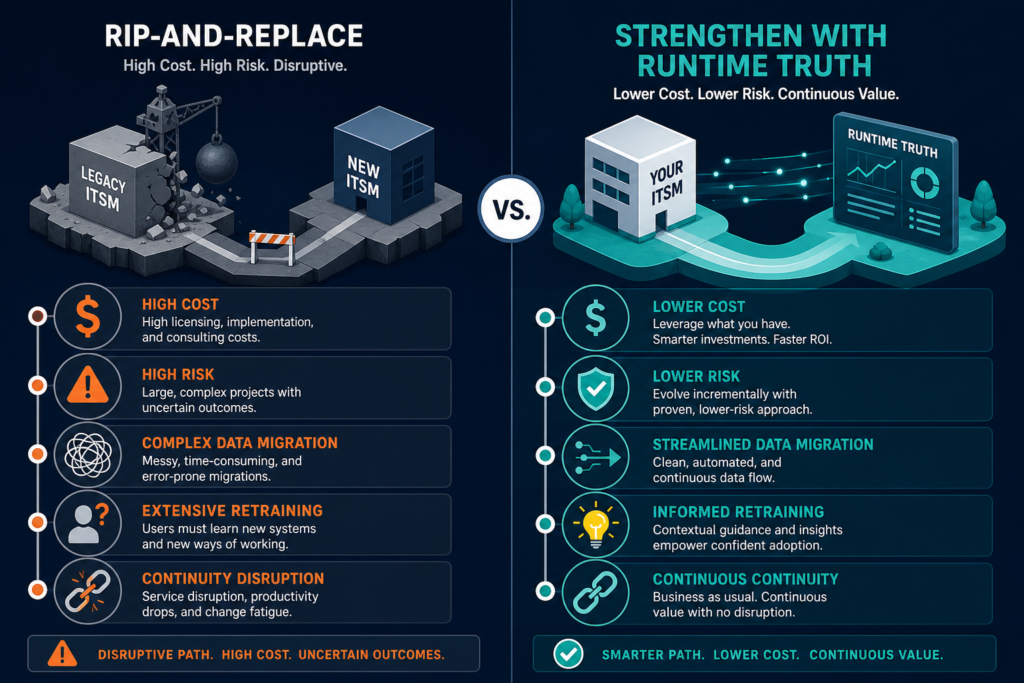
Your analysts route tickets without reliable ownership, change approvers miss downstream impact, and audit evidence stays fragmented across tools. Consolidation reviews often trace those gaps to stale configuration items and missing service relationships rather than failed process design. IT Directors compare rip-and-replace cost and risk against strengthening the current ITSM with authoritative discovery and governed service context.
Why ITSM consolidation fails without runtime truth
Most consolidation business cases focus on license reduction and process standardization. Those savings disappear when the new platform inherits duplicate assets, orphan configuration items, and missing dependency relationships from prior discovery gaps.
Service management depends on accurate configuration and change control across the estate — incident routing slows, change approvals miss blast radius, and audit evidence stays incomplete when discovery remains fragmented. A new ITSM platform does not correct those gaps on its own because migration carries the same underlying data forward.
An October 2026 EMA Research benchmark, published via Xurrent, found only 18.5% of organizations rate their ITSM and CMDB asset data at 95% accuracy or higher. Another 20% report accuracy in the 60–79% range. That gap is exactly why so many consolidation business cases miss their projected savings. IT teams that run this kind of reconciliation before a migration often find a fifth or more of configuration items are orphaned or duplicated — stale entries a rip-and-replace would otherwise carry forward unchanged.
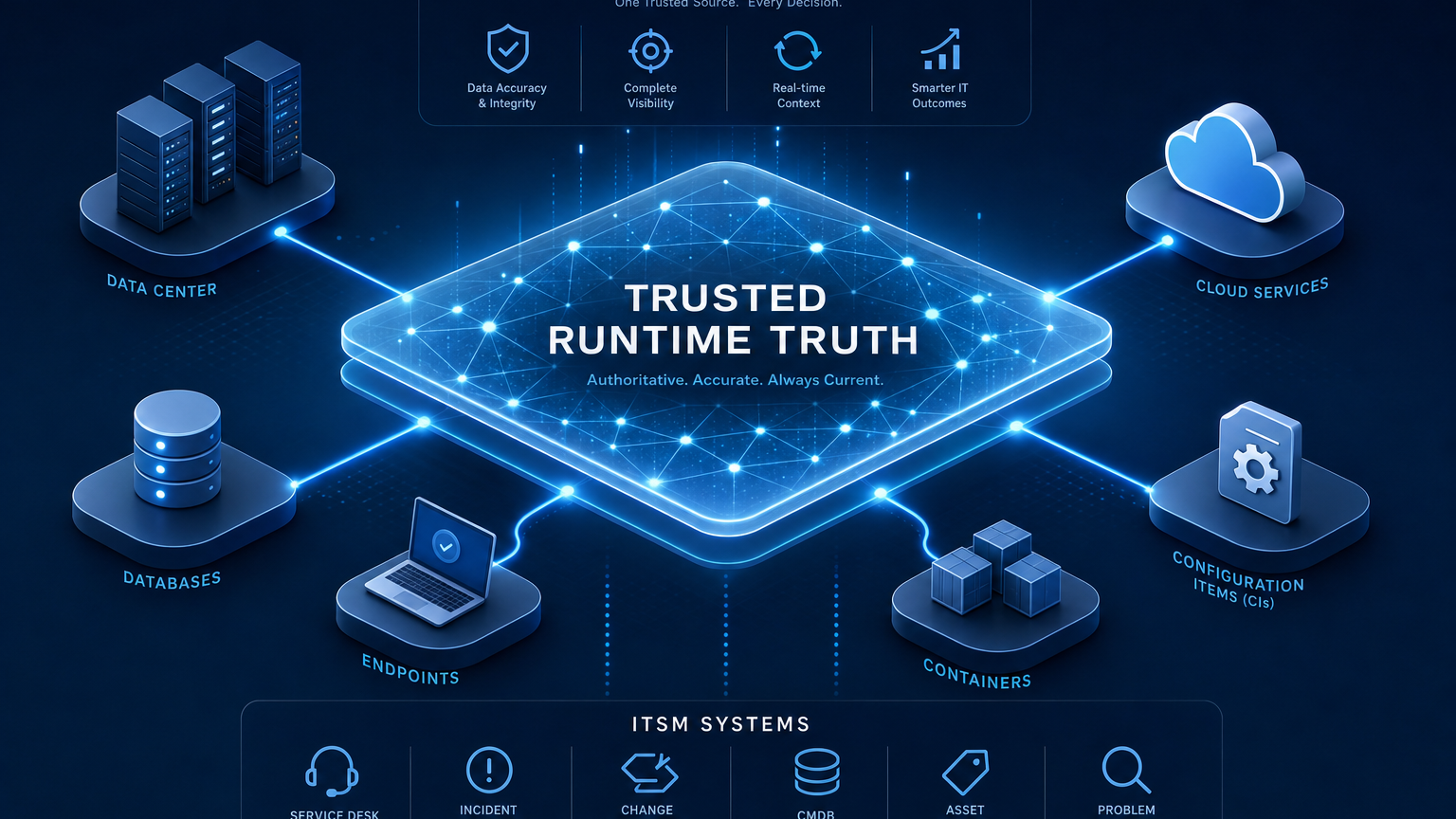
Virima delivers trusted runtime truth from authoritative multi-source discovery, so teams move faster and AI agents act safely. That truth layer covers assets, services, dependencies, ownership, change history, vulnerabilities, and blast radius in one explainable record. IT leaders use that record to stabilize incident, change, and audit workflows before making platform decisions. blog post on stabilizing incident and change workflows with accurate CMDB data
Teams evaluating consolidation should score data health before platform features. Run scheduled discovery cycles across on premises and cloud infrastructure, reconcile multi-source results into one authoritative record, and measure completeness, staleness, and ownership coverage across business critical services. That baseline shows whether the organization faces a platform limitation or a truth deficit that migration alone cannot resolve.
Explore how Trusted Runtime Truth de-risks consolidation by giving every ITSM workflow live, explainable context on what exists and what will break.
Should IT Directors rip and replace ITSM or strengthen current ITSM?
Strengthen the current ITSM when workflows are adopted but data is weak. Rip and replace only when the platform cannot support required processes, integrations, or scale. Most consolidation gaps come from stale configuration items and missing service context.
What strengthening your current ITSM looks like
Strengthening keeps proven workflows and replaces guesswork with evidence. The model has three operational parts that map directly to consolidation risk.
Discover with authority
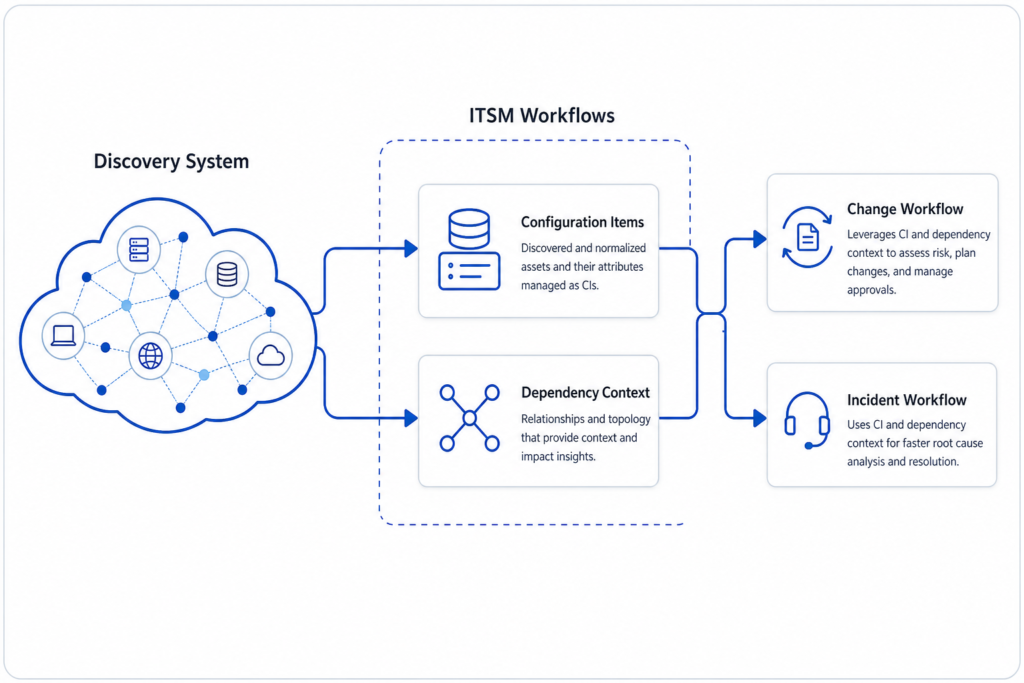
Use agent-based discovery and agentless discovery plus cloud discovery across AWS and Azure to maintain an authoritative CMDB record. Virima reconciles multi-source results into one authoritative CMDB record with source provenance and freshness tracking. Configuration items move through lifecycle stages from deployment through decommission with full history. Scheduled discovery cycles keep relationships current without manual entry, which reduces reconciliation workload for configuration teams. Flexera’s 2026 State of ITAM report puts SaaS asset visibility at only 50%. That’s exactly the blind spot that resurfaces after a platform migration if discovery was never fixed first.
Understand in context
Service definitions are provided by your team through manual input, spreadsheet import, or enterprise architecture input such as Lean IX. Virima then builds ViVID™ service maps — service dependency maps that show application and infrastructure relationships — automatically from that input. The maps stay current as infrastructure changes across scheduled discovery cycles without manual maintenance. Teams trace impact paths from a failing configuration item to the affected business service. Change teams review downstream risk before approval windows, which lowers unplanned outage exposure during consolidation planning.
Govern every action
Role-based access controls limit change visibility by team responsibility. Audit trails record configuration history for compliance review and operational accountability.
Change impact analysis shows downstream dependencies before implementation decisions. Vulnerability context from NIST NVD overlays on Windows Server configuration items helps prioritize remediation by asset and service criticality alongside broader scanner coverage. Governance makes automation safer because every recommendation carries explainable evidence. CMDB automation Why is it crucial for CMDB success?
That evidence matters during merger reviews, audit preparation, and service availability planning. Configuration owners answer ownership questions faster, change boards approve with clearer blast radius visibility, and security teams connect exposure to affected services without cross-tool investigation. The result is measurable control over accuracy, ownership, and change risk while existing ITSM processes continue operating.
Discovery-sourced configuration items and relationships sync through the Virima integration hub with existing ITSM tools including ServiceNow, Jira Service Management, Ivanti, HaloITSM, Xurrent, and Hornbill. That hub keeps integration scope clean while current ticket, change, and asset processes remain stable.
Evaluation checklist for IT Directors
Use this checklist in vendor and internal reviews before approving migration budget. blog post on ITSM consolidation evaluation criteria
- Data authority. Prove source provenance, freshness, and conflict resolution for every configuration item across hybrid infrastructure.
- Service coverage. Confirm business services are defined, mapped to infrastructure, and refreshed on scheduled cycles.
- Change readiness. Verify every change shows downstream impact, ownership, and vulnerability exposure before approval.
- Integration fit. Confirm discovery feeds the current ITSM without custom rebuilds or duplicate synchronization jobs.
- Audit defense. Export configuration history, ownership, and lifecycle evidence on demand for internal and external reviewers.
- Total cost. Model migration labor, parallel operations, retraining, and rollback against phased strengthening investment.
How do you evaluate ITSM consolidation risk?
Score data health, service coverage, change readiness, integration fit, and audit evidence before platform features. Include migration labor, parallel operations, retraining, and rollback cost. Choose replacement only when the platform blocks required scale or process.
When three or more checklist items fail on data rather than workflow design, strengthening delivers faster value with lower disruption. When workflows themselves cannot scale after remediation, segment the replacement scope and keep the truth layer intact across both systems during transition.
Keep proven workflows and correct the truth layer first
Consolidation succeeds when every incident, change, and audit pulls from the same trusted record. Replacement without that record repeats familiar outages under a new license with added migration cost. Strengthening first gives directors measurable control over accuracy, blast radius, ownership, and audit readiness before any migration decision.
Frequently Asked Questions
When does rip-and-replace ITSM make sense?
Replacement makes sense when the platform cannot support required scale, process compliance, or integration needs after remediation. Confirm data health first so migration does not carry stale configuration items into the new system.
How long does ITSM data remediation take before consolidation?
Timelines depend on estate size, source diversity, and service definition readiness. Most teams see measurable accuracy gains after initial multi-source reconciliation and scheduled discovery cycles, then expand service mapping in phases.
How do you keep incident and change data trusted during consolidation?
Maintain one authoritative record with source attribution on every CI, scheduled refresh cycles, and mapped service relationships. Virima reconciles discovery into that record and feeds ownership and impact context into existing ITSM processes.
How do you keep service maps current without manual rebuilds?
Provide service composition once through manual input, spreadsheet import, or enterprise architecture input. Virima then generates and maintains dependency maps automatically as infrastructure changes across scheduled discovery cycles.
What is trusted runtime truth for ITSM consolidation?
Trusted runtime truth is live, explainable operational context that shows what exists, how it connects, what changed, what will break, and who owns it. It supports faster team decisions and safer automated action.