Service Mapping in Higher Education: Mapping Dependencies Behind LMS and Enrollment Systems

Campus technology environments operate under an organizational paradox. Campus IT departments organize staffing, budgets, and operational oversight around individual application silos: the academic technology group oversees the learning management system, registrar analysts administer the student information system, identity engineers manage campus authentication directories, and core infrastructure teams support hosting fabrics. For students, however, these organizational boundaries do not exist. When an undergraduate logs in to access course syllabi, verify registered credit hours, submit assignments, and check mid-term grades, they perceive a single unified university learning service.
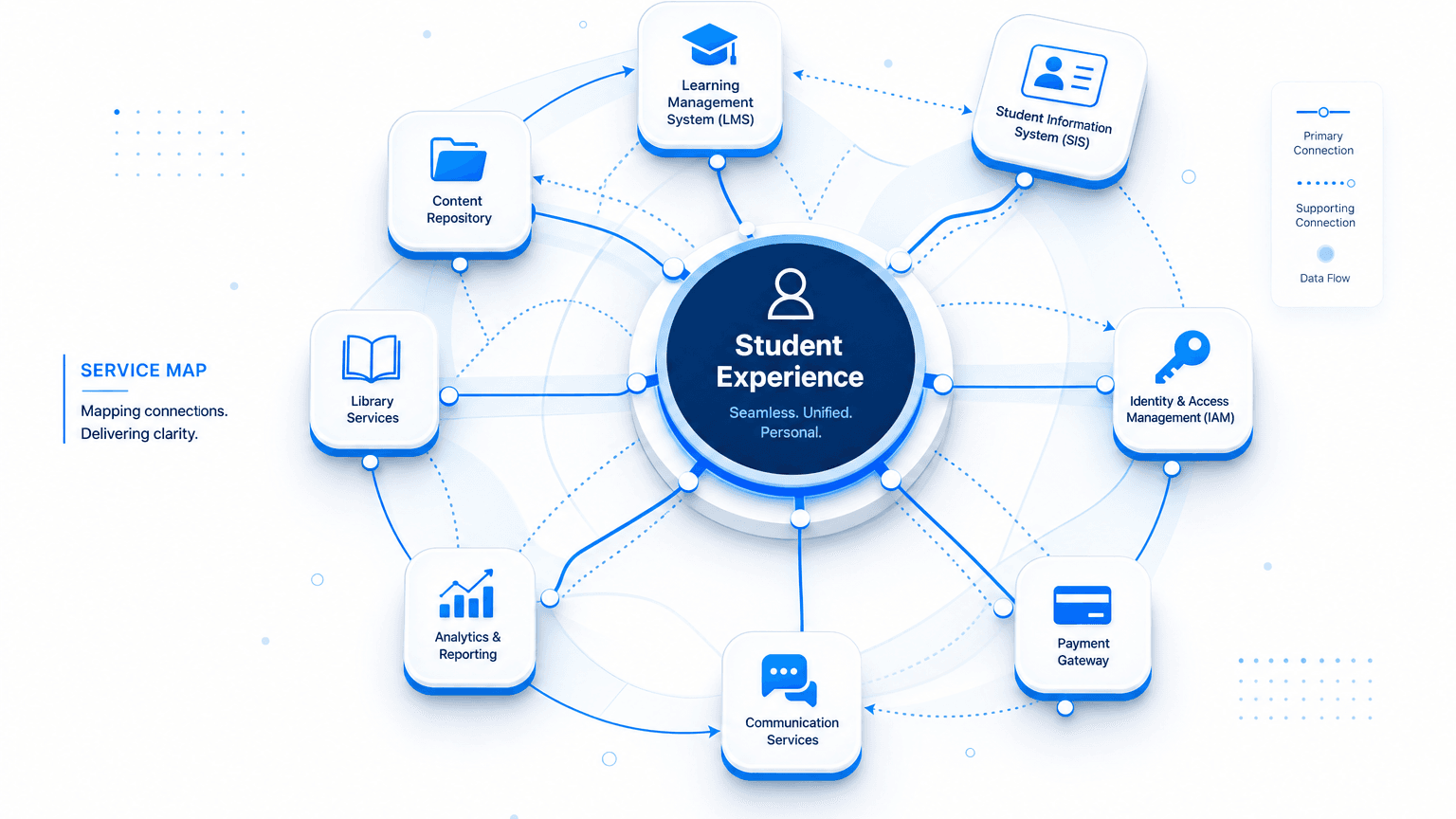
That structural divergence between administrative ownership and student experience creates severe operational blind spots during peak academic periods. An application monitoring console can show that the learning platform software is executing normally in the cloud. The actual student service can still fail completely if an unmonitored directory connector stalls, an integration batch schedule desynchronizes, or a database query times out behind the scenes. Higher education institutions organize technical responsibilities by software application, but students consume educational capabilities through cross-system workflows. Establishing service mapping in higher education provides the relational visibility campus IT teams need to understand how decoupled infrastructure components recombine to deliver essential academic experiences.
The LMS is often the visible layer, not the whole service
When students cannot open course materials on the first day of classes, help desks receive hundreds of tickets reporting that the learning platform is down. In the vast majority of campus incidents, the learning management software itself is operating with high availability. The breakdown almost always lives along an upstream or downstream dependency edge connecting the learning platform to the broader campus ecosystem.
Technical integration guides from Instructure Canvas show that modern learning management platforms rely on automated, bidirectional data exchanges with campus student information systems. User accounts, course shell definitions, section rosters, and enrollment statuses originate inside the administrative record system and must synchronize into the learning platform. Authentication routinely routes to an external university identity provider using SAML, CAS, or LDAP standards. When a student cannot access their course, the root cause may be a failed directory token exchange, a stuck API integration job, or an unannounced database schema adjustment. The learning platform remains operational, but the learning service is broken.
Why does an LMS fail when application monitoring reports normal operations?
Learning management platforms rely on external dependencies for authentication, enrollment rosters, and course provisioning. An LMS interface can remain fully operational while underlying single sign-on directories or student information system integration pipelines fail, preventing students from accessing their registered courses.
Enrollment is also a workflow across systems
Student enrollment is rarely confined to a single administrative database screen. While students interact with an enrollment web portal during open registration, their actions trigger an intricate choreography of data exchanges across campus technologies. The enrollment transaction must validate academic eligibility, verify prerequisite completions, cross-reference financial aid holds, process payment gateway transactions, generate identity tokens, and feed downstream course management systems.
Industry interoperability standards like the 1EdTech Edu-API exist precisely because higher education administrative systems must continuously exchange real-time data across academic boundaries. A student registering for an organic chemistry lecture automatically requires seat reservations in matching laboratory sections, automated roster updates in the campus bookstore system, provisioning inside digital lab software, and permission updates across campus door-access networks. The enrollment service is not a single software application. It is an enterprise workflow spanning disparate platforms owned by separate administrative departments.
Higher education integrations are becoming an operating layer
Modern university IT departments face constant demands from academic departments to integrate specialized educational technologies, departmental advising tools, and third-party SaaS applications into central enterprise systems. The EDUCAUSE community has documented how higher education institutions are establishing formal integration governance frameworks to manage the rapid proliferation of software connectors, API hooks, and external add-ons across campus. Every new integration introduces another operational dependency into the student service path.
Campus services routinely incorporate learning tools interoperability (LTI) plugins, plagiarism detection engines, digital proctoring platforms, retention analytics software, and external content repositories. Each integration enhances the academic environment, but it also expands the service boundary far beyond the core software platform originally deployed by central IT. When third-party API keys expire or an integration endpoint changes without notification, customer-facing workflows degrade unexpectedly. Higher education IT teams require systematic visibility into this expanding integration fabric to prevent unmanaged connections from jeopardizing core operational workflows.
Application ownership and service ownership are different
Universities maintain clear lines of accountability for individual software purchases. The identity administration team owns directory infrastructure. The registrar’s office and administrative computing team govern student information systems. The academic computing department manages learning management environments, while network operations oversees on-premises hardware and cloud subscriptions.
While assigning application-level ownership is standard administrative practice, it fails to establish accountability for the overarching student journey. When an integration fails between the student information system and the learning platform, departmental teams frequently check their isolated consoles, confirm local server availability, and conclude that the fault lies elsewhere. Service mapping supplies the shared operational topology that departmental boundaries obscure, visually linking technical components together under the specific academic services they deliver.
Review how Trusted Runtime Truth provides the discovery-sourced operational visibility needed to bridge campus technology silos.
A list of applications cannot explain service impact
Most higher education institutions maintain a software inventory or asset database. That repository typically records the presence of the campus student system, enterprise directory servers, cloud learning environments, database clusters, and virtual machines. An inventory provides a valuable record of purchased software licenses and deployed infrastructure assets.
An asset inventory cannot explain how those systems interact or what business capabilities break when a specific infrastructure component suffers an outage. Knowing that a database server exists in the central data center does not clarify whether that server hosts student grade histories, employee payroll tables, or facilities maintenance tickets. Service mapping elevates static inventory data into dynamic operational intelligence by capturing call direction, data dependencies, hosting topologies, and service relationships.
Shared dependencies can make separate failures look unrelated
During periods of high campus activity, service desks often receive a deluge of seemingly unrelated incident reports. A student reports an inability to access online library research journals. An academic advisor notes that student degree-audit profiles are failing to load. A faculty member submits a priority ticket stating that the learning management portal is refusing administrative credentials.
Triage teams reviewing these reports in isolation might mobilize three separate engineering groups to investigate three unrelated software applications. An authoritative service map reveals that all three services rely on a common upstream authentication directory or share an internal API gateway. Rather than troubleshooting three isolated symptoms across multiple teams, IT operations can immediately isolate the shared dependency branch and restore campus operations efficiently.
Change risk follows dependency paths
Higher education IT teams implement thousands of software upgrades, database patches, network reconfigurations, and security updates every academic year. A systems administrator planning a routine update to an on-premises database server might examine the local host, verify backup integrity, and conclude that the maintenance window presents minimal operational risk.
Operational risk is governed by downstream dependency reach, not by the perceived simplicity of the component being modified. If that database server quietly hosts the lookup tables used by the campus student information system to validate enrollment eligibility, a delayed reboot can paralyze open course registration across every academic department. Utilizing higher education IT service mapping allows change advisory boards to visualize the complete blast radius of proposed infrastructure modifications before approving execution windows.
Review how automated change management impact analysis helps IT teams identify downstream dependency risks prior to scheduled maintenance.
How does service mapping reduce change-related outages in higher education?
Service mapping visualizes the entire downstream dependency chain connecting physical servers, databases, and network routes to student-facing applications. Evaluating change requests against this visual topology allows campus change advisory boards to detect hidden dependencies and prevent outages during critical academic windows.
Academic calendars make dependency failures more consequential at specific times
Technology failures within higher education carry radically different consequences depending on the rhythm of the academic calendar. An unexpected two-hour database outage in mid-July causes minor administrative inconvenience for campus staff. That identical two-hour outage occurring on the morning of freshman class registration or during the final exam submission window creates catastrophic operational disruptions that undermine institutional reputation and generate immediate executive escalation.
Because campus service criticality fluctuates dynamically throughout the academic year, IT operations teams must evaluate infrastructure health through an academic lens. Understanding which backend servers, database instances, and integration scripts power specific student experiences ensures that infrastructure teams enforce change freezes during critical enrollment windows and prioritize incident triage effectively when high-stakes academic deadlines approach.
Static architecture diagrams cannot remain the operational map
Enterprise architecture teams in higher education frequently construct detailed system architecture diagrams during major software implementations. These static blueprints document design intentions, planned network paths, and expected integration flows at the moment an application goes live.
Campus technology environments do not remain static. Engineering teams migrate virtual machines between hypervisors, cloud operations modify VPC routing rules, developers deploy new API microservices, and academic departments adopt specialized third-party tools. Within months of deployment, static network diagrams diverge significantly from live production topology. Operational incident response and change governance require service maps that refresh dynamically based on discovered technical reality, ensuring engineers troubleshoot modern environments using accurate, up-to-date data.
Why do static architecture diagrams fail during campus IT incidents?
Static architecture diagrams capture design intentions at a single point in time, failing to reflect ongoing cloud migrations, API updates, and third-party software additions. Production incident triage requires dynamic service maps that automatically update based on scheduled discovery scans to reflect current operational reality.
What a higher-education service map should explain
| Operational Dimension | Higher Education Service Context |
|---|---|
| Student-Facing Service | Course access, term enrollment, financial aid portal, degree audit |
| Core Application Tier | Learning management system, student information system, campus IAM |
| Integration Architecture | Bi-directional SIS connectors, LTI tools, grade passback APIs, roster feeds |
| Hosting Environment | On-premises VMware clusters, AWS cloud VPCs, vendor SaaS platforms |
| Database & Record Layer | Relational student record databases, directory stores, caching layers |
| Network Fabric | Campus load balancers, edge firewalls, reverse proxies, DNS gateways |
| Shared Dependencies | Common authentication servers, shared middleware, central databases |
| Operational Change State | Recent configuration edits, deployment tickets, pending change requests |
| Downstream Blast Radius | Dependent academic departments, student services, faculty grading workflows |
This structured relational model ensures that campus technology teams move beyond disjointed asset catalogs, providing the contextual framework required to manage mission-critical academic services effectively.
A practical workflow: discover, relate, define, map, validate, refresh
Implementing reliable service mapping across a higher education environment requires a disciplined, repeatable operational framework:
- Discover: Execute automated discovery scans across campus data centers, cloud subscriptions, and network segments to identify all active compute instances, virtual machines, and installed software components.
- Relate: Detect technical hosting structures, communication edges, and network connections between discovered infrastructure assets.
- Define: Ingest campus service models, associating discovered technical infrastructure with specific academic workflows such as term registration or online learning delivery.
- Map: Automatically construct end-to-end upstream and downstream dependency graphs linking underlying infrastructure to defined student services.
- Validate: Review dependency topologies with academic technology teams, registrar system administrators, and application owners to confirm logical business connections.
- Refresh: Re-scan the environment on high-frequency schedules to capture configuration drift, cloud resource modifications, and new integration endpoints automatically.
Executing this cycle ensures that operational service models stay continuously synchronized with live campus architecture rather than degenerating into outdated documentation.
Where Virima fits for higher education service dependency mapping
Virima provides an automated, discovery-powered service mapping platform engineered to bridge the gap between campus infrastructure assets and the academic services they support. Rather than requiring teams to hand-draw architecture diagrams or manually reconcile configuration databases, Virima connects technical discovery data directly with business service definitions.
Virima Discovery scans on-premises data centers, private cloud clusters, and public cloud environments across AWS and Azure on scheduled high-frequency discovery cycles. The platform automatically detects critical operational relationships, including Runs On, Communicates With, Connected To, Installed On, Hosted On, Virtualized On, and Load Balancer For. Virima ViVID (Virima Visual Impact Display) transforms those discovered relationship records into dynamic service topology maps, giving IT leaders complete visibility into multi-tier application architectures.
Virima does not claim to decode custom academic business logic out of thin air. Instead, it combines automated technical discovery with structured service definitions imported manually, via spreadsheets, or through enterprise architecture tools like LeanIX. ViVID overlays active ITSM records, pending change requests, and known security vulnerabilities directly onto the service graph. Through unified ITSM integrations, Virima synchronizes these dependency insights across enterprise service management platforms including ServiceNow, Jira Service Management, Ivanti, HaloITSM, Xurrent, and Hornbill.
Virima does not replace campus network monitoring tools or application performance monitoring agents. Instead, it provides the persistent infrastructure dependency context needed to understand how disparate campus technologies combine to deliver reliable academic services.
Keep the student service running while campus systems evolve
Modern university education depends fundamentally on digital services. Yet students never experience campus technology as isolated database records or standalone cloud applications; they rely on complex, interdependent workflows that traverse multiple departmental boundaries to support their academic journeys.
Monitoring isolated application interfaces is no longer sufficient to guarantee educational continuity. By implementing discovery-driven service mapping, higher education IT organizations can illuminate hidden integration dependencies, evaluate change risks accurately, resolve multi-system incidents rapidly, and ensure that mission-critical learning and enrollment services remain reliable throughout every academic term.
Schedule a technical evaluation to see how Virima Discovery and ViVID service mapping bring clarity to higher education IT infrastructure.
Frequently Asked Questions
Why can an LMS appear healthy while students cannot access their courses?
Learning management platforms depend on external systems for authentication and enrollment data. If a campus single sign-on server experiences issues or an integration pipeline from the student information system fails, students cannot access their courses even though the cloud LMS software is running normally.
How does service mapping differ from a standard campus application inventory?
An application inventory merely lists installed software packages and purchased licenses across departments. Service mapping models the relationships, data flows, and infrastructure dependencies between those applications, showing how they combine to deliver business services like student registration.
Why are third-party integrations a major source of service risk in higher ed?
Universities frequently integrate specialized educational tools, plagiarism scanners, advising platforms, and payment gateways into core systems. Each integration introduces an unmonitored dependency edge that can disrupt student workflows if API credentials expire or endpoints change.
Can automated discovery tools map higher education services completely on their own?
Automated discovery identifies physical and virtual assets, open ports, and active network communications. However, establishing true business service context requires pairing those discovered technical relationships with service definitions contributed by academic technology and administrative system owners.
How does Virima help campus change advisory boards evaluate maintenance risk?
Virima ViVID maps underlying servers, databases, and network paths directly to the student services they support. When an administrator schedules an infrastructure change, ViVID visualizes the full downstream blast radius, helping change boards prevent outages during critical academic windows.