Mastering audit management and compliance tools

Regulatory expectations continue to rise. At the same time, enterprise IT environments are expanding across hybrid cloud, SaaS, and distributed infrastructure. In this environment, audit management and compliance software has evolved into a strategic control layer for IT Compliance and Risk Managers.
Yet many organizations still manage audits using spreadsheets, shared folders, and email threads. As a result, evidence becomes fragmented, remediation slows, and audit defensibility weakens.
This guide provides a structured, consultative framework to evaluate audit tool software with clarity and confidence.
TL;DR
- Audit management and compliance software centralizes evidence, links findings to assets, and preserves defensible audit trails.
- Manual audits fail because IT assets data, risk registers, and remediation workflows are disconnected.
- Audit tracking software ensures findings move from identification to verified closure.
- IT asset management audit automation reduces license, patch, and rogue asset risk platforms like Virima, which automate this layer by synchronizing discovery and CMDB data directly with compliance workflows.
- Continuous audit readiness is more sustainable than annual audit scrambling.
What is audit management and compliance software?
Audit management and compliance software is a structured platform that enables organizations to plan, execute, track, and prove audits in a controlled and repeatable way.
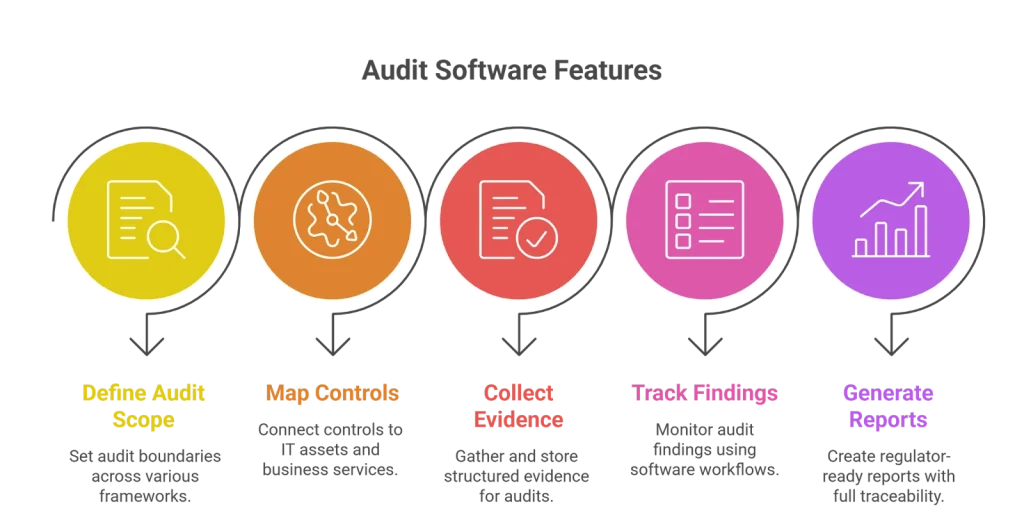
It helps teams:
- Define audit scope across frameworks such as SOX, ISO 27001, and GDPR.
- Map controls to IT assets, systems, and business services.
- Collect and store structured evidence.
- Track findings using audit tracking software workflows.
- Generate regulator-ready reports with full traceability.
Unlike generic task tools, this software preserves immutable logs. Moreover, unlike standalone compliance software that stores policies only, modern audit management and compliance software integrates directly with live operational systems.
Therefore, audits reflect real infrastructure states instead of static documentation.
Why does audit management and compliance software matter?
Audit failures rarely stem from missing policies. Instead, they result from fragmented execution.
Fragmented evidence collection
Audit artifacts typically include:
- Asset inventory exports from CMDB or ITAM systems
- Patch compliance reports
- Vulnerability scan results
- Change management logs
- Access approval screenshots
- Incident resolution tickets
When collected manually:
- File versions multiply
- Evidence becomes outdated quickly.
- Documentation lacks consistency.
- Review cycles expand unnecessarily
Consequently, preparation becomes reactive rather than controlled.
Stale IT asset data
An outdated asset inventory directly impacts:
- Software license compliance validation
- Rogue asset discovery
- End-of-life hardware tracking
- Patch compliance coverage
- Vulnerability remediation proof
If asset discovery does not synchronize with audit management and compliance software, control validation becomes unreliable.
Remediation blind spots
Without structured audit tracking software:
- Ownership is unclear
- Deadlines slip
- Risk exposure remains open
- Executive visibility declines
Centralized remediation workflows close this gap.
Common mistake
Preparing for audits once per year instead of maintaining continuous visibility.
What is audit tracking software — and how is it different?
Audit tracking software is purpose-built to manage findings from identification through verified closure.
It enables teams to:
- Assign accountable owners
- Define risk levels and due dates
- Track remediation progress
- Attach closure documentation
- Preserve time-stamped audit history
Unlike basic task managers, audit tracking software links findings directly to controls and IT assets. This linkage strengthens defensibility and reduces regulatory risk.
Key features modern audit management software must include
Evaluation should prioritize operational impact.
Core capabilities
A mature platform should provide:
- Centralized evidence repository
- Automated integration with ITAM and CMDB systems
- Built-in audit tracking software workflows
- Role-based access controls
- Immutable audit logs
- Regulatory reporting templates
These capabilities reduce administrative burden and improve traceability.
Advanced capabilities
Higher-maturity organizations often require:
- Cross-framework control mapping
- Real-time asset validation
- Executive risk dashboards
- Automated control testing
- API-driven integrations
These features support continuous audit readiness rather than point-in-time validation.
Pro tip
Evaluate integration depth before evaluating user interface design. Without strong system connectivity, automation will not scale.
IT asset management audit: A critical enterprise use case
An IT asset management audit now evaluates:
- Software license utilization and over-deployment
- Rogue and shadow IT detection
- End-of-life hardware exposure
- Patch compliance validation
- Vulnerability remediation documentation
- Configuration drift tracking
Because infrastructure changes constantly, static spreadsheets cannot provide defensible proof. Therefore, audit management and compliance software must synchronize dynamically with asset discovery tools.
This alignment ensures evidence remains current and audit preparation becomes significantly more efficient.
Audit evaluation checklist
When shortlisting vendors, structured comparison reduces bias.
Key evaluation criteria include:
- Depth of IT asset and CMDB integration
- Audit tracking software maturity
- Automated evidence collection
- Reporting flexibility
- Security and role-based access control
- Scalability across multiple regulatory frameworks
This checklist supports procurement discussions and internal business case development.
Manual vs software-driven audit workflow
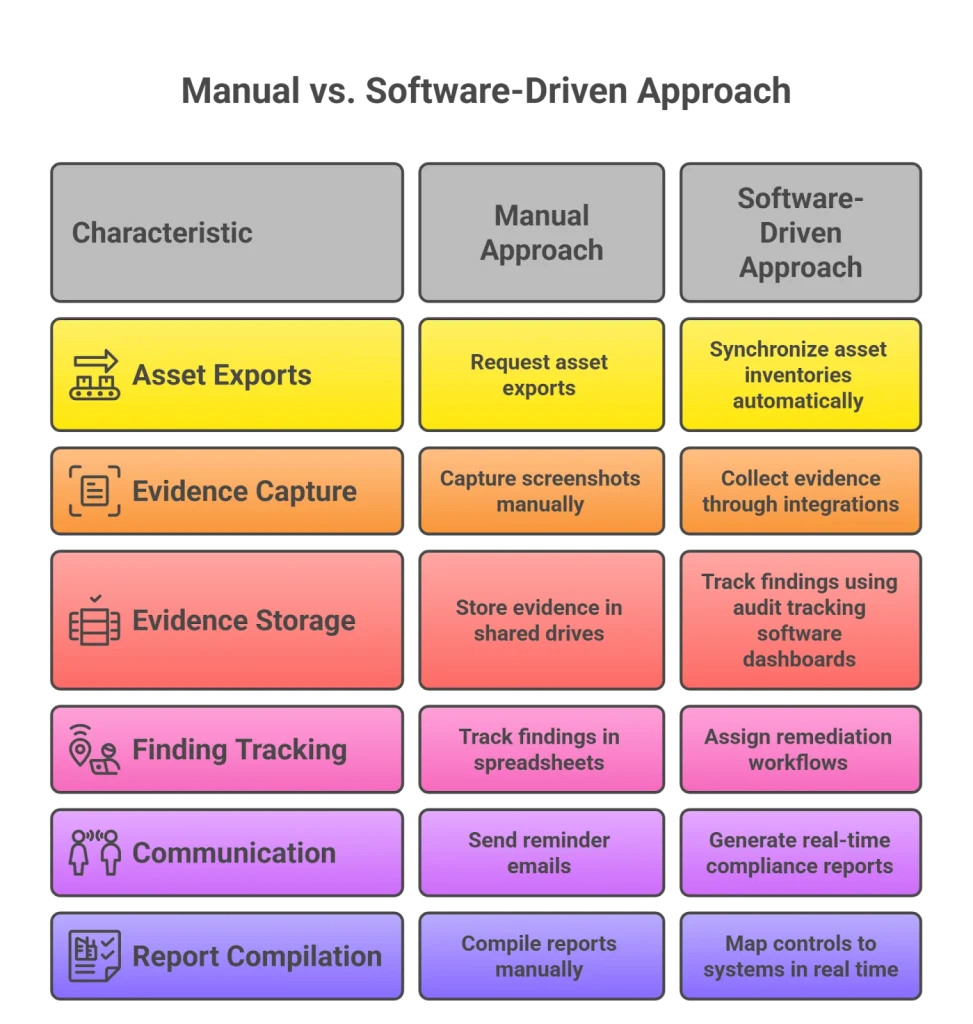
Manual approach
In a manual process, teams:
- Request asset exports.
- Capture screenshots manually.
- Store evidence in shared drives.
- Track findings in spreadsheets.
- Send reminder emails.
- Compile reports manually.
This approach increases duplication, delays, and documentation risk.
Software-driven approach
With integrated audit management and compliance software, organizations:
- Synchronize asset inventories automatically
- Map controls to systems in real time
- Collect evidence through integrations
- Track findings using audit tracking software dashboards
- Assign remediation workflows
- Generate real-time compliance reports
As a result, audit readiness becomes continuous rather than reactive.
Implementation reality
Early deployment frequently uncovers CMDB data quality issues. Addressing these gaps early maximizes long-term value.
How to choose the right audit management software
Selection should follow a structured evaluation process.
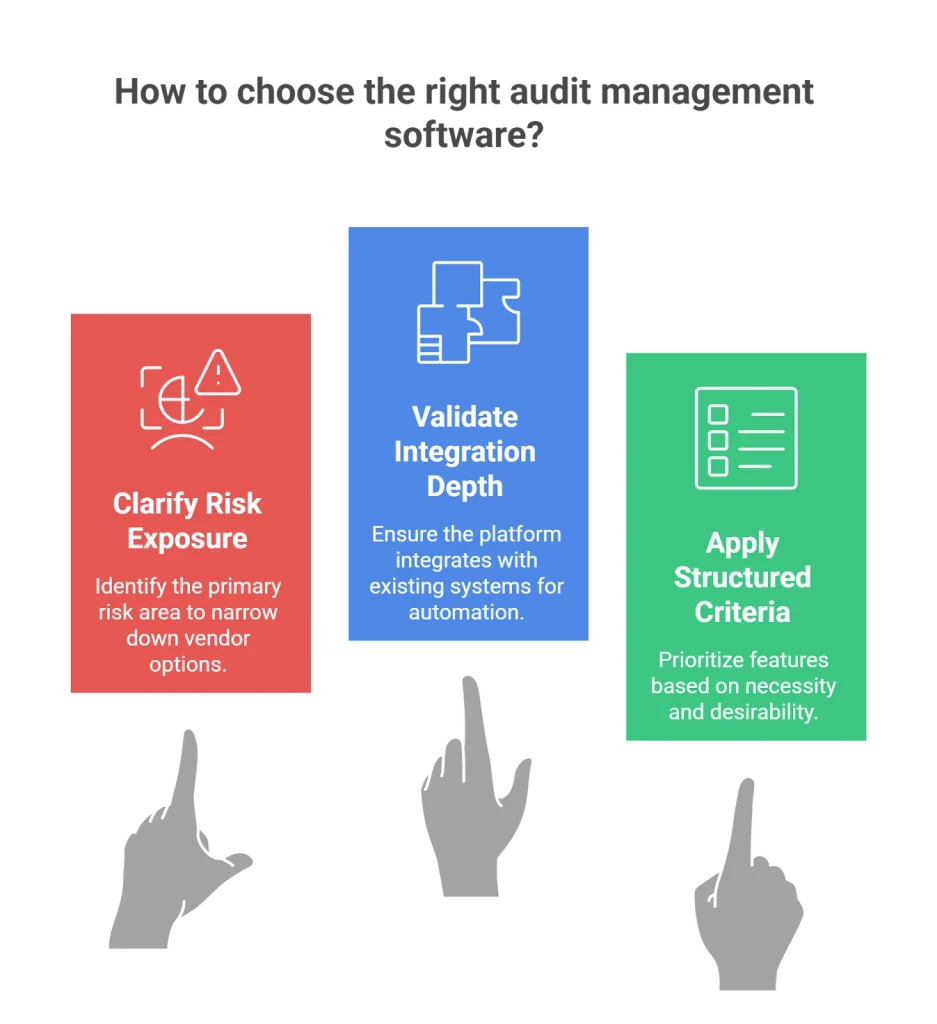
Step 1: Clarify primary risk exposure
Identify whether the largest exposure lies in:
- IT asset management audit gaps
- Financial control validation
- Multi-framework governance
- Remediation tracking inefficiencies
Clear prioritization narrows vendor options quickly.
Step 2: Validate integration depth
Confirm the platform integrates with:
- CMDB systems
- ITAM tools
- ITSM platforms
- Vulnerability scanners
- Identity and access management systems
Without deep integration, automation benefits diminish.
Step 3: Apply structured criteria
Must-have
- Automated evidence synchronization
- Built-in audit tracking software
- Secure role-based permissions
- Regulatory reporting templates
- Scalable dashboards
Nice-to-have
- Predictive risk analytics
- AI-assisted anomaly detection
- Cross-framework control mapping
- Executive reporting views
Best audit tools software
To ensure objective evaluation, each platform is assessed across:
- IT asset integration depth
- Audit tracking software maturity
- Evidence automation capability
- Continuous monitoring support
- Enterprise scalability
This structure allows IT Compliance and Risk Managers to compare tools consistently rather than relying on marketing positioning.
IT-centric audit & compliance platforms
Virima
Best for:
Organizations where IT asset management audit exposure is the primary compliance risk.
Strengths:
- Deep integration with IT discovery and CMDB- automatically populated, not manually maintained
- Strong alignment between asset data and control validation, so audit evidence reflects the live infrastructure state
- Built-in audit tracking workflows that assign findings to owners, set deadlines, and preserve time-stamped closure documentation
- Real-time asset synchronization for defensible reporting, evidence stays current between audit cycles, not just during them
- ViVID™ powered service mapping for dependency-aware compliance. When an asset is flagged during an audit, ViVID™ shows which business services depend on it, so remediation can be prioritized by operational impact, not just finding severity
Watch-outs:
- How continuous monitoring works: Virima’s discovery runs on a scheduled sync cycle rather than point-in-time scans asset records, relationship maps, and CMDB data update automatically as infrastructure changes. This means compliance controls are validated against the current state between audit cycles, not just when an audit is initiated.
- Watch-outs: Requires accurate discovery configuration during rollout; the quality of continuous monitoring depends on the completeness of the initial discovery scope.
Integrations:
ServiceNow, Jira Service Management, Ivanti, HaloITSM, leading vulnerability scanners, and IT asset discovery tools, with an open REST API for custom connections.
Ideal when:
License compliance, patch validation, rogue asset discovery, and infrastructure traceability are core audit risks.
Enterprise GRC platforms
ServiceNow GRC
Best for:
Enterprises standardized on the ServiceNow ecosystem.
Strengths:
- Strong workflow automation
- Integrated governance modeling
- Mature audit tracking software capabilities
- Enterprise-scale role-based access control
Watch-outs:
- IT asset integration depth depends on ServiceNow configuration maturity
- Licensing layers can increase cost
Integrations:
Native ServiceNow modules and third-party connectors.
Ideal when:
Governance processes are already built around ServiceNow workflows.
RSA Archer
Best for:
Highly regulated industries require advanced risk hierarchy modeling.
Strengths:
- Robust multi-framework control mapping.
- Advanced governance and risk modeling.
- Strong audit tracking functionality.
Watch-outs:
- Limited native IT asset discovery; requires integration layering.
- Implementation can be resource-intensive.
Integrations:
Enterprise risk and compliance systems.
Ideal when:
Complex regulatory requirements
modeling outweighs operational IT asset integration needs.
Internal audit-focused platforms
AuditBoard
Best for:
Internal audit and SOX-focused compliance teams.
Strengths:
- Strong workpaper management
- Structured internal audit lifecycle tools
- Mature audit tracking software functionality
- Clear reporting dashboards for financial compliance process
- Collaboration-friendly interface
Watch-outs:
- Limited native IT asset discovery depth
- IT asset management audit validation typically requires external integrations
- Infrastructure-level automation may depend on connectors rather than embedded discovery
Integrations:
ERP systems, financial reporting platforms, selected IT tools via API
Ideal when:
Primary focus is on financial control documentation and structured internal audits rather than deep IT asset validation.
Comparison table: Key capabilities
| Tool | IT Asset Integration Depth | Audit Tracking Maturity | Evidence Automation | Continuous Monitoring | Enterprise Scalability | Primary Strength |
| Virima | High | High | High | High | High | IT-centric compliance alignment |
| ServiceNow GRC | Medium-High | High | Medium | Medium | High | Workflow-driven governance |
| RSA Archer | Medium | High | Medium | Medium | High | Complex risk modeling |
| AuditBoard | Low-Medium | High | Medium | Low-Medium | Medium-High | Internal audit lifecycle management |
What the table reveals
Scores reflect depth within each tool’s primary design purpose, not overall product quality. Virima scores highest on IT asset integration and continuous monitoring because those capabilities are its core architecture, not add-ons.
ServiceNow GRC and RSA Archer score highest on enterprise scalability and governance modeling because they are their own. AuditBoard scores highest on internal audit lifecycle management for the same reason.
The practical read: If IT asset management audit risk is central, integration depth should outweigh documentation features and platforms built around discovery, and CMDB accuracy will outperform documentation-first tools regardless of feature count.
If governance modeling and cross-framework mapping are primary, enterprise GRC platforms offer a structure that IT-centric tools aren’t designed to replicate. If internal audit documentation and SOX reporting are the priority, AuditBoard’s workpaper and lifecycle tooling perform strongly in that lane.
This comparison is most useful when read against your dominant risk driver — not as an absolute ranking.
Decision guidance by common enterprise scenarios
Selecting the right audit management and compliance software depends less on brand recognition and more on primary risk exposure. Below are common enterprise scenarios aligned to likely best-fit categories.
Scenario 1: “Our biggest risk is IT asset audit failure.”
Typical environment:
- Large hybrid infrastructure
- Thousands of assets across cloud and on-prem
- Frequent license true-ups
- Ongoing patch and vulnerability audits
Primary concern:
Asset accuracy, rogue discovery, and defensible remediation proof.
Best-fit category:
IT-centric audit and compliance platforms with deep ITAM and CMDB integration.
Why:
When asset data drives compliance exposure, discovery depth, and real-time synchronization matter more than documentation workflows alone.
Platforms like Virima are built specifically for this exposure, combining automated discovery, CMDB accuracy, and ViVID™ service mapping so audit evidence reflects actual infrastructure state rather than what was documented during the last manual export.
Scenario 2: “We’re SOX-heavy and finance-led.”
Typical environment:
- Public company
- Strong finance oversight
- Internal audit team driving compliance
- Structured workpaper documentation needs
Primary concern:
Control documentation, financial reporting validation, structured audit lifecycle management.
Best-fit category:
Internal audit-focused platforms with strong documentation and audit tracking software capabilities.
Why:
When financial control testing and structured documentation are central, workflow clarity and reporting consistency take priority over infrastructure discovery depth.
Scenario 3: “We operate in a highly regulated industry.”
Typical environment:
- Financial services, healthcare, or government
- Multi-framework compliance solutions (SOX, ISO, GDPR, industry mandates)
- Dedicated governance and risk teams
Primary concern:
Complex risk modeling and cross-framework control mapping.
Best-fit category:
Enterprise GRC platforms with advanced governance modeling.
Why:
In multi-framework environments, structured risk hierarchy and centralized governance often outweigh deep IT asset integration—though integration remains important.
Scenario 4: “We struggle with remediation tracking.”
Typical environment:
- Findings identified regularly
- Email-based follow-ups
- Limited executive visibility into open risk
Primary concern:
Audit tracking software maturity and structured remediation workflows.
Best-fit category:
Platforms with strong built-in audit tracking software and dashboard visibility.
Why:
When remediation bottlenecks drive exposure, structured tracking and accountability reduce risk faster than expanding documentation tools.
Scenario 5: “We want continuous audit readiness.”
Typical environment:
- Mature IT operations
- Active vulnerability management
- Executive demand for real-time compliance management software posture
Primary concern:
Ongoing control validation rather than annual preparation.
Best-fit category:
Integrated audit management and compliance software with real-time asset synchronization and continuous monitoring.
Why:
Continuous readiness requires integration-first architecture, not reduced manual evidence gathering. For organizations at this maturity level, Virima’s continuous discovery and real-time asset synchronization eliminate the evidence gap that makes annual audit preparation stressful, as controls are validated against live asset state, not a snapshot from three months ago.
Practical takeaway
- If the dominant risk driver is infrastructure accuracy, prioritize integration depth.
- If the dominant driver is governance modeling, prioritize GRC maturity.
- If the documentation workflow is central, prioritize internal external audit lifecycle tools.
Alignment to risk exposure—not vendor reputation—produces the most sustainable audit outcomes.
Continuous audit readiness: A strategic shift
Forward-looking enterprises no longer treat audits as annual events. Instead, they rely on integrated audit management and compliance software to maintain ongoing compliance visibility.
This approach enables:
- Real-time control validation
- Faster remediation cycles
- Reduced preparation stress
- Greater executive confidence
Over time, audit teams transition from reactive documentation coordinators to proactive risk advisors.
Next steps: Strengthening audit readiness
Modern audit programs require integration, traceability, and continuous visibility. Tool evaluation should focus on how effectively a platform aligns IT asset accuracy with structured compliance workflows.
Audit pressure rarely decreases. However, preparation can become simpler and more structured.
If audit evidence is fragmented, remediation tracking is inconsistent, or IT asset visibility creates risk exposure, it may be time to evaluate a more integrated approach.
The audit failures described at the start of this guide, fragmented evidence, stale asset data, and remediation without accountability all share a common root cause: compliance requirements, automated workflows that run on incomplete infrastructure visibility.
Virima addresses this at the foundation.
- Automated discovery keeps asset records current between audit cycles.
- CMDB accuracy ensures that control validation reflects the real infrastructure state.
- ViVID™ powered service mapping adds the dependency context auditors increasingly expect, showing not just what assets exist, but what depends on them and what breaks if they fall out of compliance tracking.
- Audit tracking workflows assign findings to accountable owners, set deadlines, and preserve time-stamped closure documentation that survives regulator scrutiny.
For teams currently evaluating audit process management and compliance program software, the right starting point is integration depth, not interface design. If your asset data isn’t continuously synchronized with your compliance workflows, no amount of documentation tooling will close that gap.
Explore how Virima supports continuous audit readiness and IT asset compliance monitoring alignment.
FAQs
Can you recommend the best audit tools for internal audits?
The best audit findings tools software depends on the environment complexity. IT-centric platforms often suit asset-heavy enterprises, while enterprise GRC suites may suit governance-focused organizations.
Can an IT asset management audit be automated?
Yes. Automation requires synchronized asset discovery, CMDB accuracy, and integrated audit tracking software workflows.
Do we need audit management software to comply with SOX or ISO 27001?
Although not legally mandated, structured audit management and compliance software significantly improves defensibility, traceability, and audit preparation efficiency.
How does audit tracking software reduce compliance risk?
It ensures findings are assigned, monitored, documented, and closed with preserved historical evidence, thereby reducing unresolved exposure.