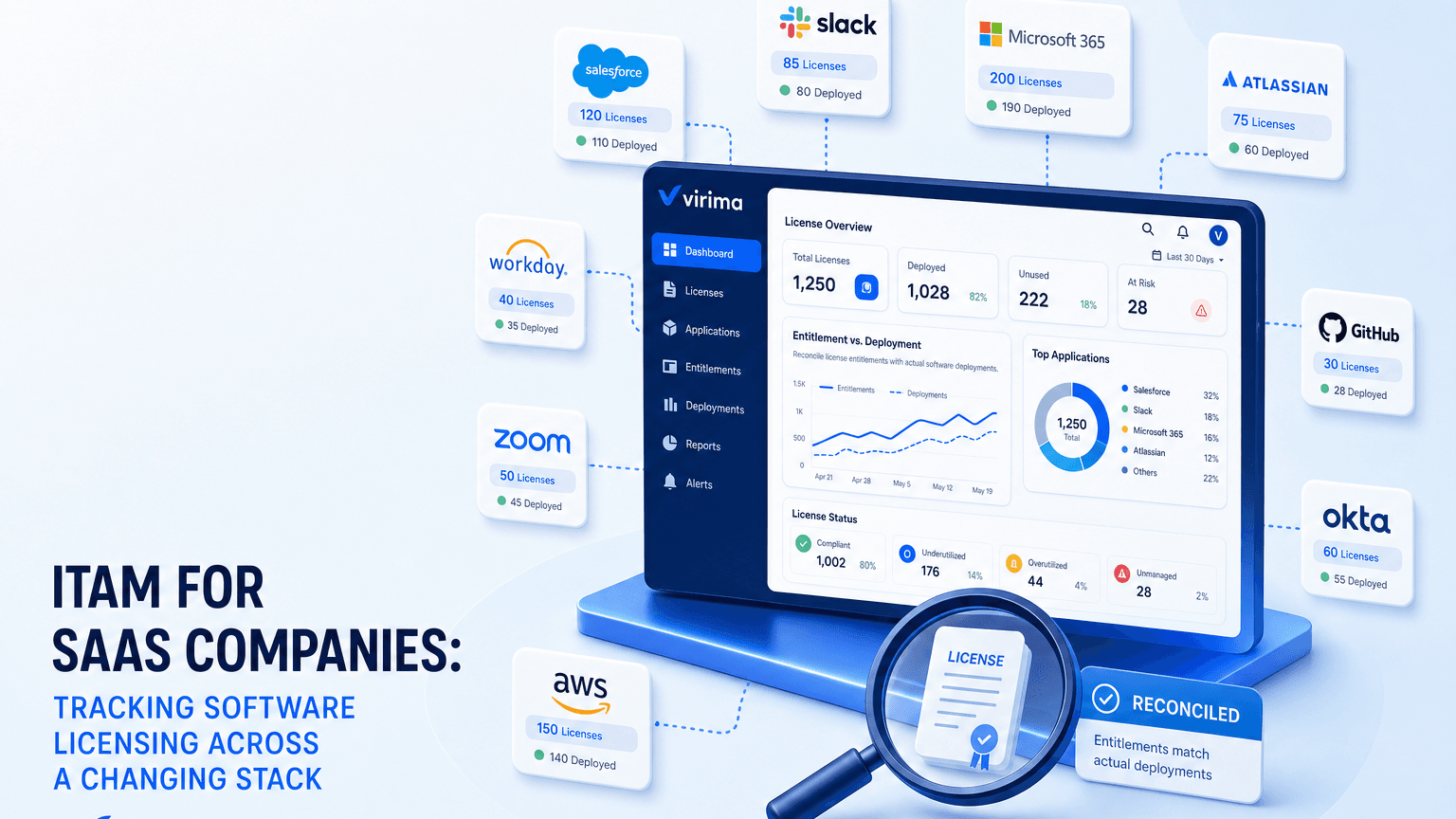
ITAM for SaaS Companies: Tracking Software Licensing Across a Changing Stack

An engineering team adopts a new monitoring tool. Another team already holds licenses for a product that does the same thing. A developer leaves. Their assigned seats remain active. A project ends. The software it used stays installed. A subscription renews at last year’s seat count.
The stack has changed several times over. The entitlement record may still reflect decisions made twelve months ago. The problem for technology companies is not simply knowing what was purchased. It is keeping what was purchased aligned with what is actually deployed, assigned, and used.
Technology Companies Optimize for Fast Software Adoption
Software adoption in technology companies is structurally different from adoption in traditional enterprises. Engineering teams evaluate and acquire tools quickly. Individual contributors can often add SaaS products without a formal procurement cycle. Development environments include IDEs, database tools, testing platforms, monitoring utilities, cloud services, security tools, and design software. Some of that tooling sits on company-managed devices. Some lives in accounts tied to organizational credentials.
This is not negligence. Engineering velocity rewards teams for acquiring useful tools quickly. The decentralized model makes sense while each decision stays small. The licensing problem emerges later, when many independent decisions accumulate into an estate that no single record fully reflects.
Procurement Records Describe Entitlement, Not Actual Deployment
A purchase order may document 300 seats acquired under a named-user agreement. It does not document 243 active installations, 19 users who have since left, 12 unused assignments, and 26 seats never deployed. Discovery can identify software installed on 280 endpoints. It cannot determine, on its own, whether those installations fall within the coverage of the current agreement.
ITAM for SaaS companies earns its role by connecting those two views. The entitlement ledger records what was purchased and under what terms. Deployment data records what is actually running and where. Neither record alone answers whether the organization is licensing its software correctly.
Why can’t a software inventory alone show whether licenses are compliant in a SaaS company?
A software inventory shows what is installed or assigned. A license record shows what was purchased and on what terms. Compliance depends on comparing the two against the metric the vendor defines: named user, device, concurrent seat, or usage tier. Inventory without entitlement context cannot show whether deployments are covered or which seats may be at risk.
Software Stacks Change Faster Than License Records
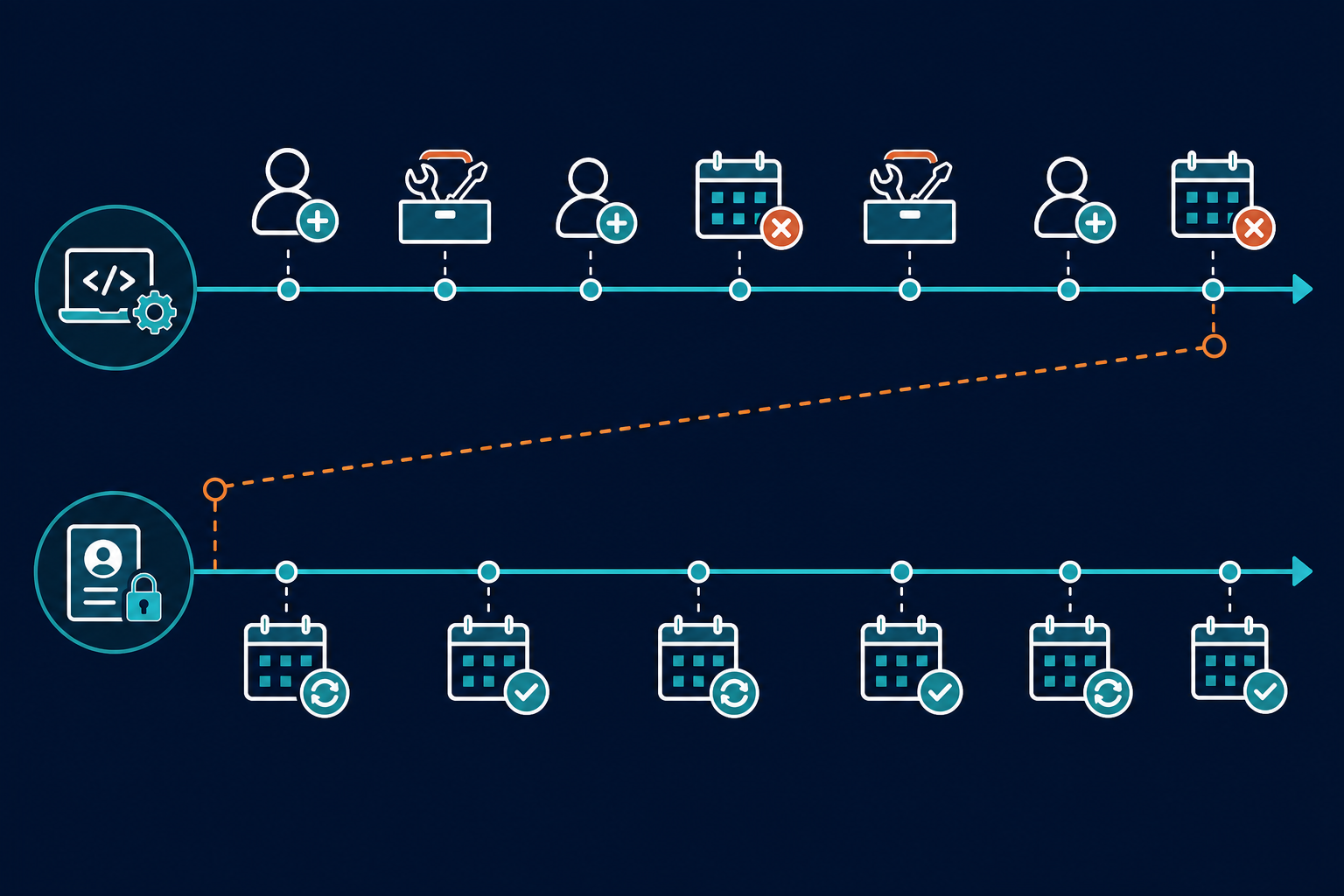
A technology company’s software estate changes through hiring, offboarding, project creation, project closure, tool replacement, new cloud services, local installations, and subscription model changes. Each of those events can shift the gap between what was purchased and what is actually deployed. Licensing records update on different timescales: annual renewals, quarterly reviews, procurement cycle updates, contract negotiations.
The result is temporal drift. The entitlement record reflects a past decision. The deployment state reflects today’s reality. The faster software adoption changes, the shorter the useful lifetime of a static entitlement record. In a team that rotates projects quarterly and adds contractors regularly, that gap can form within weeks of a renewal.
What causes software licensing drift in fast-moving technology companies?
Licensing drift forms when software deployments and entitlement records update on different timescales. A technology team can shift its software footprint through hiring, offboarding, or project changes within weeks. Most entitlement records update annually or quarterly. The gap between those two states widens every period they are not actively reconciled against each other.
SaaS Licensing Adds Assignment Complexity
Not all software behaves like installed desktop software. License metrics differ by product and vendor. A tool may be licensed per named user, per device, per concurrent session, per subscription tier, per usage unit, or under an enterprise-wide agreement. One seat count cannot explain the licensing position across a mixed estate.
A software asset record in a SaaS company should connect product and edition to its license metric, the entitlement quantity, the current assignment or deployment count, and usage data where the vendor makes that measurement meaningful. That chain allows comparison between what was purchased and what is actually deployed or assigned. Vendor agreements still determine what compliance means for each specific product. Entitlement-to-install comparison informs the position. Contractual terms define the standard.
Developer Tools Create a Different Reclamation Problem
Some software in technology companies is installed locally on developer machines. Some is accessed through SaaS accounts tied to organizational SSO. Some licenses belong to teams rather than individual users, and some belonged to individuals who have since moved to different tools or left the company.
The relevant question for IT asset management is therefore not simply whether an application is installed. It is whether the entitlement behind it is still attached to a real operational need. A tool used intensively during one project may sit idle the following quarter. Where usage measurement is technically and contractually meaningful, ITAM can help identify potentially underutilized licenses before renewal. Not all developer tooling exposes reliable activity data, and not every tool with low recent usage can or should be reclaimed.
Offboarding Exposes the Gap Between Identity and Licensing
An employee exits. Their access to corporate systems often ends within hours. Their software footprint may not. Assigned SaaS seats can remain active under their email address. Named-user licenses may remain attached to their account. Local installations on company devices may persist through device reassignment. Subscriptions managed under their credentials may stay connected to the organization’s payment method.
A clean offboarding process should connect identity changes to software assignment and entitlement recovery. That connection matters primarily for licensing, not only for access control. A departed user represents a licensing assumption the organization continues to pay for. SaaS software license management should make that assumption visible and actionable before the next renewal cycle.
Duplicate Tooling Is Often an Information Problem
Two engineering teams may independently subscribe to similar tools not because either team ignores procurement, but because neither team knows what the other already has. The result can include overlapping subscriptions, unused capacity within existing agreements, redundant products serving the same function, and inconsistent renewal dates creating unnecessary contract complexity.
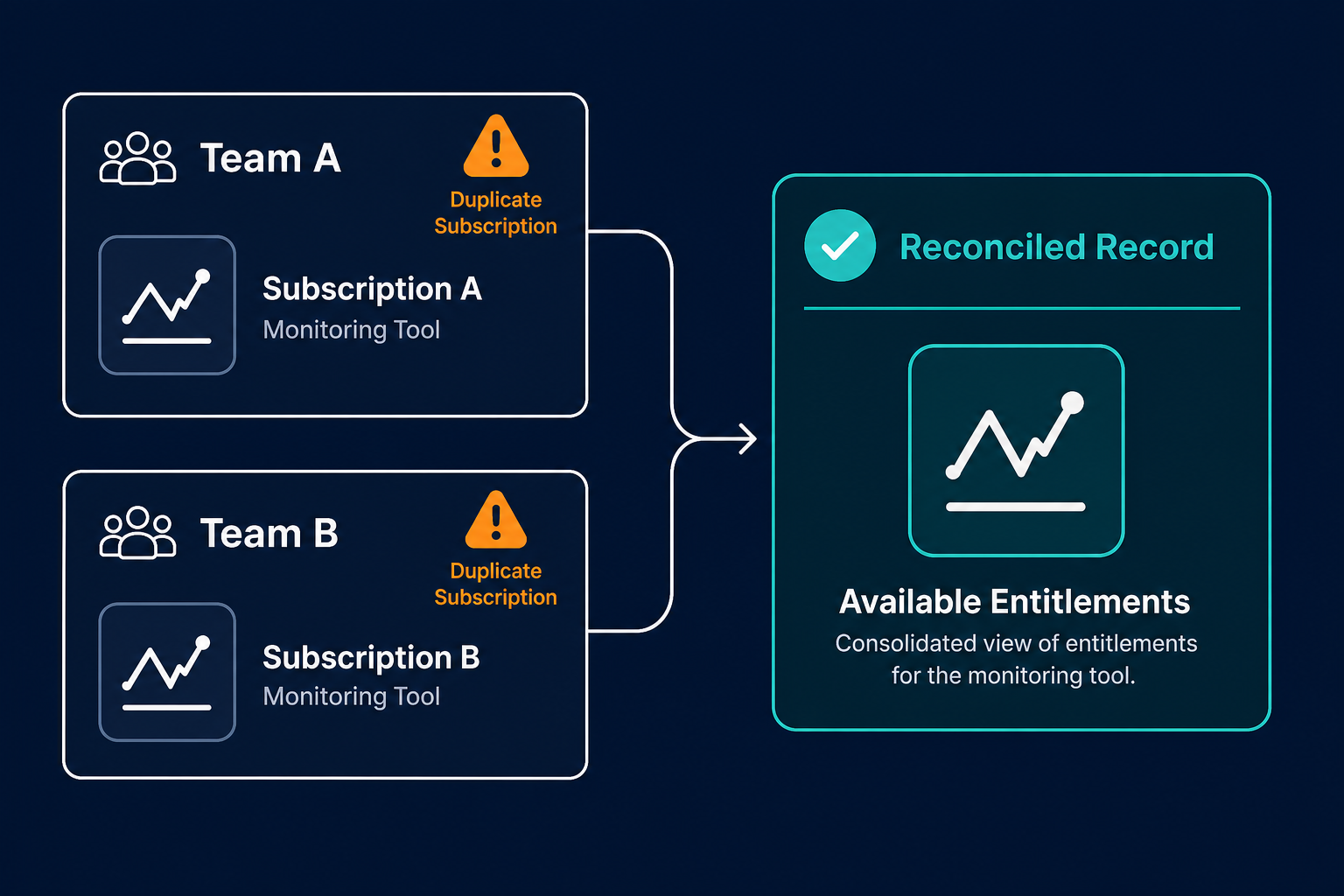
Useful software asset management for technology companies addresses that problem before purchase and before renewal. Relevant questions include: does the organization already own this product? Which teams use it? How many entitlements exist, and how many appear inactive? When does the current agreement expire? Visibility before a purchasing decision prevents duplication more reliably than policy enforcement after the fact.
Discovery Should Challenge the Software Inventory
A software register that relies only on procurement records reflects purchasing decisions, not deployment reality. IT discovery verifies installed applications, versions, endpoints, software changes, and removals across the managed estate. That observed state then serves as the input to ITAM reconciliation.
The comparison between discovered installations and entitlement records reveals installations without clear coverage and entitlements without observed deployments. It also surfaces software that appears in the inventory but has not been observed recently on active devices. None of those findings automatically constitute a compliance conclusion. They identify the gaps that require review and the assignments or purchases that may follow from that review.
Usage Should Inform Decisions, Not Define Compliance
Usage information can help an ITAM team identify inactive licenses, evaluate reclamation candidates, size upcoming renewals, and investigate tools that no longer appear in active use. That information is valuable for optimization and for renewal conversations. It does not by itself determine licensing compliance.
A specialized development tool may show minimal recent activity but remain operationally necessary when its specific function is required. A concurrent-use license may appear idle during off-peak hours but fully utilized during release cycles. Vendor licensing terms define compliance independently of usage patterns. Usage data supports optimization decisions and informs renewal negotiations. It does not replace contractual interpretation, and ITAM should treat those two functions as distinct.
What Software ITAM Should Connect in a SaaS Company
| Question | Required context |
|---|---|
| What software exists? | Product, edition, version |
| Where is it deployed? | Endpoint, VM, user, environment |
| Who is it assigned to? | Named user or team |
| What covers it? | License, subscription, or enterprise agreement |
| What metric applies? | User, device, concurrent, usage tier |
| How many were purchased? | Entitlement quantity |
| How many are deployed or assigned? | Install or assignment count |
| Is it still in use? | Activity data where available and meaningful |
| When does it renew? | Contract or subscription date |
| Can it be reclaimed? | Operational need and contractual terms |
What does a reconciled software asset record enable that procurement records or discovery scans cannot provide independently?
A reconciled software asset management (SAM) record connects purchased entitlements to verified deployments and active assignments. It shows which seats may be reclaimed before renewal, which installations lack entitlement coverage, and which products show low enough activity to review for right-sizing. Neither a procurement ledger nor an IT discovery scan provides that combined view on its own.
A Practical Workflow for Software License Management
Discover. Identify installed software and SaaS assignments across the managed estate using agent-based, agentless, or API-based collection.
Normalize. Match product names and versions consistently across sources to remove duplicates from different collection methods.
Entitle. Record purchased licenses, subscriptions, and the metric that defines coverage for each product.
Reconcile. Compare entitlement quantities against installation or assignment counts to identify gaps in both directions.
Measure. Apply activity data where the vendor makes usage measurement technically and contractually meaningful.
Act. Reclaim unused seats, reassign idle licenses, adjust purchase quantities, or flag products for review before renewal.
The sequence matters. Reconciliation only works when discovery has produced a current installation count and entitlement records reflect actual purchases. Acting on stale data from either source extends the drift problem rather than closing it.
Where Virima Fits for SaaS Software License Management
Virima ITAM connects the discovery layer to license, ownership, lifecycle, and usage context. It does not serve as the authority on any specific vendor’s licensing rules. Vendor agreements define those rules. Virima provides the deployment, entitlement, assignment, and usage context that purchasing and compliance decisions depend on.
Virima Discovery supports agent-based, agentless, and API-based collection, capturing installed software, versions, and endpoint assignments across the managed estate. The ITAM layer records purchased licenses and subscriptions, compares entitlements to observed installations, tracks ownership and allocation by user or team, and applies usage metering where data is available and relevant. Source attribution and freshness timestamps on discovered records allow teams to trace how and when each software observation was made.
| Operating challenge | How the ITAM layer helps |
|---|---|
| Changing software estate | Recurring, scheduled discovery cycles |
| Installed applications | Software inventory with version and endpoint detail |
| Purchased rights | Entitlement records by product and license metric |
| Deployment mismatch | Entitlement-to-install comparison |
| Potentially unused seats | Usage metering where supported by the product |
| User offboarding | Ownership and assignment context by user |
| Renewal planning | License quantity, usage, and contract date reporting |
Connect software deployments to your entitlement records
See how discovery-sourced Trusted Runtime Truth gives IT and procurement teams the current deployment context they need for licensing decisions, without turning the inventory tool into a compliance authority.
Keeping Entitlement Records Aligned With the Actual Stack
Technology companies will continue changing their software tools quickly because that flexibility supports engineering speed and product delivery. The asset-management challenge is keeping entitlement records close enough to actual deployment and use that procurement decisions, renewal negotiations, and licensing reviews remain grounded in the current stack rather than last year’s records.
That reconciliation requires a discovery process running at an appropriate cadence, an entitlement record reflecting current purchases and license metrics, and an ITAM layer connecting the two continuously. Virima provides that infrastructure, not as a replacement for vendor-specific licensing judgment, but as the deployment and assignment evidence that makes that judgment possible.
See how SaaS and technology teams manage licensing with Virima
Request a demo to see how Virima discovery, entitlement tracking, and usage metering support software license management across a continuously changing technology stack.
Frequently Asked Questions
What makes software license management different for SaaS and technology companies?
Technology companies change their software stacks faster than traditional enterprises through rapid hiring, project rotation, and decentralized tool adoption. Entitlement records update on annual or quarterly cycles while deployments shift continuously. That gap between the two timelines means static procurement records become unreliable quickly, and reconciliation has to run at a cadence that matches the pace of adoption.
What is software license entitlement drift, and why does it matter for IT asset management?
Entitlement drift is the widening gap between what a company purchased and what it actually deploys and uses. It forms when software deployments change faster than entitlement records are updated. Left unreconciled, drift means renewal decisions are made against inaccurate baselines, and licensing reviews lack current deployment data to work from.
Can IT discovery replace ITAM for software license tracking in a SaaS company?
No. IT discovery identifies what is installed, where, and on which endpoint. ITAM adds entitlement records, license metrics, ownership context, assignment tracking, and usage metering. Compliance and optimization decisions need both layers: discovery for current deployment state, and ITAM to compare that state against what was purchased under what terms.
How should SaaS and technology companies handle software licenses when employees leave?
Offboarding should connect identity changes to software assignment and entitlement recovery. Specifically, SaaS seats, named-user licenses, and subscription access tied to the departed user should be reviewed and reclaimed where the agreement permits. A departed user left as an active license holder is a recurring cost without operational justification.
Does Virima determine whether a company is compliant with a vendor’s software license terms?
No. Virima provides deployment, entitlement, assignment, and usage context: what is installed, what was purchased, who holds assignments, and where usage data is available. Vendor agreements define what compliance means for each product. Virima’s role is to supply the current technical evidence that IT, procurement, and legal teams use when making that determination.