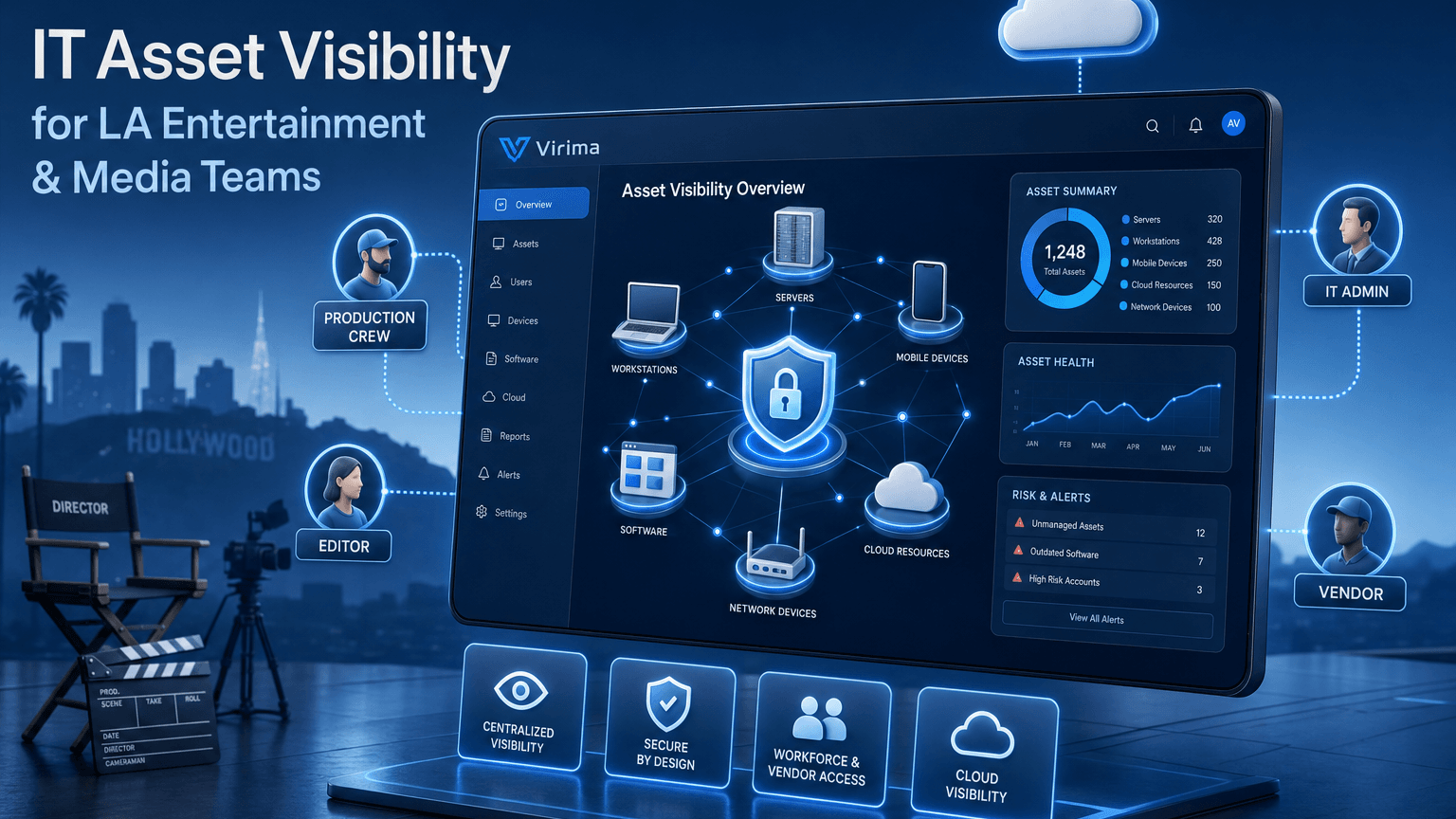
IT Asset Visibility for LA Entertainment & Media Teams

In July 2024, a hacking group calling itself NullBulge published 1.1 terabytes of data pulled from Disney’s internal Slack workspace. The haul included nearly 10,000 channels going back to 2013, unreleased project files, source code, and login credentials. The access point was human, not technical: an employee downloaded a fake AI image-generation tool laced with credential-stealing malware. Disney’s response was structural: the company moved most of its business units off Slack toward Microsoft Teams. The hacker behind it, Ryan Mitchell Kramer, pleaded guilty in federal court in the Central District of California to charges carrying up to five years in prison.
IT asset visibility is the one discipline Los Angeles entertainment and media companies can’t take for granted — the pattern below repeats itself: employee turnover and infrastructure changes outpace the record of who can still reach what.
A year earlier, twelve miles away in Burbank, the ransomware group Rhysida walked out of Insomniac Games with 1.67 terabytes: unreleased Spider-Man and Wolverine assets, a decade of product roadmaps, and passport scans of current and former staff. One detail in that leak said more than the $2 million ransom demand did. Among the exposed records was a former Insomniac employee, laid off months earlier, who had since gone to work at Disney.
Neither breach’s documented cause was a missed vulnerability scan — both turned on credential theft after an employee-focused compromise. Both also happened inside an industry whose workforce and vendor network turn over constantly, and turnover is exactly what an asset inventory has to survive to mean anything. Every layoff, every shuttered vendor, every VFX artist who lands at a competitor a month later leaves behind a credential, an access grant, or a copy of unreleased IP that someone has to remember to revoke or account for. In an industry contracting this fast, that bookkeeping is the thing most likely to get skipped.
IT asset visibility for Los Angeles entertainment and media cybersecurity teams
The industry this is actually about
Los Angeles entertainment is not scaling like Bay Area AI headcount. It is contracting and consolidating, which changes the failure mode for inventory work.
A 2026 industry analysis of entertainment layoffs frames the post-strike, post-streaming-reset labor picture: California production jobs down from 136,000 in 2022 to 82,000 by September 2025. Yahoo / Variety and the World Property Journal report major-facility soundstage occupancy near 62 percent, down from 90-plus percent through 2022. Variety covered Quixote Studios laying off 70 people and winding down its Los Angeles soundstage business in the same slump.
That is stages going dark, vendors exiting, freelancers bouncing between shows, and mid-tier shops disappearing while a few facilities hold. Instability, not velocity, is the mechanism. Every exit leaves access paths and IP copies that still need an owner on the books.
What asset visibility means when workforce and vendors both churn
IT asset visibility in this setting is a current record of systems, identities, and access paths that can still reach production or pre-release material, plus who owns each one after the last roster change. It is not a static server list refreshed once a year. It is configuration-item truth for infrastructure, collaboration platforms, render capacity, and the people and vendors who can still open them.
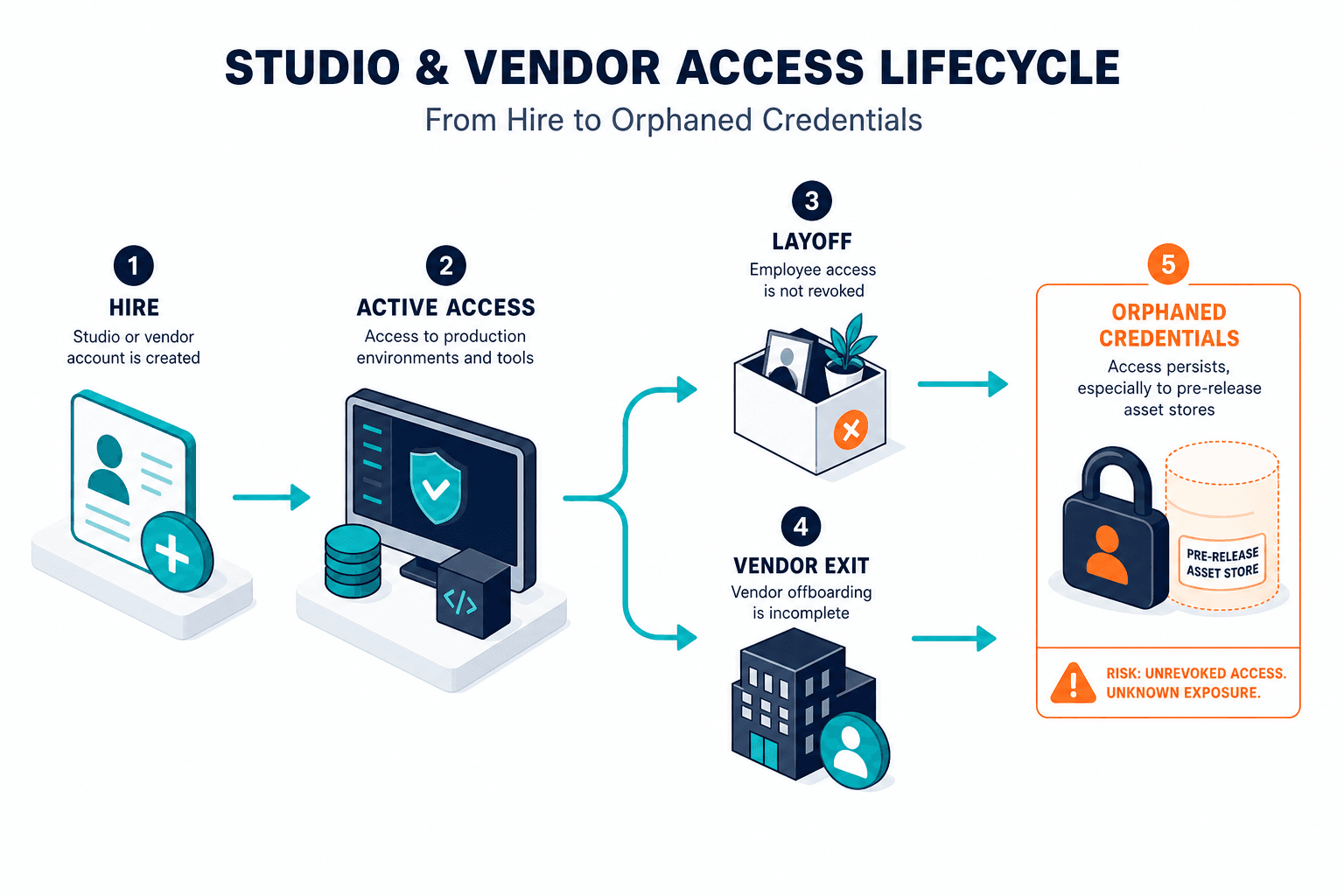
A configuration item is a Slack or Teams workspace, a VFX vendor render farm, a shared drive of dailies, a cloud project holding unreleased builds, and a laid-off employee’s still-active credential. The Insomniac leak made that last category impossible to ignore. A former employee appeared in exposed records after moving on, including into Disney’s orbit. Employment ended. The access story did not cleanly end with it.
Security teams that only inventory corporate servers miss the human and vendor hop. Studios that only track badge lists miss the SaaS grants and partner portals sitting next to those badges. Visibility fails when HR offboarding, vendor offboarding, and IT discovery never meet in one owned map.
Where it actually breaks, with evidence
Disney’s Slack breach is the central public exhibit. SpyCloud and Fortune covered NullBulge’s publication of roughly 1.1 terabytes from Disney Slack via compromised employee credentials, including long-lived channel history and project material. Disney’s response went structural: most business units moved off Slack toward Microsoft Teams. Reporting on Kramer’s guilty plea covered the case in the Central District of California, on charges carrying up to five years.
Insomniac’s Rhysida incident is the second exhibit, also Burbank-rooted. Coverage of the Rhysida ransomware attack on Insomniac detailed the hit on the Spider-Man 2 developer. Reporting around the leak described about 1.67 terabytes including unreleased game assets, multi-year roadmaps, and personal documents such as passport scans. Bloomberg covered how Sony video game plans spilled into public view through the same event. Both cases show data and access that had accumulated for years without a governed CMDB that could show who still had a path to those files.
Neither story is “the antivirus missed a file.” Both are industries where people, freelancers, and vendors rotate constantly, and inventory that cannot survive that rotation stops being inventory.
How did the Disney Slack breach start for enterprise security teams?
NullBulge published about 1.1 TB from Disney Slack after credential-stealing malware arrived through a fake AI image tool used by an employee. The case shows collaboration platforms and long-lived channel history as high-value targets when identity and tool inventory lag workforce behavior.
Why LA’s contraction makes this worse
A shrinking market multiplies offboarding events. Each layoff, vendor wind-down, and show wrap creates revoke-and-account work. When production volume falls, that work competes with keeping remaining shows alive, so it slips.
KiTalent describes a bifurcated labor market: mid-tier VFX and animation shops hit hard while top facilities stay relatively stable, and AI-augmented production roles can sit unfilled for 180-plus days even as traditional roles get cut. Skills mismatch plus headcount cuts means fewer people own the access ledger while more edge cases appear. Pre-release assets also sit across vendor companies that may not exist in six months. If the studio’s CMDB never modeled that vendor path as an owned dependency, recovery and legal review start from email threads.
VFX vendor access management: the gap nobody owns
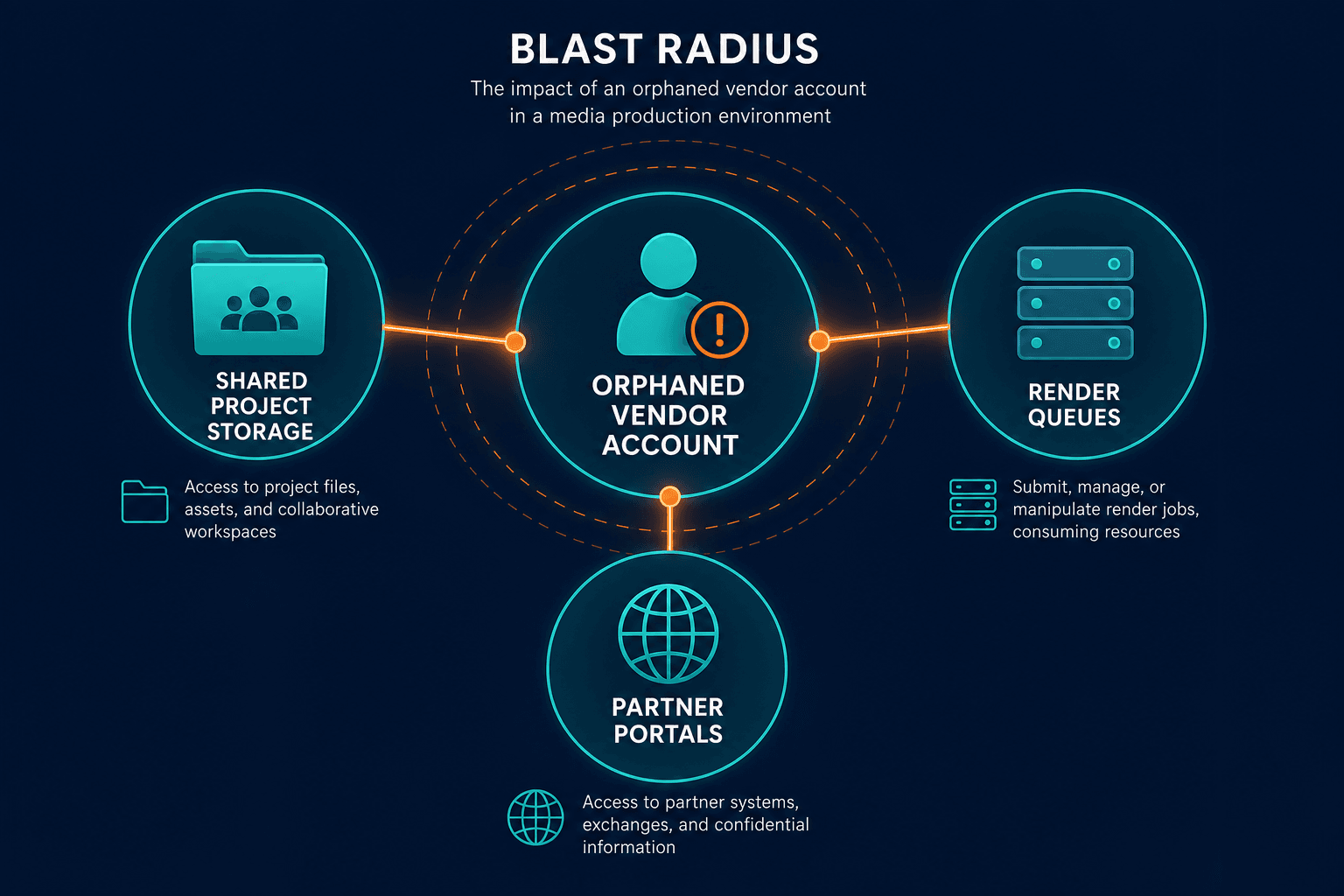
Contraction does not reduce attack surface automatically. It often increases orphaned access while reducing the staff who clean it up. Tracking vendor and third-party access as a lifecycle event, provisioned, reviewed, and revoked on schedule instead of granted once and forgotten, is the fix. blog post on third-party and vendor risk management for CMDB teams covers that same discipline for any industry with high partner turnover.
See what trusted runtime truth requires when people and vendors change faster than the inventory.
LA studios and media teams carry orphaned VFX vendor credentials and departed-staff access into pre-release IP long after the roster changes. blog post on third-party and vendor risk management for CMDB teams covers tracking that access as a lifecycle, not a one-time grant.
What breaks first when nobody tracks who still has access
Incident scoping slows first. When 1.1 TB or 1.67 TB is already outside the building, the first questions are which workspaces, shares, render jobs, and accounts were in scope, and which of those still belonged to active staff or active vendors. Without a current map, containment and notification become archaeology.
Legal and partner exposure hit next. Public reporting on the Insomniac leak included commercial material tied to broader Sony and Marvel publishing relationships, so a security failure became a partner-trust problem on the same timeline as the IP loss. Regulatory fines are lighter here than in healthcare or payments for many studio workflows. The real stakes are unreleased titles, personal data of crew, and whether partners still trust the chain of custody.
Change impact analysis only helps if collaboration platforms, identity stores, and vendor-linked systems are present as configuration items with owners. A pretty network diagram that stops at the corporate firewall does not answer who still has the dailies.
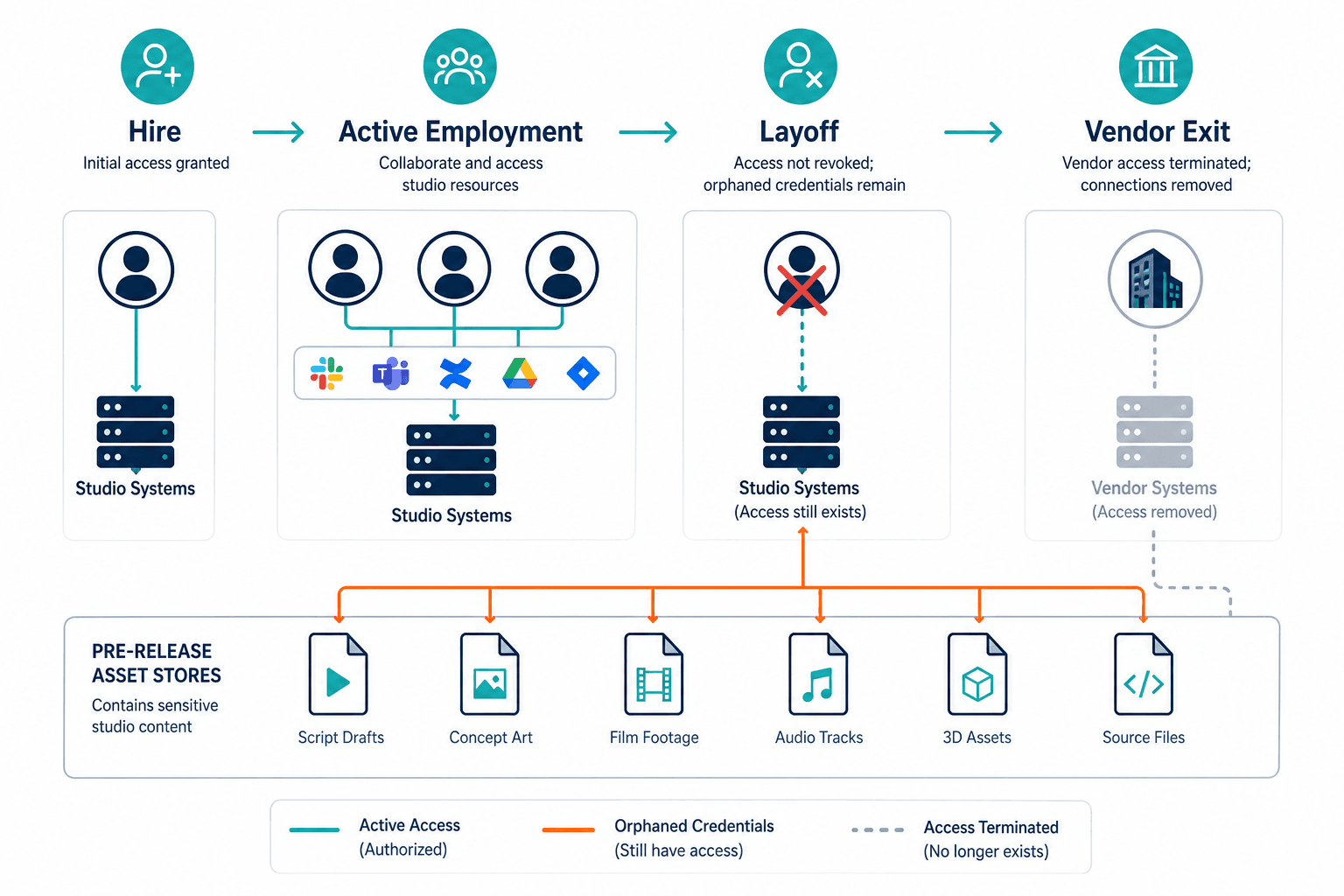
Why does entertainment workforce churn create IT asset blind spots?
Layoffs, show wraps, and vendor exits leave credentials, SaaS grants, and copies of pre-release assets behind. When HR, vendor management, and IT discovery never share one owned inventory, access outlives employment and contracts by default.
What accurate visibility actually looks like for this industry
Accurate visibility tracks identity and access lifecycle as closely as infrastructure. Scheduled IT discovery reaches endpoints, cloud projects, collaboration tenants, and supporting servers on a cadence teams can defend, not a once-a-year audit after a leak.
It joins people and vendors to systems. Offboarded employees and closed vendor contracts should clear from the same source of truth security uses in an incident. IT asset inventory hygiene means every high-value store of unreleased media has an owner, an environment tag, and a known path from corporate identity.
It extends past the lot. VFX and post-production depend on external render and review paths. Those paths need to appear in the configuration management database as relationships, not as tribal knowledge on a producer spreadsheet. Once teams define which titles or pipelines count as business services, service mapping can show blast radius from a compromised account into the stores that hold unreleased work.
Where a platform fits
Platforms that combine multi-source discovery, a governed CMDB, and service mapping after service definitions are supplied turn that model into operations. Virima discovers and reconciles IT and cloud assets on scheduled discovery cycles, maintains configuration item relationships — including identity and vendor access paths modeled as discovered configuration items — and builds ViVID™ service maps once teams define the services that matter, so collaboration systems, media stores, and supporting infrastructure show up as owned inventory instead of tribal lists. ITAM and ITOM views can pull from the same discovery-sourced records. Integrations with ITSM platforms such as ServiceNow, Jira Service Management, Ivanti, HaloITSM, Xurrent, and Hornbill keep that inventory inside change and incident workflows, all reachable through a single integrations hub.
The platform job is not a longer hardware list. It is a runtime picture security, IT, and production technology can share when the next layoff wave or vendor exit hits.
See how ViVID™ service maps model vendor and identity access paths before the next churn event.
Tracking people and access as carefully as servers
A former Insomniac employee showed up in leaked records after moving into Disney’s world, and Disney later faced its own Slack-scale exposure. In a market this fluid, that is not a coincidence of headlines. It is what happens when access and IP paths outlive the roster that created them.
In Los Angeles entertainment, the asset inventory has to track people and access at least as carefully as it tracks servers. That’s the IT asset visibility Los Angeles entertainment companies need before the next contraction cycle, not after. Otherwise every contraction cycle widens the same gap: credentials and copies that still exist in production systems, and nowhere on the map that incident responders trust.
Request a demo and walk identity, vendor, and media-system ownership against a current inventory.
Frequently Asked Questions
What caused the Disney Slack data leak reported in 2024?
Public reporting attributes the NullBulge leak of about 1.1 TB from Disney Slack to credential theft after an employee used a fake AI image-generation tool. Disney later moved much of its business off Slack to Microsoft Teams, and the perpetrator pleaded guilty in federal court in California.
What did the Insomniac Games Rhysida attack expose?
Reporting described roughly 1.67 TB including unreleased game assets, multi-year product roadmaps, and personal documents such as passport scans for staff. The leak also surfaced commercial material tied to broader publishing relationships, turning a security incident into a partner-trust problem.
Why is LA entertainment especially exposed to orphaned access?
Production job cuts, low soundstage occupancy, and vendor exits create constant offboarding. Freelancers and VFX partners rotate between shows while pre-release IP sits across companies that may shrink or close, so credentials and grants outlive the engagement unless inventory tracks them.
Does Virima track vendor and freelance access separately from employee accounts?
Virima models vendor, freelance, and employee access as distinct configuration items with their own relationships in the CMDB, discovered on scheduled cycles rather than tracked in a separate spreadsheet. That gives IT and security one owned record for infrastructure, collaboration tenants, media stores, cloud projects, and the vendor paths that can reach unreleased work — joined to offboarding events.
How does Virima help entertainment cybersecurity and IT teams?
Virima runs scheduled discovery across IT and cloud environments, reconciles configuration items into a governed CMDB, and builds ViVID™ service maps after teams define services. That gives security and IT a shared view of what exists, how it connects, and what to prioritize when staff or vendors exit.