How Asset Data Strengthens GRC Software Programs

Governance, risk, and compliance (GRC) software manages organizational policy, risk taxonomies, and control testing workflows. Enterprise compliance teams rely on dedicated platforms such as ServiceNow GRC, Archer, LogicGate, and MetricStream to centralize governance operations. Every one of those programs runs on a foundation they depend on but rarely build themselves: an accurate, current record of the technology assets those controls govern. Without authoritative asset records, risk scores decay into static assumptions, audit evidence loses credibility, and control failures remain undetected across complex hybrid environments.
What GRC Software Platforms Actually Manage
A GRC software platform serves as the central system of record for policy libraries, risk registers, control testing schedules, and audit evidence artifacts. For regulatory frameworks such as the Sarbanes-Oxley Act (SOX), compliance teams document control activities linked to financial reporting processes and remediation tracking. For data privacy standards like the General Data Protection Regulation (GDPR) or cybersecurity frameworks like NIST SP 800-53 Rev. 5, GRC platforms manage data processing inventories, vendor risk assessments, and breach notification workflows.
The primary strength of a GRC platform lies in workflow orchestration. It transforms scattered policy documents, legacy spreadsheets, and manual attestations into structured, governed processes that auditors can evaluate. However, this workflow orchestration depends entirely on external operational data. A control requiring security teams to verify patch levels on internet-facing servers is only as accurate as the server inventory feeding that control. When the underlying asset data is incomplete or outdated, the control testing process yields false confidence.
The Asset Data Gap Inside Dedicated GRC Software
Most enterprise GRC software implementations begin with control frameworks and risk taxonomies before working backward to the physical, virtual, and cloud assets those controls govern. In practice, asset detail enters the GRC platform through manual file uploads, periodic CSV exports from IT service management systems, or self-attestation forms completed quarterly by system owners. Each of these ingestion methods produces a static point-in-time snapshot rather than an active operational record.
Modern integrated risk management (IRM) frameworks attempt to bridge this gap by linking risks and controls directly to system records. Industry analysts note that ServiceNow IRM vs GRC implementations succeed only when powered by current operational inputs. A risk score assigned to a database server that was decommissioned months ago provides no security value. Worse, it misleads compliance auditors into evaluating non-existent risk profiles while newly provisioned cloud instances operate without assigned controls.
Is Your GRC Software Running on Outdated Asset Data?
Static risk registers and manual attestations create dangerous compliance blind spots. Discover how Virima delivers trusted runtime truth to automate control mapping and audit readiness.
Why do risk registers depend on CMDB infrastructure data?
Risk registers depend on CMDB infrastructure data because risk scores require accurate context on system configurations, dependencies, and ownership. When infrastructure changes occur without updating the CMDB, risk scores become stale, control mappings fail, and compliance teams lose visibility into actual operational risk exposures.
Why Risk Registers Depend on Infrastructure Data Quality
A functional risk register entry connects three distinct elements: a threat vector, a compliance control, and a specific technology asset. Threat assessments and control selection are strategic policy decisions, but the targeted asset is a dynamic operational entity. Infrastructure changes continuously as engineers provision cloud instances, deploy microservices, retire legacy hardware, and modify network configurations.
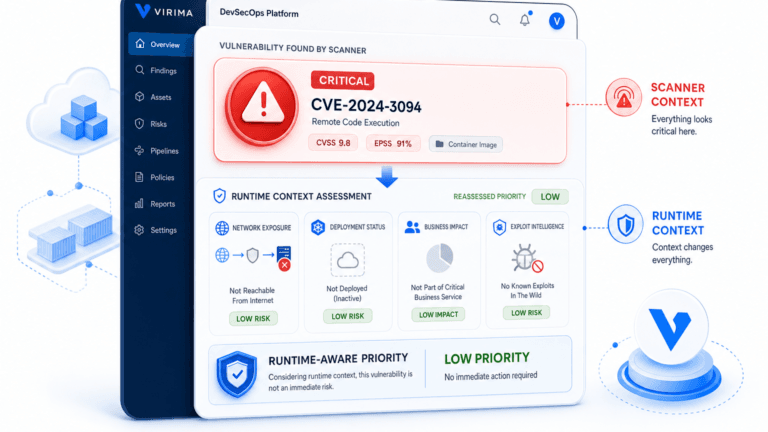
When the asset record inside a risk register becomes stale, the calculated risk score breaks down. A high-criticality vulnerability score attached to an isolated test environment misallocates remediation resources. Conversely, an unmapped production server hosting sensitive customer data remains invisible to compliance reporting. Sustaining accurate risk scoring requires infrastructure data that updates through scheduled discovery cycles whenever changes occur in production environments.
What a CMDB Contributes to Compliance Workflows
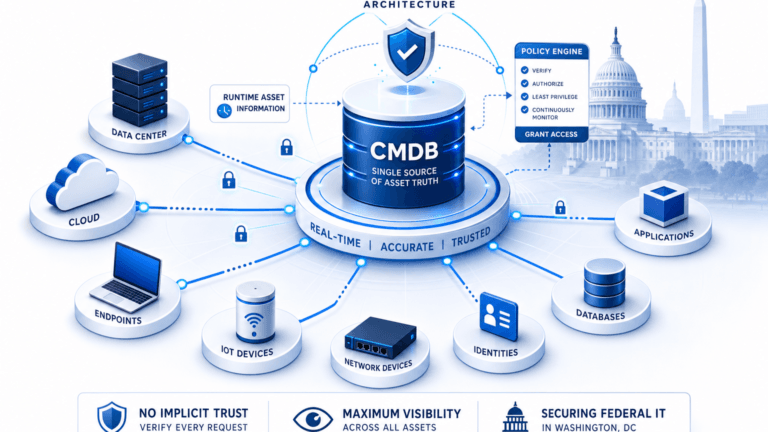
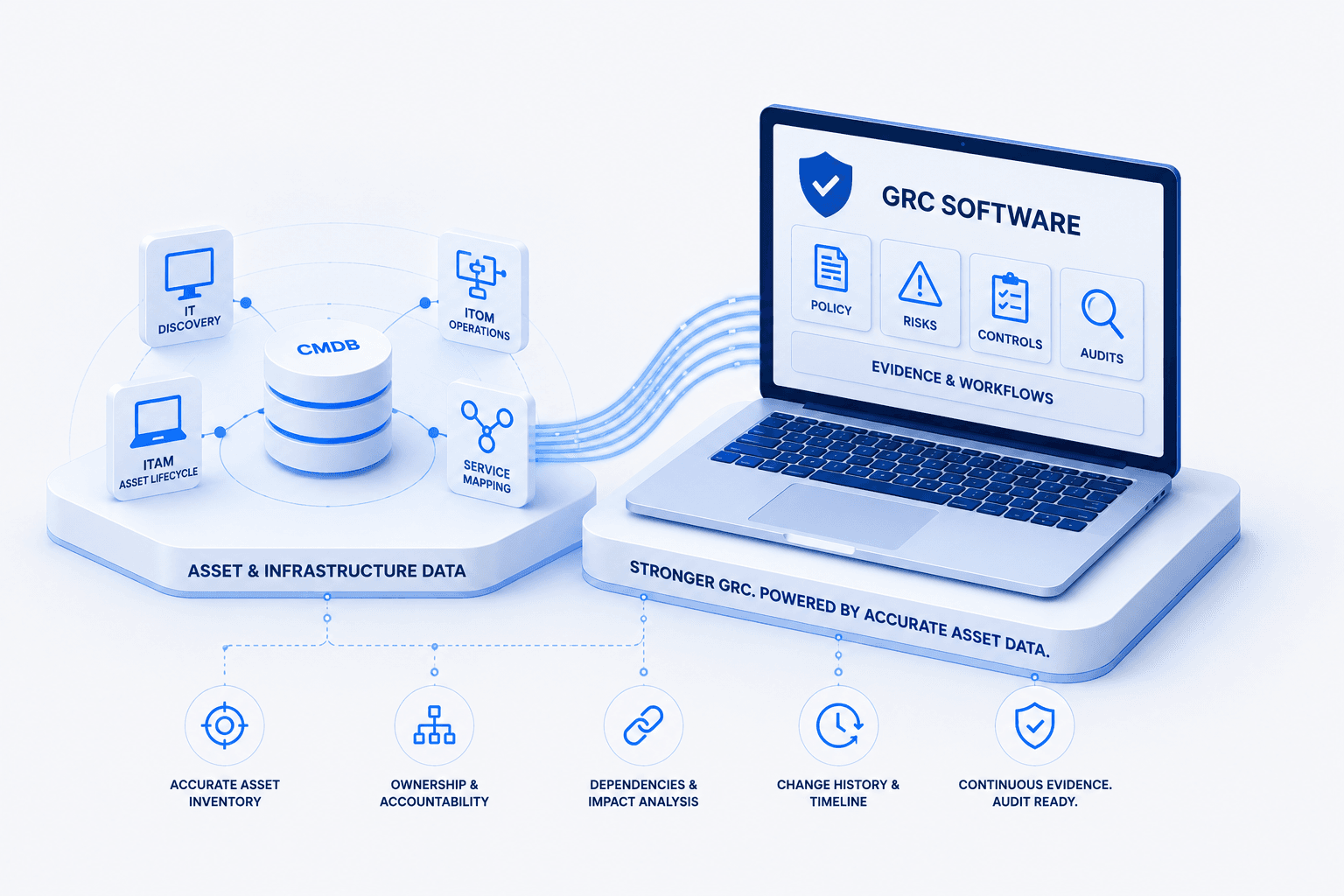
An enterprise configuration management database (CMDB) tracks configuration items (CIs), including physical servers, virtual machines, cloud instances, network devices, application services, and their interdependencies. That structural visibility addresses three requirements that GRC software programs cannot maintain independently:
- Ownership and Accountability History: When a control test fails or a compliance exception occurs, compliance officers must identify the exact system owner. A maintained CMDB tracks ownership records and change histories, reducing delay during remediation.
- Dependency Mapping and Impact Analysis: A vulnerability discovered on an isolated web gateway often poses cascading risks to connected database clusters. Dependency data enables compliance teams to scope audit boundaries accurately and assess blast radius during security incidents.
- Audit Timeline Integrity: Auditors require verifiable proof of continuous control enforcement. A CMDB provides historical configuration baselines, showing when systems were modified, patched, or retired over time.
Research on integrated identity and compliance frameworks published by Pathlock’s GRC analysis highlights that combining CMDB context with identity governance creates a unified control plane. That combination allows enterprise compliance teams to perform precise threat modeling and impact analysis during regulatory reviews.
How does IT Discovery replace snapshot-based audit evidence?
IT Discovery replaces snapshot-based audit evidence by scanning and classifying network assets, cloud workloads, and software dependencies through scheduled discovery cycles. Instead of relying on manual quarterly spreadsheets, discovery feeds verified, timestamped asset configuration logs into GRC audit workflows.
Moving GRC From Snapshots Toward Higher-Frequency Audit Evidence
Traditional audit cycles rely on quarterly attestation sampling, operating on the assumption that IT environments remain relatively stable between review periods. Cloud computing, containerized architectures, and rapid CI/CD deployment pipelines have rendered point-in-time sampling insufficient. Regulatory authorities increasingly mandate more frequent control monitoring rather than periodic self-reporting alone.
Enterprise compliance implementation guides, such as Essenn Associates’ ServiceNow GRC framework, emphasize that modern GRC tooling must pull directly from live operational data streams. As vendors build GRC solutions designed to consume operational telemetry, the value of underlying discovery and management systems increases significantly.
Streamline Compliance Audits With Automated Asset Intelligence
Eliminate manual evidence gathering and spreadsheet-based attestations. See how Virima unifies IT Discovery, ITAM, and ITOM to power your GRC platform.
Where ITAM, ITOM, and Discovery Data Enter the Picture
Connecting GRC software to a complete operational data layer requires integrating three distinct IT disciplines:
- IT Asset Management (ITAM): Tracks hardware and software lifecycles from procurement to disposal. ITAM provides financial ownership, vendor agreement status, software licensing detail, and hardware warranty lifecycle data essential for contract compliance and lifecycle risk tracking.
- IT Operations Management (ITOM): Monitors operational performance and service health. ITOM links underlying infrastructure components to business services, delivering the operational context required to measure business impact when systems fail control tests.
- IT Discovery: Scans, identifies, and classifies connected network devices, cloud accounts, and software instances. Automated IT Discovery capabilities establish a verified baseline of what actually runs across enterprise environments.
When GRC software consumes data from all three disciplines, compliance teams gain clearer control mapping. ITAM provides ownership context, ITOM delivers relationship mapping, and IT Discovery ensures unmonitored shadow IT assets are less likely to bypass regulatory controls.
How do ITAM, ITOM, and IT Discovery feed GRC control mapping?
ITAM supplies ownership, lifecycle, and licensing context; ITOM provides operational service dependency mapping; and IT Discovery identifies physical, virtual, and cloud assets. Together, these three disciplines feed verified operational data into GRC platforms to maintain accurate control mapping and risk scoring.
Establishing the Ground Truth Layer for GRC Programs
A compliance control is only as reliable as the asset inventory behind it. A risk register score is only as meaningful as the operational data supporting its calculations. GRC software platforms provide essential workflow management, policy organization, and audit reporting structure, but their effectiveness depends entirely on the operational truth beneath them.
By integrating automated IT Discovery, maintainable CMDB relationships, and dynamic Service Mapping tools, organizations establish an authoritative data layer for governance activities. Rather than attempting to maintain duplicate asset inventories inside GRC platforms, enterprise compliance teams achieve higher accuracy by consuming discovery-sourced operational context directly from dedicated infrastructure management solutions.
Accelerating GRC Audits With Virima Operational Context
Virima supplies the authoritative infrastructure data layer that enterprise GRC software programs require. Through automated, agentless IT Discovery, ViVID™ dynamic service mapping, and a centralized CMDB, Virima captures assets, dependencies, configuration histories, and ownership details across hybrid IT environments through scheduled discovery cycles.
By feeding verified asset intelligence into GRC software tools, Virima reduces manual evidence gathering, shortens audit cycles, and helps risk registers reflect true operational reality.
Ready to Strengthen Your GRC Program With Live Asset Intelligence?
See how Virima replaces static asset snapshots with discovery and service mapping to keep your GRC software audit-ready.
Frequently Asked Questions
Why do GRC software programs require external IT asset data?
GRC software manages policy, risks, and compliance workflows but does not natively discover or track IT infrastructure. External IT asset data from discovery tools and CMDBs provides the inventory, configurations, and dependencies necessary to map controls accurately and score risk accurately.
What are the risks of using manual spreadsheets for GRC asset tracking?
Manual spreadsheets create static point-in-time snapshots that become outdated quickly in dynamic IT environments. Relying on spreadsheets leads to unmapped assets, inaccurate risk scores, failed control tests, and extended audit preparation times due to manual evidence verification.
How does a CMDB improve audit readiness for compliance frameworks like SOX and GDPR?
A CMDB maintains configuration histories, application dependencies, and ownership records for technology assets. For frameworks like SOX and GDPR, a CMDB provides verifiable change logs and system boundary maps that help prove control enforcement to external auditors.
How does Virima integrate with enterprise GRC software platforms?
Virima integrates with major GRC software platforms by discovering hybrid IT assets, mapping application dependencies, and populating CMDB records. Virima feeds verified operational context into GRC risk registers and control workflows without replacing existing ITSM investments.
Can Virima replace a dedicated GRC software platform?
No. Virima is not a standalone GRC software platform. Virima provides the underlying operational data layer, including IT Discovery, ITAM, ITOM, CMDB, and ViVID service mapping, that feeds dedicated GRC software programs and makes policy and risk management workflows more accurate.