Device42 Competitors in 2026: Top Alternatives Compared by IT Teams

Device42 competitors include Virima, Faddom, Lansweeper, ServiceNow Discovery, BMC Helix, and Sunbird, and each takes a distinct approach to IT asset discovery, CMDB population, and service dependency mapping. Device42, now part of Freshworks, provides agentless infrastructure discovery and application dependency mapping for hybrid environments. This guide compares the leading alternatives on discovery method, ITSM integration depth, service mapping, and pricing, so your team can make an informed call for your specific environment.
Industry data sets the stakes. In its Annual Outage Analysis, the Uptime Institute reported that four in five respondents said their most recent serious outage could have been prevented with better management, processes, and configuration. That is the case for accurate, well-governed configuration data, and it is the lens this comparison uses.
Whether you are evaluating Device42 for the first time, reconsidering it after the Freshworks acquisition, or looking to move beyond basic asset tracking into governed, service-aware CMDB data, the alternatives here address meaningfully different use cases. We examine each on the criteria IT directors and ops managers actually use to decide.
Why Enterprise Teams Re-Evaluate Device42 Competitors in 2026
Device42 is an IT asset management and infrastructure discovery platform that Freshworks acquired in 2024. It provides agentless discovery for physical, virtual, cloud, and container environments and populates a centralized CMDB with discovered assets and their relationships. Core capabilities include agentless asset discovery, application dependency mapping, IP address management (IPAM), and data center infrastructure management (DCIM).
Device42 integrates with ITSM platforms including ServiceNow, Jira Service Management, and Freshservice, and it aligns with ITIL practices for configuration management. For many organizations it has been a reliable foundation for asset visibility.
Even so, buyers evaluating Device42 in 2026 face a market that has moved. Alternatives now offer deeper service-context overlays, more bidirectional ITSM integrations, and pricing models that do not scale by device count. That combination is why so many teams are comparing Device42 competitors this year.
Device42 Limitations: What Enterprise Users Report
The following limitations, reported by verified users on G2 and Gartner Peer Insights, represent the most cited reasons teams start searching for Device42 alternatives.
- Steep learning curve. Device42’s interface is frequently described as complex and not immediately intuitive, particularly for teams without prior CMDB implementation experience. New users typically need significant onboarding time before the full feature set becomes productive.
- System performance under load. Users report slowdowns during peak operational periods, particularly in large infrastructure footprints. That can create friction during time-sensitive discovery cycles or during incident triage, when accurate asset data is needed fast.
- Limited customization. Device42 restricts direct addition of custom Management Information Bases (MIBs), which limits how well it adapts to non-standard network devices. This affects teams with heterogeneous networks or specialized hardware that needs custom SNMP definitions.
- Plugin-gated feature gaps. Several capabilities users expect as core features are available only through separate add-ons or plugins. That creates unexpected cost and confusion during evaluation, because a demo environment may show capabilities the base license does not include.
- Per-device pricing that scales unpredictably. Device42’s license model is tied to device and IP counts. In organizations with growing or dynamic infrastructure (particularly those adopting cloud-native or containerized architectures), that model can produce significant, hard-to-forecast cost increases as the discovery footprint expands.
Device42 Under Freshworks: What Buyers Should Know
If you already run Freshservice and are considering Device42 as a discovery layer, the integration story is straightforward. If you are not on Freshservice, the acquisition raises a fair question: is Device42’s roadmap still oriented toward the broadest possible ITSM ecosystem, or is it gradually being optimized for the Freshworks platform?
We published a dedicated analysis of the Freshworks Device42 acquisition and what it means for Freshservice customers.
Virima functions as an ITSM-agnostic discovery and CMDB layer. It integrates bidirectionally with ServiceNow, Jira Service Management, Ivanti, Halo, Xurrent, and Hornbill, which helps you avoid the single-vendor dependency the acquisition introduces.
Top 6 Device42 Competitors in 2026
These alternatives span the full range of enterprise discovery and CMDB use cases, from agentless speed-focused tools to full ITSM-integrated platforms. Each entry covers key capabilities, limitations, and the profile it fits best.
1. Virima: Discovery-Driven Runtime Truth
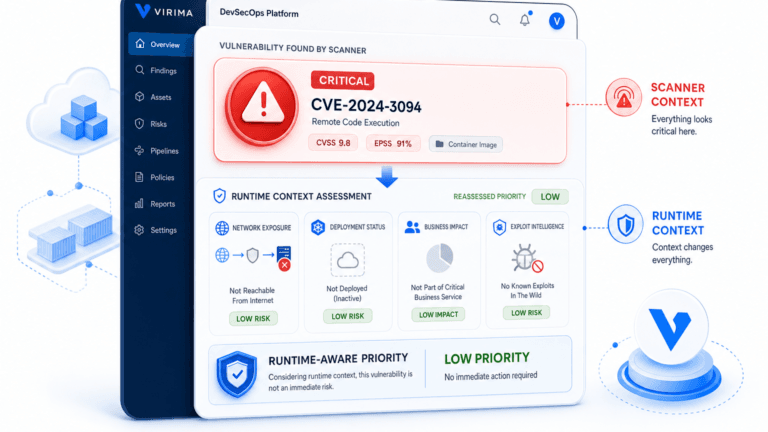
Virima is a CMDB, IT discovery, and service mapping platform built for IT teams that need authoritative, governed data for ITSM workflows and AI-driven operations. That full platform is available as Virima, including Virima Business Pro for growing environments. Where Device42 gives you asset visibility, Virima gives you discovery-driven runtime truth: a reconciled, policy-aware data layer that answers not just what exists, but how it connects, what changed, what is likely to break, and who owns it.
- Discovery-driven ground truth. Virima uses a hybrid model that combines agentless probes, agent-based collection, and native cloud provider API integrations across AWS and Azure. Discovery runs populate and reconcile CMDB records through multi-source data reconciliation, resolving conflicts between sources into a single trusted CI record. That reduces the manual review step Device42 users frequently cite as a cost after each discovery cycle.
- ViVID™ Service Mapping with an ITSM context overlay. Virima’s ViVID™ Service Mapping builds application-to-infrastructure dependency maps from your service definitions and keeps those maps current as infrastructure changes. The distinguishing capability is the overlay: ViVID surfaces open incidents, recent changes, pending changes, and NIST NVD vulnerabilities directly on the service map, giving you one view that ties operational status to infrastructure reality.
- Change Impact Analysis. Before a change is approved, Virima’s Change Impact Analysis surfaces the downstream impact, showing which CIs, services, and business functions are affected. It is wired into connected ITSM change records, so the impact is visible at the point of decision rather than discovered afterward. If managing change confidently is a priority, this is where Virima helps you manage change with fewer surprises.
- Six bidirectional ITSM integrations. Virima integrates bidirectionally with ServiceNow, Jira Service Management, Ivanti, HaloITSM, Xurrent, and Hornbill out of the box via the integrations hub. CI data, service context, and dependency maps flow in both directions, cutting the reconciliation work that follows a one-way push from Device42 into a separate ITSM platform.
- Packaged platform pricing. Discovery, CMDB, ViVID™ Service Mapping, and ITAM ship together. Virima Business Pro packages that full capability for growing IT estates; larger footprints move to Enterprise. Teams in cloud migration or container adoption get predictable packaging instead of a per-device penalty as the discovery footprint grows.
Virima vs. Device42: Capability comparison
| Capability | Device42 | Virima |
|---|---|---|
| Discovery method | Agentless with optional remote collectors; primarily infrastructure scanning | Hybrid: agentless, agent-based, and cloud provider API integrations (AWS, Azure) across on-premises, virtual, and container environments |
| CMDB population | Discovery feeds the CMDB; relationship mapping and CI enrichment often require manual review | CI population and relationship mapping from discovery runs; multi-source reconciliation reduces manual cleanup |
| Service mapping | Application dependency mapping with basic visualization | ViVID™ Service Mapping with overlays for open incidents, recent changes, pending changes, and NIST NVD vulnerabilities (service definitions provided by you) |
| ITSM integrations | ServiceNow, Jira, and a small number of platforms; sync depth varies | Bidirectional with ServiceNow, Jira Service Management, Ivanti, Halo, Xurrent, and Hornbill, with CI and service context flowing both ways |
| Pricing model | License-based, tied to device/IP counts; scales unpredictably | Packaged subscription (Business Pro for growing estates; Enterprise for larger scale); no per-device penalty as footprint expands. See Virima Business Pro |
| Deployment time | Enterprise rollouts typically take weeks to months, depending on collector setup and CMDB tuning | Faster time-to-value through pre-built discovery probes, relationship mapping, and templated ITSM integrations |
| Change impact analysis | Basic dependency visualization; limited pre-change risk surfacing | Change Impact Analysis shows downstream CI impact before approval, integrated with ITSM change records |
For a side-by-side breakdown, see our Virima vs. Device42 vs. ServiceNow comparison.
Schedule a Virima demo to see how this compares in your own environment.
2. Faddom: Fast Agentless Dependency Mapping
Faddom is an agentless infrastructure mapping tool focused on speed and simplicity. It documents on-premises and cloud environments and refreshes those maps as the environment changes, with teams typically generating their first dependency maps in well under an hour. Faddom does not require credentials or agents, so initial deployment is light.
Faddom fits teams that need rapid infrastructure visibility for a specific project, such as a cloud migration or a security audit, where deployment speed matters more than ITSM depth. When the requirement extends to a governed, ITSM-integrated CMDB with service mapping and change impact analysis, Virima addresses the layer Faddom does not. For a deeper look, see our Faddom solution overview.
| Area | Strengths | Limitations |
|---|---|---|
| Discovery | Agentless, no credentials required; fast initial deployment | Agentless only; no agent-based or cloud API collection depth |
| Mapping speed | First maps in under an hour; maps refresh as the environment changes | Less service context than ITSM-integrated platforms |
| Pricing | Transparent, project-friendly model | Lighter ITSM integration ecosystem than Virima or ServiceNow |
| Use cases | Discovery, migration planning, change planning | Not a full CMDB replacement for governed CI lifecycle management |
3. ServiceNow Discovery: Native Depth for ServiceNow-First Teams
ServiceNow Discovery is a native ITOM module within the ServiceNow platform. For teams already on ServiceNow ITSM, it provides very tight native integration, with discovered CIs populating the ServiceNow CMDB directly without a middleware sync layer. ServiceNow’s pending acquisition of Armis (announced December 2025, expected to close in 2026) is set to extend its visibility into IoT, OT, and unmanaged devices.
ServiceNow Discovery is a strong choice when you are already committed to ServiceNow as your ITSM platform and the budget supports full ITOM licensing. Teams not running ServiceNow ITSM often find a purpose-built option such as Virima or Faddom a better fit. Where teams do run ServiceNow, Virima complements it by enriching the ServiceNow CMDB with discovery-driven data, with fewer duplicates and less noise.
| Area | Strengths | Limitations |
|---|---|---|
| Integration | Native, deep integration with ServiceNow ITSM workflows | Requires a ServiceNow ITSM subscription; not a standalone discovery tool |
| Coverage | Managed IT assets, with IoT/OT visibility expanding via the pending Armis deal | Full ITOM licensing is a meaningful cost for teams not already on ServiceNow |
| CMDB depth | Full ServiceNow CMDB with ITIL process modules | Implementation typically needs ServiceNow-certified expertise |
| Breadth | End-to-end ITSM platform beyond CMDB/discovery | Data portability outside the ServiceNow ecosystem is limited |
4. Lansweeper: Strong Endpoint Inventory, Lighter on Service Context
Lansweeper is an asset discovery and inventory platform with broad hardware and software scanning across physical endpoints, virtual machines, network devices, and IoT. It offers agentless and agent-based scanning, detailed inventories, and reporting that supports license optimization and compliance auditing. It is a widely used entry-level to mid-market CMDB option with a strong footprint in endpoint-heavy environments.
Lansweeper is excellent at answering “what do we have?” across a large device estate. It is less suited to answering “what will break?” before a change, or to teams that need a governed service map with an ITSM overlay. For those needs, Virima’s service mapping and change impact capabilities provide a different level of operational insight. See our Virima vs. Lansweeper comparison for specifics.
| Area | Strengths | Limitations |
|---|---|---|
| Asset inventory | Comprehensive hardware/software inventory including IoT | Limited ITSM integration depth; primarily one-directional data push |
| Deployment | Agent and agentless options; fast scanning for large estates | Service mapping depth is limited vs. dedicated tools |
| Reporting | Strong compliance and license-usage reports out of the box | Scalability concerns reported in very large, complex environments |
| Pricing | Competitive for mid-market device estates | UI complexity reported as a friction point |
5. BMC Helix: Established ITSM at Enterprise Scale
BMC Helix is a full-stack enterprise ITSM platform with integrated CMDB, incident, problem, and change management, and service request fulfillment. It is a legacy leader with a large installed base in regulated industries including financial services, healthcare, and government. If you already run BMC Remedy or Helix ITSM, extending into BMC’s discovery and CMDB capabilities maintains platform consistency.
BMC Helix is a defensible choice for large enterprises that prioritize platform depth and vendor stability over deployment speed or cost. Teams weighing it against Virima should compare CMDB accuracy and service mapping depth specifically, as Virima’s discovery-first model typically produces a more accurate, regularly reconciled CMDB than BMC’s broader platform approach. Our Virima vs. Device42 vs. BMC comparison goes deeper.
| Area | Strengths | Limitations |
|---|---|---|
| ITSM breadth | Full lifecycle: incident, problem, change, service request | High licensing cost; complex, multi-year implementations |
| Enterprise scale | Handles very large, distributed environments | Legacy UI components require significant training investment |
| CMDB | Integrated CMDB with an ITIL-aligned data model | Less strong than dedicated discovery-first tools |
| Industry fit | Strong in regulated verticals with compliance needs | Heavyweight for teams that need discovery speed over breadth |
6. Sunbird: DCIM for Data Center Operations Teams
Sunbird specializes in Data Center Infrastructure Management (DCIM), which makes it a fundamentally different tool from the other five on this list. It excels at data center visualization, physical rack layout, power and cooling monitoring, continuous environmental alerting, and capacity planning. It is purpose-built for data center operations teams, not general IT service management or enterprise CMDB use.
Sunbird is worth evaluating only if your specific need is data center physical infrastructure management. For a Device42 replacement across hybrid IT with ITSM integration, Sunbird does not address that use case. Treat it as a specialist tool rather than a general alternative.
| Area | Strengths | Limitations |
|---|---|---|
| DCIM strength | Strong data center visualization and capacity planning | Not a CMDB or IT discovery tool in the enterprise ITSM sense |
| Monitoring | Continuous power, cooling, and environmental monitoring | Very limited ITSM integration; no service mapping |
| Fit | Data center ops teams managing physical infrastructure | Not suited for hybrid cloud or general enterprise asset management |
Why Agentic IT Teams Are Re-Evaluating Device42
As AI-native IT operations move from experiment to production, the quality bar for CMDB data rises. An AI agent acting on a stale CI, an unvalidated relationship, or a missing dependency path creates risk in proportion to the autonomy it is granted.
Virima’s position is that validated, discovery-driven data (explainable and policy-aware) is the foundation that makes agentic IT operations safe and auditable. Virima’s runtime truth model builds on confidence scoring and multi-source reconciliation available today: rather than scanning everything around the clock, it monitors data confidence and refreshes on demand when that confidence degrades, extending the service-map rescan Virima customers already use. That is materially different from a CMDB populated by scheduled scans, reviewed by hand, and exported downstream without a governance layer.
How to Choose the Right Device42 Alternative
- Feature set and discovery coverage. Start with the gaps you are trying to close. If basic asset inventory is the need, Lansweeper or Faddom may be enough. If governed CI data with service context and change impact analysis is the requirement, Virima addresses that directly. If you are already on ServiceNow and want native integration, ServiceNow Discovery is the lowest-friction path.
- ITSM integration depth. Evaluate not just which ITSM platforms a tool connects to, but whether the integration is bidirectional and whether it passes service context, not just raw CI records. A one-way push that populates the ITSM CMDB without maintaining relationship and service data leaves your ITSM team working with incomplete information.
- Pricing model fit for your trajectory. Per-device pricing creates budget unpredictability when you are migrating to cloud or adopting containers. Models aligned to environment complexity rather than device count produce more predictable total cost of ownership. Ask any vendor for a multi-year projection based on your expected growth.
- Time to value. Ask each vendor specifically: how long until we have our first accurate service dependency map? Faddom delivers first maps in under an hour. Virima uses pre-built probes and templated ITSM integrations to accelerate initial deployment. ServiceNow and BMC Helix typically require certified implementation partners and multi-week to multi-month projects.
When you shortlist, request demos and focus each session on a realistic scenario from your environment: a live change impact assessment, a service dependency map for a business-critical application, or a CI reconciliation run in a hybrid cloud environment. A structured evaluation against a real use case tells you far more than a generic feature tour.
Make the Device42 Decision With Data You Can Defend
The right Device42 alternative is the one that matches your environment and your trajectory, not the one with the longest feature list. If your goal is a governed, service-aware CMDB that your ITSM workflows and AI agents can trust, evaluate Virima against a real scenario from your own infrastructure.
Schedule a Virima demo and see discovery-driven runtime truth in your own environment.