How Do You Connect Asset Management to Service Desk Tickets and the CMDB?

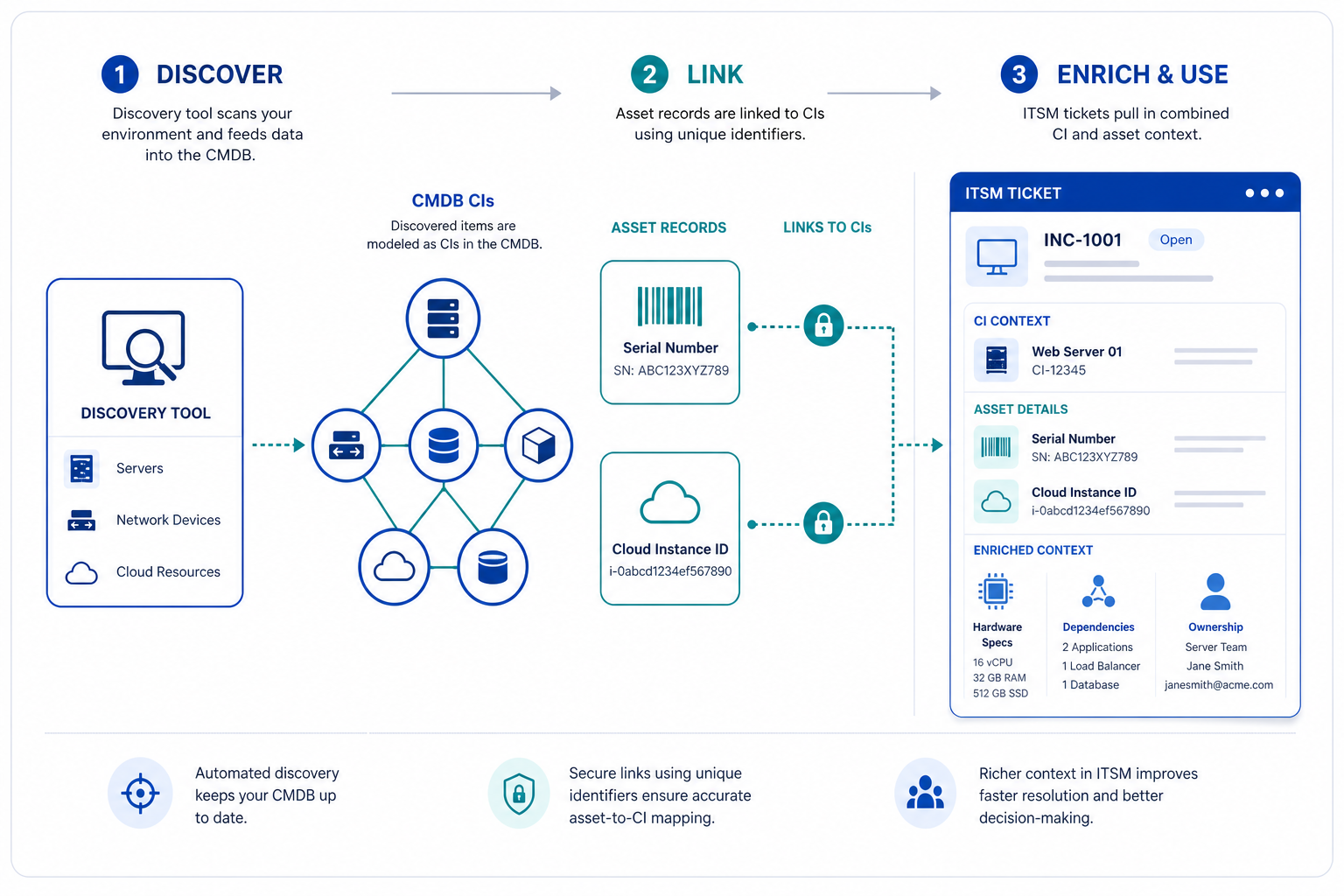
You connect asset management to service desk tickets and the CMDB by linking all three to the same configuration item record. Use durable identifiers — serial number or cloud instance ID — instead of a hostname that changes on every rebuild.
Scheduled discovery populates the CMDB with configuration items and relationships, the asset record adds lifecycle, ownership, warranty, and cost detail to that same item, and the ITSM integration surfaces that combined context inside the ticket. When an incident opens against a laptop, server, or application, the agent sees specifications, dependencies, recent changes, and ownership without switching consoles.
This shared record replaces manual lookup across procurement spreadsheets, monitoring tools, and inventory exports. Service desk teams triage from governed data that reflects the production environment as discovered during scheduled cycles.
Link asset records and CIs on durable join keys
CMDB asset reconciliation holds only when asset and configuration item records share a durable identifier that survives rebuilds and renames.
Hostname values change during operating system rebuilds, device renames, and cloud reprovisioning, so mature teams join on serial number for physical hardware and cloud instance ID for virtual workloads. Purchase order numbers, contract identifiers, and MAC addresses provide supporting evidence during reconciliation, while serial and cloud instance ID carry the authoritative match. That instability carries a real trust cost. A 2025 WanAware survey of 600 enterprise professionals found that 95% of IT leaders say they trust their asset data, but only 35% of other managers trust its accuracy (WanAware 2025 ITAM confidence survey). That gap widens whenever join logic depends on a value that changes on its own.
Virima’s CMDB reconciles multi-source discovery data into one authoritative configuration item record using those durable keys. Agent-based discovery collects deep hardware and software inventory from Windows, macOS, and Linux endpoints, agentless scanning covers network infrastructure over WMI, SSH, and SNMP, and API-based discovery pulls inventory from AWS and Azure environments.
When the same serial appears from procurement records and from discovery output, the platform merges the entries rather than creating a duplicate configuration item. That reconciliation keeps asset financial detail tied to operational truth as devices move between sites, owners, and lifecycle states.
CMDB owners should audit unmatched asset rows each week and resolve discovery gaps before they affect ticket quality. High match rates on serial and cloud instance ID indicate the foundation can support ticket enrichment.
What key should join asset records to CMDB CIs?
Join asset records to CMDB CIs on serial number for physical devices and cloud instance ID for virtual workloads. These identifiers persist through renames and rebuilds, while hostname values change and cause duplicate records and failed ticket lookups.
What is CI reconciliation?
CI reconciliation is the process of matching configuration items discovered from multiple sources — procurement records, agent-based scans, agentless network scans, and cloud APIs — into one authoritative record using a durable identifier. Without it, the same server can exist as two or three unmatched CMDB entries.
Join governance also requires clear ownership for reconciliation exceptions. Assign one owner for discovery coverage, one owner for asset data quality, and one owner for ITSM field mapping so unmatched records receive review within each scheduled cycle. For a deeper look at why raw completeness percentages can mask real reconciliation gaps, see this analysis of CMDB data quality metrics.
Keep the CMDB current with scheduled discovery cycles
A ticket shows accurate context only when the underlying CMDB reflects the environment discovered during recent scheduled cycles.
Stale configuration item attributes send agents to the wrong owner, the wrong operating system version, or a decommissioned host. Scheduled discovery refreshes specifications, installed software, relationships, and lifecycle state through agentless, agent-based, and API-based discovery, while CMDB health scoring flags records that remain incomplete or approach staleness thresholds.
Virima tracks configuration item lifecycle from deployment through decommission and logs change history for audit review. Change impact analysis shows downstream dependencies before approval, which helps change managers assess blast radius with operational evidence rather than assumptions.
Teams that review health scores weekly catch coverage gaps after network changes, credential expirations, or cloud account additions. That cadence prevents slow data decay that otherwise surfaces during major incidents when accurate ownership matters most, the same reconciliation discipline behind measurable MTTR reduction from CMDB automation.
Operational dashboards give IT operations leaders consolidated visibility across on-premises and cloud infrastructure. Infrastructure health views then help directors prioritize remediation for segments with low completeness scores.
Eliminate data decay with discovery-sourced Trusted Runtime Truth for your CMDB and service desk.
Surface CI to ticket linking inside the service desk
Once the join stabilizes, ITSM CMDB integration projects configuration item context into incident, problem, and change forms where agents perform triage — this is where CI to ticket linking becomes visible to the agent.
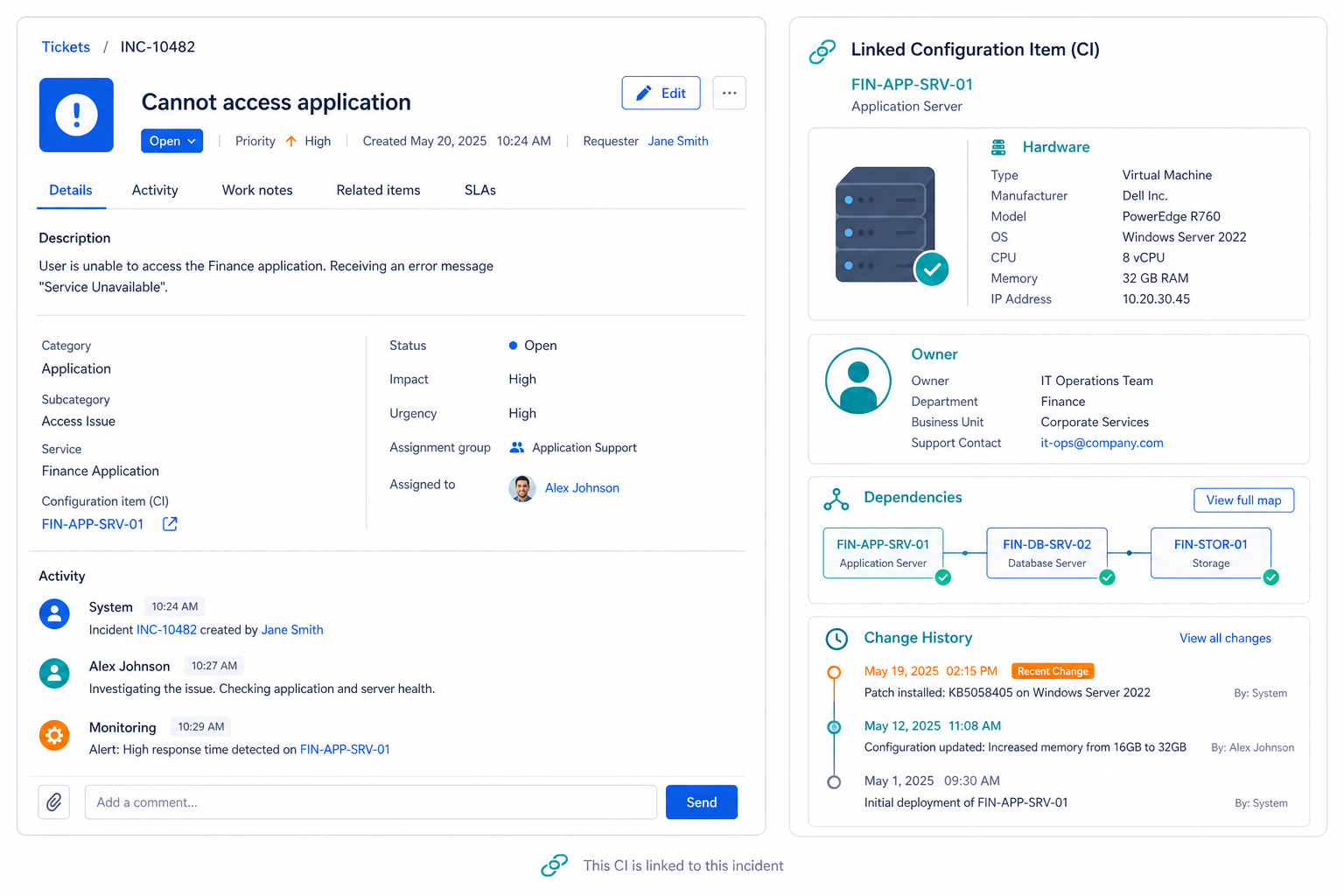
The agent opening a ticket linked to a configuration item should see hardware specifications, operating system and patch level, installed software, owner and department, location, warranty status, dependencies, recent incidents, and open vulnerabilities. That panel removes the need to search separate asset consoles during active triage and reduces assignment errors.
Virima shares configuration item data with ITSM platforms through native integrations. Explore the available ITSM integrations to review supported platforms and synchronization patterns for your service desk environment.
For example, a database slowdown ticket linked to a database configuration item can display the host server, storage dependency, supporting network switch, and the business service supported by that chain. The agent escalates to the database owner with dependency evidence attached, rather than routing through three assignment groups before identifying the responsible team.
Ticket linking also strengthens problem management because recurring incidents against the same configuration item expose shared infrastructure causes. Problem managers can document those patterns with relationship evidence drawn from the CMDB.
Add service dependency context for faster triage
Configuration item attributes describe what the asset is, while service maps describe what breaks when that asset fails.
Once service definitions are provided manually, through spreadsheet import, or through enterprise architecture input, Virima automatically builds the service dependency map and keeps it current as infrastructure changes through scheduled discovery. ViVID™ service maps show web, application, and database tiers plus infrastructure dependencies that support each named business service.
What is the difference between a CMDB and a service map?
A CMDB record describes what an asset is — its specifications, owner, and lifecycle state. A service map describes what breaks when that asset fails, tracing dependencies up to the business service it supports. Triage needs both: CI attributes to identify the asset, and dependency mapping to show the blast radius of its failure.
During an outage, impact path tracing follows the failing configuration item upward to the affected business service. Agents prioritize tickets tied to revenue systems or regulated workloads first, while lower-impact tickets follow standard queues. The NIST SP 800-53 configuration management controls describe baseline inventory and dependency discipline as foundational practices for operational response.
That service context improves escalation accuracy because agents attach affected service names and dependency paths to the ticket record. Receiving groups understand scope immediately and mobilize appropriate specialists without additional discovery calls.
How do service maps improve service desk triage?
Service maps link failing CIs to the business services they support, so agents see impact scope inside the ticket. That visibility supports faster prioritization, more accurate escalation, and documented evidence for problem records tied to shared infrastructure.
Service mapping input deserves explicit governance because service composition originates outside automated discovery. Maintain service definitions through a named owner, review membership after application releases, and validate tier assignments before major change windows.
Tie lifecycle and contract detail to ticket decisions
Asset lifecycle data changes the decision an agent makes inside the ticket record.
A laptop with an expired warranty routes to procurement for replacement rather than to depot repair. A server approaching end-of-support triggers a risk review before a change receives approval. A software installation without a matching entitlement flags a license review before the request closes.
Virima’s ITAM tracks hardware lifecycle from procurement through disposal, normalizes software publisher and product names, compares installations against entitlements, and monitors contract and warranty expirations. License compliance reporting supports audit preparation with installation-level evidence tied to discovered inventory.
When that detail appears in the ticket, agents avoid approving changes on unsupported platforms and avoid closing software requests that would create compliance exposure. Finance and procurement receive cleaner handoffs because ownership, cost center, and contract dates travel with the escalation record.
End-of-life tracking adds further value for change planning because CAB reviewers see support risk alongside technical impact. That combined view helps directors defer or redesign changes that depend on platforms nearing vendor support boundaries, the same risk exposure detailed in this breakdown of what CMDB inaccuracy actually costs.
Put governance around the integration
A durable connection needs ownership, review cadence, and measurable accuracy targets that survive staff changes.
The discovery, reconciliation, and ITSM field-mapping owners assigned above also set the review cadence: unmatched assets weekly, expired credentials biweekly, and configuration item completeness monthly. Role-based access controls limit who can edit configuration item attributes, asset financial detail, and service definitions. Audit trail history shows who changed each record and when — supporting change governance and compliance review across regulated environments.
Track the percentage of incidents linked to a configuration item, the percentage of items with verified owners, and mean time to identify impacted services.
Start with one high-volume ticket category, such as laptop incidents or database performance issues. Validate join rates and agent feedback within that category, then extend the same pattern to change requests and problem records after accuracy targets hold through two consecutive review cycles.
Custom reporting helps leaders demonstrate progress because coverage, ownership completeness, and ticket linkage rates can be exported for operational reviews. Data export to CSV supports downstream analysis for teams that consolidate ITSM metrics in external analytics platforms.
Closing: Make every ticket carry asset truth
Connected asset, CMDB, and ticket data turns triage from manual search into governed response across hybrid estates.
Durable join keys hold the model together, scheduled discovery keeps records current, ITSM integration places context where agents work, and service maps add impact scope. Lifecycle detail then guides replacement, risk, and compliance decisions without added handoffs between asset, operations, and procurement teams. That’s what it takes to connect asset management to service desk tickets and the CMDB in a way that survives rebuilds, ownership changes, and staff turnover.
See how CMDB owners link asset truth to every ticket and reduce triage effort across hybrid estates.
Frequently Asked Questions
How do I link existing asset spreadsheets to CMDB CIs?
Match spreadsheet rows to discovered CIs on serial number or cloud instance ID, then import ownership, cost center, and contract fields into the joined record. Validate unmatched rows weekly until coverage reaches your accuracy target.
Why do tickets show the wrong asset owner?
Owner drift usually comes from stale discovery credentials, HR moves without CMDB updates, or hostname-based joins that broke after rebuilds. Refresh discovery coverage, rejoin on durable keys, and assign an owner for monthly verification.
What should a service desk agent see for each CI?
Agents need specifications, software inventory, owner and location, dependencies, service impact, recent changes, and warranty status. That set supports assignment, prioritization, and escalation without leaving the ticket.
How does Virima keep ticket CI data accurate?
Virima refreshes CIs through scheduled hybrid discovery, reconciles multi-source records into one authoritative entry, and shares that context with ITSM platforms through native integrations. Health scoring highlights incomplete records before they affect triage.