How Do You Choose an Asset Management Tool by Company Size?

ITAM Managers feel the mismatch first during true-up season, when installs exceed entitlements, and no joined record shows the gap. Directors feel it during incidents when ownership is unclear and escalation paths stall. CIOs feel it at renewal when contract spend grows while confidence in coverage stays flat. To choose an asset management tool by company size, match the tool to who owns the data, how fast the estate changes, and what audit or change decisions depend on that data.
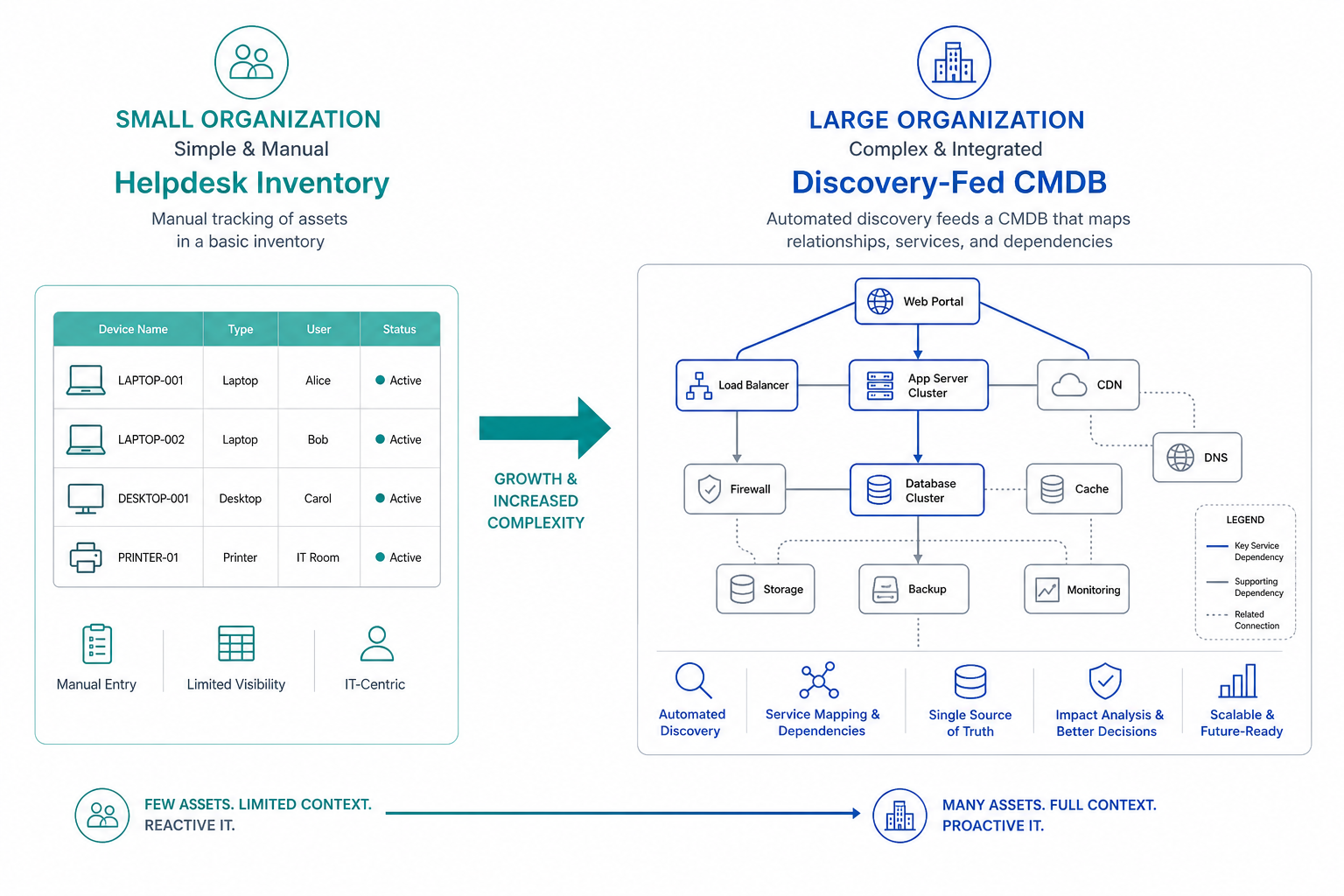
Small teams under a few hundred devices should pick a simple tracker or a service-desk module; mid-size teams need discovery and license tracking; enterprises need CMDB, ITSM integration, and governance. Match the tool to the asset count and the team that owns it.
How do you choose an asset management tool by company size?
Choose by owner, change rate, and decision risk. Small teams prioritize adoption and lifecycle dates. Growing teams require scheduled discovery and license joining. Enterprises require a governed CMDB, service context, and ITSM sync.
What breaks when the tool does not match company stage
A small team that buys an enterprise platform pays for governance workflows before anyone owns them. Administrators spend weeks configuring CI classes, approval states, and reconciliation rules that no one maintains. Data entry falls behind, trust drops, and staff revert to side spreadsheets for daily work.
A growing team that keeps a simple tracker faces the opposite failure. Laptops, virtual machines, cloud workloads, network devices, and SaaS subscriptions multiply across owners and locations. Manual updates miss decommissioned hosts, duplicate serial records accumulate, and software installs drift away from purchased entitlements. Audit preparation turns into a reconciliation project because the system of record never captured the full estate.
That gap shows up even at organizations that already invest in asset management. Flexera’s 2026 State of ITAM report found only 36% of organizations have a complete picture of their IT assets, and 48% were audited by a software vendor in the past year alone.
An enterprise that runs change and compliance from an incomplete inventory carries operational risk into every window. Change reviews approve work without downstream impact context. Vulnerability response prioritizes patches without business service criticality. Finance renews contracts based on vendor counts rather than verified deployment counts.
What is the difference between a CMDB and an asset management tool?
An asset management tool tracks what you own — hardware, software, licenses, warranties. A CMDB adds relationships — how each asset connects to services, incidents, and changes. Small teams need the first; mid-market and enterprise teams need both joined into one record to support change review and incident triage.
The selection question therefore centers on operational load. Who confirms ownership when discovery finds an unknown device? How license consumption is joined to entitlements. How service relationships inform change review. How often the record refreshes across on-prem and cloud infrastructure.
Explore how discovery-sourced inventory supports Trusted Runtime Truth for change, incident, and audit decisions.
Asset management software for small business: simplicity with a path to discovery
The right asset management software for small business teams emphasizes fast inventory capture, clear ownership assignment, and lifecycle dates that prevent surprise renewals. The best starting point is usually a combined helpdesk inventory or a lightweight asset tracker that records hardware details, assigned users, purchase dates, warranty expirations, and installed software versions.
Look for barcode or agent capture for laptops and desktops, straightforward import from procurement records, and simple views by location, department, and owner. Contract reminders for warranties and subscriptions matter more at this stage than complex relationship modeling. Reporting should answer basic questions about what exists, who uses it, and what needs replacement within the next two quarters.
Avoid heavy CMDB data models until someone owns configuration accuracy as a weekly responsibility. Extensive CI classes, relationship rules, and approval workflows create administrative overhead without improving daily support outcomes. A simpler tool with consistent use delivers stronger data quality than an enterprise suite with partial adoption.
Small teams should still confirm that export paths remain open. Verify CSV export, API access for future ITSM sync, and a clear upgrade route toward scheduled discovery when device counts grow, or cloud workloads enter the estate. Starting simple works when the exit path stays open.
Learn what lightweight ownership looks like in asset management software for small business.
Mid-market IT asset discovery: license tracking and service context
Mid-market IT asset discovery has to keep pace with estates that usually span on-prem servers, virtual infrastructure, AWS and Azure workloads, network gear, and distributed endpoints. Manual inventory cannot keep pace once virtual machines spin up and down and SaaS adoption spreads across departments. Scheduled discovery becomes the foundation for trustworthy asset data.
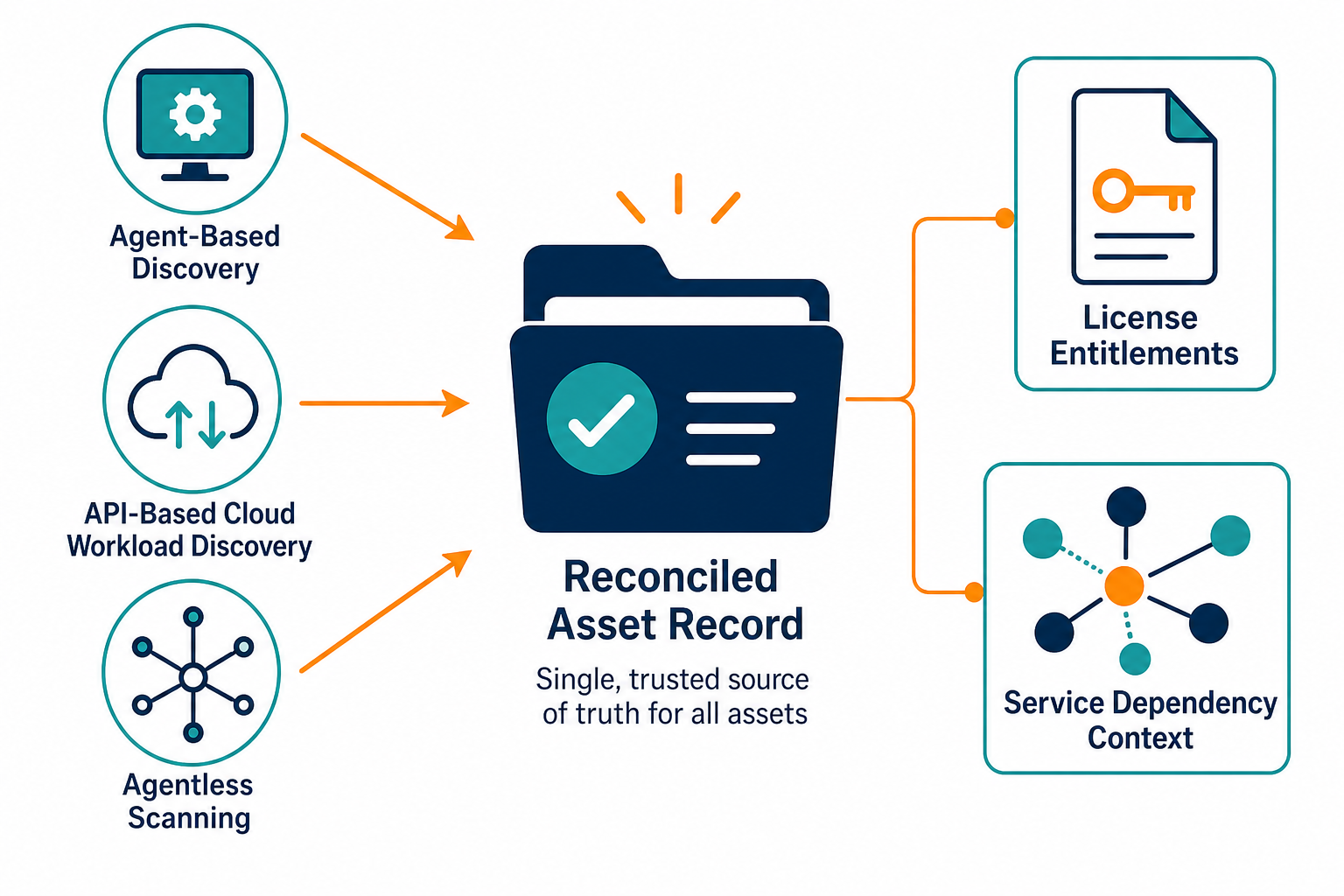
Evaluate discovery coverage across three methods:
- Agent-based coverage for managed endpoints
- Agentless scanning (WMI, SSH, SNMP) for infrastructure that cannot host agents
- API-based discovery for cloud workloads, with fingerprinting for operating system versions, hardware serials, and patch levels
Multi-source reconciliation matters because the same device often appears in several feeds with conflicting attributes. The platform should merge those feeds into one authoritative record with history logging for changes.
Software license management becomes critical at this stage. The tool should normalize publisher and product names, join installs to entitlements, flag over-deployment before vendor true-up, and surface end-of-life software that raises support and security costs. According to guidance from the National Institute of Standards and Technology on asset management, maintaining an accurate inventory provides the basis for vulnerability tracking and lifecycle decisions across the environment.
Service context separates useful ITAM from a parts list. Once service definitions are supplied through manual input, spreadsheet import, or architecture sources, Virima’s ViVID™ service maps show how applications depend on servers, databases, middleware, and network components. That context helps change reviewers understand downstream impact and helps incident responders trace from a failing CI toward the affected business service.
Ownership also needs definition. Assign asset owners by business service, infrastructure domain, or location so discovery exceptions route to someone with authority to confirm or retire records. Without named ownership, unknown devices queue indefinitely and data quality declines between review cycles.
Enterprise CMDB governance: ITSM integration and audit evidence
Enterprise CMDB governance starts from compliance obligations rather than inventory convenience. Change management, vulnerability response, financial reporting, and compliance evidence all draw from the same configuration record. The asset platform must therefore operate as a governed CMDB with lifecycle controls, not as a standalone tracker. For more on why record completeness alone does not guarantee a trustworthy CMDB, see Virima’s CMDB statistics roundup.
Require automated CI population, CI relationship mapping, health scoring for accuracy and completeness, and lifecycle management from deployment through decommission. Change impact analysis should show downstream dependencies before approval so advisory boards assess blast radius with shared evidence. Audit trail logging should record who changed each CI record and when that change occurred.
The same Flexera report found 44% of organizations spent more than $1 million on software audits across the past three years. Microsoft conducted audits at 64% of those organizations over that span — the highest rate of any vendor. That is the direct cost audit-grade evidence is meant to offset.
Integration depth determines whether governed data reaches daily workflows. The CMDB should sync discovered CIs and relationships into the ITSM platform where incidents, problems, and changes are managed. Virima supports bidirectional sync patterns with existing ITSM systems through its integrations hub, which keeps discovery-sourced truth available inside ticket and change workflows without rip-and-replace migration.
Role-based access control, custom reporting, and REST API access support distributed ownership across regions and business units. Multi-site support helps federated teams maintain local accountability while headquarters retains consolidated reporting for risk and spend decisions. Data export in standard formats preserves downstream analysis for finance and security teams that consume asset data outside the CMDB.
Security and compliance stakeholders need measured language here. Discovery-sourced inventory strengthens vulnerability prioritization by joining asset criticality to business service context. It does not replace dedicated scanners or governance platforms. Enterprises get the most value when CMDB data feeds established patch, incident, and audit workflows with clear ownership.
How to compare tools without overbuying
Company size guides the shortlist, but evaluation should test daily workflows rather than feature checklists.
- Demo on your own environment. Ask each vendor to demonstrate discovery against a representative subnet and cloud account, not a prepared slide deck. Review how duplicates reconcile, how unknown devices route for ownership confirmation, and how stale records age out after decommission.
- Test license reporting with your own publisher mix. Provide a sample of Microsoft, Adobe, or engineering tool deployments and ask for effective license position reporting that joins installs to entitlements. Confirm software normalization handles version variants and suite components without manual cleanup for every import cycle.
- Review service mapping with one of your own business services. Supply the application and infrastructure list, then assess whether the map traces impact paths clearly enough for change review. Confirm that maps refresh as infrastructure changes without manual redrawing before each maintenance window.
- Compare total effort, not only subscription scope. Count agent deployment work, credential management for scanning, integration configuration, report building, and ongoing reconciliation time. A platform that reduces manual reconciliation through scheduled discovery often delivers stronger returns than a lower-cost tracker that requires constant spreadsheet cleanup.
See broader category options in top asset management tools you need to know about.
Where Virima fits for growing teams
Virima fits teams that have outgrown manual tracking but want to keep ITSM workflows intact. Hybrid discovery across agent-based endpoints, agentless infrastructure, and AWS and Azure APIs feeds a reconciled CMDB without requiring manual updates for every change. ITAM capabilities track hardware lifecycle, software installs against entitlements, warranty dates, and end-of-life flags that inform replacement planning.
Once service definitions are provided, ViVID™ service maps connect technical infrastructure to named business services for impact analysis and faster triage. Teams can assess change risk with dependency context, link alerts to affected CIs and services, and maintain audit-ready history as records evolve through scheduled cycles.
Smaller organizations often start with Virima Business Pro as a right-sized path to discovery-fed asset accuracy with native CMDB and service mapping depth. Larger organizations use the full platform for distributed ownership, broader integration coverage, and deeper governance controls. Both paths keep existing ITSM investments in place while improving the data those workflows consume.
Can a small business start simple and upgrade asset management later?
Yes, when export paths stay open. Confirm CSV export, API access, and a clear path to scheduled discovery and service mapping before committing. That preserves history while adding automation as hybrid coverage grows.
Choose for the next stage, not just the current count
The right asset management tool reduces reconciliation work, clarifies ownership, and supplies joined evidence for license, change, and audit decisions. Small teams should prioritize adoption and lifecycle basics. Mid-market teams should require scheduled discovery, entitlement joining, and service context. Enterprises should require governed CMDB controls, ITSM sync, and audit-grade history.
The time to choose an asset management tool by company size is before renewal pressure forces a rushed decision. Select the platform that your team will actually maintain through growth. Schedule a working session to map your discovery sources, license risks, and service dependencies against evaluation criteria. Schedule a demo to review your estate profile and confirm fit.
Frequently Asked Questions
How many assets is too many for an Excel spreadsheet?
Spreadsheets usually break down once virtual machines, cloud workloads, and distributed endpoints change faster than manual updates. Common signals include duplicate serial records, missed decommissions, unclear ownership for unknown devices, and painful audit reconciliation. Teams that see those patterns benefit from scheduled discovery with ownership routing and history logging.
Do mid-size IT teams need a CMDB?
Mid-size teams need CMDB discipline once incidents and changes depend on relationship context rather than device lists alone. A lightweight but governed configuration record with discovery-fed updates, ownership assignment, and service mapping supports faster triage and safer change review. Full enterprise governance can wait until audit and multi-site controls require it.
Does Virima integrate with ServiceNow or Jira Service Management for asset data?
Virima syncs discovered CIs and relationships into ServiceNow, Jira Service Management, and other ITSM platforms rather than replacing them. Bidirectional sync keeps discovery-sourced data available inside existing incident, change, and problem workflows, so teams get accurate asset and service context without a rip-and-replace migration.
Can a small business start with a simple tool and upgrade later?
Small businesses can start simple when export paths and discovery upgrade routes remain open. Confirm CSV export, API access, and a clear migration path toward scheduled discovery and service mapping before committing. Virima Business Pro provides one growth path for teams that need discovery-fed accuracy without replacing ITSM workflows.