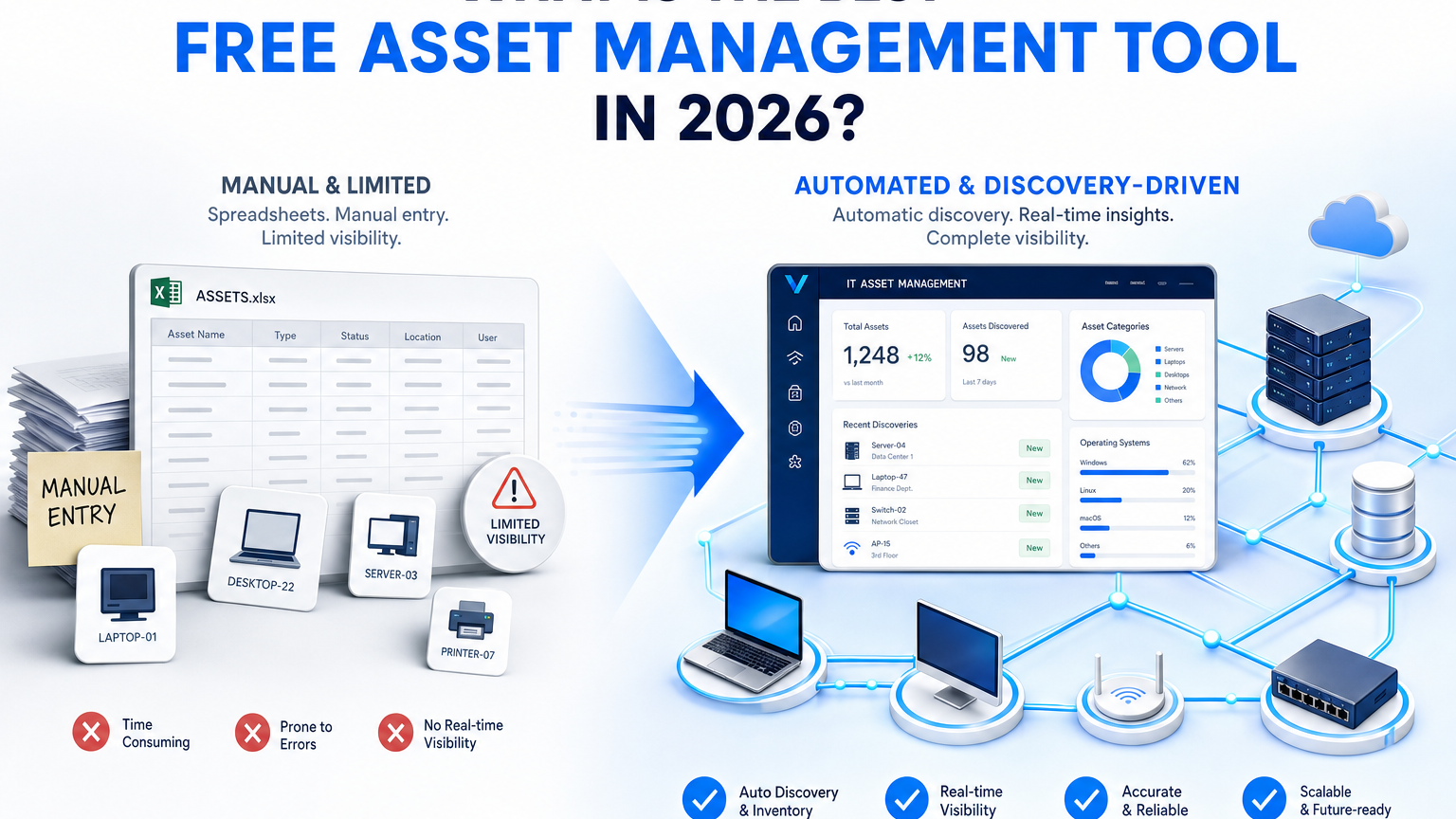
What Is the Best Free Asset Management Tool in 2026?

Small IT teams often begin managing assets using spreadsheets until manual errors and missing devices force a search for dedicated software. Budget constraints then push technology leaders to evaluate free IT asset management software before committing to an enterprise platform. Snipe-IT and AssetTiger are the two names IT teams land on most often when searching for the best free asset management tool, one self-hosted and open source, the other a hosted freemium option. The real question is whether either one delivers adequate operational control without introducing hidden administrative overhead or a hard asset cap.
Snipe-IT handles IT hardware with structured check-in and check-out workflows, barcode generation, and centralized asset assignments. AssetTiger suits general physical equipment and is free for up to 250 assets before a paid tier kicks in. But as an organization’s infrastructure grows, the gap between manual asset logging and automated estate governance becomes an operational bottleneck.
Quick picks:
- Best for IT hardware: Snipe-IT (self-hosted, no asset cap)
- Best for general equipment: AssetTiger (free up to 250 assets)
- Best for help desk plus assets combined: GLPI
Understanding what free software handles well, and where manual data entry breaks down, helps IT directors size up their current scale. That’s the signal for when it’s time to move beyond a free tool.
Snipe-IT vs AssetTiger: best free asset management tool options compared
Free asset management utilities fall into two distinct deployment models: self-hosted open source applications and vendor-hosted freemium software. Self-hosted software eliminates subscription fees but requires administrative time for server maintenance, software patching, and database backups. Freemium hosted platforms remove hosting duties but enforce strict asset caps or functional restrictions to encourage upgrades.
The table below outlines the primary open source ITAM tools and freemium asset trackers evaluated by system administrators.
| Tool Name | Deployment Model | Best Suited For | Asset Limits and Tier Caps | Core Operational Strength |
|---|---|---|---|---|
| Snipe-IT | Self-Hosted Open Source | Internal IT hardware fleets | Unlimited when self-hosted; paid cloud hosting tiers exist | Mature check-in workflows, custom asset fields, barcode generation |
| AssetTiger | Cloud Hosted Freemium | General physical equipment | Free for up to 250 assets; requires paid subscription beyond | Pre-configured maintenance schedules, depreciation calculation, tag support |
| GLPI | Self-Hosted Open Source | Combined help desk and asset logging | Unlimited self-hosted; paid enterprise support packages | Native ticketing integration, inventory management, user permission roles |
| Ralph | Self-Hosted Open Source | Data center rack hardware | Unlimited self-hosted under Apache license | DCIM rack layouts, network switch port mapping, server tracking |
| Spiceworks | Cloud / Ad-Supported | Small network discovery | Free with advertising; limited API integrations | Basic network device scanning and integrated user help desk |
GLPI differs from Snipe-IT mainly in scope: GLPI bundles help desk ticketing with asset tracking, while Snipe-IT focuses purely on hardware asset lifecycle and check-in and check-out workflows. Two more free tools are worth noting here: ManageEngine AssetExplorer offers a free tier capped at 25 nodes, and Lansweeper’s free tier caps out at 100 assets. Both skew toward network discovery features rather than the check-in and check-out workflows Snipe-IT and AssetTiger are built around.
Teams evaluating these options must recognize that free licensing addresses hardware assignment records rather than live configuration data. For organizations managing distributed endpoints, comparing top open source IT asset management software reveals that manual record-keeping remains necessary across every free platform.
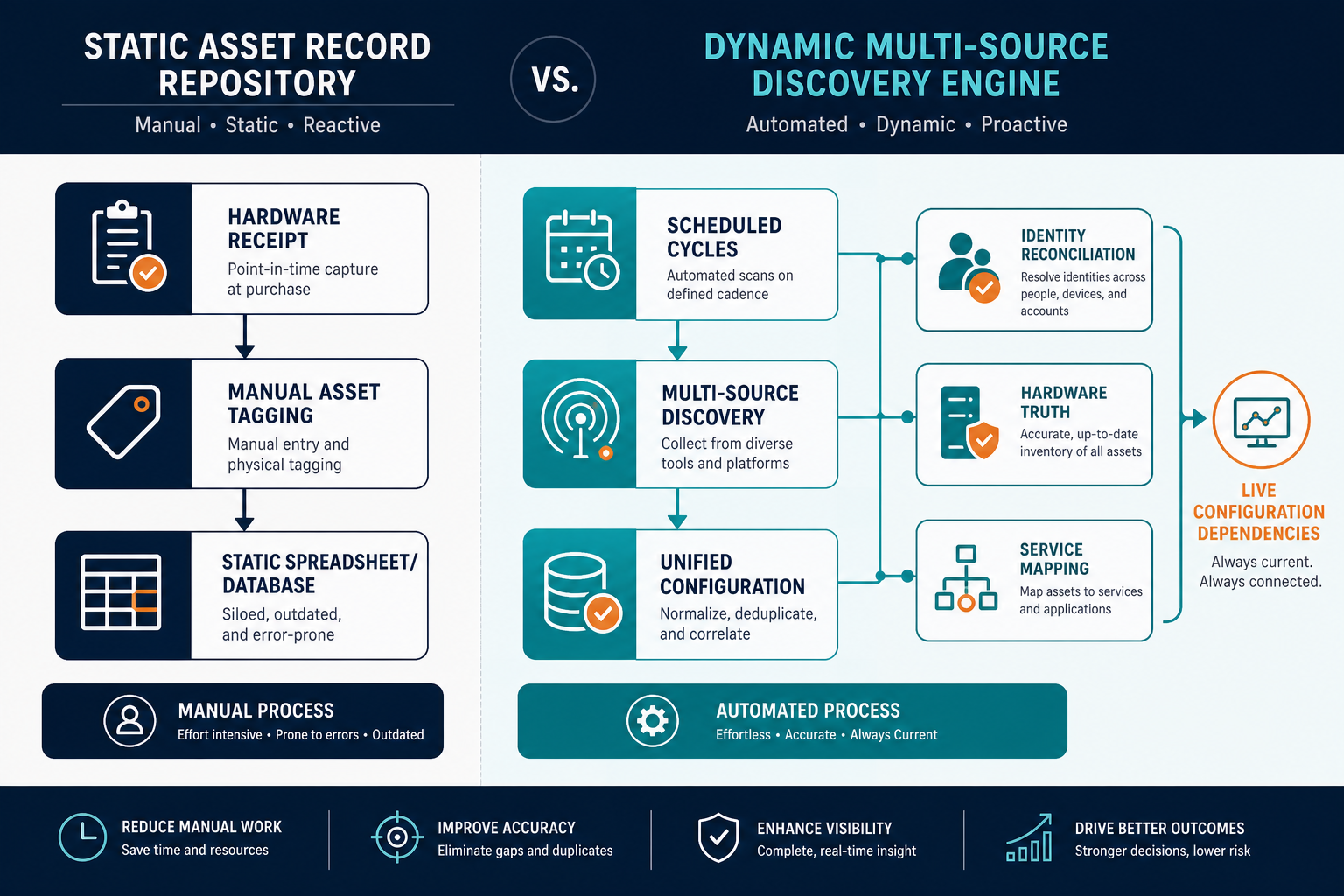
+-----------------------------------------------------------------------------------+
|               Free Trackers vs. Discovery-Fed Management Estates                  |
+-----------------------------------------------------------------------------------+
|  FREE TRACKER LAYER (Manual Entry)                                                |
|  [Hardware Receipt] ---> [Manual Asset Tagging] ---> [Static Spreadsheet/Database] |
|                                                                                   |
|  AUTOMATED ESTATE LAYER (Discovery-Fed Authority)                                 |
|  [Scheduled Cycles] ---> [Multi-Source Discovery] ---> [Unified Configuration]   |
|         |                        |                               |                |
|         v                        v                               v                |
|  [Identity Reconciliation]  [Hardware Truth]              [Service Mapping]       |
+-----------------------------------------------------------------------------------+
Five hard limits of free asset trackers
As fleet sizes grow, five structural limitations become operational bottlenecks that introduce data blind spots and audit exposure.
1. Absence of native automated discovery
Free asset software operates as a passive repository. The system’s records include only the devices that a technician manually enters into the web interface or imports through a static CSV file. When an engineer provisions a cloud virtual machine or an employee connects a tablet, no entry exists in the system for either device until someone adds one by hand.
Maintaining accurate records requires technicians to log every physical deployment, user reassignment, and hardware retirement. According to NIST SP 1800-5 IT Asset Management Guidelines, accurate asset posture requires automated mechanisms that discover devices across all network segments. Without automated discovery cycles, asset registers decay within weeks of initial baseline entry.
2. No service dependency mapping
Free tools store assets as isolated data rows. A record contains attributes such as serial number, purchase date, assigned employee, and physical office location. But the record cannot display which business applications rely on that specific database server or network switch.
So when infrastructure engineers plan maintenance or respond to an unexpected network outage, isolated asset rows provide no dependency context. Technicians cannot determine whether rebooting a server disrupts financial billing, customer support, or internal payroll. Understanding operational risk requires moving beyond flat inventories toward topological relationships.
3. Lack of native software license reconciliation
Free tools allow administrators to create software records and manually increment seat counts. However, they cannot audit installed executable files, track software version numbers, or measure actual application usage across endpoints.
Without automated software detection, organizations cannot identify unauthorized installations or unassigned licenses. True software asset governance requires comparing purchased entitlements against running instances discovered across the network. Relying on manual seat counts leaves companies exposed to compliance audit penalties and redundant subscription costs, a risk explored further in Virima blog post on software license compliance and SAM reconciliation.
4. Fragmented device identity across remote fleets
Modern enterprise fleets shift between home networks, branch offices, and corporate wireless environments. When an employee connects through a virtual private network, hostnames and temporary network addresses change frequently.
Free inventory databases cannot correlate transient network records with permanent hardware markers. A single remote laptop often appears as multiple conflicting entries when re-scanned or reported by different endpoint agents. Managing fleets accurately requires durable hardware keys, such as serial numbers or immutable cloud instance IDs, rather than temporary hostnames.
5. High administrative maintenance overhead
Open source platforms advertise zero software licensing costs, but hosting and administering them requires skilled engineering hours. The IT department must provision server hardware, configure web servers, secure database ports, and apply security patches.
When an internal server encounters performance degradation or corruption, in-house administrators must troubleshoot without vendor service-level agreements. A thorough evaluation of Snipe-IT asset management features and limitations shows that internal maintenance costs often eclipse commercial subscription fees as fleet sizes scale. Virima’s Trusted Runtime Truth approach addresses this same gap from the other direction, establishing dependable hardware and service visibility across dynamic hybrid environments from discovery-sourced data rather than manual entry.
When small IT teams should upgrade to paid ITAM
Transitioning from a free asset tracker to a commercial asset management platform is driven by operational inflection points rather than arbitrary calendar dates. Organizations should evaluate paid solutions when manual maintenance creates unacceptable business risk.
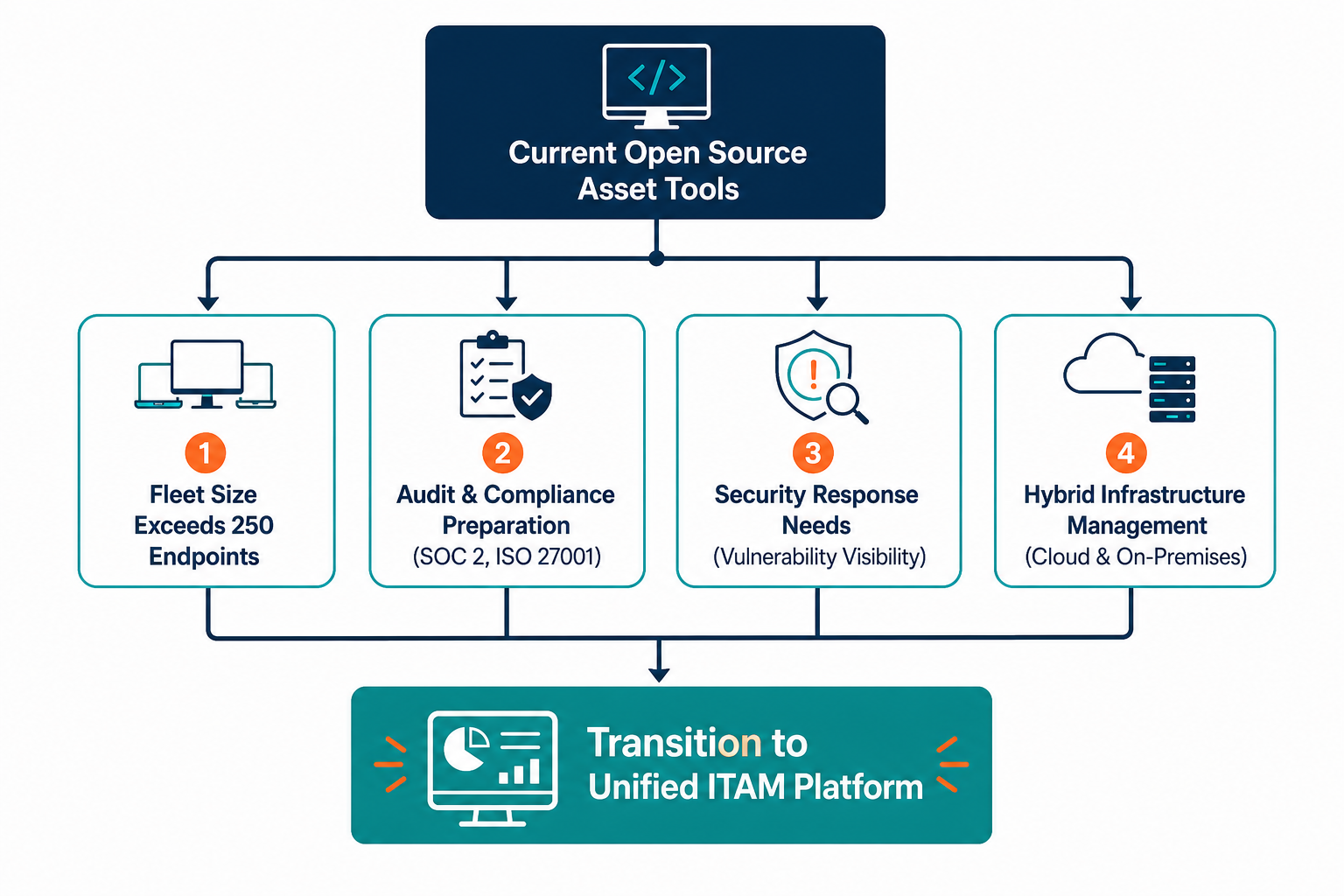
+-----------------------------------------------------------------------------------+
|               Operational Triggers for Moving to Commercial ITAM                  |
+-----------------------------------------------------------------------------------+
|  FLEET SIZE TRIGGER: Exceeding 250 connected endpoints or multi-site offices      |
|  AUDIT & COMPLIANCE: Preparing for SOC 2, ISO 27001, or external vendor audits    |
|  SECURITY RESPONSE: Needing immediate blast-radius visibility for vulnerabilities |
|  HYBRID INFRASTRUCTURE: Managing cloud instances alongside on-premises equipment  |
+-----------------------------------------------------------------------------------+
Milestone 1: managing more than 250 active endpoints
When an organization maintains fewer than one hundred laptops, a diligent system administrator can update asset records manually during employee onboarding and hardware provisioning. Between 100 and 250 devices, that manual process strains but still holds. Once total hardware counts exceed 250 units, manual tracking breaks down structurally: employee reassignments, hardware swaps, and remote device ship-backs occur too frequently for manual documentation. Commercial ITAM platforms deploy automated discovery agents and network scanners that update asset statuses without requiring human intervention.
Milestone 2: preparing for rigorous security and regulatory audits
Frameworks such as SOC 2, ISO 27001, HIPAA, and PCI DSS require verifiable proof of asset ownership and configuration baselines. External auditors do not accept self-reported spreadsheet exports or manually edited asset tables without timestamped discovery logs. Paid asset platforms provide immutable audit histories showing when an asset was discovered, who used it, and what configuration changes occurred throughout its operating lifecycle.
Milestone 3: unifying endpoint management systems
Growing companies typically deploy dedicated endpoint tools such as Microsoft Intune, Microsoft Entra ID, and Jamf. Managing hardware across separate management portals creates conflicting records and duplicate device counts. Upgrading to one integrated platform allows organizations to aggregate multiple data streams into a single reconciled CMDB. Integrating these systems eliminates duplicate records by connecting endpoint data through the integrations hub into one source of truth.
Milestone 4: managing dynamic hybrid and multi-cloud infrastructure
As infrastructure expands into public cloud environments such as AWS and Microsoft Azure, short-lived virtual compute instances, serverless functions, and storage volumes outpace manual asset logging. Free tools designed for physical office hardware cannot capture ephemeral cloud resources that spin up and terminate within hours. Commercial platforms utilize direct cloud API discovery connectors to synchronize transient infrastructure with core asset inventories automatically.
Scale Asset Management with Automated Discovery
Eliminate spreadsheet maintenance and bridge endpoint management silos with unified discovery and configuration tracking.
Evaluating platform architecture: a guided proof of value
Organizations moving away from open source trackers should test commercial platforms through an objective proof of value rather than relying on vendor presentations. A structured proof of value reveals whether a platform can discover complex infrastructure and reconcile conflicting identifiers across enterprise networks.
Phase 1: validating scheduled discovery cycles
The primary test of an asset management platform is its ability to locate unmanaged hardware without manual prompting. During an evaluation, administrators should configure scheduled discovery cycles across server subnets, wireless corporate networks, and cloud tenancies. The platform should detect unmanaged switches, network printers, remote laptops, and transient virtual machines while cataloging open network ports and installed operating systems.
Phase 2: resolving configuration and identity ambiguity
A viable enterprise asset solution must demonstrate intelligent identity reconciliation. In testing, the platform should ingest telemetry from endpoint tools, cloud APIs, and agentless network scans. It must match disparate identifiers, such as serial numbers, MAC addresses, and cloud instance IDs, into a single authoritative asset record rather than generating three duplicate devices for one laptop.
Phase 3: connecting assets to configuration management
Hardware asset inventory represents only the baseline layer of modern IT operations. High-performing IT departments connect physical assets to configuration management databases and ViVID™ service maps. Asset records that link upstream to business services give incident response, change management, and disaster recovery processes access to complete dependency context.
Phase 4: measuring total cost of ownership across operations
Calculating the true financial commitment of free tools requires measuring internal personnel hours alongside visible licensing fees. A tool with zero subscription cost can still generate thousands of dollars in administrative overhead. Engineers lose hours every week patching application dependencies, troubleshooting database performance, and manually reconciling hardware lists.
When evaluating whether to maintain an open-source deployment, IT leaders must compare expected infrastructure hosting and maintenance labor against the predictable cost of commercial platforms. Investing in unified platforms equipped with automated discovery delivers measurable return on investment by returning productive engineering hours back to core business initiatives.
Take control of your infrastructure beyond free tools
Free tools serve an essential purpose for early-stage organizations establishing basic hardware accountability. However, relying on manual data entry introduces operational vulnerabilities as headcount expands and infrastructure diversifies across cloud and on-premises environments.
Modern IT asset management requires automated multi-source discovery, intelligent identity reconciliation, and full service dependency visibility, and the best free asset management tool can only carry a growing estate so far before those gaps show up as risk. Moving to a commercial platform replaces administrative maintenance with dependable configuration accuracy.
To see how automated asset discovery and configuration management can eliminate blind spots across your expanding estate, Schedule a Demo with our technical team today.
Frequently Asked Questions
Is Snipe-IT really 100% free?
Snipe-IT is completely free and open source when downloaded and self-hosted on your own infrastructure. Organizations that choose this option must provide their own server hosting, database maintenance, and administrative support. The developers also offer paid, hosted software-as-a-service plans for organizations that prefer not to manage internal server infrastructure.
What are the asset limits on free software?
Self-hosted open source tools such as Snipe-IT and GLPI do not enforce software asset caps, allowing organizations to log as many devices as their server hardware can support. In contrast, cloud-hosted freemium tools enforce strict limits. For example, AssetTiger provides free tracking for up to 250 assets, after which organizations must purchase a paid annual subscription.
When should my team move to paid ITAM?
Organizations should upgrade to paid ITAM when hardware counts exceed 250 devices, when preparing for formal security audits such as SOC 2 or ISO 27001, or when manual record updates consume excessive engineering time. Commercial solutions introduce automated network discovery and endpoint integration, eliminating the data discrepancies inherent in manual tracking.
Can I import data from Snipe-IT into a CMDB?
Yes, data from Snipe-IT can be exported into standard CSV formats or extracted through its REST API for ingestion into an enterprise CMDB. However, static asset records must be reconciled against live network discovery data to ensure device attributes, network relationships, and software configurations reflect the actual runtime state of the environment.
Does Virima’s CMDB ingest data from tools like Snipe-IT or AssetTiger?
Virima’s CMDB can ingest exported asset data from tools like Snipe-IT via CSV or API, then reconciles those records against live network discovery so hardware details stay accurate after migration, rather than importing a one-time static snapshot.