What Reports and Audit Trails Should an Asset Management System Provide?

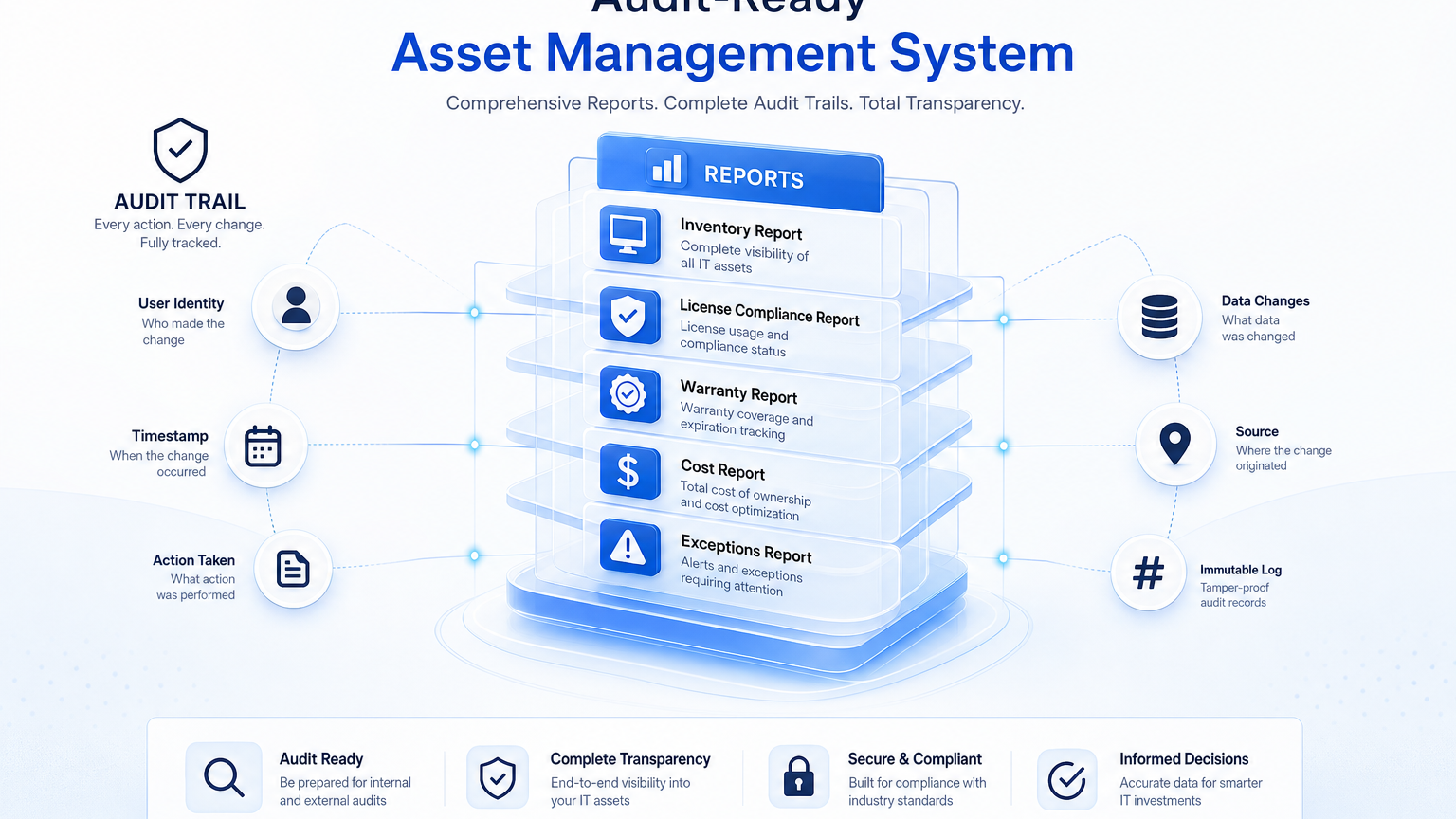
An auditor opens a ticket during a SOC 2 review and asks for last quarter’s license variance report, change history for ten sampled devices, and proof nobody edited a serial number without a trail. The GRC lead has none of it preassembled, only a spreadsheet patched together the night before the last audit. That is the real test behind asset management reports and audit trails. Can the system produce an inventory report, license compliance report, warranty and renewal calendar, cost and depreciation summary, and a change history showing who changed which record and when — on demand, rather than after a scramble.
For the writing craft behind a single leadership report, see the sibling guide on how to create an effective asset management report. This article covers system capabilities instead: which reports must exist, what an audit trail must store, and how exports hold up in a SOC 2 or NIST-oriented review.
Essential executive and operational reports list
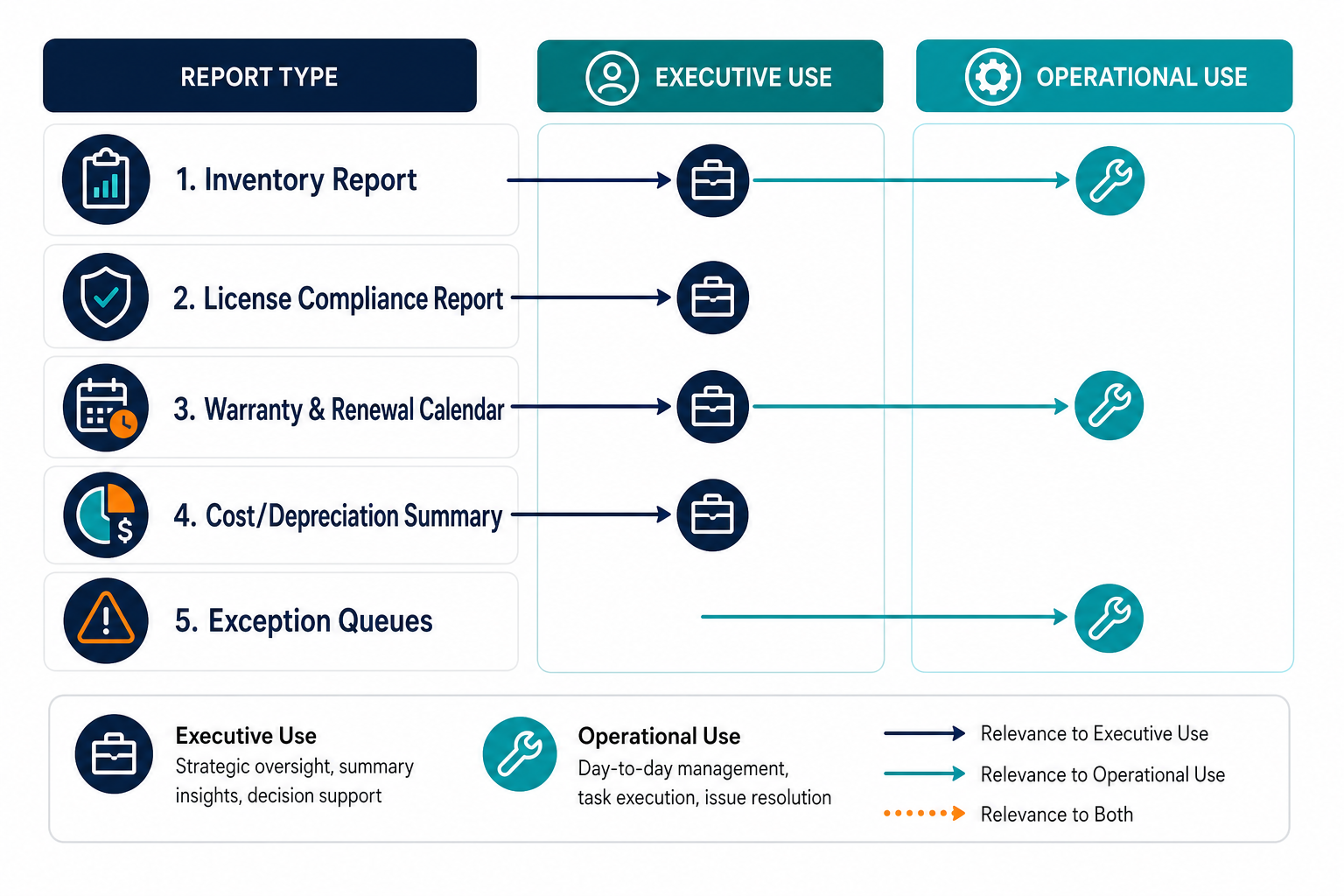
Start with a living inventory report that lists every CI with durable identifiers, status, owner, location, and last discovery source, maintained against the CMDB as the system of record rather than a point-in-time export. Serial number or cloud instance ID must appear so hostnames that change after rebuilds do not split one asset into two rows. That gap is not rare: Flexera’s 2025 State of ITAM report, a survey of more than 500 IT professionals, found complete technology-stack visibility fell to 43 percent, down from 47 percent the year before. NIST SP 1800-5 treats authoritative asset tracking as foundational for operational and security programs; the inventory report is the first place that authority shows up for executives.
These asset inventory compliance reports only work as a set. Add the following report types to the catalog:
- A license compliance report comparing discovered installs and usage signals to entitlements
- A warranty and renewal calendar report with cover end dates and refresh candidates
- A cost or depreciation summary tied to purchase and assignment data
- Exception queues for assets without owners, devices missing from the last discovery cycle, and CIs with conflicting serials
Operational teams use the exception queues daily; the executive pack summarizes risk and spend without replacing that exception work.
Teams that only export inventory once a year still scramble when auditors ask for license variance or owner history from the same quarter. Build the report catalog so each extract shares durable keys and status definitions, then schedule the same views to the people who own remediation.
Which reports should every asset management system provide?
An audit-ready asset management system provides five report types: a living inventory with durable identifiers, a license compliance report comparing installs to entitlements, a warranty and renewal calendar, a cost/depreciation summary, and exception queues for missing owners or discovery gaps. Executives use the summaries; operators act on the exception queues weekly.
Audit trail requirements (who changed what, when, source)
A report without a change history fails the second auditor question. These IT asset audit trail requirements start with six fields. The audit trail must record:
- Actor identity
- Action type
- The field or relationship changed
- Before and after values, where practical
- A timestamp with timezone
- The source system or discovery job that produced the change
Manual edits, import jobs, API updates, and scheduled discovery merges all need the same trail structure so investigators can reconstruct custody. For example, when a scheduled discovery job reassigns a server’s owner field after an org change, the trail should show the prior owner, the new owner, the timestamp, and the job ID that made the update — not only the final value sitting in the CI record.
NIST SP 800-53 Revision 5 emphasizes audit and accountability controls that support after-the-fact investigation. Asset platforms that overwrite rows silently force teams to rebuild history from tickets and email. Prefer append-only or versioned history with retention aligned to your compliance program, not only to the help-desk ticket archive.
When discovery merges two candidate rows, the trail should show the winning durable key and the job that applied the merge. That detail separates a controlled reconciliation from an unexplained overwrite that fails sampling later.
What must an asset management audit trail record?
An IT asset audit trail entry requires six fields: actor identity, action type, the field or relationship changed, prior and new values, a timestamped entry with timezone, and the source — manual edit, import, API, or discovery job. Omitting source makes it impossible to tell a human edit from an automated merge.
Dashboard wireframe and key widgets
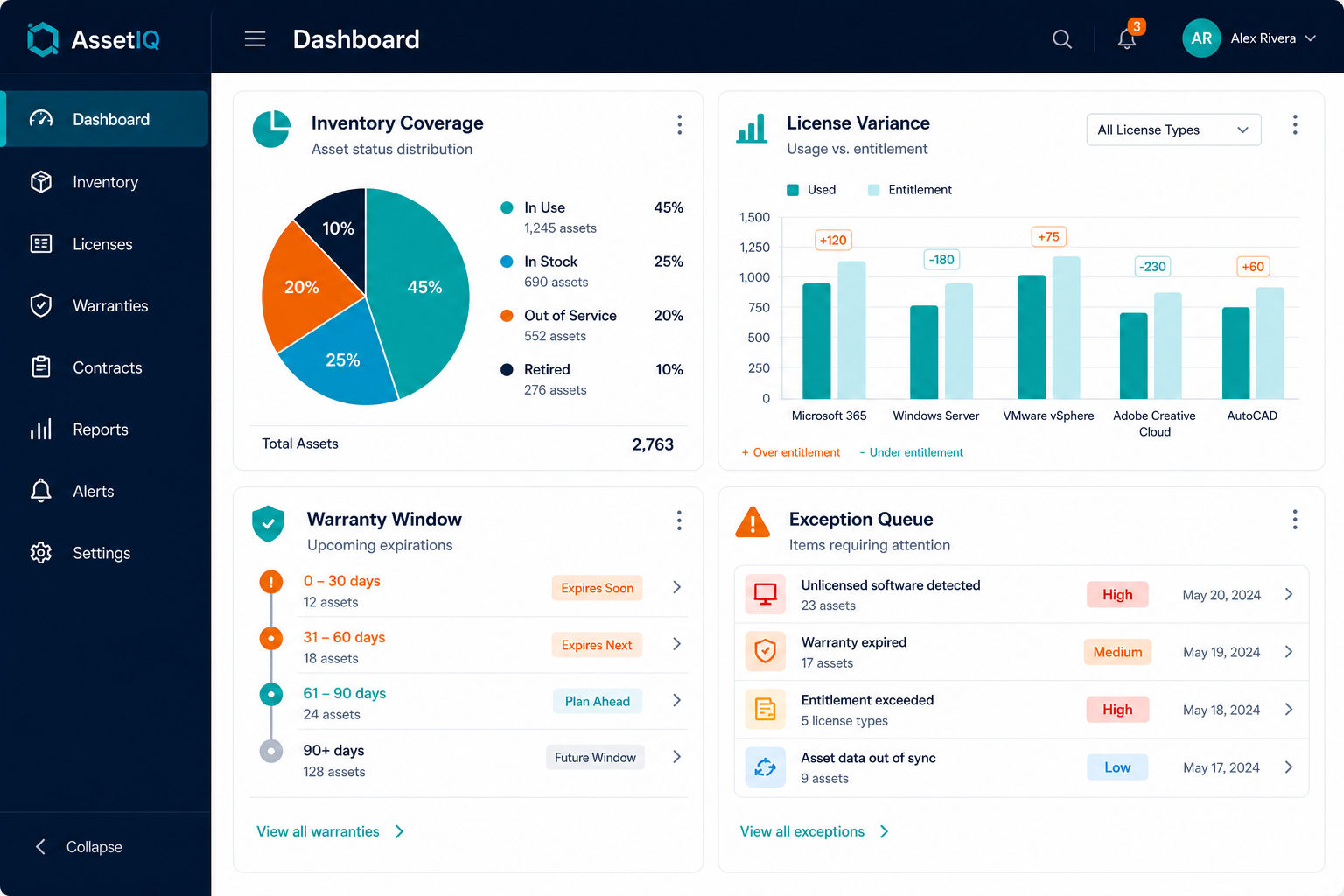
Dashboards should surface the same truth as exports, only faster. Useful widgets include estate counts by status, discovery coverage versus expected subnets and cloud accounts, license variance heat for top publishers, warranty expiry in the next ninety days, and open exception counts by owner. Click-through must land on the filtered report or CI list, not a dead chart. Role-based views matter too: an operator needs the exception queue filtered to their own assets, while an auditor or executive needs the aggregate trend without the row-level detail cluttering the view.
Keep widgets explainable. Show last discovery cycle time and data source on the inventory tile so leaders know the age of the numbers. Service maps and dependency context belong after service definitions exist; until then, keep the board on inventory, license, warranty, and exceptions. The IT asset management feature set is where contract, warranty, and lifecycle fields sit beside discovery-backed CIs when those widgets need depth.
How to export asset data for auditors
Auditors ask for populations they can sample. That includes full inventory extracts, license position with entitlement evidence, change history for a defined window, and proof of sanitization or disposal for retired assets — a certificate of destruction or wipe confirmation ID, not just a line item marking the asset retired. Exports should include durable keys, owners, and timestamps in machine-readable formats your GRC tools can ingest. Filterable date ranges on the audit trail matter as much as the inventory CSV. For a SOC 2 Type II review, that usually means producing evidence across the full audit period rather than a single point-in-time snapshot, so the export job needs a defined start and end date, not a “current state” pull alone.
License-focused evidence pairs with broader software license management guidance when the sample is publisher true-ups. Control environment narrative for trust services often routes through separate SOC 2 compliance documentation while the asset system still supplies the population files. Do not invent control language the platform does not store; export what discovery and ITAM actually hold.
How should teams export asset data for auditors?
A SOC 2 Type II evidence request covers the full audit period, not a current-state snapshot. Asset exports need a defined start and end date, durable keys, owners, and timestamps in a format the GRC tool can ingest — a point-in-time inventory pull does not satisfy a period-based control test.
How Virima supports report-ready asset truth
Virima scheduled discovery keeps inventory inputs current across hybrid estates so reports start from what is present, not from last quarter’s spreadsheet. Configuration items carry source tags and durable keys that reduce duplicate rows when hostnames churn. ITAM fields for contracts, warranties, and lifecycle status sit on the same records operators already trust for tickets and change.
Once administrators define business services, ViVID™ service maps add service-dependency context for impact-aware reporting. ServiceNow, Jira Service Management, Ivanti, HaloITSM, Xurrent, Hornbill, and TeamDynamix remain systems of engagement; Virima feeds validated CIs through the integrations hub rather than replacing those platforms.
When leadership needs explainable estate numbers before the next audit window, start from Trusted Runtime Truth as the standard for discovery-sourced reporting inputs.
Need inventory, license, and change history reports that auditors can sample without a weekend rebuild? See how Virima discovery and ITAM keep asset data export-ready.
Make reports and trails part of daily operations
The right asset management system produces inventory, license, warranty, cost, and exception reports on demand, and keeps an audit trail of who changed what, when, and from which source — that is what asset management reports and audit trails are for. Writing skill still matters for the executive narrative; system design decides whether the numbers survive scrutiny. The GRC lead from the opening scenario shouldn’t need a weekend to rebuild that evidence; the system should already have it.
Ready to align your report pack and change history to discovery-backed configuration items? Schedule a demo and map required exports to the fields your next audit already expects.
Frequently Asked Questions
Which asset management reports do auditors ask for most?
Auditors most often request a complete inventory population, license compliance position with entitlement evidence, warranty or custody status for sampled devices, and a change history extract for the review window. Disposal or sanitization proof is required when retired assets once held sensitive data.
How long should asset change history be preserved?
Retain audit-trail history for at least as long as your longest applicable compliance, contract, or legal hold requirement, often multiple years for financial and regulated environments. Align retention with GRC policy rather than with help-desk ticket defaults alone.
Does Virima schedule inventory, license, and warranty reports automatically?
Yes. Virima can schedule inventory, license variance, warranty, and exception reports to owners on a fixed cadence so audit prep stays current rather than annual only. Scheduled delivery still depends on scheduled discovery keeping the underlying CIs current.
What fields belong in an asset audit trail entry?
Each entry should include actor, action, object or field changed, prior and new values when available, timestamp, and source system or discovery job. Without source and actor, the trail cannot show whether a human edit or an automated merge produced the change.
Does Virima’s audit trail show whether a change came from discovery or a manual edit?
Yes. Virima’s audit trail records the source of every change — manual edit, import, API, or discovery job — alongside the actor, field, and timestamp, so teams can tell a human edit from an automated merge without digging through tickets or email.