Who Owns the Asset Register: IT, Finance or Ops?

An audit request can expose a disagreement between the IT inventory and the finance fixed asset register. Finance may still list a laptop after IT has recorded its disposal. Operations may hold the disposal certificate, while neither register identifies who must resolve the mismatch.
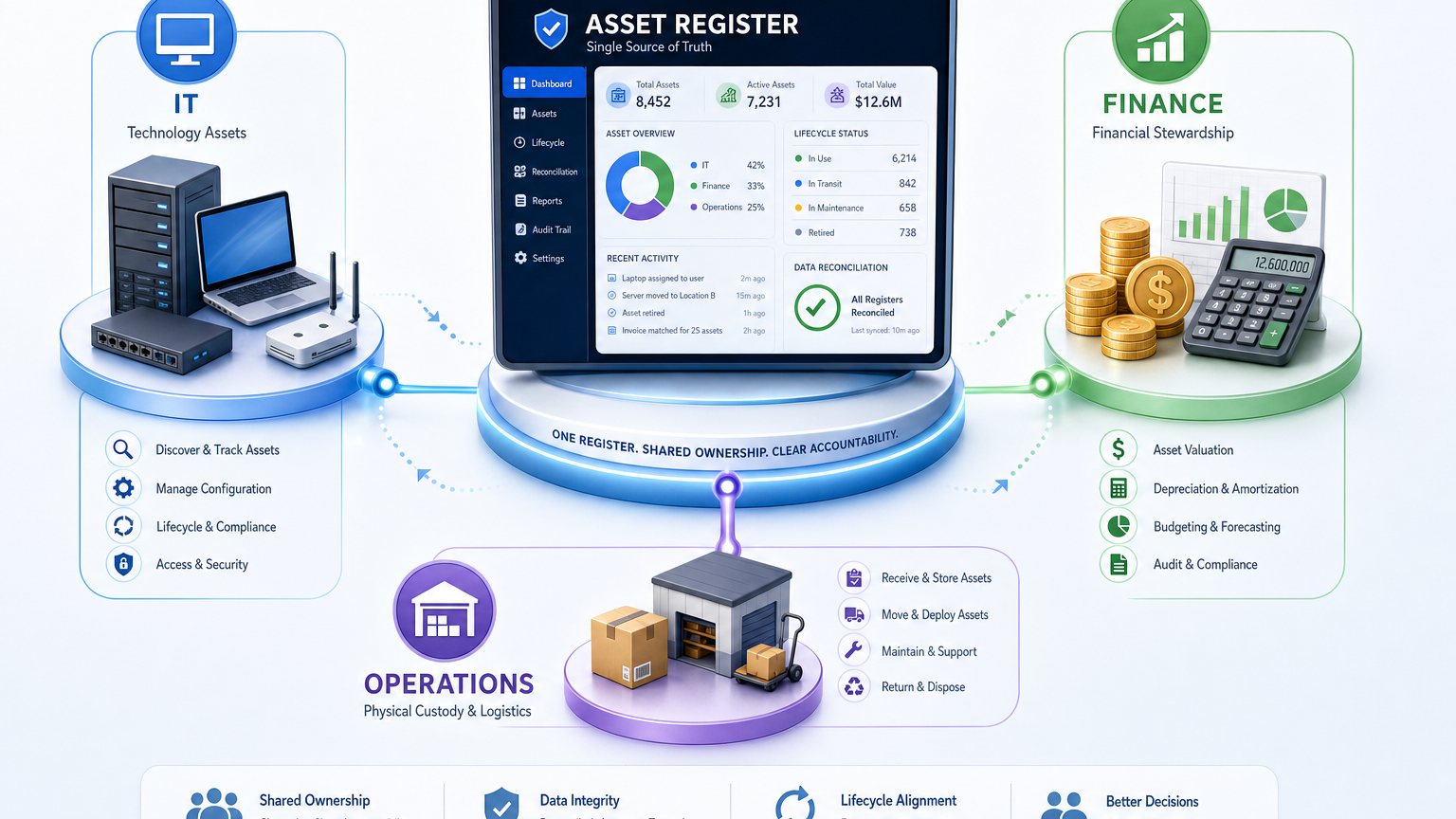
Who owns the asset register across IT, finance and operations? For the IT asset register, a practical starting point is one accountable IT asset management owner. Finance remains accountable for financial records and accounting decisions. Operations or facilities teams maintain the physical custody information assigned to them.
The right accountable role depends on the register’s purpose and the organization’s governance. A company can have separate IT and financial registers with different owners. What matters is that each register has a named owner, documented scope, and an agreed process for reconciling differences.
Define which asset register needs an owner
An IT asset register records information needed to manage technology assets throughout their lifecycle, including laptops, servers, network equipment, and software records, depending on the organization’s policy and the information its teams need.
An IT asset register and a fixed asset register can overlap in content but serve different decisions: the IT register supports lifecycle and security management, while the fixed asset register supports depreciation and accounting. A device can appear in one register without appearing in the other, depending on cost thresholds and lease terms.
Agree on the register’s purpose before assigning accountability. Write down which asset classes belong in it, which decisions it supports, and which related records remain elsewhere. Ask finance to document its accounting boundary, including the treatment of leases and pooled purchases. For a closer look at choosing which fields belong in the register before assigning ownership, see What Fields Should an IT Asset Register Include?.
Visibility gaps make the ownership question harder to answer. Flexera’s 2026 State of ITAM report found that only 36% of organizations have complete visibility into their IT estate, down from 43% in 2025, with cloud instances and SaaS among the weakest spots (Flexera, 2026). Without a named owner, those blind spots stay open because no one is accountable for closing them.
Can an IT asset register and a fixed asset register have different owners?
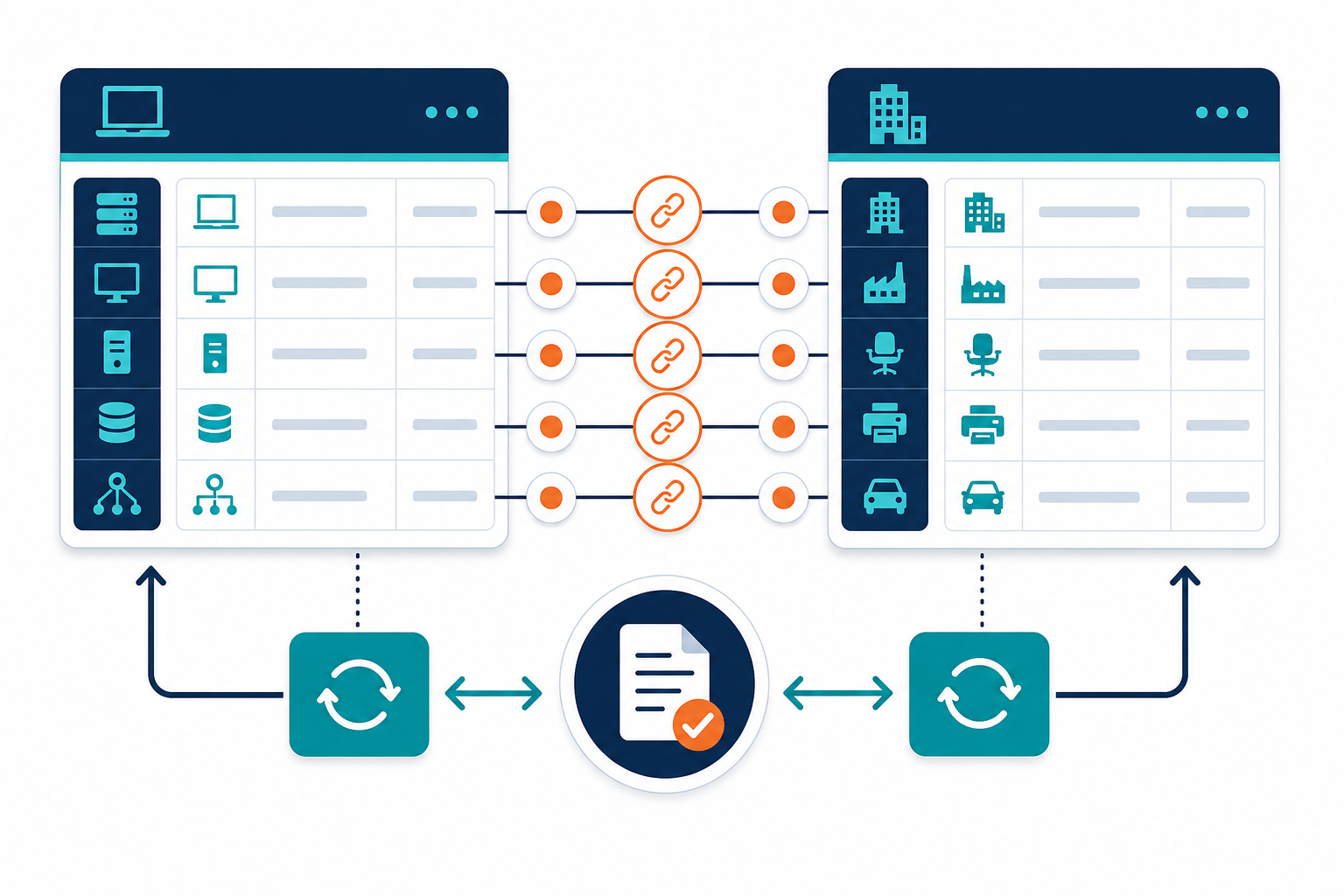
An IT asset register and a fixed asset register can have different accountable owners because they serve different decisions. The IT asset management owner may coordinate technical inventory, while finance controls accounting records. Their teams should agree on matching identifiers, reconciliation timing, and a route for unresolved discrepancies.
Give one role accountability for each register
For an IT asset register, appoint an IT asset management manager or another designated IT leader as accountable owner, with authority to set the register’s scope, assign stewards, review data quality, and escalate unresolved issues. A named deputy should cover absences and organizational changes.
A record steward handles the daily work needed to maintain the register, coordinating updates, checking exceptions, and following up when evidence is missing. One person can hold both roles when the organization has the capacity to support them.
The register owner differs from the owner of an individual asset — an application team may be accountable for a server’s business purpose while infrastructure maintains it. The register owner’s job is to make sure that distinction is recorded, not to own it personally. That authority covers the process, not every financial or operational decision: finance still determines accounting treatment, and a site manager still confirms custody when assigned.
Document the ownership decision in a short statement naming the register, its accountable owner and steward, the included asset classes, the review cycle and escalation route, and who approves changes to scope, then store it with the operating procedure so future owners can find it.
Explore Trusted Runtime Truth to see how discovery-sourced records support visibility into what exists, how it connects, what changed, what could break, and who owns it. That context gives the register steward a starting point for investigating gaps alongside human-supplied records.
Divide the work between IT, finance, and operations
A practical responsibility model assigns one accountable role to each decision or activity below. Adjust the roles to the teams that actually hold the authority and evidence in your environment.
| Activity | Accountable role in this example | Other contributors |
|---|---|---|
| Define the IT register scope and quality rules | IT asset management owner | Finance, operations, security, and business stakeholders |
| Maintain cost and accounting treatment | Finance owner | Procurement and IT asset management |
| Confirm technical identity and support assignment | IT operations owner | Asset steward and technical support teams |
| Confirm physical location and custody | Assigned operations or site owner | IT support and the asset custodian |
| Reconcile discrepancies between registers | IT asset management owner for the shared process | Finance and operations resolve their assigned exceptions |
| Approve financial disposal treatment | Finance owner | Operations supplies disposal evidence and IT updates lifecycle status |
The accountable person may delegate execution, but the delegation needs a clear handoff: who performs the work, who provides evidence, and where an unresolved decision goes. This table is a RACI for the asset register itself — responsible, accountable, consulted, and informed roles assigned per decision, not per configuration item.
Finance should not validate network discovery scans, and IT should not infer accounting treatment from them. Each team sticks to the fields and decisions inside its own authority.
Operations can mean IT operations in one company or facilities in another, so name the actual role instead of a broad department label.
Who resolves an asset register disagreement?
The register’s agreed exception process should name a coordinator and the decision owner for each type of disagreement. Finance can determine financial treatment, while the technical or site owner validates operational evidence. If neither team accepts the assignment, the register owner escalates the unresolved case to the designated sponsor.
Make lifecycle handoffs explicit
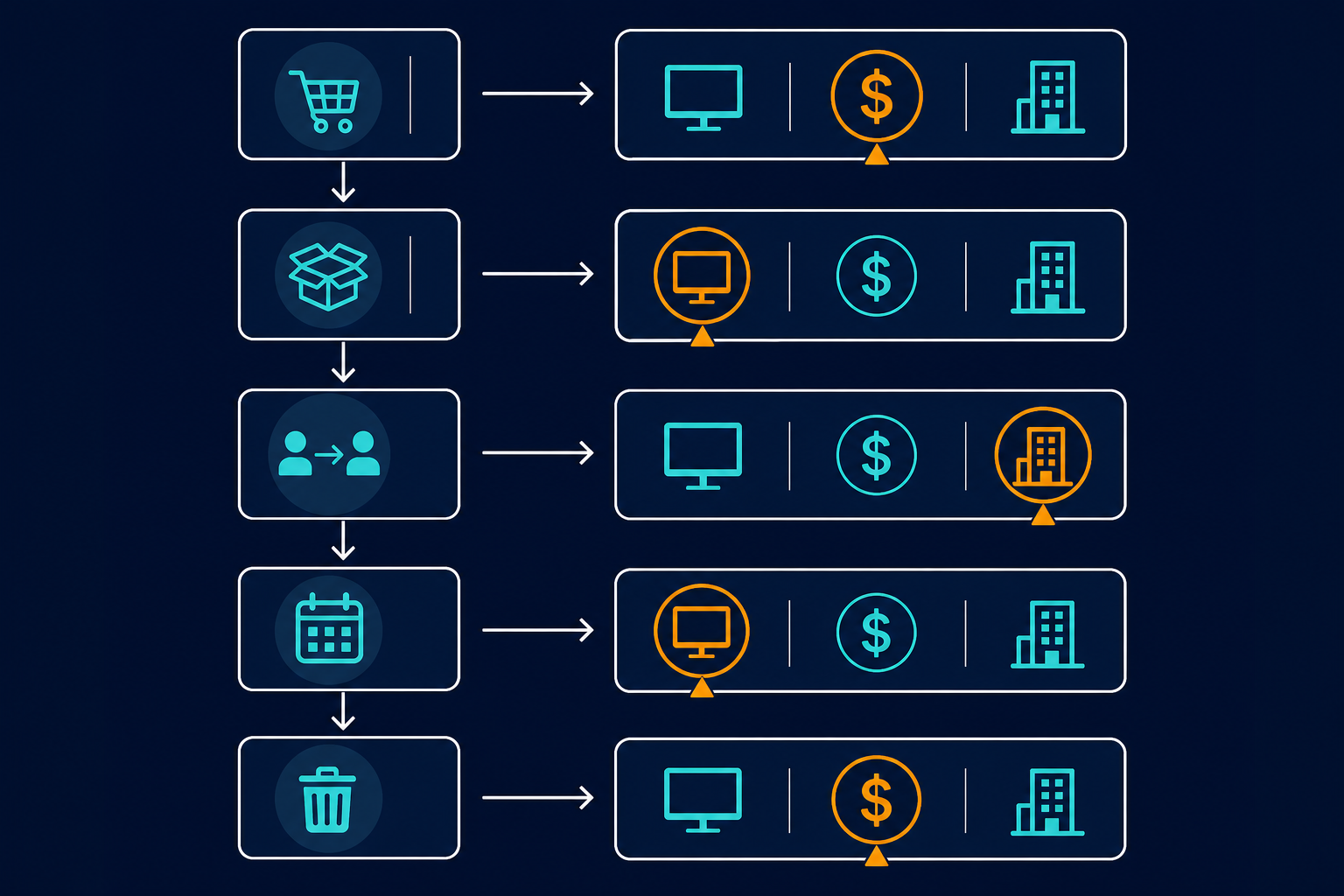
Ownership becomes useful when teams apply it to events that change asset records: acquisition, deployment, movement, retirement, and disposal. Identify the record each team updates at each step.
Purchase and receipt
Procurement supplies the purchase order, supplier, and acquisition details, and finance determines whether the item enters the fixed asset register. The IT steward links the device record to that purchase evidence using an appropriate asset identifier. Because a purchase order can cover multiple devices, preserve the line item and serial number or asset tag where available so finance and IT can investigate differences without assuming a one-to-one match.
Deployment and movement
IT support records the deployment and technical assignment, while the site or operations owner confirms physical location when that team maintains custody information. A transfer between departments should name the previous and new custodian, and finance reviews any cost-center changes that affect its records.
Retirement and disposal
IT records that the asset has left service after the relevant technical checks, operations or an approved disposal provider supplies the evidence required by policy, and finance decides when to update the accounting record. Keep retirement and disposal as distinct decisions when the organization uses both — a device removed from service may sit in storage before disposal, and a missing scan alone is not evidence that it has been destroyed or should leave the financial register.
Reconcile the IT and finance records without forcing a one-to-one count
Start an asset register reconciliation by agreeing on the reporting date, the populations compared, and the asset classes, thresholds, leases, and exclusions in scope. An intentional scope difference should stay visible as an explained difference, not an error.
Match physical assets using a verified serial number or a maintained asset tag where available. Cloud instances require provider and account scope alongside their instance identifiers. A hostname can change or be reused, so it should not serve as a durable join key by itself.
Preserve each source record’s identifier and the date of the evidence. Where a financial record represents a group of devices, document the relationship instead of inventing a one-to-one match, and keep uncertain matches open for review until the relevant owners provide evidence.
A reconciliation queue should capture:
- The asset or group identifier and source records
- The reporting period and comparison scope
- The discrepancy, its likely explanation, and the responsible team
- Supporting evidence, the next review date, and the approved resolution
A 2025 federal audit of a public water utility found that eight vehicles acquired with federal funds, valued at $303,960, had been left off the fixed asset register entirely. The finding was tied to 2 CFR § 200.313(d), which recommended periodic reconciliations going forward (federal audit finding, 2025). The gap was not a technology failure, but a missing handoff between whoever tracked the vehicles physically and whoever updated the financial register.
Consider a laptop marked disposed in the IT register but active in finance. The steward checks the serial number and disposal record, operations confirms the evidence, and finance decides whether the accounting entry needs a change before the IT owner closes the exception. A reverse case, an active device with no finance entry, may simply sit below a capitalization threshold or belong to a lease; finance should confirm treatment first.
Use discovery to support the register steward
Scheduled discovery gives IT a way to compare observed infrastructure with existing asset records, though coverage depends on the configured scan scope, credentials, methods, and asset availability. A device outside that coverage may need another source or a manual check.
Virima supports agent-based and agentless discovery, along with discovery of supported virtual and cloud assets. Its IT asset management capabilities track lifecycle, contracts, warranties, and financial information. Teams still determine which source is authoritative for each field and who approves a correction.
An observed serial number can help a steward investigate a possible match, but a scan does not establish who accepted custody, which cost center should be charged, or whether a disposal was approved. Those answers come from the responsible teams and their records.
Use the configuration management database (CMDB) for the configuration items and relationships needed by operational teams. The CMDB and the asset register commonly have different accountable owners, even when the same team manages both: the CMDB owner is accountable for configuration-item accuracy, while the register owner is accountable for lifecycle and reconciliation decisions.
See how discovery-sourced asset records can help your IT, finance, and operations teams investigate register discrepancies.
Review ownership and measure unresolved work
Review the responsibility model when teams reorganize, an outsourced service changes, or an asset class enters scope, since a departure can leave an apparently populated owner field pointing to an inactive contact.
The register owner should periodically confirm assignments with the named teams and return rejected ones to the exception queue.
Can discovery confirm who is accountable for an asset register?
Discovery can provide observations about assets within its configured scope, but accountability for the register is assigned by the organization. A designated owner accepts the process responsibility and coordinates stewards. Finance and operations remain responsible for the records and decisions assigned to their teams.
Useful measures include the share of in-scope assets with confirmed custodians, open reconciliation exceptions, and the age of unresolved discrepancies, defined consistently before comparing results across teams.
Keep process health separate from accounting accuracy: a completed reconciliation confirms the agreed review occurred, while finance determines whether its own records satisfy applicable accounting requirements.
Put the register ownership model into practice
Start with a documented decision: name one accountable owner for the IT asset register, ask finance to name the owner of its fixed asset register, and identify the operations roles that hold custody evidence. Confirm scope and handoffs before selecting measures.
Choose one asset class for the first reconciliation. Review the results with the relevant teams, assign exceptions, and document how disputes reach a decision. Expand the process once the owners can explain the evidence, close the outstanding handoffs, and the organization has a documented IT asset register ownership model in place.
Schedule a Virima demo to discuss how discovery and asset records can support your register review process.
Frequently Asked Questions
Who should own the IT asset register?
An IT asset management manager or designated IT leader typically owns the register’s scope and quality process, with authority to coordinate stewards and escalate discrepancies. The right appointment depends on the organization’s operating model.
Does finance own the fixed asset register?
Finance commonly owns financial asset records and accounting decisions, though the organization must assign the responsibility explicitly. IT and operations supply technical identity, custody, and disposal evidence, while finance decides the accounting treatment.
Can one team own both asset registers?
One team can coordinate both registers with the right authority and expertise, but it should still identify who approves financial treatment, validates technical records, and confirms custody. Internal controls or separation-of-duties requirements may shape those assignments.
How can Virima help with asset register reconciliation?
Virima provides scheduled discovery and IT asset records that teams can compare against finance records when reviewing inventory differences. Finance and operations still need to confirm their own evidence and decisions.
Can Virima identify an asset’s operational context?
Virima supports configuration item records and relationships that provide context for an asset review, though available information depends on discovery coverage and the data the team maintains. Asset owners should still validate assignments before updating the register.