Virima + Xurrent Integration: Real-Time CMDB Data for Your ITSM Platform

Table of Contents
- What Is Xurrent?
- The Challenge: ITSM Without Accurate CMDB Data
- How Virima Integrates with Xurrent
- Use Cases
- The Value: CMDB-Enriched Service Management
- Getting Started
TLDR
Xurrent is a modern enterprise ITSM platform that helps IT and service teams deliver faster, more consistent service across the organization. Paired with Virima’s automated discovery and CMDB, Xurrent users gain real-time asset data, dependency maps, and CMDB-enriched incident and change workflows — available directly from the Xurrent App Store via Streamline Partners. The result is faster incident resolution, fewer failed changes, and the change impact analysis Xurrent users need to make confident decisions at speed.
What Is Xurrent?
Xurrent is a SaaS-based enterprise service management platform, formerly known as 4me, that rebranded in September 2024 to reflect its expanded vision for modern IT and business service delivery. (Xurrent)
Xurrent serves IT and service teams at growing businesses and large enterprises, combining ITSM with incident management response (IMR) in a single connected platform. Its design philosophy centers on scalability, ease of deployment, and operational efficiency — capabilities that have made it a trusted choice for IT directors and service management teams who need a platform that can adapt as their organizations grow.
Xurrent’s ITxM platform unifies service workflows, incident response, and asset and configuration management so that every request, alert, and update moves through a consistent, traceable process. The platform places a strong emphasis on cross-team collaboration and real-time visibility — and that is precisely where Virima adds its deepest value.
The Challenge: ITSM Without Accurate CMDB Data
Xurrent users who run incident management and change management workflows already have access to a powerful, intuitive service desk platform. The gap that many encounter is not in the service workflow itself — it is in the quality of the CMDB data that feeds those workflows.
Consider a major incident affecting a critical business application. The Xurrent incident record captures the symptom, the affected service, and the assigned team. But the responders need more: which servers support this application? What are their dependencies? Is any underlying hardware approaching end-of-warranty or already flagged for change? What other services share the same infrastructure and could be affected if the incident spreads?
Without an accurate, continuously updated CMDB behind Xurrent, answering these questions requires manual cross-referencing across multiple systems — adding minutes or hours to incident resolution time that could have been spent on the fix. The same problem affects change management: approving a change without visibility into the full dependency chain of the CI being changed is a leading cause of failed changes. Over 80% of IT-related outages stem from planned changes, and most of those failures trace back to incomplete impact analysis at the time of change approval. (Virima)
The Uptime Institute Annual Outage Analysis 2025 confirms that while overall outage frequency has declined, the growing complexity of hybrid IT architectures amplifies the business impact of each outage that does occur — making accurate CI context a non-negotiable requirement for modern incident response teams.
How Virima Integrates with Xurrent
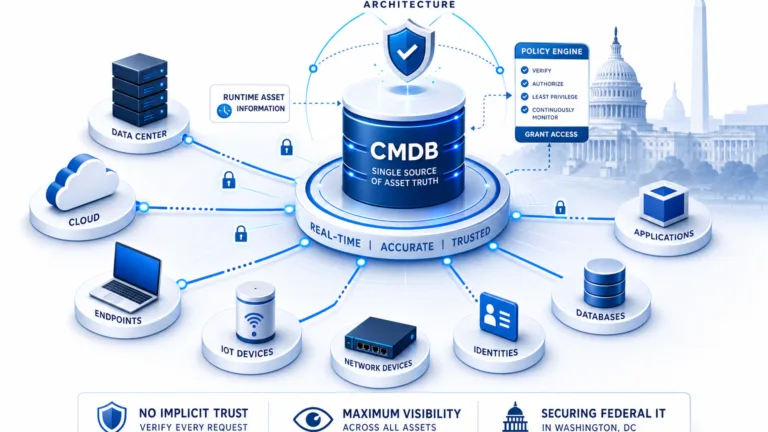
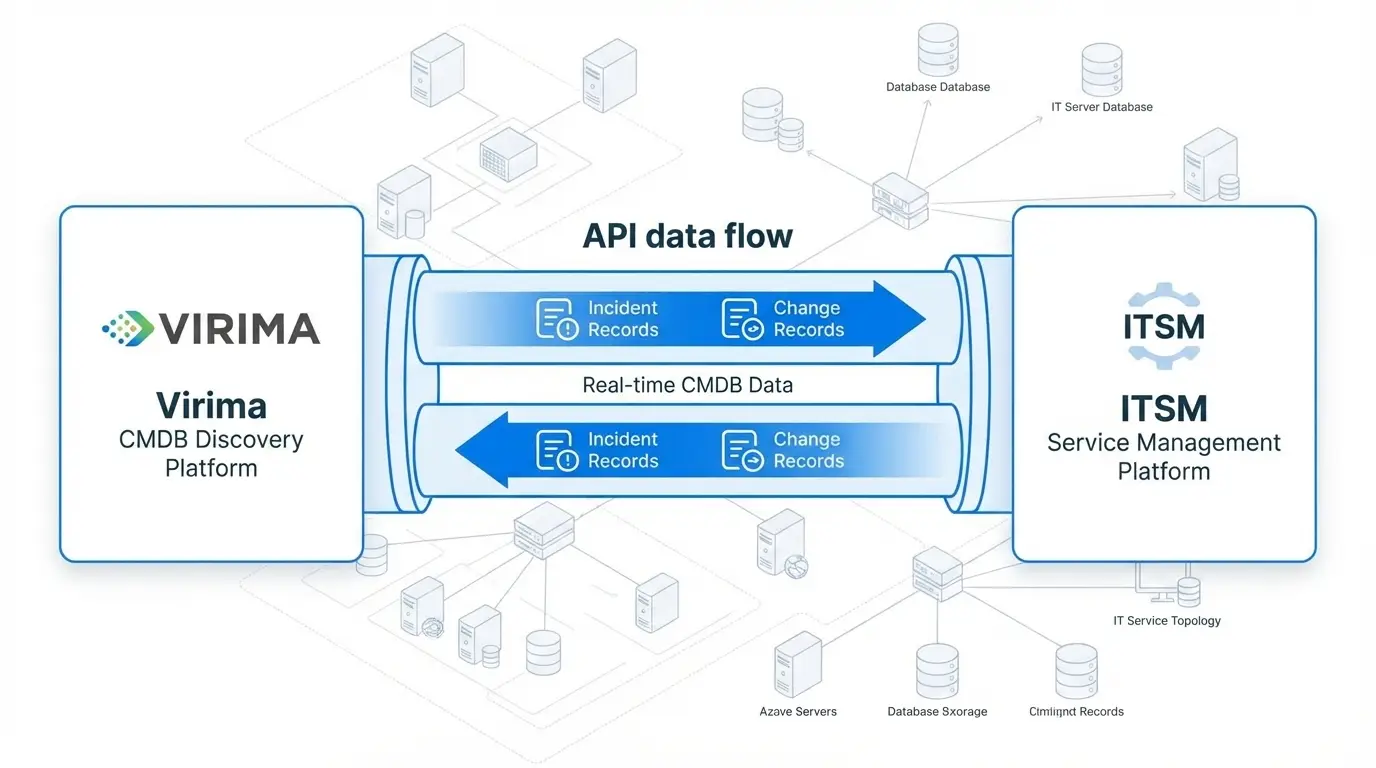
By incorporating Virima’s automated CMDB discovery and service mapping, Xurrent provides its users with a comprehensive solution that enriches their CMDB and ITSM processes with detailed insights, all visually accessible through Virima Visual Impact Display (ViVID™).
The integration is available directly from the Xurrent App Store via Streamline Partners, in just a few simple steps — no custom development, no scripting, and no complex configuration.
Discovery: The Foundation of Accurate CMDB Data
Virima’s discovery engine continuously scans hybrid IT environments — on-premise, cloud, and multi-cloud — using agentless IP-based network scanning supplemented by over 140 extendable probes. Optional agents for Windows and Linux systems provide deeper visibility where needed.
Discovery extends through API integrations with a broad range of hypervisor, cloud, container, orchestration, network, storage, and monitoring platforms. Every discovered asset is modeled as a CI in Virima’s CMDB, with attributes populated from live scan data rather than manually maintained spreadsheets.
This continuous discovery process is what gives Xurrent users access to CMDB data they can trust. Virima’s flexible discovery and intelligent CMDB automation keep the information in the CMDB accurate and current — so the data Xurrent surfaces during incident and change workflows reflects reality, not a snapshot from three months ago.
ViVID™ Service Mapping for Xurrent
Virima Visual Impact Display (ViVID™) provides visual representations of business service dependencies: infrastructure relationships, application dependencies, network topologies, and system communications. Critically for Xurrent users, ViVID completes these service maps with overlays of Xurrent ITSM records — including open incidents and recent or planned changes.
This means a Xurrent change manager can open a service map for the application they are about to modify and see, in a single visual, every CI involved in that application’s delivery chain, the status of any open incidents currently affecting those CIs, and any other planned changes scheduled for infrastructure in the same dependency cluster.
This is the rapid impact and root cause analysis that Xurrent users gain from the Virima integration — not a separate portal, but CMDB and service context layered directly into the service management workflow.
Autonomic Social Discovery (ASD)
Virima’s Autonomic Social Discovery automates human intelligence gathering to fill knowledge gaps that technical scanning alone cannot close. ASD captures asset lifecycle status, ownership information, business criticality, and policy and SLA details — the contextual data that makes CMDB records actionable rather than merely accurate.
For Xurrent users, this means that the CI context surfaced during incident and change workflows includes not just technical attributes but business-relevant details: who owns this asset, what SLA governs it, and how critical is it to the business services it supports.
Use Cases
Incident Response with CI Context
A Xurrent user opens an incident ticket for a failing application. With the Virima integration, the incident record surfaces the relevant CIs from the CMDB — the servers, network components, and software dependencies involved in that application — along with their hardware asset details, warranty status, and current discovery health. The responder sees the full dependency map in ViVID alongside the open incident list, immediately identifying whether the failure is isolated or part of a broader service disruption.
Resolution time drops because the team does not spend the first 20 minutes of the incident manually searching for what infrastructure is involved. The CMDB data is there, current, and linked to the ticket from the moment the incident is created. This is what a well-implemented Xurrent integration delivers in practice: it bridges IT operations and incident response so responders work from the same live infrastructure data the operations team already relies on.
Change Management with Full Asset Visibility
A Xurrent change manager is reviewing a planned change to a production database server. The Virima integration for Xurrent surfaces the CI record for that server — including its hardware asset details, all dependent application services, the current open incident count for CIs in its dependency cluster, and any other planned changes scheduled in the same window.
The change advisory board can now assess the actual risk of the change: is the hardware healthy and under warranty? Are there concurrent changes that could create conflict? Are there open incidents on dependent services that make this change window risky? This is the kind of contextual review that reduces failed changes and the downstream outages they cause.
The Value: CMDB-Enriched Service Management
Together, Virima and Xurrent give IT teams the combination of strong service workflows and reliable CMDB data that each platform alone does not fully provide.
Xurrent users take comfort in knowing that the information in the CMDB is accurate — allowing them to make informed decisions during incidents, changes, and capacity planning without stopping to question whether the data they are looking at is current.
The measurable outcomes:
- Reduced MTTR: Incident responders work from complete CI context from the first moment of triage, not after a manual discovery phase
- Fewer failed changes: Change approvers see full service dependency maps and concurrent change conflicts before approving
- Faster root cause identification: ViVID service maps with open incident overlays surface the source of service disruptions visually, not through log triage
- Increased MTBF: Accurate hardware lifecycle data prevents the deferred maintenance and missed refresh cycles that cause unplanned outages
Enterprise-level discovery, CMDB automation, and ViVID service mapping — available at a price point on par with Xurrent, with simple configuration via the Xurrent App Store.
Getting Started
The Virima integration for Xurrent is available directly from the Xurrent App Store via Streamline Partners. Configuration is codeless and fully managed through the Virima and Xurrent user interfaces.
Xurrent users who need an automated CMDB and a powerful service mapping solution will find both in Virima — with the flexibility to discover hybrid IT environments at scale and the visual intelligence to make every incident and change workflow decisively faster.
Ready to enrich your Xurrent environment with accurate, real-time CMDB data? Schedule a demo at virima.com and see the Virima-Xurrent integration in action.