Revolutionizing Change Management With ServiceNow and Virima

ServiceNow Change Management is central to how enterprise IT teams control risk while keeping the business moving. In a fast-changing digital environment, effective IT change management protects an organization’s uptime and its competitive edge. The ServiceNow Change Management module gives teams a faster, more controlled way to plan and implement IT changes, which reduces disruption when it is backed by accurate data.
Uptime Institute’s 2025 outage analysis found that the proportion of human error-related outages caused by failure to follow procedures rose by ten percentage points compared with 2024, underscoring how much change discipline still depends on the accuracy of the data behind it. That is the real story behind pairing ServiceNow Change Management with Virima: a partnership that strengthens ServiceNow’s process controls with discovery-driven configuration data.
Let’s walk through how this combination simplifies ServiceNow Change Management and gives IT operations teams a clearer, more defensible view of every change.
A deeper look at ServiceNow Change Management
ServiceNow Change Management goes beyond basic process automation. It gives teams integrated workflows that speed up IT changes while separating low-risk changes from complex ones, which has reshaped how many change management teams operate day to day.
Integrated change management workflows
ServiceNow expands the scope of change management by integrating workflows that speed up IT changes and separate low-risk changes from complex ones. This keeps the change process lean without skipping the checks that matter.
Orchestration of change tasks
By cutting manual handoffs, ServiceNow helps keep transitions between change tasks smooth, which reduces bottlenecks and improves predictability.
Structured workflows
These workflows guide planning, execution, and monitoring for every phase of a change, helping teams avoid a congested backlog of pending work.
Impact analysis and risk ranking
ServiceNow performs impact analysis, assesses risk, and applies a closed-loop change process, which helps minimize back-outs and anticipate service collisions before they happen.
Closed-loop implementation process
A closed-loop system helps the ServiceNow Change Management module reduce failed changes and build a clearer schedule for implementation.
Unified backlog management
All change requests live in a single backlog, which supports more organized implementation and clearer prioritization.
Dashboards and reporting
Detailed dashboards and reporting tools give visibility into the change process, supporting informed decisions and faster throughput.
High-frequency discovery cycles and configuration accuracy
The whole system depends on accurate, current configuration data. When that data goes stale, change approvals start to rest on guesswork instead of ground truth. This is the gap that Virima IT Discovery is built to close, feeding ServiceNow Change Management with configuration records refreshed through recurring scheduled scans rather than a single snapshot in time.
How Virima strengthens ServiceNow Change Management
Virima covers a wide range of IT operations needs. Here is how its discovery and service mapping capabilities extend ServiceNow Change Management and deliver measurable ITSM benefits.
Discover more, guess less
A standout feature of Virima is its discovery capability. Virima IT Discovery helps keep configuration data current and gives teams a single, dependable source of truth. That matters because outdated or incomplete data leads to errors, missed dependencies, and change approvals made on bad assumptions.
The Virima Discovery module extends IT asset and configuration management with a dynamically updated view of the IT environment, so change managers are not working from a picture that is months out of date.
IT asset discovery
Virima performs asset discovery through agentless IP-based scanning along with an optional agent for Windows. With an extensive library of discovery probes and integration with AWS and Azure, Virima identifies physical and virtual assets while reviewing hardware configurations and installed software across Windows, Linux, Unix, and Mac.
How Virima IT discovery works
Virima Discovery runs on both an agentless and an agent-based model. The agentless model identifies network-connected devices and analyzes their hardware and software configurations. Virima also offers an agent for assets running desktop and server versions of Windows that do not usually connect to the network or that need persistent configuration monitoring.
Better CMDB population
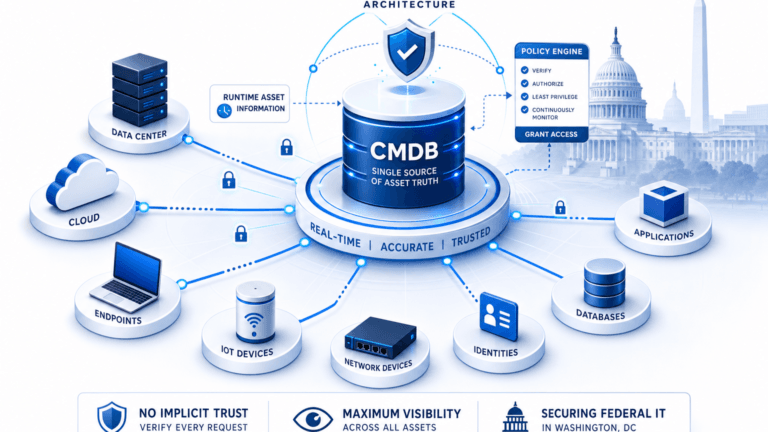
Virima Discovery detects and identifies hardware, software, configurations, and interdependencies, which builds a richer, more accurate ServiceNow CMDB. That gives change management teams a stronger foundation for decisions.
Greater inventory visibility
With Virima Discovery, ServiceNow gains improved visibility into the organization’s IT assets, including hardware, software, and network devices. That supports more efficient change management and more targeted troubleshooting.
Enhanced change management
By connecting Virima Discovery with the ServiceNow Change Management module, teams can better assess the risks and impact tied to a proposed change. This helps reduce downtime and lowers the chance of a failed change. You can read more about how a CMDB reduces change risk at every stage of the process.
Kept current through recurring scans
Virima Discovery keeps the CMDB current by running recurring scheduled scans of the IT environment and updating records as changes occur. That gives ServiceNow users a dependable, current picture of their infrastructure to support change decisions.
Dependency mapping
Virima Discovery identifies and maps dependencies between IT components, which improves ServiceNow’s ability to manage complex change processes. Dependencies can be visualized, supporting more thorough planning and reducing the odds of an unforeseen issue during implementation.
ViVID Service Mapping
Next is ViVID Service Mapping. It builds dynamic dependency maps covering compute, network, and storage relationships, host-to-host communication, application dependencies, and service topology. This gives IT teams a faster way to identify and address the causes of service disruption. Read more on how ViVID turns discovery data into service maps.
Changes can be planned and executed with more confidence because application dependency mapping shows what a change window will affect, or what went wrong if a change causes an issue.
Dynamic visual mapping
Using discovery data and organizational input, Virima Service Mapping builds dynamic visual maps of relationships and dependencies across the IT infrastructure, giving teams a current view rather than a static diagram.
Establishing dependencies
Virima Service Mapping identifies relationships and dependencies between IT business services. During change impact assessments in ServiceNow Change Management, this gives teams a clearer read on what a proposed infrastructure change could affect.
Service versatility
Virima can map on-premises, cloud-based, and hybrid services, along with major applications and broader business services.
Informing root cause analysis
Virima Service Mapping helps teams quickly trace the root cause of a service interruption, including identifying what changed just before the disruption occurred.
Change management assistance
Teams use Virima to understand the impact of a change, coordinate with the right stakeholders, and assess recent changes for any resulting service disruption.
ViVID overlays
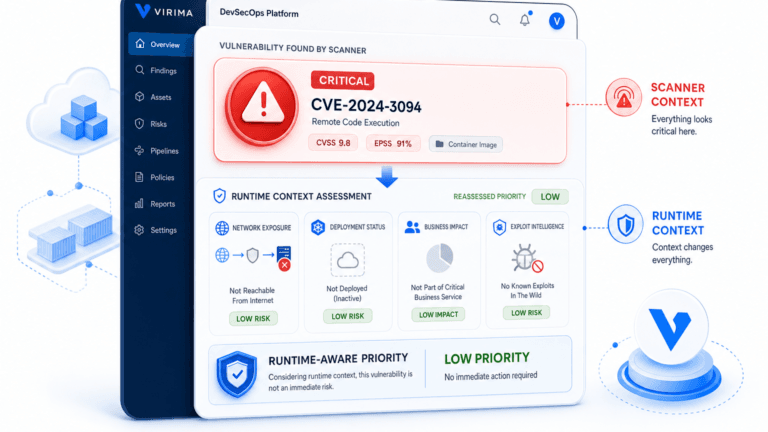
The Virima Visual Impact Display (ViVID) layers ITSM records, vulnerabilities, and service dependencies over the service map. That helps teams understand the potential risk of a change and identify the right stakeholders, which reduces change collisions and can help teams time changes to planned downtime windows.
Sharper CMDB quality
ViVID adds real value to the CMDB, turning it from a data repository into a resource stakeholders actually rely on by providing a precise map of service relationships. This includes infrastructure and network map views, service topology views, and communication views that show host-to-host traffic flow.
Close integration with monitoring and ITSM tools
Virima Service Mapping combines data from system monitoring tools with ITSM integration, which gives earlier visibility into potential service availability impacts. It also shows which assets have open incidents or recently completed changes, helping teams identify root causes faster.
Connected IT integrations
Virima integrates with system monitoring and ITSM platforms, including ServiceNow, Ivanti, Halo, Jira Service Management, and Xurrent, to provide prompt alerts and incident visibility for proactive service management. You can see the full picture in Virima’s change management use case.
Together, these capabilities help teams manage changes more effectively, lower both the risk and impact of disruption, and support a more stable, productive environment.
How Virima and ServiceNow work together
Virima’s strength is generating accurate data about the IT environment, which adds real value to the ServiceNow Change Management process. Together, Discovery, Service Mapping, and ViVID help teams manage changes with more confidence.
Once connected, discovery and service mapping data from Virima flows into the ServiceNow CMDB. Current, consistent CMDB records improve the reliability of the ServiceNow Change Management module, helping teams better anticipate impact, reduce business risk, and coordinate before deploying changes across the environment.
More accurate data supports better-managed changes, which can help lower Mean Time to Repair (MTTR), sharpen change impact analysis, and support a more resilient IT environment overall.
Fewer surprises, more confident changes
When ServiceNow Change Management and Virima work together, IT teams get a more manageable, efficient, and dependable change process. Virima adds pace to the process by grounding it in current configuration data, so teams can move through change windows with fewer surprises.
The result is a change management practice that moves from manual, error-prone review toward faster, data-backed decisions, whether the goal is change management, knowledge management, or problem management.
| Ready to see it in action? Schedule a demo to walk through your own environment. |
Frequently asked questions
Why do change management processes fail without accurate configuration data?
Change approvals rely on knowing what a change will touch. When configuration data is stale or incomplete, teams miss dependencies, underestimate risk, and approve changes that later cause outages or rollbacks.
What causes most unplanned IT outages?
Human error and process failures, including gaps in change and configuration management, remain leading causes of unplanned outages according to industry outage research, which is why accurate, current configuration data matters so much before a change goes live.
How does Virima integrate with ServiceNow Change Management?
Virima Discovery and ViVID Service Mapping data flow into the ServiceNow CMDB, giving the ServiceNow Change Management module current, discovery-driven records to support risk assessment and change scheduling.
How does Virima Service Mapping help assess change impact before deployment?
Virima Service Mapping shows the dependencies between applications, infrastructure, and services, so teams can see what a proposed change will affect, coordinate with the right stakeholders, and reduce the chance of a change collision before deployment.