How Do You Manage SaaS and Cloud Assets Alongside Hardware?

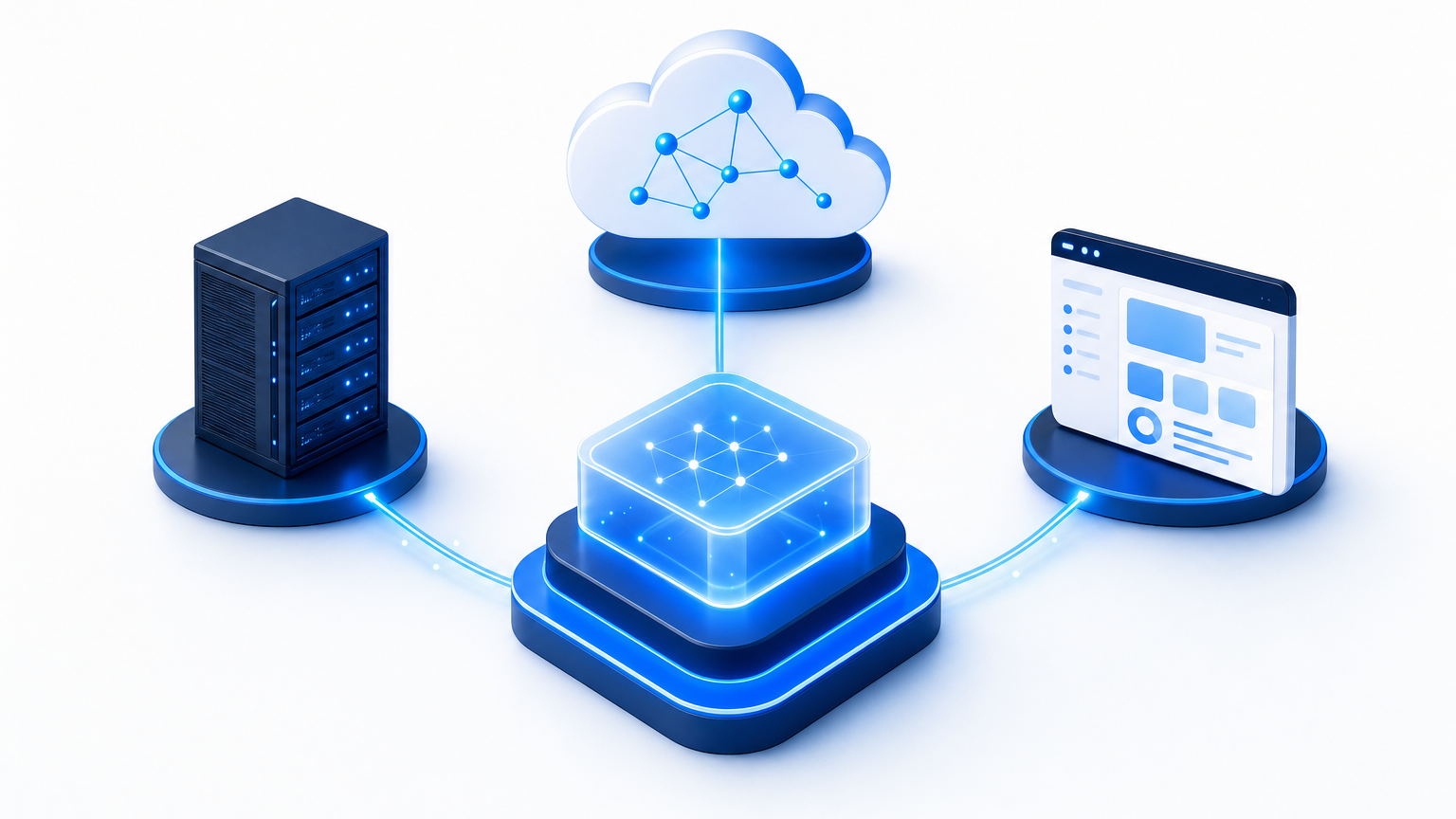
You manage SaaS, cloud, and hardware together by treating them as one estate under a shared inventory model: scheduled multi-source discovery, durable identity keys, a single system of record for assets and configuration items, owners and cost centers on every record, and service or dependency context for anything that can break a business function.
Spreadsheets, three tools, and three sources of truth fail the moment a laptop, an EC2 instance, and a SaaS seat all support the same workflow. Hardware arrives with serial numbers and purchase orders. Cloud instances appear and disappear with account credentials and tags. SaaS seats land through credit cards, marketplace buys, and SSO sprawl — the same pattern behind shadow SaaS growing faster than manual tracking can catch it. If each class lives in a separate list, you cannot answer who owns it, what it costs, what depends on it, or what a change will hit.
Why separate stacks break the same questions
IT leaders still ask the same four questions across every asset class: what do we have, who owns it, what does it cost, and what happens if it changes or fails. Hardware-only asset management answers those questions for laptops and servers. Cloud consoles answer them for instances and subscriptions inside one provider.
SaaS admin portals answer them for seats and plans. None of those views alone can answer them for a hybrid service path.
CISA Binding Operational Directive 23-01 puts asset visibility at the center of reducing exposure. That’s the same inventory problem enterprises face when SaaS, cloud, and hardware never share one list. The practical failure mode is simpler than any directive: renewal season, an audit sample, or a change window pulls three exports that disagree on counts, owners, and lifecycle state.
Hardware lists go stale when devices move sites or leave with contractors. Cloud lists go stale when tags are optional and accounts multiply. SaaS lists go stale when departments buy outside IT and deprovisioning lags offboarding. Managing them alongside each other means one reconciliation cadence and one place where conflicts get resolved.
Put every class on the same identity and ownership rules
Unified management starts with identity rules that survive tool swaps.
For hardware, durable keys are serial numbers and asset tags, not hostnames, which change and collide. For cloud, durable keys are provider instance IDs, subscription or account IDs, and resource IDs that the console will still recognize after a rename. For SaaS, durable keys are tenant IDs, application instance IDs, and licensed user or seat identifiers tied to identity providers, not a marketing product name in a spreadsheet cell.
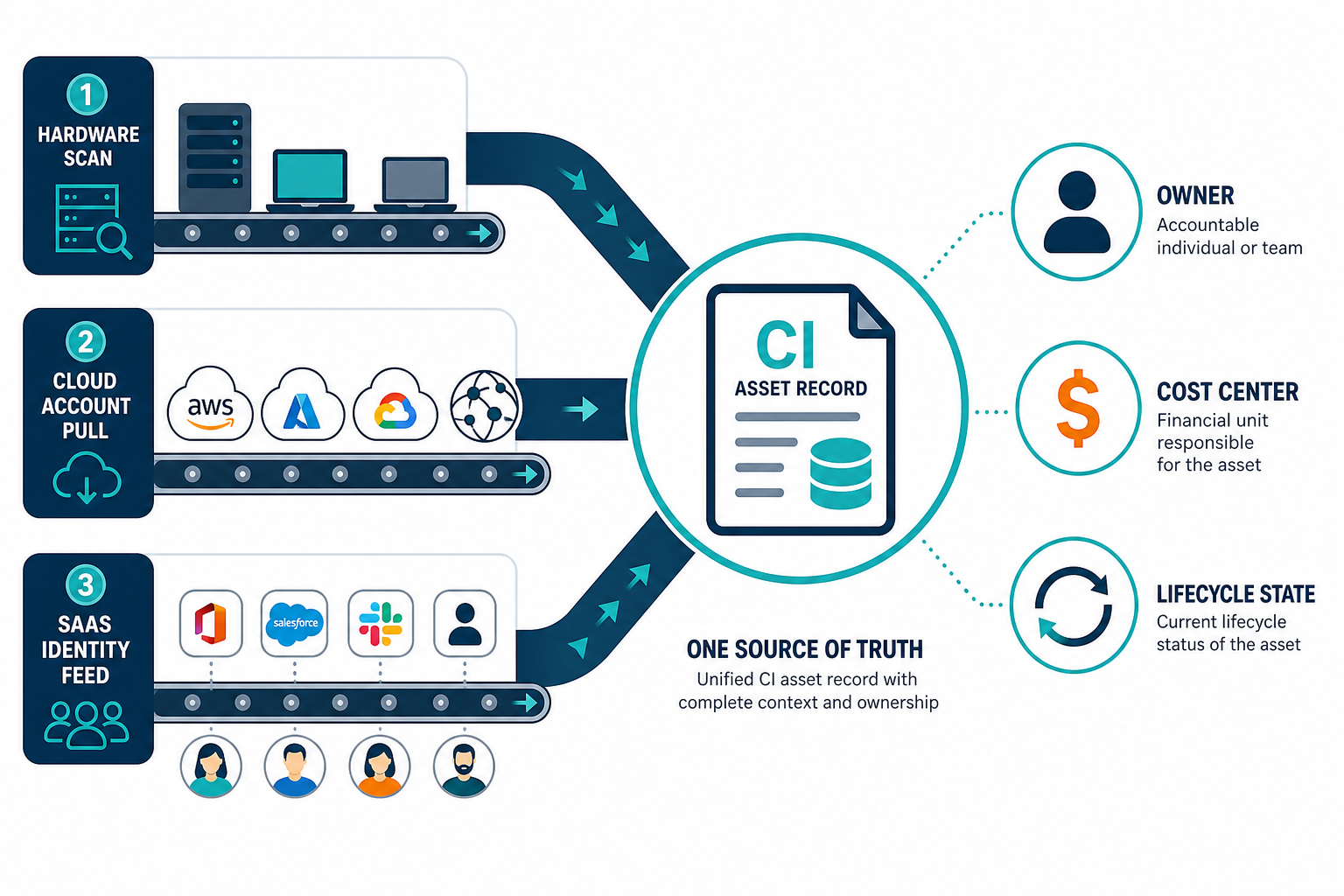
Ownership must be a person or team on the record, plus a cost center or business unit where finance needs it. SaaS without an owner becomes forever-renewed shelfware. Cloud without an owner becomes orphaned spend. Hardware without an owner becomes ghost inventory after moves and exits.
That risk is not rare. Okta’s 2025 Businesses at Work report found the average company now runs 101 apps, crossing the 100-app mark for the first time in a decade of tracking. That is exactly the scale where ownerless seats turn into renewal guesswork instead of a managed estate.
Lifecycle states should use one vocabulary across classes: requested, active, suspended, and retired. Cloud terminated and SaaS cancelled still need a retired state so audits and CMDB cleanup don’t leave zombies.
Discover on a schedule, then reconcile into one record
Discovery is how the shared model stays honest. SaaS and cloud assets change state faster than hardware, so discovery on those classes needs a defined cycle, not a quarterly merge. Agent-based and agentless scans cover on-prem servers, endpoints, and network gear. Cloud connectors pull AWS and Azure inventories on a defined cycle. Software inventory and entitlement views cover installed titles. SaaS and identity signals (SSO apps, admin APIs where available, contract feeds) cover subscriptions that never install a binary on a corporate laptop. That gap is exactly what a combined cloud and SaaS inventory approach is built to close.
Virima’s IT discovery is multi-source and scheduled. It does not claim passive continuous event streaming as the operating model today.
Reconciliation merges sources into one authoritative configuration item or asset record per real-world object. Multi-source merge is where hostname-only matching fails. Prefer serial, cloud instance ID, or equivalent durable keys when linking discovery data to the CMDB and to ITAM financial fields.
Keep cloud and SaaS CMDB data unified with hardware and ITAM
A configuration management database holds what exists and how it relates. IT asset management holds financial, contractual, and lifecycle attributes. Managing SaaS and cloud alongside hardware means both layers see the same objects.
Cloud instances and network gear should appear as CIs with relationships, not only as bill line items. SaaS applications that support a named business service should appear as CIs or application records with owners, even when the asset is a subscription rather than a serial-numbered box. Hardware remains the classic ITAM spine: procurement through disposal, warranty, and location.
Virima pairs discovery-fed CMDB population with ITAM capabilities such as hardware lifecycle tracking, software license management against installs, EOL/EOS flags, and contract or warranty fields. The point of the combined view is not a prettier catalog. It is one place where license position, cloud footprint, and device inventory stop contradicting each other during audits and change reviews.
When teams already run an ITSM platform, discovery-sourced records can feed that platform through integrations rather than forcing a second manual inventory. ServiceNow, Jira, Ivanti, HaloITSM, and similar platforms receive the same estate view through the shared path at Virima integrations.
Add service context so alongside means blast radius, not three tabs
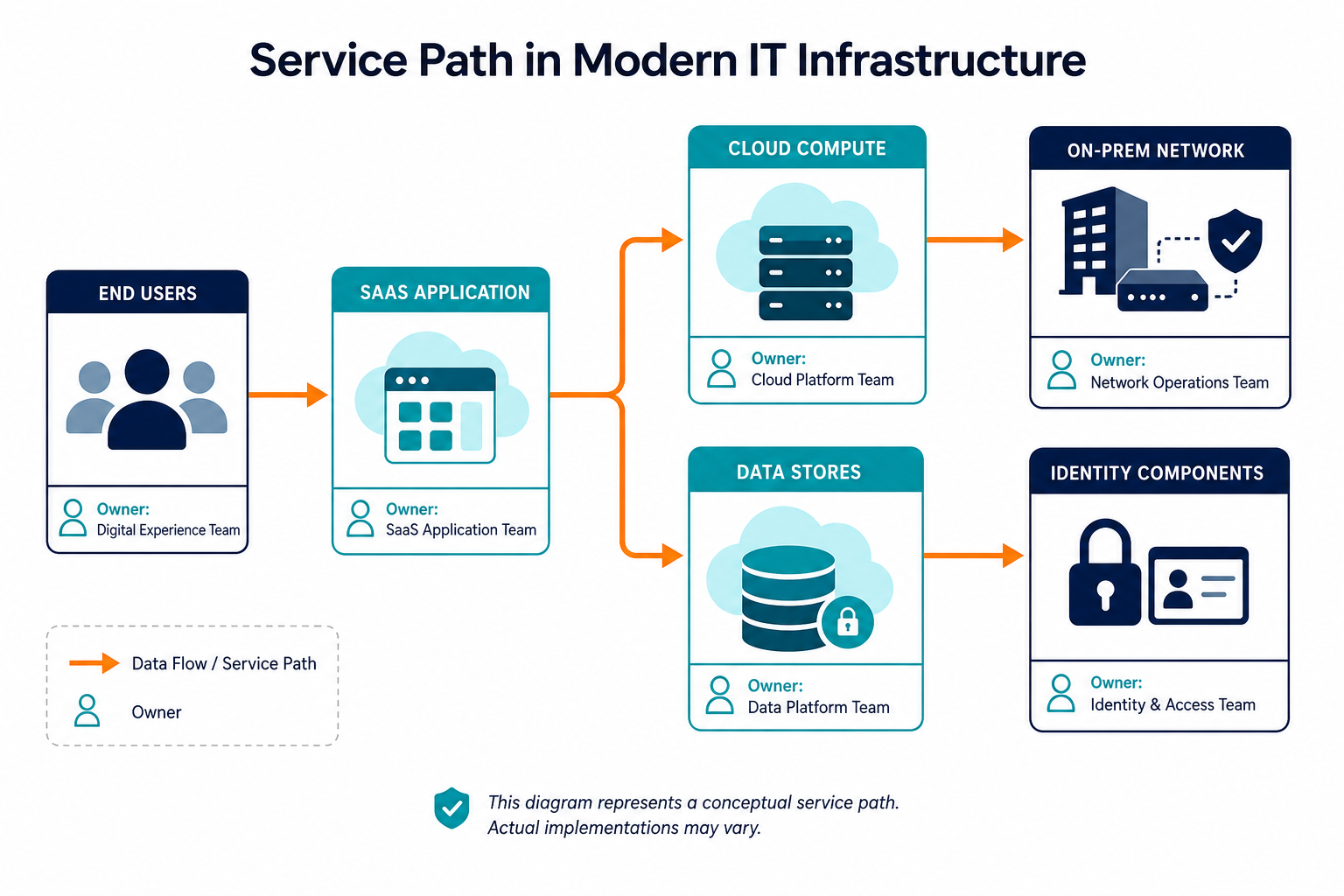
Inventory without dependency context still leaves change and incident teams guessing. After service definitions are supplied (manually or via import), ViVID™ service maps build application-to-infrastructure dependency maps and keep those maps current as infrastructure changes.
That is how a SaaS dependency, a cloud database, and a hardware load balancer show up in one path when someone asks what a Friday change will touch. Service composition is defined by the business; map building is automated from discovery once those definitions exist. Service maps do not replace SaaS renewal ownership or cloud tagging discipline.
For deeper framing on discovery-sourced operational truth across assets, services, and change impact, start with Trusted Runtime Truth.
Run one hybrid IT asset management cadence across all three classes
A workable weekly or monthly cadence looks like this in practice.
Intake
New hardware POs, new cloud accounts or subscriptions, and new SaaS contracts all create or update records in the same hardware and cloud inventory system within the same SLA. Shadow buys still happen; the cadence assumes discovery and identity feeds will surface them.
Reconcile
Compare discovery counts to CMDB active counts and to contract entitlements. Flag any variance above a threshold you set in advance — a gap over a few percent, or any missing high-criticality asset — for investigation instead of accepting silent drift.
Govern spend and risk
Flag unused SaaS seats, idle cloud resources, and hardware past warranty or past EOL. Software usage and install evidence support license position. SaaS needs seat and last-activity signals where the vendor API allows it. That governance step pays for itself fast. Flexera’s 2025 State of ITAM Report found 45% of organizations spent over $1 million on software audits in the past three years. Shared inventory and clean license evidence can cut that cost directly.
Change and decommission
Require CI or asset IDs on changes that touch production paths. Decommission hardware, terminate cloud resources, and cancel SaaS seats as one offboarding checklist tied to the same owner record.
Report
Leadership sees one estate dashboard: active hardware, active cloud resources by account, active SaaS products by owner, open reconciliation exceptions, and services missing map coverage.
See how discovery-fed inventory keeps SaaS, cloud, and hardware on one operating record.
What good looks like when the model works
You know the model is working when a single query can return a laptop serial, a cloud instance ID, and a SaaS tenant tied to the same business service and owner. Audit samples pull from the same system finance and security already trust. Change tickets reference CIs that still match last discovery. Renewals start from usage and ownership, not from last year’s invoice PDF alone.
You know it is failing when hardware looks complete in the asset tool, cloud looks fine in the FinOps export, SaaS looks fine in the SSO gallery, and nobody can prove the three lists describe one company. That failure mode is already widespread: the same Flexera report found visibility across the technology stack fell to 43% from 47% year over year, even as each tool looked complete on its own.
How do you manage SaaS and cloud assets alongside hardware?
Use one inventory model across all three: scheduled multi-source discovery, durable IDs instead of hostnames alone, shared ownership and lifecycle states, CMDB plus ITAM attributes on the same objects, and service dependency context for change and incident impact.
Common failure patterns to retire
- Hostname as the join key. It breaks cloud renames, cloned images, and laptop reimages. Prefer serial and cloud instance IDs.
- SaaS treated only as a vendor invoice. Without tenant, owner, and identity linkage, you cannot deprovision or prove usage.
- Cloud treated only as cost. Without CI relationships, cost cuts still surprise dependent services.
- Hardware treated only as custody. Without software and dependency context, a returned laptop story misses local installs and access paths that still matter.
- Manual quarterly merges. Hybrid estates drift inside a quarter. Scheduled discovery cycles and exception queues beat hero spreadsheets.
Closing: one estate, one set of rules
Managing SaaS and cloud assets alongside hardware is a design choice: one identity standard, one ownership model, one discovery-fed system of record, and service context for anything that carries business risk. Split tools can still feed that record, but none of them should pretend to be the full truth.
If your team is ready to put discovery-sourced inventory, CMDB relationships, and ITAM lifecycle on the same backbone, schedule a Virima demo with your own asset classes on the table.
Frequently Asked Questions
Do SaaS subscriptions belong in a CMDB with hardware and cloud?
Yes when the subscription supports a named business service or carries material operational risk. Record the application or tenant, owner, and identity linkage so change and incident work can see SaaS next to infrastructure CIs, not just in a finance file.
What is the best unique ID for mixed hardware and cloud inventory?
Use durable manufacturer or provider identifiers. Serial numbers and asset tags for hardware. Cloud instance IDs and account or subscription IDs for cloud resources. Hostnames are labels for humans, not reliable join keys.
How often should discovery run for a hybrid SaaS, cloud, and hardware estate?
Run on a defined high-frequency schedule that matches change velocity, then reconcile exceptions on a fixed queue. Many hybrid teams cycle infrastructure discovery more often than SaaS contract reviews, but both should land in the same system of record.
Can Virima discover AWS and Azure assets next to on-prem hardware?
Yes. Virima discovery covers on-prem and network gear plus cloud asset discovery for AWS and Azure environments, then reconciles multi-source data into CMDB and ITAM views. SaaS visibility still depends on identity and contract sources you connect separately.
How is this different from only running software asset management or only hardware asset management?
SAM optimizes software entitlements and usage. Hardware asset management optimizes physical lifecycle and custody. Managing SaaS and cloud alongside hardware requires both disciplines plus cloud resource inventory and shared CMDB relationships.
Does Virima enforce a specific identity key format, or does it adapt to the IDs I already have?
Virima reconciles against the durable identifiers you already have: serial numbers and asset tags from procurement, cloud provider instance and account IDs, and SaaS tenant or seat IDs from your identity provider. It does not require a new ID scheme before discovery and CMDB reconciliation can start.