What is the difference between ITAM, EAM, DAM and fixed asset management?

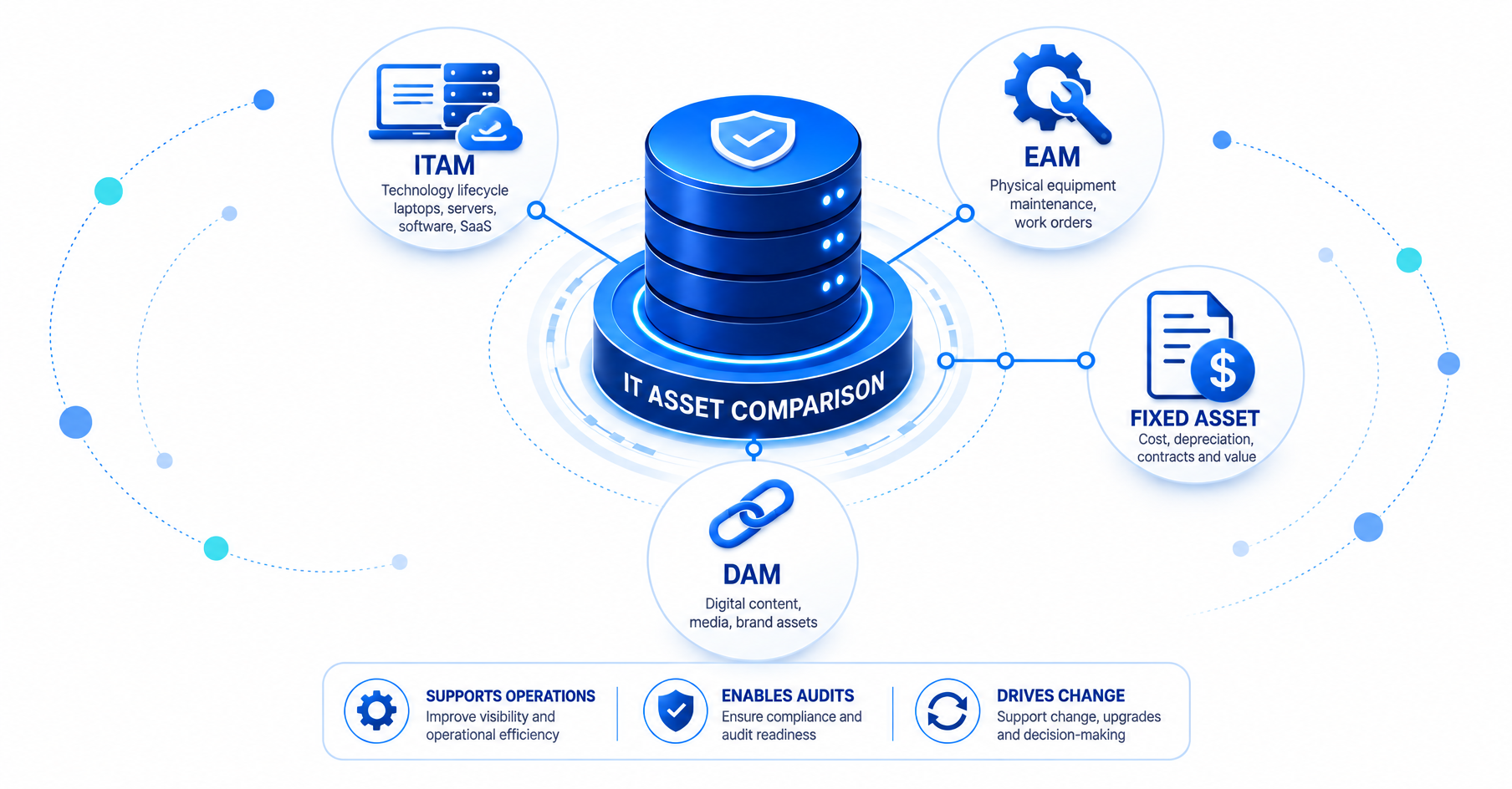
The difference between ITAM, EAM, DAM, and fixed asset management comes down to what each tracks: ITAM covers the technology lifecycle, EAM covers physical equipment, DAM covers digital content, and fixed asset management covers financial capitalization.
Many IT teams confuse these disciplines during tool selection. This guide defines each discipline by scope, asset types, owner, and lifecycle, then shows where they overlap and how IT leaders coordinate them.
What IT asset management covers
IT asset management tracks technology assets from request and procurement through deployment, support, optimization, and disposal. It covers laptops, servers, network devices, installed software, SaaS subscriptions, and cloud resources. It joins purchase records, discovery data, contracts, warranties, and license entitlements into one lifecycle view.
ITAM owners usually sit in IT operations, infrastructure, or service management. Their concerns include license compliance, audit readiness, hardware refresh planning, SaaS sprawl, and end of life exposure. Accurate ITAM depends on scheduled discovery that refreshes inventory, software installs, ownership, and relationships without manual spreadsheets. Those stakes are rising: Flexera’s 2025 State of ITAM report found 45% of organizations spent over $1 million on software audits in three years, with 23% topping $5 million in 2025.
Discovery-sourced inventory gives ITAM a defensible starting point for entitlement reconciliation. Software normalization standardizes publisher names and versions before compliance calculations begin. Contract and warranty tracking connects renewal dates to actual deployed assets. End of life tracking flags unsupported hardware and software before security exposure grows. When inventory is manually maintained instead of discovery-sourced, the gap doesn’t stay contained to IT — stale device and license records flow downstream into the fixed asset register, so finance ends up depreciating equipment IT already retired. For a closer look at closing compliance gaps before an audit lands, see Virima blog post on software license compliance and audit readiness.
For a closer look at establishing trusted runtime truth before audits, renewals, and refresh decisions, see Virima’s Trusted Runtime Truth overview.
What enterprise asset management covers
The ITAM vs EAM distinction starts with the asset type: enterprise asset management focuses on physical assets that support production, facilities, utilities, transportation, and field operations. It covers manufacturing equipment, HVAC systems, vehicles, medical devices, power systems, and building infrastructure. The discipline emphasizes work orders, preventive maintenance, reliability engineering, spare parts, downtime reduction, and worker safety.
EAM owners usually sit in operations, facilities, plant engineering, or field services. Their priorities include asset uptime, maintenance cost control, mean time between failures, regulatory inspections, and capital planning. EAM systems hold asset hierarchies, maintenance histories, meter readings, failure codes, permits, and technician assignments. The cost of getting this wrong is steep: a 2025 Fluke survey of manufacturers found 61% had experienced unplanned downtime in the past year, with industry-wide losses estimated at up to $852 million a week.
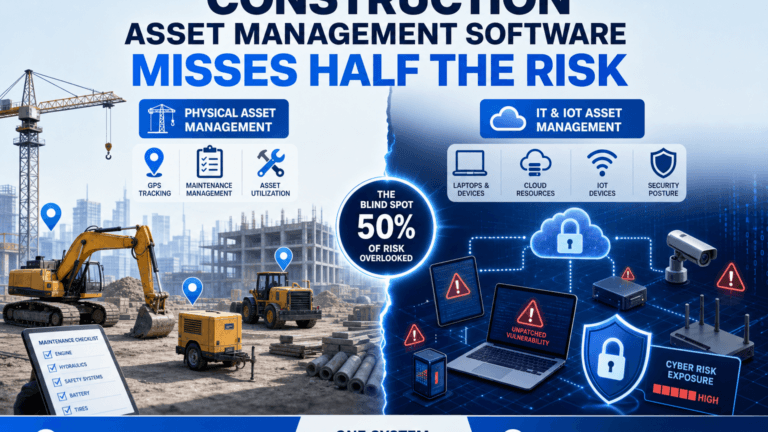
ITAM and EAM overlap where technology controls physical equipment. Networked sensors, industrial controllers, fleet telematics units, and connected medical devices have IT attributes and maintenance needs. IT teams track firmware, IP addresses, certificates, and patch status. Operations teams track calibration, inspection dates, failure history, and replacement parts.
Coordination works best when each system remains authoritative for its own attributes. ITAM stays authoritative for configuration, software, ownership, and license position. EAM stays authoritative for condition, maintenance history, work orders, and reliability metrics. A shared asset identifier, such as serial number or cloud instance ID, links both views without duplicating ownership.
What digital asset management covers
Digital asset management organizes rich media and branded content for search, reuse, rights control, and distribution. It covers product images, marketing video, design files, logos, documents, audio, and campaign creative. The platform provides version control, metadata tagging, usage rights, expiration dates, and channel-specific renditions.
DAM owners usually sit in marketing, creative operations, product content, or communications. Their priorities include faster content discovery, brand consistency, license compliance for stock and talent, regional approvals, and omnichannel publishing. DAM workflows include ingestion, tagging, review, approval, expiration, archival, and performance tracking.
DAM differs from ITAM because it manages the content itself rather than the devices or licenses used to create it. A video file in DAM may have a talent release expiring in six months. The editing workstation used to produce that video belongs in ITAM with its own warranty and software license. Both matter for audits, but different teams answer different questions.
IT teams support DAM through storage, access control, backup, and identity integration. Marketing teams own taxonomy, metadata quality, rights data, and lifecycle rules. Clear handoffs prevent lost files, expired usage rights, duplicate storage costs, and inconsistent brand presentation across channels.
What fixed asset management covers
Fixed asset management supports finance with capitalization, depreciation, valuation, impairment, transfers, and disposal accounting under standards such as GAAP or IFRS. It tracks assets that meet capitalization thresholds and appear on the balance sheet. Examples include buildings, capitalized IT hardware, machinery, vehicles, furniture, and leasehold improvements.
Fixed asset owners usually sit in finance, accounting, or controllership. Their priorities include accurate registers, policy-compliant capitalization, depreciation schedules, physical verification, tax reporting, and external audit support. The fixed asset register holds purchase cost, placed-in-service dates, useful life, depreciation method, net book value, location, and custodian — the data finance needs to calculate depreciation and confirm ownership. Registers rarely hold up to scrutiny: an April 2025 SFG20 survey of facilities professionals found only 9% considered their asset register 100% accurate, and 37% rated it 50% accurate or less.
ITAM feeds fixed asset management with verified deployment, location, custodian, and retirement data. Finance determines capitalization treatment, useful life, and depreciation calculations under applicable standards. Without this connection, finance may depreciate assets that IT retired months earlier. IT may also support devices that finance cannot locate during verification. A CMDB is not a fixed asset register — the CMDB tracks configuration and relationships, while the register tracks cost basis and depreciation.
Hostname alone cannot reconcile these systems because names change during reimaging and reassignment. Durable identifiers such as hardware serial numbers and cloud instance IDs provide stronger joins across IT and finance records. Scheduled discovery refreshes those identifiers, while defined retirement workflows remove disposed assets from both operational and financial views.
ITAM vs EAM vs DAM vs fixed asset management: comparison table
| Dimension | ITAM | EAM | DAM | Fixed Asset Management |
|---|---|---|---|---|
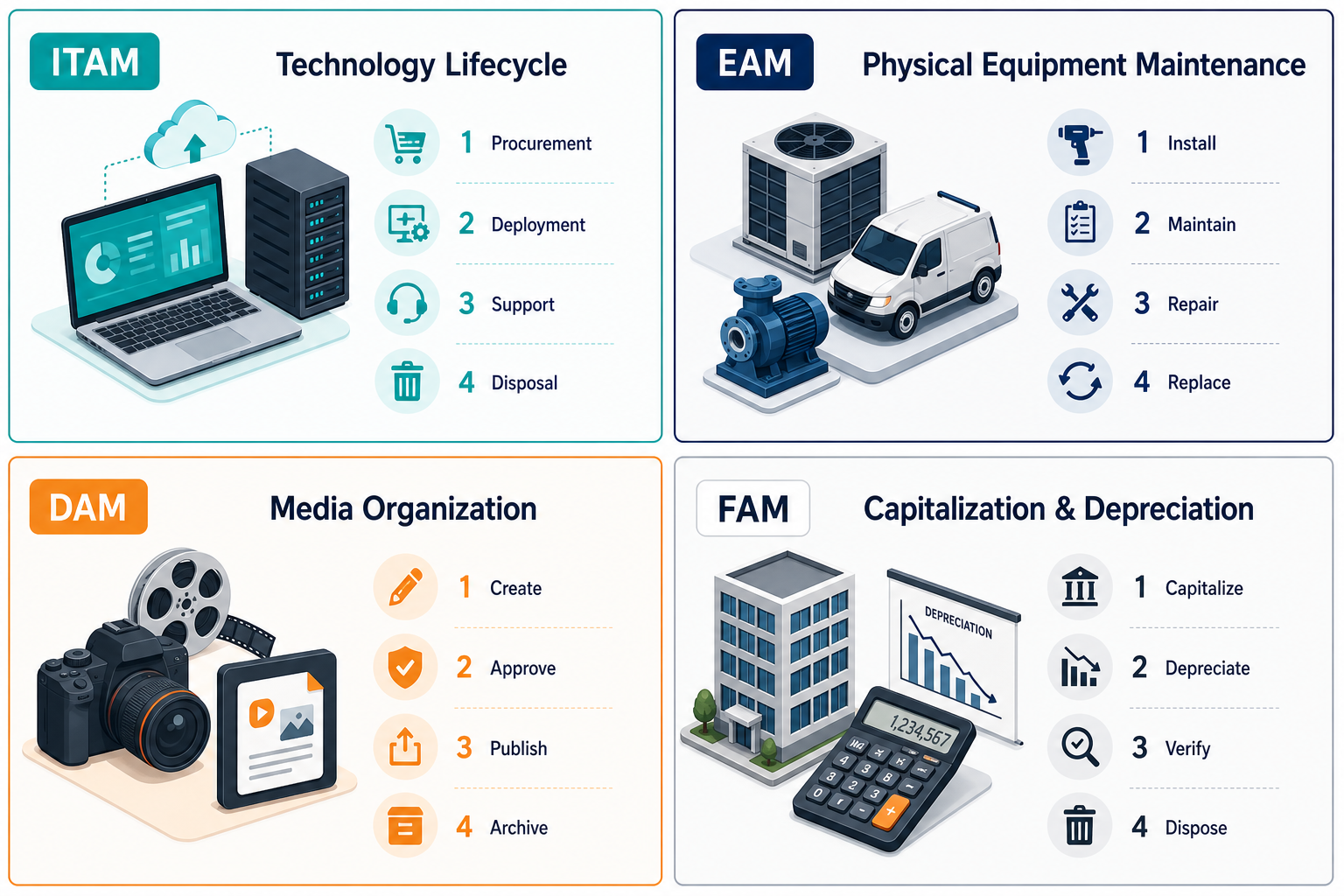
| Primary scope | Technology lifecycle and license compliance | Physical asset reliability and maintenance | Media organization and rights control | Capitalization and depreciation accuracy |
| Example assets | Laptops, servers, SaaS, cloud workloads | Pumps, HVAC, vehicles, production lines | Images, video, logos, campaign files | Buildings, capitalized equipment, vehicles |
| Typical owner | IT operations or ITAM manager | Plant, facilities, or field operations | Marketing or creative operations | Finance or controllership |
| Lifecycle focus | Procure, deploy, support, retire | Install, maintain, repair, replace | Create, approve, publish, archive | Capitalize, depreciate, verify, dispose |
| Success measure | Audit readiness and license optimization | Uptime and maintenance cost control | Reuse and rights compliance | Financial accuracy and audit support |
The table helps buyers assign ownership before purchasing tools: lifecycle questions belong in ITAM evaluations, maintenance and reliability requirements belong in EAM evaluations, media workflow requirements belong in DAM evaluations, and capitalization and depreciation requirements belong in finance-led fixed asset evaluations.
How the four disciplines work together
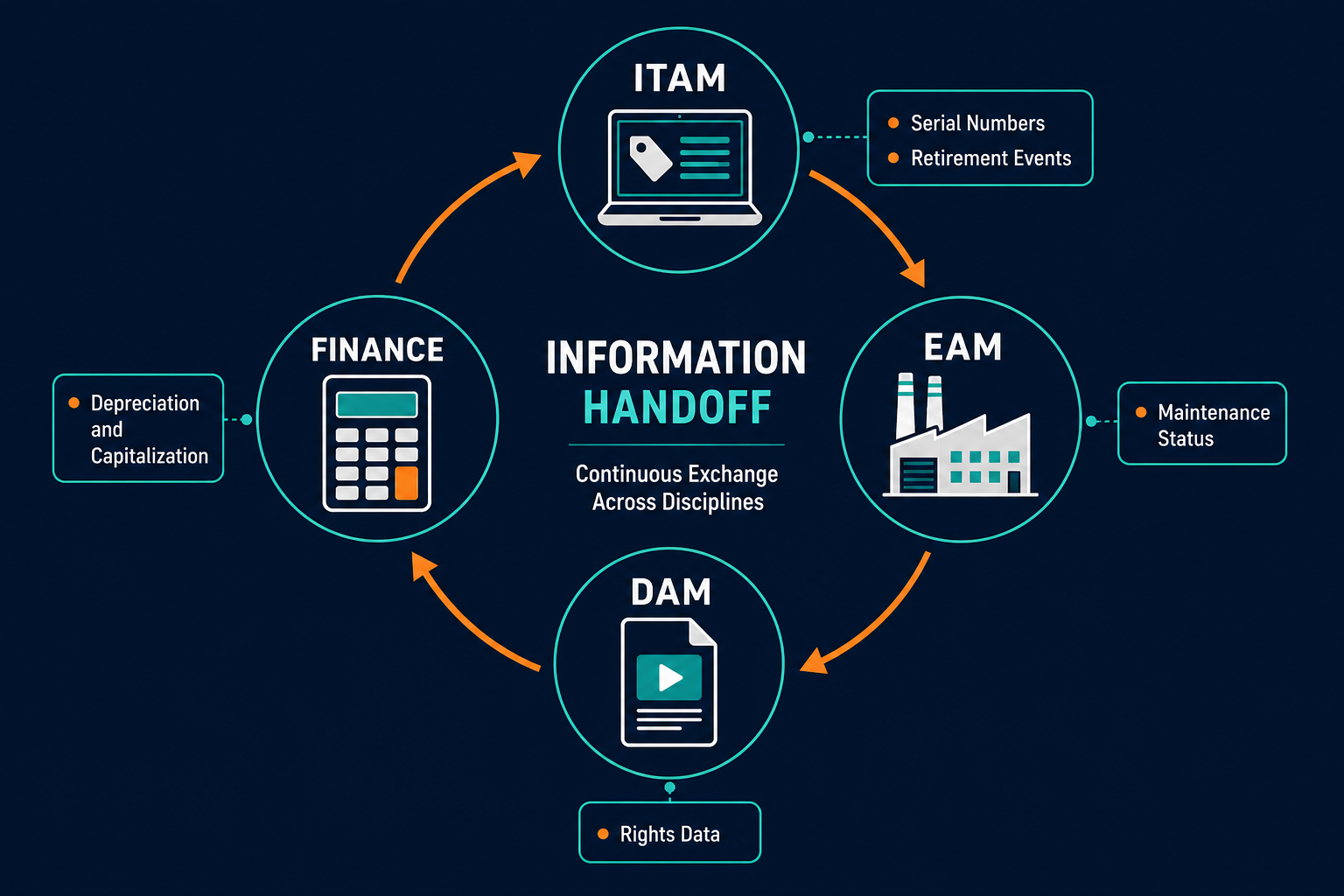
Most enterprises need all four disciplines operating with clear boundaries and defined handoffs.
The laptop handoff
A laptop illustrates the interaction across systems. ITAM tracks assignment, software installs, warranty coverage, and refresh eligibility. Finance capitalizes the device when policy thresholds are met and depreciates it over the assigned useful life. Marketing may store product photos created on that laptop in DAM, while facilities has no EAM role unless the device supports building systems.
The sensor handoff
A manufacturing sensor illustrates a closer IT and operations overlap. ITAM or discovery tracks connectivity, firmware, certificates, and patch status. EAM tracks calibration, inspection results, failure history, and spare parts. Finance tracks capitalization and depreciation when the sensor meets the financial threshold. Each team consumes shared identifiers while maintaining its own authoritative attributes.
Effective coordination depends on defined data ownership and scheduled reconciliation:
- IT provides verified inventory, ownership, location, and lifecycle status from discovery and procurement records.
- Operations provides condition, maintenance activity, downtime causes, and replacement forecasts.
- Marketing provides content metadata, rights status, and archival decisions.
- Finance provides capitalization rules, useful life, valuation, and disposal authorization.
Integration strategy should connect systems around these handoffs rather than merging them into one repository. ServiceNow and other ITSM platforms exchange asset and configuration data with discovery sources through established connectors. CMDB relationships add service context by showing which applications and business services depend on specific infrastructure. ViVID™ service maps show dependency paths once service definitions are supplied through manual input, spreadsheet import, or architecture sources. For more on connecting discovery data to service impact, see Virima blog post on CMDB and service dependency mapping.
Is fixed asset management the same as ITAM?
No, ITAM manages technology use, licenses, and lifecycle operations. Fixed asset management manages financial capitalization, depreciation, and balance sheet accuracy. ITAM data supports finance, but finance determines accounting treatment.
Choosing the right starting point
Start with the business problem that carries the greatest audit, cost, or downtime exposure:
- License audit pressure points toward ITAM cleanup, entitlement reconciliation, and software normalization.
- Unplanned downtime points toward EAM work order discipline, preventive maintenance, and spare parts availability.
- Content delays or rights violations point toward DAM taxonomy, approvals, and expiration controls.
- Audit adjustments or missing registers point toward fixed asset verification and retirement discipline.
IT organizations often begin with ITAM because technology estates change rapidly through procurement, cloud provisioning, SaaS adoption, and employee turnover. Scheduled discovery establishes what exists, what software is installed, who owns each asset, and how infrastructure supports business services. That foundation improves license decisions, refresh planning, vulnerability response, and change risk assessment. Teams tackling SaaS sprawl specifically can start with Best Software License Management Tools in 2026 (Reviewed & Ranked).
Public guidance from sources such as IBM’s ITAM overview describes ITAM as a lifecycle discipline spanning inventory, contracts, compliance, and financial optimization. Use that definition to align stakeholders before selecting tools.
Avoid selecting one platform to perform all four roles unless requirements clearly overlap. EAM maintenance depth, DAM creative workflows, and finance depreciation controls require specialized capabilities. ITAM platforms support finance and operations through accurate inventory, contracts, warranties, retirement records, and service context. Specialized systems then apply their own maintenance, creative, and accounting logic.
Bringing asset truth into daily IT decisions
Asset management delivers value when verified data supports procurement, support, change control, security response, and financial reporting. Stale spreadsheets create disputes over ownership, license position, warranty coverage, refresh timing, and audit evidence.
Teams also need service context around infrastructure changes. A server retirement affects applications, databases, integrations, support queues, and business services. Configuration data linked to service maps shows those dependencies before maintenance windows begin, so change teams can notify service owners, sequence work safely, and plan rollback actions with clearer impact understanding.
The four disciplines succeed together when IT supplies accurate technology truth, operations supplies reliability truth, marketing supplies content truth, and finance supplies valuation truth. Leadership should review handoffs at least once per quarter. Retirement backlogs, unmatched purchases, missing serial numbers, expired rights, and overdue verifications deserve explicit owners and completion dates.
Clarify ownership before your next audit or renewal
Understanding the difference between ITAM, EAM, DAM, and fixed asset management is the first step — including where the enterprise asset management vs IT asset management boundary sits, since physical and technology ownership blur there most often. Document which team owns each process across your organization. Define shared identifiers, reconciliation schedules, retirement handoffs, and audit evidence requirements. A short ownership matrix prevents duplicate tools, reduces audit findings, and improves renewal negotiations through verified deployment and entitlement data.
Frequently Asked Questions
What is ITAM in simple terms?
ITAM tracks technology assets across procurement, deployment, support, optimization, and retirement. It covers hardware, installed software, SaaS subscriptions, cloud resources, contracts, warranties, and license entitlements for audit and cost decisions.
What is the difference between EAM and ITAM?
EAM manages physical asset maintenance, reliability, work orders, and uptime for plants and facilities. ITAM manages technology lifecycle, software compliance, ownership, and refresh planning for IT estates.
What does DAM manage?
DAM manages images, video, design files, logos, and marketing content. It controls metadata, versions, approvals, usage rights, expiration dates, and distribution across publishing channels.
What is fixed asset management?
Fixed asset management tracks capitalization, depreciation, valuation, and disposal for assets that meet an organization’s capitalization threshold and appear on the balance sheet, such as buildings, capitalized IT hardware, machinery, and vehicles.
Does Virima provide IT asset discovery and ITAM data for ITSM workflows?
Virima provides scheduled agent-based and agentless discovery, IT asset lifecycle tracking, software inventory, contract visibility, and CMDB relationship data. ITSM teams use that data for change impact analysis, incident triage, and audit preparation.