
A case study: CMDB Jira integration reduced MTTR 34% via discovery-driven CI context

Most incident-resolution delays are not caused by slow fixes. They are caused by the minutes lost at the very start, before anyone can act, while responders work out which asset is involved, who owns it, and what it depends on. When the ticketing tool holds none of that context, every incident begins with the same manual hunt. This is the story of one organization that closed that gap, and what changed once it did.
For most of a year, one of our clients was stuck. Their incidents took about four and a half hours to resolve on average, and the number would not move. They rewrote playbooks, added escalation steps, and reviewed every major outage. None of it made a measurable difference.
Then, in the quarter that followed that long plateau, resolution time fell by roughly a third, from about four and a half hours to just over three. What surprised them most was that the fix had little to do with the process. The root cause was more basic: what their responders could see the moment a ticket opened, which was fixed when they integrated Jira with their CMDB.
The problem was concrete. When an incident landed in their Jira with no link to the affected asset, the team lost the opening stretch of every incident just working out what had broken. Across a busy week, that was their single biggest drain.
Before the integration of Jira with Virima, a ticket gave them a short description, a priority label, and the name of whoever reported it, but never the affected system, what it connected to, or who owned it. So nearly every incident started under-informed, not blank, but well short of what a responder needed to act.
Looking back over a few months of tickets, the pattern was clear. Before the integration existed, none of the tickets arrived with the affected asset attached, because that link simply was not there yet. On each one, the team spent close to 45 minutes answering a single question: what is actually broken?
On a high-priority incident, it was often the difference between wrapping up in an afternoon and working late into the night.
| When MTTR is stuck because tickets open without CI, owner, and dependency context, start with discovery-backed estate accuracy under the desk you already run. Explore Trusted Runtime Truth. |
What is a CMDB Jira integration for incident response?
A CMDB Jira integration attaches trusted configuration item, owner, and dependency context to Jira Service Management tickets so responders stop spending the open of every incident hunting for what broke. The ticket inherits live estate truth instead of a short description and a priority label alone.
The CMDB Data That Was Already There
The core issue was not missing data. It was disconnected data. Their CMDB held thousands of configuration items, from servers and databases to cloud instances, and most of them already carried an owner and a service link. The data was sitting right there. It just was not reaching the people working the ticket.
When they checked, the vast majority of their incidents involved assets that were already in the CMDB. Nothing was missing. There was simply no bridge between that record and the ticket in front of the responder.
How the CMDB Jira Integration Solved This
Virima’s Jira Service Management integration built that bridge. Once it was in place, opening a ticket meant the responder could see the affected asset, who owned it, what it connected to, and what had changed recently, all without leaving Jira.
That is the difference between a plain ticketing view and one backed by discovery-sourced CMDB intelligence. And it only holds up when the underlying data stays current on high-frequency scheduled discovery cycles rather than a one-time import.
Teams that try to force a CMDB without that discovery spine usually rebuild the same identification delay inside a cleaner database. Inventory without discovery authority decays under load for the same reason tickets open blind: the record looks complete until change and cloud churn outrun the last manual update.
What Changed for Responders
The Immediate Win: Far Less Time Spent Identifying the Problem
The first thing they noticed was how quickly the identification step shrank. What used to eat up the better part of an hour dropped to just a few minutes within the first month. That one change accounted for most of the overall improvement in resolution time.
The Second Win: Spotting Repeat Problems
The subtler win was pattern spotting. Incident history was always in Jira, but without a consistent way to tie tickets to the specific component behind them, that history was hard to act on. The same underlying component might be described five different ways across five tickets, so responders rarely connected incidents that were actually the same recurring problem.
They described a stretch where one component caused several separate incidents over half a year, each handled in isolation, each dragging on for hours, because nothing linked them to a shared root.
Once the asset was attached to every ticket, that changed. A new incident would surface the record, and a responder could immediately see the earlier incidents tied to the same component, with no guessing and no re-reading old descriptions hoping to spot a match. That is the practical payoff of a CI-to-ticket integration for proactive incident response. In one quarter it let them step in early on a couple of brewing issues that would otherwise have blown up into major incidents.
The 90-Day Numbers
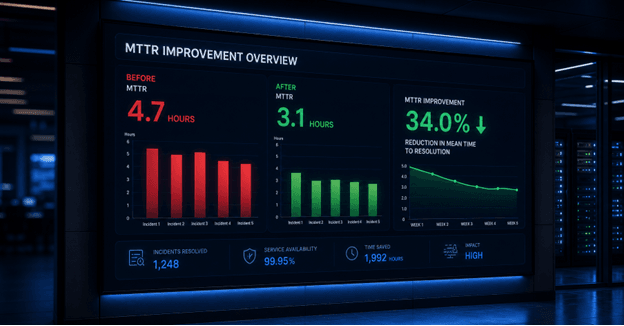
The handful of tickets that still lacked context were mostly third-party tools outside discovery scope at the time. They put that gap on the backlog.
Why the Financial Impact Matters
It is easy to underestimate what that lost time costs. So look at the numbers. New Relic’s 2025 Observability Forecast surveyed over 1,700 tech professionals across 23 countries. It found that a high-impact outage carries a median cost of about $2 million per hour, or roughly $33,000 for every minute systems stay down.
Of course, not every incident becomes an outage that big. Even so, the pattern holds at any size. Every minute a team spends hunting for what broke still costs money. And those minutes add up quietly across the year.
That is why the identification step matters more than it looks. In most incidents, it is the most expensive phase. It is also one of the easiest to improve: put the affected asset in front of the responder from the start.
The Discovery Layer That Made It Possible
None of this works if the data cannot be trusted. Connecting a ticket to an out-of-date CMDB does not solve the problem. It just moves it. Responders either second-guess what they see or act on something that is no longer true.
Auditing Before Connecting
Before integrating Jira with their CMDB, the client ran a cleanup. They found a large batch of assets with missing or outdated owners, and another set whose service links no longer matched how the business was actually organized.
Sorting that out took a few weeks. It was not exciting work, but it was the reason the integration delivered real results instead of adding noise. Ownership and service-link cleanup is the work worth finishing before the first ticket inherits a CI.
Why clean the CMDB before a Jira integration?
Tickets inherit whatever ownership and service links the CMDB already holds. If those fields are stale, responders get faster wrong context. Cleanup first, then connect, so CI attach improves identification instead of amplifying noise.
Why Sequence Matters
The order mattered more than they expected. First, they cleaned up the CMDB. Only then did they connect it to Jira. That sequence is exactly what made the improvement stick. For the broader pattern of inventory that looks complete until discovery authority is missing, see CMDB without discovery.
Connecting Discovery Data to Your CMDB
Virima keeps records current with a mix of methods. It runs agentless scanning and agent-based discovery across Windows, macOS, and Linux. It also covers public cloud with discovery for AWS and Azure. On top of that, high-frequency scheduled discovery cycles refresh the data on their own. As a result, what shows up in a ticket reflects the current state, not an old snapshot. Agent coverage for remote endpoints that rarely stay on the corporate subnet is part of that multi-method mix alongside agentless and cloud API paths.
Agentless methods still cover racks, network gear, and many servers where credentials and SNMP or WMI paths already exist. API discovery fills AWS and Azure instance and configuration gaps that neither agent path will see from inside the guest alone. Currency is the contract with responders. If the CMDB only refreshes when someone remembers to import a spreadsheet, Jira inherits last quarter’s owners and last month’s topology. Scheduled multi-method discovery is what makes CI attach worth trusting on a Monday morning major.
What ViVID™ Service Maps Added
The team did more than attach the affected asset to each ticket. They also inducted ViVID™ service maps into their incident response arsenal after service definitions were provided for the paths that mattered. During a major issue, a responder could open a live map of the affected service. That map showed what sat upstream, what was already showing trouble, and what had changed recently.
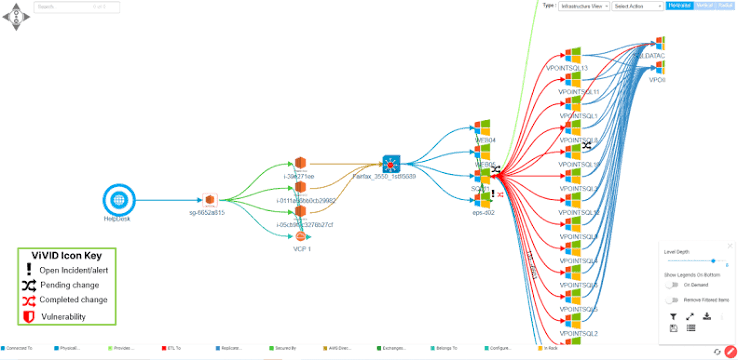
An illustration of a service dependency map displaying incident impact across infrastructure dependencies with connection health status and change indicators. Maps only help after the team names the business services that matter under load. Once those definitions exist, dependency edges and change markers stop living in tribal knowledge. For the capability pattern behind those maps, see service mapping after service definitions are in place for the paths you will pilot.
For a longer walkthrough of maps under Jira Service Management, use the companion service-mapping and ViVID™ JSM materials already published on virima.com when you need desk-specific rollout detail.
How do service maps cut MTTR beyond attaching the asset?
After service definitions exist, maps show upstream and downstream dependencies, open incidents on supporting configuration items, and recent change. Responders move from guessing the first broken node to containing blast radius before a second outage starts.
From Reactive Triage to Impact-Aware Response
The service map changed the questions a responder could ask, and the order they could ask them in. It starts by showing where to look. Open the map for the affected service, and the place to start is visible rather than guessed.
From there, the next question is whether anything is already broken. The map shows any open incident on a supporting CI, so a responder can see a failing dependency instead of hunting for it. Then comes what changed, because a recent change to a component is often the cause. And finally, the map answers what else could be affected, by either the incident or the change. That last view is what turns a fix into containment. The problem is often bigger than the first ticket suggests, or about to be.
That sequence is the shift from reactive triage to impact-aware response. The old way chased a failure that had already happened. This way surfaces the next one before it lands. On a few occasions, the map showed a service starting to slip while it was still running. The team acted early, and the second outage never came.
This is what current, reliable asset data does in daily work. It does not sit in a dashboard people admire once and forget. It sits inside the incident, so every response starts with the context already in hand.
Many teams still run incidents in Jira with far less than this. Each one pays the same slow start, incident after incident. The fix is not complicated. Clean up the CMDB first, the way this client did, then connect Jira to it under the system of engagement you already run. Virima does not replace Jira Service Management. It feeds discovery-sourced CMDB and map context into the tickets responders already use. Confirm current desk and cloud coverage on the integrations hub.
Does CMDB ticket context only work with Jira?
The pattern is desk-agnostic: attach trusted CI, owner, and dependency context to the ticket system of engagement. Virima integrates with Jira Service Management, ServiceNow, Ivanti, HaloITSM, Xurrent, Hornbill, and more under one integrations hub. It does not replace the ITSM desk.
If identification still eats the first hour of every major, turn this case sequence into a short pilot on one critical hybrid path: cleanup owners and service links, attach CI context in Jira, then induct maps for the services that fail most often.
Walk one of your own high-severity tickets with discovery-sourced CI context and ViVID™ maps under Jira Service Management. Leave with a clearer picture of how much identification time your team can still reclaim.
Your Next Incident Does Not Have to Start Blind
This organization spent a year chasing process improvements, adding escalation steps, rewriting playbooks, and reviewing outages, and nothing moved the needle. Then they realized the bottleneck was not complexity. It was visibility. The moment they connected Jira to their CMDB, incidents stopped starting in the dark. Responders saw the broken asset, who owned it, and what depended on it before they took their first action. That single change cut their resolution time by about 90 minutes per incident, roughly a 34% MTTR improvement in the quarter that followed.
Most teams are still doing what this organization did for that first year: responding to incidents with incomplete context. Every ticket starts the same way: someone hunting for what broke, and that hunt costs real money across a year of incidents.
The Jira CMDB integration is not a feature brochure line. It is the bridge between the asset data your team already has and the incident tickets your team already uses. And it costs far less to build than it costs to keep not building it.
Disclaimer: Outcomes in this case study reflect one client environment and timeline. Integration behavior, discovery scope, and ticket field mapping vary by estate. Confirm current capabilities and commercial terms in official documentation. New Relic figures are median high-impact outage costs from the public 2025 Observability Forecast press page linked above.
Frequently asked questions
What is a CMDB Jira integration and how does it help incidents?
A CMDB Jira integration connects your asset inventory to Jira Service Management so responders see the affected system, owner, and dependencies when a ticket opens. Instead of spending close to 45 minutes hunting for what broke, the team starts with CI context already attached. That is why the organization in this case study cut MTTR by about 34%.
How long does it take to set up a Jira CMDB integration?
Timelines depend on estate size, discovery credential readiness, and how clean ownership and service links already are. Many programs spend a few weeks on CMDB cleanup first, then configure a pre-built Jira Service Management integration without custom development. Full context on tickets often appears within about a month of a focused project, but your pilot should measure against your own ticket volume.
Do we need a perfect CMDB before integrating with Jira?
No, but you do need one your team trusts. Before connecting, clean up asset ownership and service links so responders can act on what they see. The case study organization did this cleanup first, and it is the reason their integration delivered results instead of adding confusion.
Can we use CMDB ticket context with systems other than Jira?
Yes. The pattern is the same on other ITSM desks: attach trusted CI context to the system of engagement. Virima integrates with Jira Service Management, ServiceNow, Ivanti, HaloITSM, Xurrent, Hornbill, and more. Check current platform coverage on the integrations hub. Virima does not replace your ITSM product.
What is the financial impact of a CMDB Jira integration?
New Relic’s 2025 Observability Forecast reports a median high-impact outage cost of about $2 million per hour, or roughly $33,000 per minute. The organization in this case study shaved about 90 minutes off each incident after CMDB context reached Jira. Across a year of incidents, identification time savings compound, and early containment can stop some issues from becoming major outages.