Asset Tracking vs. Asset Monitoring: What Is the Difference?

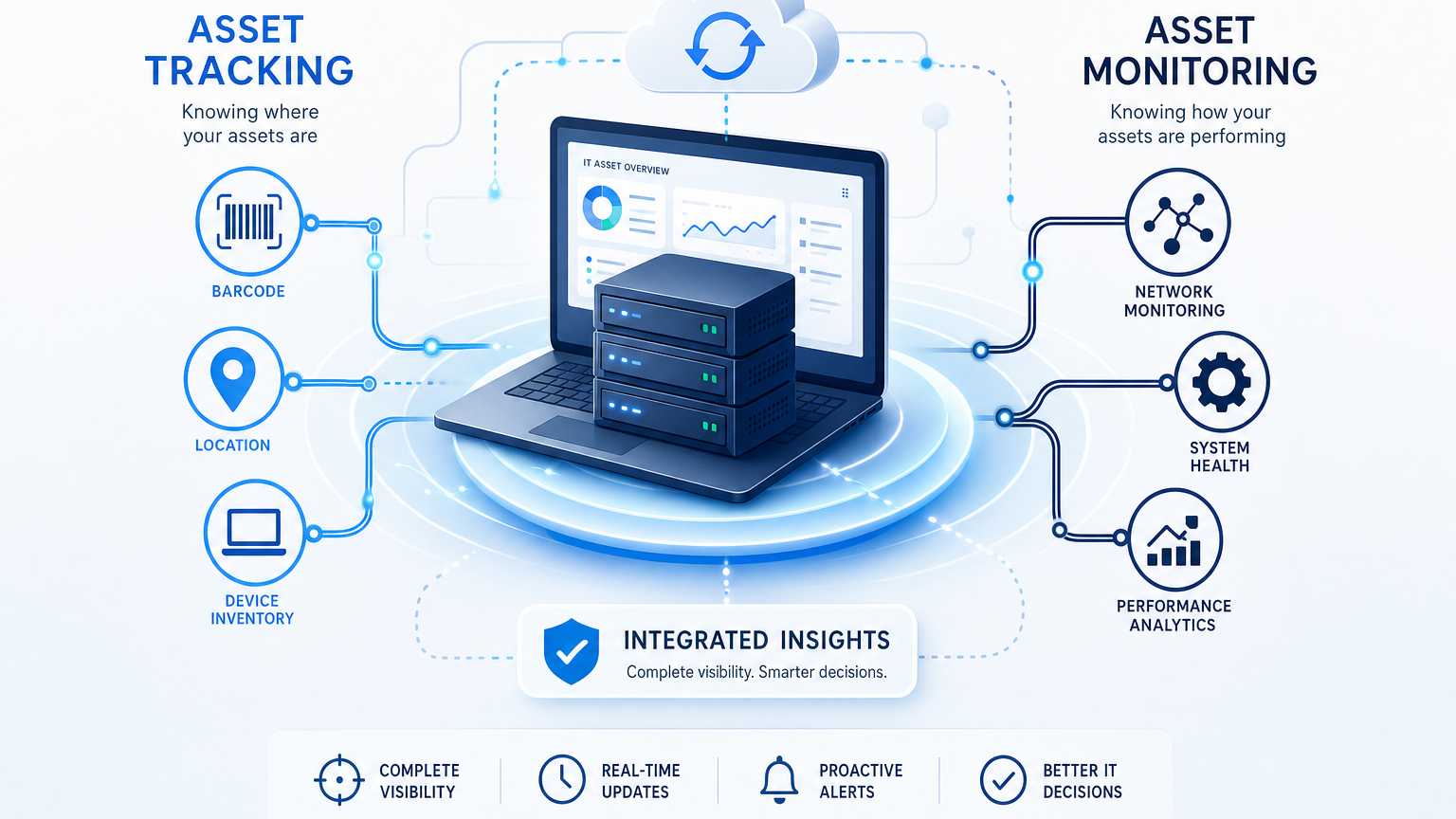
An asset tag shows a laptop checked out to an employee who left the company four months ago — but the device is still active on the VPN, running unpatched software nobody approved. That gap is what separates two disciplines IT teams often treat as one. The difference between asset tracking and asset monitoring: tracking records who owns an asset and where it is, updated at check-in or check-out; monitoring continuously verifies whether that asset is still healthy, compliant, and where it claims to be, updated on a scheduled discovery cycle. Conflating the two creates blind spots that lead to compliance fines and preventable downtime.
Administrative spreadsheets and barcode labels excel at logging hardware purchase dates, initial assignments, and depreciation schedules. However, physical hardware moves between facilities, virtual instances change IP addresses, and operating system packages update without notification. When tracking stops at static inventory records, operations teams struggle with unauthorized changes, missing equipment, and failed audits.
Modern IT operations need tracking and monitoring working together, not run as separate disciplines. Asset tracking provides the administrative foundation of ownership and financial accountability, while asset monitoring delivers ongoing operational visibility. Establishing trusted runtime truth across physical servers, cloud workloads, and distributed endpoints ensures engineering and security teams respond to configuration drift before minor discrepancies trigger operational downtime.
The difference between asset tracking and asset monitoring: definitions
To build a defensible hardware and software governance strategy, IT leaders must understand the distinct operational scope of tracking versus monitoring.
What asset tracking covers
Asset tracking is an administrative process focused on location, custody, lifecycle state, and ownership. When an enterprise purchases hardware, the asset manager records the serial number, assigns an internal asset tag, links the purchase order, and registers the employee custodian. This discipline answers questions regarding asset counts, physical building locations, warranty expiration dates, and financial depreciation.
What asset monitoring covers
Asset monitoring is an active operational discipline that measures health, performance metrics, network presence, and configuration changes over time. Rather than logging where a server should be, monitoring systems query the network to verify its actual state. They confirm the server is communicating on its assigned subnet, running authorized services, and operating within acceptable storage thresholds. Monitoring captures state deltas and triggers immediate alerts when an unauthorized configuration change occurs.
Organizations seeking to formalize baseline inventory controls often consult dedicated IT asset tracking methodologies before deploying dynamic telemetry.
What is the main difference between asset tracking and asset monitoring?
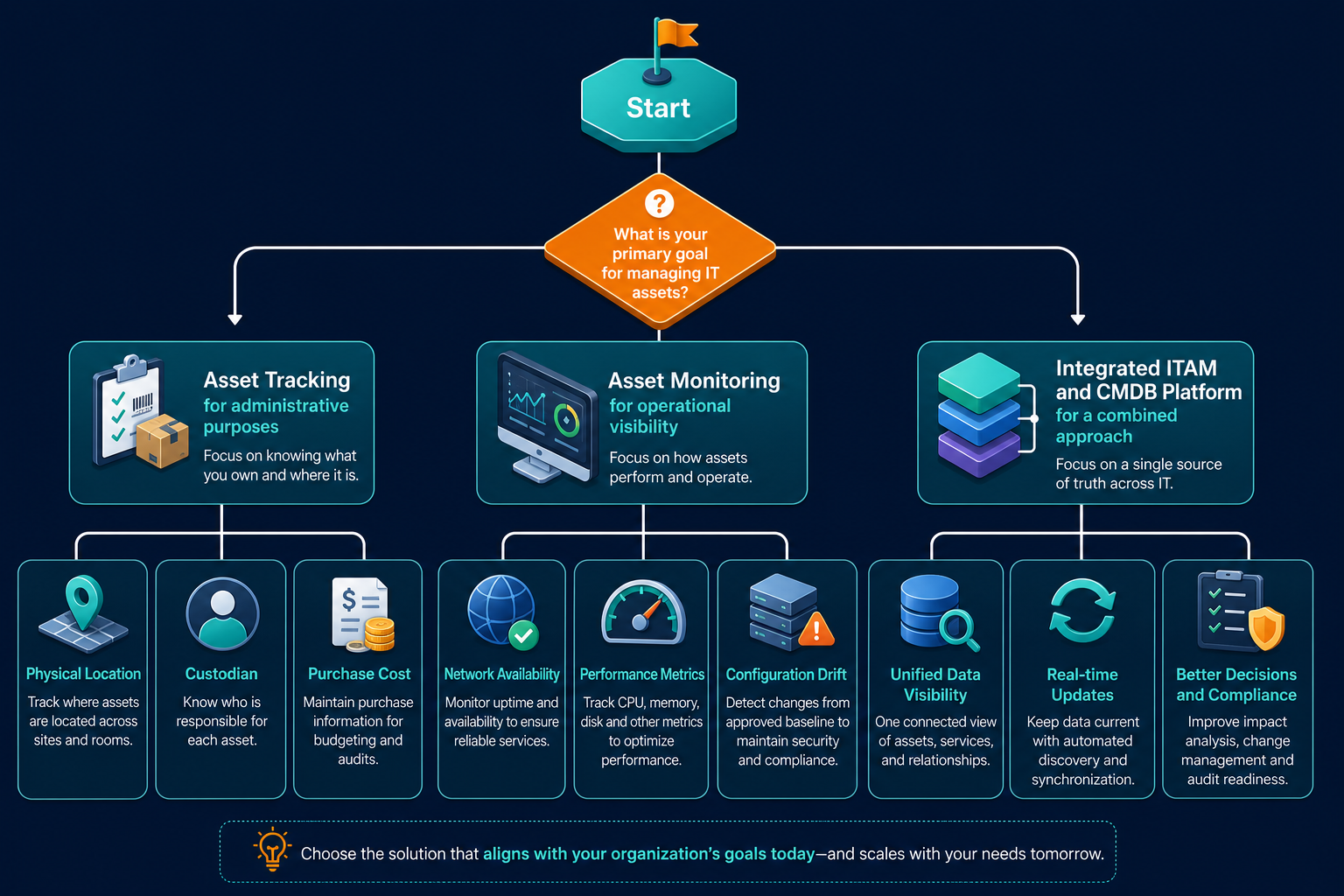
Asset tracking records administrative details like physical location, custodian assignment, purchase cost, and warranty status. Asset monitoring actively measures operational health, network availability, storage capacity, and configuration drift through scheduled automated discovery sweeps and event alerts.
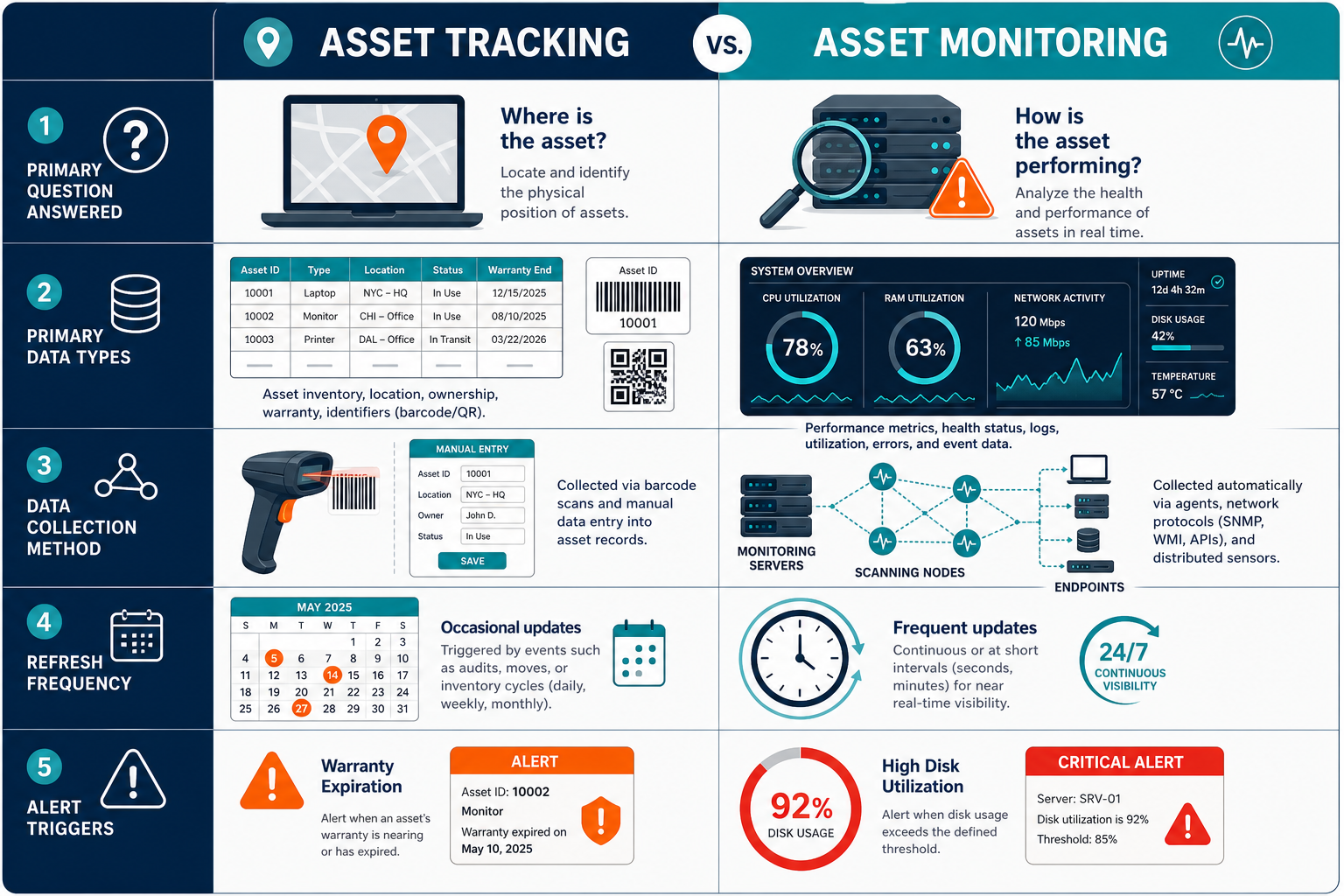
Side-by-side comparison table
While both disciplines track business equipment, their underlying mechanisms, data models, and update frequencies serve different organizational needs.
| Dimension | Asset Tracking | Asset Monitoring |
|---|---|---|
| Primary Question Answered | What do we own, who has it, and where is it located? | Is the asset operating correctly, and what changed? |
| Primary Data Types | Serial number, purchase date, cost, depreciation, custodian name, physical office | Last-seen timestamp, CPU and RAM load, disk capacity, open ports, software build versions |
| Data Collection Method | Barcode scans, RFID readers, purchase order imports, manual spreadsheet entry | Agentless network scanning (SNMP, WMI, SSH), endpoint agents, cloud provider APIs |
| Refresh Frequency | Event-driven (check-in, check-out, office moves, periodic annual audits) | Scheduled discovery cycles (hourly, daily, or polling intervals) |
| Alert Triggers | Warranty expiration approaching, lease termination date, missing audit scan | High disk utilization, unauthorized software installation, unexpected open port, offline status |
| Primary Stakeholders | Procurement managers, financial accountants, IT asset managers, compliance officers | Systems administrators, network engineers, security operations (SecOps), SREs |
| Core Governance Objective | Financial accuracy, software license entitlement, physical loss prevention | Service availability, security posture enforcement, configuration drift mitigation |
Physical assets vs. IT assets: how the distinction shifts
The operational line between tracking and monitoring varies significantly depending on whether you manage physical equipment or digital IT infrastructure.
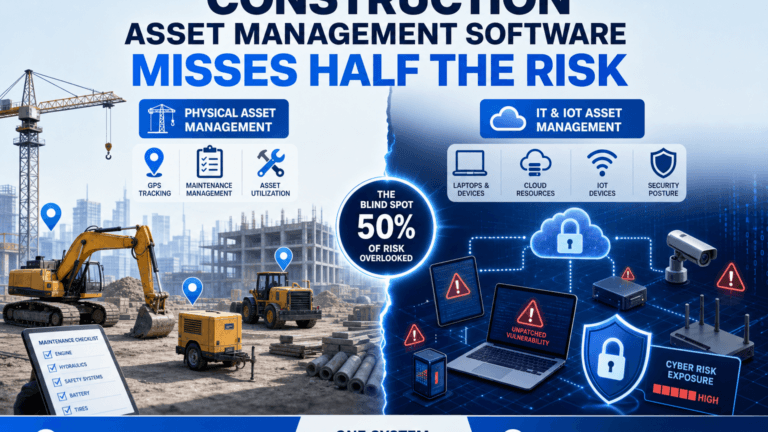
Physical and industrial asset operations
For heavy equipment, shipping containers, and vehicle fleets, asset tracking relies on passive tools like barcode labels, QR codes, and passive RFID tags. A warehouse technician scans a pallet when it enters a storage depot and scans it again when loaded onto a freight carrier. Between scans, the tracking record shows the asset at its last scanned location, regardless of whether it has physically moved since.
Physical asset monitoring introduces telemetry through battery-powered IoT sensors, GPS receivers, and cellular transmitters. Instead of waiting for a manual barcode scan, monitoring systems continuously report geographic coordinates, ambient temperature, vibration levels, and engine runtime hours. If a refrigerated container experiences temperature fluctuations that spoil pharmaceuticals, the monitoring system triggers immediate alerts before cargo is ruined.
Enterprise IT infrastructure operations
In enterprise IT environments, the boundary between tracking and monitoring is defined by network connectivity and software configuration states.
IT asset tracking logs which employee received a specific laptop, which departmental cost center funded the purchase, and when the hardware warranty expires. It maintains the commercial record in an IT asset management system. However, tracking alone cannot confirm whether the laptop’s hard drive is encrypted or if unauthorized applications are running.
IT asset monitoring queries the live state of that laptop during scheduled cycles. It captures when the operating system last contacted corporate identity servers, whether security patches are up to date, and if unapproved administrative accounts have been created. On data center servers, monitoring inspects open listening ports and CPU consumption, routing operational anomalies into the central CMDB. Configuration drift compounds daily between discovery cycles, which is why monitoring cadence matters as much as monitoring coverage.
NIST SP 1800-5 IT Asset Management makes the same distinction: static hardware registers must be validated against automated telemetry to maintain organizational cybersecurity posture (NIST SP 1800-5).
How often should IT assets be scanned for monitoring?
Most IT teams run agentless network discovery daily and poll high-risk assets like internet-facing servers hourly, while asset tracking updates only at discrete events like a check-out, office move, or annual audit. Monitoring cadence should match the asset’s risk level, not a single fixed schedule across the environment.
When you need tracking vs. when you need monitoring
Knowing when to apply tracking, monitoring, or both depends on the specific operational challenge your team faces.
When asset tracking is sufficient
- Office furniture, server racks, docking stations, monitors, and specialized hand tools have no network interfaces or operating systems — asset tracking software, barcode tags, and periodic physical audits are sufficient for this category.
- Financial auditors require proof of purchase, depreciation schedules, and asset retirement certificates. Tracking systems provide these auditable paper trails for fixed asset accounting and tax depreciation.
- Managing laptop refresh cycles every three years requires tracking purchase dates and warranty terms rather than live CPU cycles.
When asset monitoring is essential
- Monitoring storage capacity, memory exhaustion, and server responsiveness prevents sudden application crashes that disrupt customer transactions.
- When an engineer installs an unauthorized database server on an unapproved port, asset monitoring detects the anomaly and triggers an alert to security operations. That detection gap only widens as shadow SaaS grows faster than manual tracking can follow.
- Regulatory frameworks like ISO 27001, SOC 2, and DORA require verification that systems maintain approved security configurations across their operating lifecycles.
The Flexera State of ITAM Report found that organizations relying solely on static tracking tools see higher visibility gaps and more software licensing penalties (Flexera State of ITAM Report). Teams that use configuration drift detection to reconcile tracking records with automated discovery telemetry avoid both.
How Virima automated discovery unifies tracking and monitoring
Where disconnected tracking and monitoring break down
Operating tracking and monitoring in separate, disconnected silos creates friction between procurement managers and infrastructure engineers. Procurement manages spreadsheets that become outdated within weeks, while engineering runs monitoring tools that lack cost center context.
A unified discovery pipeline
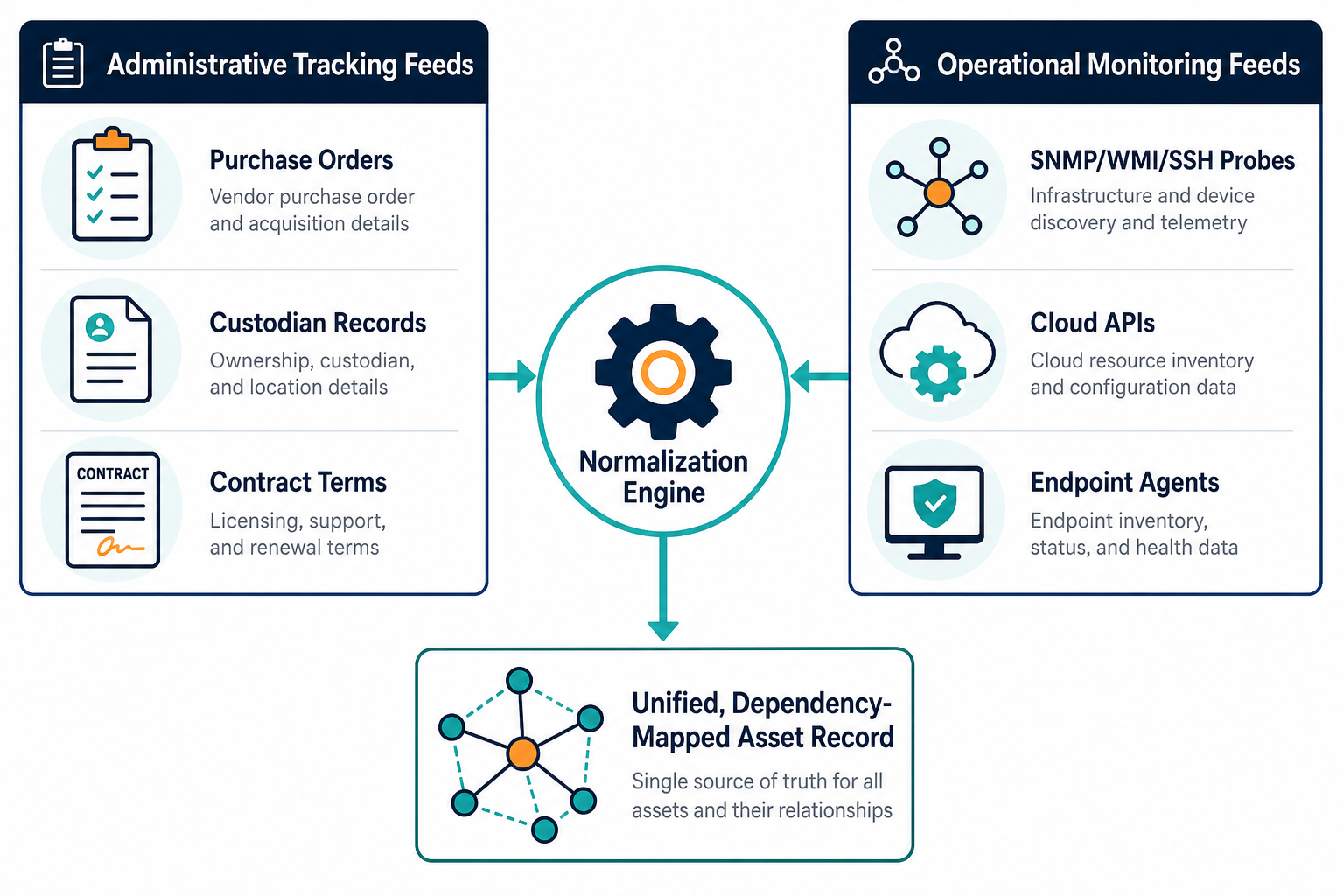
Virima bridges this gap through scheduled IT discovery. By combining agentless network scanning across enterprise subnets with lightweight discovery agents on remote laptops, Virima captures both administrative attributes and live operational metrics. The platform automatically reconciles discovered hardware against purchase registers, mapping operating systems, software packages, listening ports, and service dependencies. When an endpoint drifts from its golden image or stops communicating, Virima triggers automated alerts, logging actionable tickets directly into your ITSM platform.
Does asset monitoring replace the CMDB?
No. Asset monitoring feeds the CMDB with live operational state — it does not replace it. The CMDB remains the system of record for ownership, relationships, and lifecycle data; monitoring keeps that record from going stale by reconciling it against what is actually running.
Eliminate the gap between what you own and what is running. Schedule automated discovery to unite asset tracking with operational monitoring across your hybrid estate.
Closing: bridging the gap between inventory and operational health
Why neither discipline works alone
Relying solely on asset tracking leaves engineering teams blind to critical configuration changes, unpatched vulnerabilities, and impending hardware failures. Conversely, running asset monitoring without tracking creates operational telemetry that lacks financial ownership, contract boundaries, and business context.
Building the continuous feedback loop
Organizations that reconcile tracking and monitoring data into a single CMDB close the gap between what they own and what is actually running: monitoring supplies the live state, while tracking supplies the ownership and financial context neither discipline can produce alone. By combining scheduled discovery sweeps, automated baseline reconciliation, and intelligent drift alerts, IT leaders maintain control over their hybrid assets from procurement to decommissioning.
Ready to see how automated discovery resolves the difference between asset tracking and asset monitoring across your hybrid infrastructure? Schedule a demo with Virima to explore full visibility today.
Frequently Asked Questions
Do IT teams need both asset tracking and asset monitoring?
Yes. IT asset tracking governs procurement, vendor warranties, financial depreciation, and custodian assignments. Asset monitoring tracks system availability, configuration drift, storage capacity, and security patch states to maintain operational reliability.
Is automated discovery considered asset monitoring?
Yes. Automated network and cloud discovery operates as a foundational form of asset monitoring. It scans subnets on scheduled cycles, detects newly connected hardware, inspects running services, and flags configuration discrepancies against approved baselines.
Can barcode scanners perform asset monitoring?
No. Barcode scanners are point-in-time tracking tools used during manual physical audits or inventory check-ins. They cannot capture operational health, measure CPU loads, or detect unauthorized software configuration changes.
What alerts matter most for IT assets?
Critical IT asset alerts include last-seen offline thresholds, storage volume capacity ceilings, unauthorized open listening ports, unexpected administrative privilege grants, and unapproved software installations violating corporate security baselines.
Does Virima combine asset tracking and asset monitoring in one platform?
Yes. Virima unifies procurement and custodian records with agentless, agent-based, and API-based discovery, reconciling administrative ownership data against live operational state in a single CMDB.