Strengthening Vulnerability Response with Virima and Jira Service Management

Most organizations know they have vulnerabilities. The harder problem is closing them fast enough to matter. IBM’s Cost of a Data Breach Report 2024 found that the average breach lifecycle spans 258 days, at an average total cost of $4.88 million USD. That gap shrinks only when security teams have accurate asset data, live service context, and direct integration between discovery and ticketing workflows.
| What Does Effective Vulnerability Response Require? Effective vulnerability response depends on three inputs: knowing what assets exist, understanding which business services they support, and prioritizing remediation by business impact rather than CVSS score alone. Without discovery-sourced asset data connected to your ITSM platform, teams fix the wrong things first and miss the exposures that matter most. |
How Asset Visibility Builds the Foundation for Vulnerability Response
Security teams can only protect what they can see. Every untracked asset is a potential blind spot. Virima’s IT Discovery scans hybrid environments using agentless, agent-based, and API-based methods. The result is an accurate inventory of every configuration item across on-premises and cloud infrastructure.
That inventory feeds directly into Service Mapping. Service Mapping shows not just what assets exist but how they connect, which business services they support, and what breaks when an attacker targets one. That dependency context separates targeted vulnerability response from a flat, unordered patching queue.
A Complete View of the IT Ecosystem
Virima Service Mapping generates visual representations of IT infrastructure, application dependencies, and business services. For security teams, this visibility does two things. It identifies the stakeholders accountable for each asset. It removes guesswork when a service disruption needs tracing.
When a new vulnerability surfaces, teams immediately see which assets are in scope and which business processes sit downstream. That context shortens triage time and focuses remediation effort on the assets where blast radius is largest.
Discovery-Sourced Prioritization for Remediation
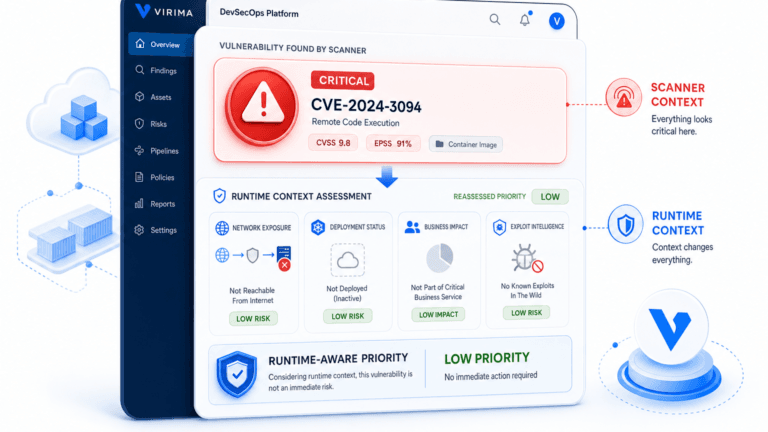
Service Mapping, combined with Virima Discovery and the NIST NVD look-up, aligns vulnerability management with operational context. Virima sets remediation order by asset criticality and service impact, not CVSS severity alone.
A medium-severity CVE on a payment processing server outranks a critical finding on a decommissioned test machine. The system connects reported vulnerabilities to the actual business processes they threaten, giving security teams a prioritization logic that holds up in review.
CMDB Accuracy as the Vulnerability Response Backbone
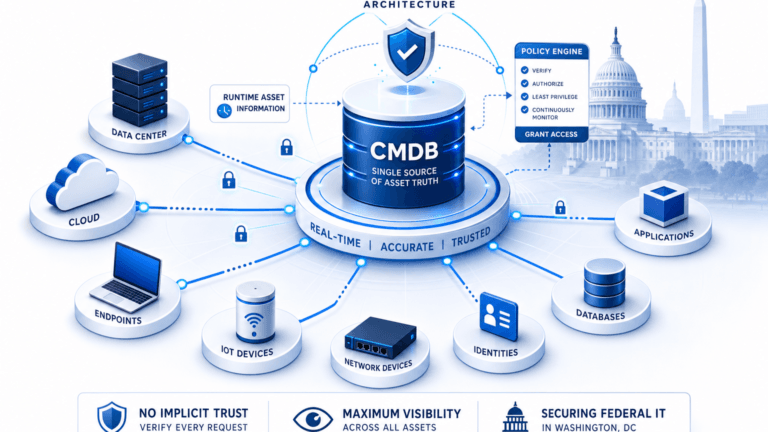
CMDB accuracy is the difference between a vulnerability response plan that works and one that misses half the attack surface. Virima Service Mapping builds dependency maps directly from discovery data. There is no reliance on manual input, so the maps stay current as the environment changes.
A clear dependency map tells IT teams which resources support critical services and what the impact is when attackers exploit a vulnerability on any one of them. Dynamic CMDB visualizations make those relationships fast to navigate and act on.
Rapid Vulnerability Identification with ViVID™ Service Maps
ViVID™ service maps are the interface layer that turns Virima’s discovery and mapping data into a real-time decision tool. They overlay vulnerabilities, incidents, changes, and event alerts directly onto service maps. Security and IT operations teams get one visual to triage and prioritize, rather than working across disconnected systems.
| ViVID™ and Vulnerability Response: The Visual Layer ViVID™ overlays vulnerabilities from the NIST National Vulnerability Database onto live service maps, highlighting at-risk assets within the context of their business service dependencies. Security teams see not just which CVEs are present but which ones sit on operationally critical services, making remediation prioritization faster and better-informed. |
See how Virima builds discovery-sourced Trusted Runtime Truth at virima.com/trusted-runtime-truth.
From Service Maps to Actionable Overlays
ViVID™ service maps incorporate ITSM incidents, changes, event management alerts, and vulnerabilities, all layered onto the same map used for change and incident work. IT operations, cybersecurity asset management, and DevOps teams work from one shared view rather than separate toolsets.
Once Virima Discovery, Service Mapping, and your ITSM platform connect, identifying critical dependencies becomes straightforward. Teams can see the full scope of impact, every asset at risk, and who owns each component, all in one place.
Change Management with Blast Radius Awareness
Every proposed change carries risk. Before approving a modification to critical infrastructure, ViVID™ overlays show exactly which services and stakeholders fall within the blast radius.
Integrated with Jira Service Management, this visibility ensures incidents, changes, and service requests get handled with full knowledge of downstream impact. Faster restoration, lower productivity impact, and better-informed sign-offs follow.
No-Code Integrations That Power ViVID™
ViVID™’s effectiveness comes from data breadth. Its no-code integration with Jira Service Management, Ivanti, and ServiceNow brings live operational data into every overlay:
- Change and incident records from your ITSM platform, enriching the overlay with real-time work context.
- Alerts from event and monitoring tools, adding environmental health signals to the visual map.
- Cross-references to the NIST National Vulnerability Database (NVD), so teams set remediation priorities with CVE context attached.
- Flexible APIs for additional data sets, centralizing information flow for faster decisions.
Incident Response and Vulnerability Assessment via Jira
The integration with Jira Service Management brings precision to incident response. ViVID™’s layered alerts and recent change data let teams pinpoint root causes rather than guess at them. MTTR drops when root cause analysis takes minutes instead of hours.
Jira’s prioritization workflows, combined with ViVID™’s NVD data, let security teams rank vulnerabilities by the actual exposure they create. Remediation strategies draw from live context, not static spreadsheets.
Proactive Event Management to Prevent Service Disruptions
ViVID™ displays system monitoring alerts as overlays on service maps. Teams spot potential problems before they escalate into disruptions. The Jira integration lets teams assess every alert against its potential business service impact using asset Service Value Ratings (SVR).
Teams manage incidents inside the same Jira workflows they already use. There is no context switch, and no information lost in translation between monitoring and remediation.
Risk Prioritization with NIST NVD Integration
A vulnerability list sorted by CVSS score is only the starting point. The harder question is which of those vulnerabilities sits on an asset that supports a business-critical service. Virima answers that question automatically.
Turning Severity Scores into Prioritized Remediation Queues
Virima correlates every discovered asset against the NIST National Vulnerability Database continuously. Each CVE maps to the specific configuration item it affects. Security teams work from an impact-ranked queue, not a raw severity list.
This approach ensures the team patches the right assets first. A medium-severity finding on a core financial system takes priority over a critical score on an isolated lab machine.
| NIST NVD Integration and Vulnerability Prioritization: Virima’s automatic correlation of discovered assets against the NIST NVD links each CVE to the actual CI it affects. This turns a flat vulnerability list into an impact-ranked queue where remediation order reflects business risk, not CVSS score alone. Security teams address the right vulnerabilities first, cutting exposure time on the assets that matter most. |
A Trustworthy CMDB as the Backbone of Vulnerability Response
A Configuration Management Database is only as useful as it is accurate. Stale CI data produces blind spots, and blind spots mean unpatched assets. The gap between what the CMDB says and what is actually running in the environment is where vulnerabilities hide.
Discovery-Driven Updates, Without Manual Effort
Integrating Virima with Jira Service Management keeps CMDB management accurate through automated updates from Virima Discovery. Configurations, relationships, and ownership records reflect the current state of the environment. No manual reconciliation cycles, no data entry backlogs.
Virima’s IT Operations Management layer ties discovery, CMDB, service maps, and ITSM integrations together into one operational view. Teams respond to vulnerabilities without switching between disconnected tools, and every action draws from the same trusted data.
| CMDB Accuracy and Vulnerability Response Outcomes: When a CMDB gets its data from automated discovery rather than manual updates, it stays current. Security teams working from an accurate CMDB find the right assets, understand their relationships, and prioritize remediation correctly. The difference between an accurate and a stale CMDB often determines whether a patch cycle takes 48 hours or 48 days. |
Building a Stronger Security Posture with Virima and Jira Service Management
Why Every Component in the Integration Matters
Every component in the Virima and Jira Service Management integration plays a defined role. IT Discovery keeps the asset inventory current. Service Mapping connects assets to business services. ViVID™ service maps surface risk visually. NIST NVD integration adds CVE context. An accurate CMDB ties it all together.
Together, these capabilities shorten the distance between vulnerability detection and confirmed remediation. They do it by grounding every action in accurate, discovery-sourced data rather than assumptions.
The Cost of a Slow Vulnerability Response
IBM’s Cost of a Data Breach Report 2024 found that the average breach lifecycle spans 258 days. Closing that gap starts with knowing what is in your environment, who owns it, and which services a vulnerable asset supports.
See how discovery-sourced asset intelligence accelerates vulnerability response. Request a demo at virima.com.
| The Fastest Path to Better Vulnerability Response: Connect your discovery data to your ITSM platform and the NIST NVD, then layer service dependency context on top. Organizations that do this reduce MTTR, prioritize patches by business impact, and shrink the window between detection and confirmed remediation. Accurate asset data, not more scanning tools, is the limiting factor. |
Frequently Asked Questions About Vulnerability Response
What is vulnerability response in IT security?
Vulnerability response is the process of identifying, assessing, and remediating security weaknesses before attackers exploit them. It spans asset discovery, vulnerability correlation, risk prioritization, ticket creation, patch deployment, and verification. The process runs across security, operations, and ITSM teams working from shared data.
Why do organizations struggle with vulnerability response at scale?
The most common reason is an incomplete or stale asset inventory. Without an accurate CMDB, security teams cannot reliably determine which assets have exposure, which services face risk, or which vulnerabilities to fix first. Poor visibility turns response into guesswork, and guesswork leads to missed exposures.
How does service mapping improve vulnerability response?
Service mapping adds business context to every vulnerability. Instead of treating every exposed asset the same, teams see that a CVE on a payment processing server demands immediate action while the same CVE on a development machine can wait. That context makes remediation decisions defensible, not just reactive.
How does Virima integrate with Jira Service Management for vulnerability response?
Virima’s no-code integration feeds discovery data, ViVID™ service maps, and NIST NVD correlations directly into Jira workflows. Security teams get asset-level context inside their existing ticketing system. ViVID™ overlays surface affected services visually, and the integration creates remediation tickets with full dependency context already attached.
What role does the NIST National Vulnerability Database play in Virima’s workflow?
Virima correlates every discovered asset against the NIST NVD, mapping known CVEs to the specific CIs they affect. This converts the NVD from a reference database into an active prioritization tool. The integration weights vulnerability severity against asset criticality and business service impact, so the remediation queue reflects real business risk.