How Much Does Asset Management Software Cost? A 2026 Guide

Vendor quotes for how much does asset management software cost rarely survive contact with the invoice. Implementation fees, API limits, and tier upgrades show up only after signing, because vendors gate automated discovery and API sync behind add-on tiers. Entry-level trackers run $10 to $100 a month, discovery-led IT asset management (ITAM) platforms start near $15,000 a year, and enterprise CMDB suites can exceed $100,000 annually depending on asset count and licensing model.
Virima Business Pro starts at $4,740 annually for 2,000 assets, covering multi-source agentless discovery and CMDB governance. Enterprise deployments that add dependency mapping and full CSDM alignment land at the top of that $15,000-to-$100,000+ range.
Understanding license models, implementation overhead, and ongoing data hygiene costs helps IT teams secure executive buy-in while avoiding expensive renewal surprises. Establishing trusted runtime truth across physical, cloud, and virtual environments ensures every dollar spent on asset software protects operations.
Industry price bands table by software class
Software pricing corresponds directly to architectural depth, automation capabilities, and the scope of data collected across your estate. Platforms with deeper CMDB and discovery automation command higher per-asset pricing because they do structural work no simple tracker attempts.
| Software Class | Target Asset Scale | Typical Annual Cost Range | Primary Pricing Unit | Standard Capabilities Included | Typical Overage and Add-On Costs |
|---|---|---|---|---|---|
| Spreadsheet & Open Source | Under 500 assets | $0 in software licensing (Labor intensive) | Internal labor only | Manual hardware logging, basic check-in and check-out logs | Self-hosting servers, manual data entry labor, external audit true-ups |
| Point Solution Trackers | 100 to 1,000 assets | $1,200 to $6,000 per year | Per admin seat ($15 to $50/mo) or asset packs | Barcode scanning, mobile check-in, warranty logging, vendor assignment | Custom field fees, historical audit logging, advanced reporting packs |
| Mid-Market ITAM Suites | 1,000 to 5,000 assets | $6,000 to $25,000 per year | Per asset ($2 to $8/yr) or per technician seat | Agent-based inventory, software license tracking, contract renewals | Network discovery probes, cloud connectors, additional technician seats |
| Discovery-Led ITAM & CMDB | 2,000 to 10,000+ assets | $15,000 to $65,000 per year | Tiered platform asset bands | Multi-source agentless discovery, hardware normalization, service context | Large estate asset overages, custom connector development, premium SLA |
| Enterprise ITOM & Service Suites | 10,000+ hybrid assets | $75,000 to $250,000+ per year | Annual enterprise contracts with module pricing | Global CMDB, full CSDM alignment, automated change impact, SecOps feeds | Mandatory professional services, API volume meters, multi-tenant instances |
For organizations evaluating mid-market options, reviewing the top budget-friendly ITAM software for enterprises clarifies how commercial features align with organizational requirements. Growing organizations evaluating whether asset inventory software alone is enough often start here before layering in discovery.
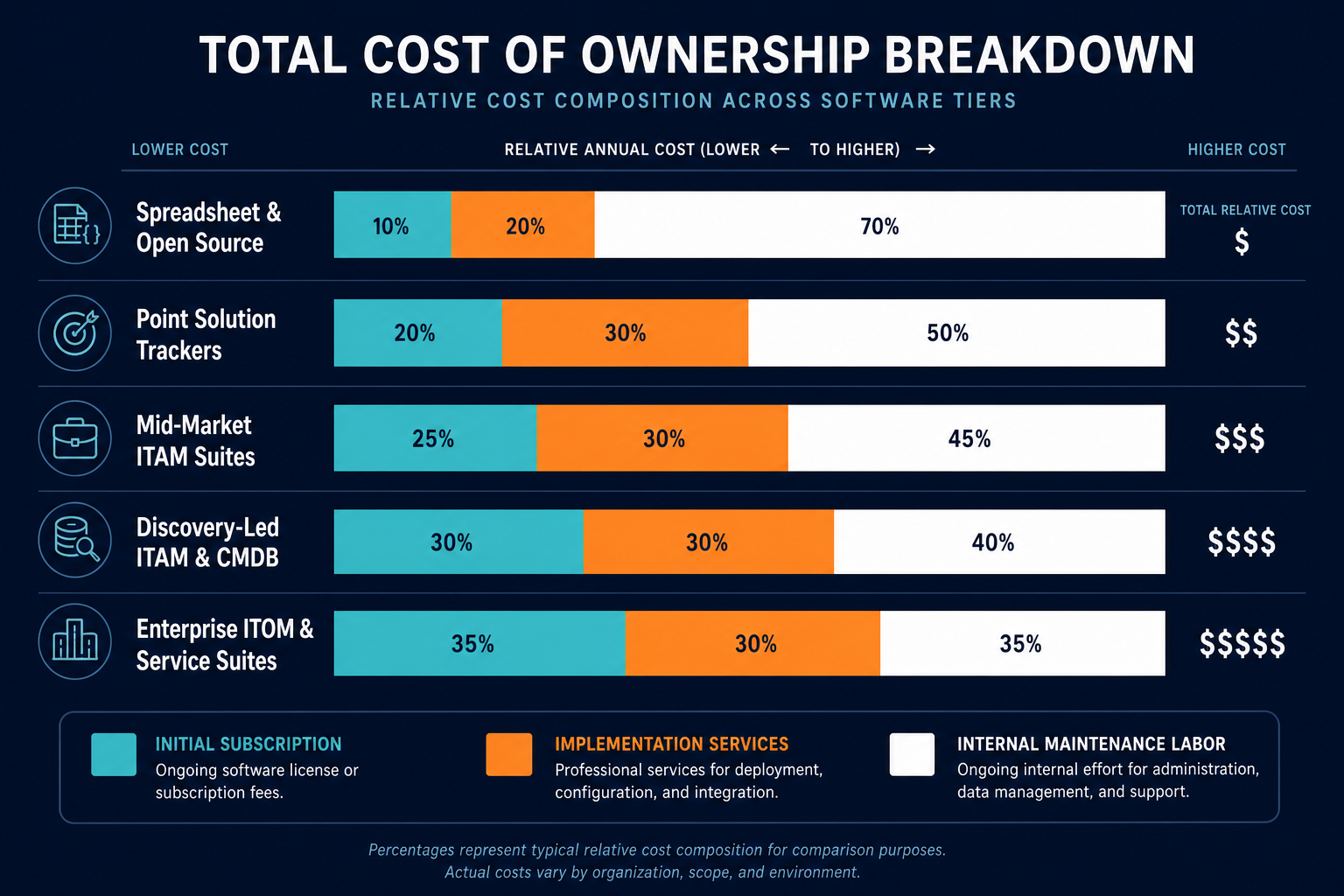
Primary cost drivers in asset management pricing
Software quotes for identical device counts can vary by tens of thousands of dollars. Three architectural choices explain most of this variance.
1. Asset count versus operator seat licensing
Vendor pricing strategies generally fall into two primary licensing models:
- Per managed asset or node: In this model, you pay a rate for each device cataloged in the system, typically ranging from $2 to $12 per asset annually. This structure aligns well with organizations that have stable hardware counts and broad administrative access requirements across procurement, desktop support, and security teams.
- Per technician or admin seat: Here, licensing costs $40 to $150 per technician monthly, while allowing unlimited assets. This approach benefits lean IT departments managing extensive hardware estates. However, it penalizes organizations when project managers, auditors, and department heads require access to review reports or approve hardware disposals.
2. Agent-based versus agentless discovery architecture
Deploying lightweight desktop agents across employee laptops is standard practice for endpoint management. However, software agents cannot be installed on network routers, core switches, hypervisors, SAN storage systems, or IoT controllers.
Platforms that rely solely on agent licensing appear cheaper on initial proposals but require secondary tools to discover infrastructure. Comprehensive platforms incorporate agentless discovery protocols (including SNMP, WMI, SSH, and cloud APIs) into the baseline platform. While discovery-backed suites carry higher initial licensing fees, they eliminate the need to purchase separate network scanners. That premium also buys discovery-sourced data for ViVID™ service maps, since relationship mapping is only as accurate as the inventory feeding it.
3. Add-on modules and feature tiering
Tiered software pricing commonly segregates essential capabilities behind premium packaging:
- Basic Inventory Tier: Covers manual data entry, hardware status tracking, and contract records.
- Compliance Tier: Introduces automated software license tracking, publisher compliance calculations, and procurement workflows.
- Operations Tier: Unlocks automated discovery, relationship mapping, and ITSM service desk connectors.
Is per-asset or per-agent pricing cheaper in asset management?
Per-asset pricing is typically cheaper for organizations with large teams that need shared system access across procurement, security, and IT support. Per-agent or per-technician pricing is more economical for lean IT teams managing large device fleets where only a few administrators access the management console.
Hidden costs that inflate total software expense
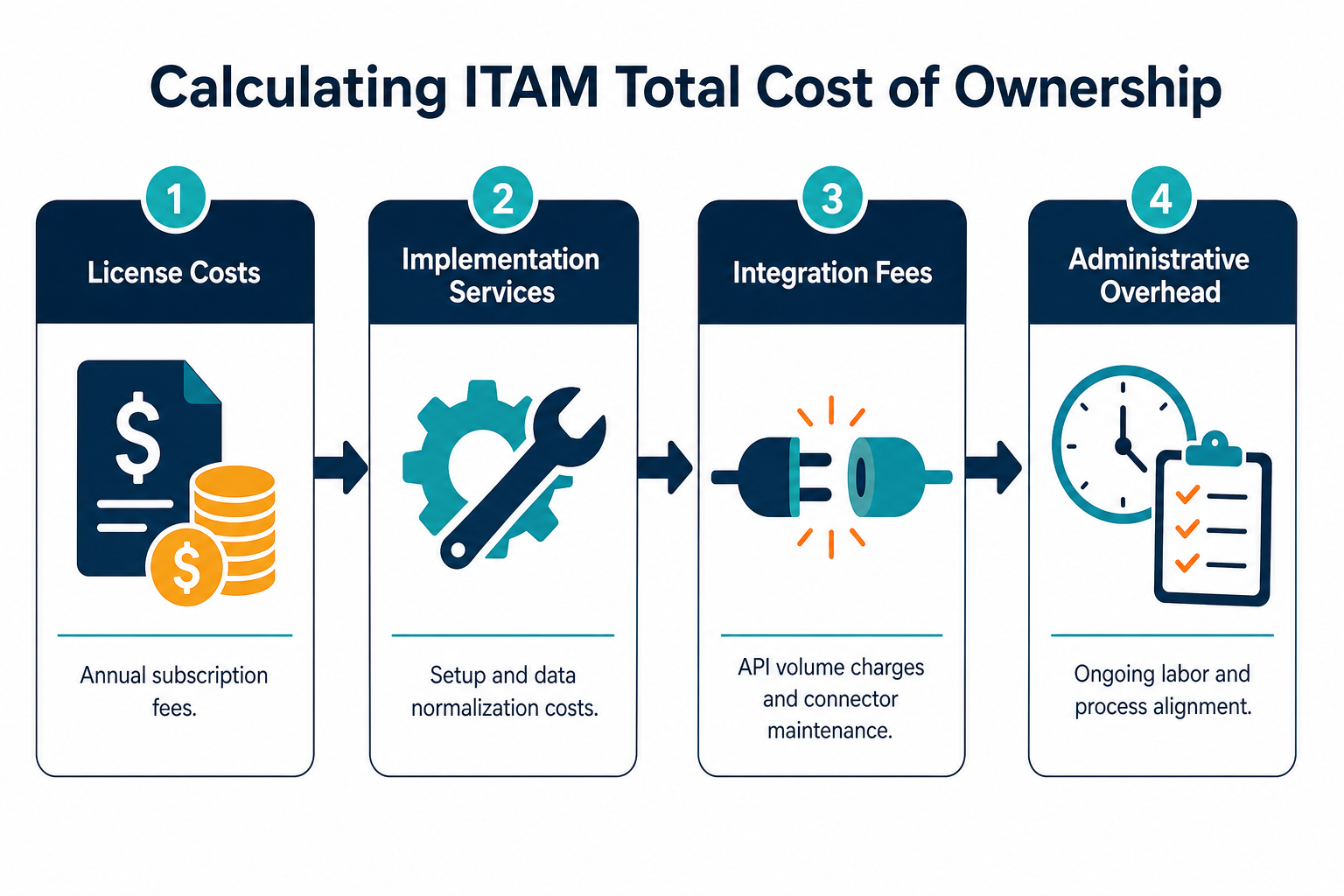
The line-item subscription on a vendor quote rarely covers the complete investment required to establish functional asset governance. Budgeting for hidden expenses prevents project delays and procurement disputes.
+--------------------------------------------------------------------------+
|                  TOTAL COST OF OWNERSHIP (TCO) ICEBERG                   |
|                                                                          |
|   VISIBLE ON QUOTE:                                                      |
|   ====================================================================   |
|   * Annual Software Subscription License                                 |
|                                                                          |
|   HIDDEN BELOW THE SURFACE:                                              |
|   ====================================================================   |
|   * Legacy Spreadsheet Data Cleansing & Normalization                    |
|   * Implementation & Professional Services ($5K-$20K, Mid-Market)        |
|   * API Request Volume Charges & Connector Upgrades                      |
|   * Dedicated Network Discovery Collector Server Hosting                 |
|   * Internal Admin Training & Process Alignment Labor                    |
|   * Annual Contract Renewal Uplifts (5% to 10% per year)                 |
+--------------------------------------------------------------------------+
Implementation and data cleansing services
Importing legacy data into a modern platform exposes missing serial numbers, inconsistent hardware names, and duplicate custodian records. Most mid-market implementations require between 20 and 80 hours of data normalization work. Vendors often charge $175 to $275 per hour for professional implementation assistance, adding $5,000 to $20,000 in upfront deployment costs.
API volume fees and connector maintenance
Connecting asset registers to external service desks or directory services can introduce unbudgeted fees. Certain vendors impose strict API limits, charging extra when asset inventories exceed daily transaction quotas. Reviewing dedicated Lansweeper comparison benchmarks illustrates how connector packaging and discovery capabilities alter total operating expense.
Administrative labor and data hygiene overhead
Maintaining asset accuracy requires sustained effort. According to the Flexera State of ITAM Report, IT teams lose visibility into hybrid infrastructure as their environments grow, forcing continuous manual intervention to keep records current. If an asset tool lacks scheduled automated discovery, internal teams spend dozens of hours every month manually reconciling purchase receipts against Active Directory logs. That cost compounds without a plan for IT cost optimization.
What does ITAM software implementation typically cost?
ITAM implementation typically adds $5,000 to $20,000 to a mid-market rollout, driven by 20 to 80 hours of data normalization, discovery configuration, directory integration, and administrative workflow training at $175 to $275 per hour in professional services fees.
Sample budget breakdowns for 500 and 2,000 assets
Examining realistic deployment scenarios highlights how license models, discovery automation, and support fees shape total three-year expenditure.
Scenario A: Growing organization managing 500 endpoints
A 500-asset environment typically consists of employee laptops, mobile devices, local office networking gear, and several virtualized application servers. Software licensing for an entry-level commercial SaaS package tracking 500 assets costs approximately $3,000 annually, or about $6 per asset per year. Self-guided setup supported by vendor onboarding materials adds roughly $1,500 in one-time implementation costs, and part-time administration — about 4 hours a week for hardware provisioning, updates, and vendor returns — rounds out the internal workload. Total Year 1 outlay lands around $4,500 in direct software vendor fees, plus internal staffing time.
Scenario B: Mid-market enterprise managing 2,000 hybrid assets
A 2,000-asset organization operates distributed physical offices, enterprise networking hardware, cloud server instances across AWS and Azure, and complex software licensing. A discovery-backed ITAM platform licensing 2,000 assets costs between $4,740 and $12,000 annually, depending on whether service relationship mapping is enabled. Assisted deployment covering multi-subnet discovery, Entra ID sync, and ITSM connector configuration runs $4,000 to $8,000 in professional services. Standard business support and maintenance fees are included, though dedicated customer success management may add $2,500 annually. Total Year 1 outlay typically runs $8,740 to $20,000 in total first-year vendor commitments.
Evaluating ROI: justifying asset management investments
Evaluating software cost in isolation overlooks the financial waste and security liabilities caused by unmanaged infrastructure.
An accurate IT asset management (ITAM) system generates quantifiable returns across three operational areas:
- Software License Reclaim: Identifying unused desktop software and unattached cloud storage instances can reclaim a meaningful share of annual software license spend within the first six months of deployment.
- Audit Avoidance: Publisher audits impose substantial penalties when organizations cannot prove entitlement baselines. Centralized documentation eliminates compliance true-up fines.
- Hardware Lifecycle Optimization: Tracking physical equipment warranties prevents unnecessary hardware repurchases and ensures equipment is decommissioned per regulatory standards.
Teams exploring platform capabilities can review comprehensive pricing plans to evaluate tier structures against expected operational savings.
Is there a free tier for IT asset management software?
Yes. Several platforms provide free tiers for up to 50 or 100 assets with basic inventory logging. Additionally, open-source registers offer free software licenses, but require internal hosting, security maintenance, and manual data administration.
See how Virima’s tiered pricing compares to the cost bands above — with no unexpected add-on fees.
Closing: choosing the right investment path
Investing in asset management software is a choice between paying for automated software intelligence or paying for recurring administrative labor. Point-solution inventory tools offer low initial entry points, but they leave infrastructure blind spots that require manual spreadsheets to reconcile.
Platforms that combine multi-source agentless discovery with hardware and software lifecycle tracking eliminate data entry backlogs and provide verified infrastructure truth. By evaluating total cost of ownership across licensing, implementation, and ongoing management, IT leaders can answer how much does asset management software cost for their own environment and select a platform that scales cleanly with enterprise growth.
To see how Virima’s published tiers compare against the cost bands above, review pricing plans — or schedule a demo if you’re ready to talk through your specific environment.
Frequently Asked Questions
Is per-asset or per-agent pricing cheaper?
Per-asset pricing is generally more cost-effective for teams with many stakeholders who need reporting or audit access. Per-agent or per-technician pricing saves money for lean IT teams managing large device counts where only a few admins log into the console.
Is there a free tier for IT asset management?
Yes. Many commercial providers offer free entry plans for small estates under 50 or 100 devices. Open-source solutions provide free licensing for any scale, though internal hosting, patching, and manual data maintenance costs still apply.
What does ITAM implementation cost?
ITAM implementation typically adds $5,000 to $20,000 to a mid-market rollout (1,000 to 5,000 assets), driven by 20 to 80 hours of data normalization, discovery configuration, and administrative training at $175 to $275 per hour in professional services fees.
How do I compare vendor pricing quotes?
Compare quotes on a three-year total cost basis. Check whether network discovery, cloud connectors, and API access are bundled or billed as add-ons, and request clear terms regarding annual renewal price increases and asset overage penalties.
What does Virima Business Pro cost for 2,000 assets?
Virima Business Pro starts at $4,740 annually for 2,000 assets, covering multi-source agentless discovery and CMDB governance. Implementation and ITSM connector setup are quoted separately based on environment complexity.