Device42 ServiceNow Alternative: Supercharge Your ITSM with Virima

ServiceNow is a leading ITSM platform, and keeping its configuration management database (CMDB) accurate is critical to getting value from it. Large enterprises depend on ITSM platforms for end-to-end service operations and incident management, which is why accurate CMDB data matters for day-to-day IT work.
Many organizations use the Device42 ServiceNow integration to sync configuration items (CIs) from Device42 to ServiceNow. That integration has limits that can slow down ITSM operations. Integrating ITSM tools with existing discovery and inventory systems is a common operational bottleneck that can delay automation and reduce the value of CMDB data.
This article covers where the Device42 ServiceNow integration falls short and how Virima’s ServiceNow integration delivers deeper visibility and a stronger return on investment.
| Device42 vs. Virima for ServiceNow CMDB Device42’s ServiceNow integration pushes configuration item data one way, from Device42 into the ServiceNow CMDB, using DOQL queries and transform maps. Virima syncs bidirectionally with ServiceNow through a no-code transform mapping engine, and adds ViVID™ service maps with ITSM record and NIST NVD vulnerability overlays that Device42’s integration does not include. |
What is the Device42 ServiceNow integration best for?
Device42’s ServiceNow integration is a capable one-way CI sync using DOQL and transform maps. It fits teams that need discovery data pushed into ServiceNow and can operationalize maps elsewhere. Virima fits when ServiceNow needs bidirectional no-code sync, discovery-populated relationships, and ViVID™ maps after service definitions.
| See how discovery-sourced CIs become Trusted Runtime Truth inside ServiceNow workflows. Explore Trusted Runtime Truth. |
Where the Device42 ServiceNow integration falls short
Device42 offers a capable ServiceNow integration that syncs CIs, including hardware, software, dependencies, and IP address details. It supports both on-demand and scheduled syncs. For many environments, that covers the basics well. Organizations looking for deeper CMDB operationalization run into a few areas where the integration does not go far enough:
- Sync without operational context: Device42 syncs CI data to ServiceNow, but the integration focuses on data transfer rather than operational intelligence. It does not overlay ITSM records, vulnerability data, or service health indicators onto dependency maps the way ViVID™ does. Teams still need to cross-reference multiple views to connect a CI to its open incidents, pending changes, or known vulnerabilities.
- Setup complexity: Configuring the integration involves setting up Device42’s Cloud Connector, writing or customizing DOQL queries, installing the ServiceNow plugin, and configuring transform maps for each data source. Organizations without dedicated Device42 or ServiceNow admins may find this slows initial deployment.
- One-directional data flow: The Device42 ServiceNow integration pushes data from Device42 into the ServiceNow CMDB. Organizations that need changes in ServiceNow to reflect back in Device42 may need additional configuration or workarounds.
- Limited subcomponent change tracking: Device42 syncs hardware details like CPU and memory to ServiceNow, but tracking granular configuration changes to those subcomponents over time, useful for compliance and audit reporting, is not a documented strength of the integration.
- Total cost considerations: The integration itself is free from the ServiceNow Store, but total cost of ownership includes Device42’s on-premises appliance, the operational overhead of managing DOQL queries and transform maps, and any customization needed to meet specific sync requirements.
These are not flaws in Device42’s product. They reflect the boundaries of a discovery-to-CMDB sync approach. Organizations that need their ServiceNow CMDB to function as an operational tool, with visual dependency context, vulnerability prioritization, and no-code configuration, often look for an integration that goes further.
Where does Device42 still win for ServiceNow teams?
Device42 still wins when multi-cloud inventory breadth, DCIM-style data center depth, FreeBSD agent coverage, or a one-way ServiceNow push already solves the job. Those strengths matter most when operational dependency maps and bidirectional CMDB hygiene are handled in another plane.
How Virima’s Device42 ServiceNow alternative integration works
Virima provides a bidirectional integration with ServiceNow, powered by a transform mapping engine that keeps your CMDB accurate and gives your team context for root cause analysis, change impact assessment, and vulnerability prioritization.
High-frequency IT discovery and CMDB updates
Virima reduces manual data entry for CMDB maintenance through agentless IT discovery and scheduled configuration updates. It uses agentless IP-based scans that identify devices through their IP address, along with hundreds of out-of-the-box, extendable probes and optional discovery agents for Windows, macOS, and Linux to find physical, virtual, and cloud assets across your environment.
Business rules run discovery and configuration-change syncs to your ServiceNow CMDB on recurring, high-frequency discovery cycles, keeping data current without manual intervention.
Virima Visual Impact Display (ViVID™) for an operationalized CMDB
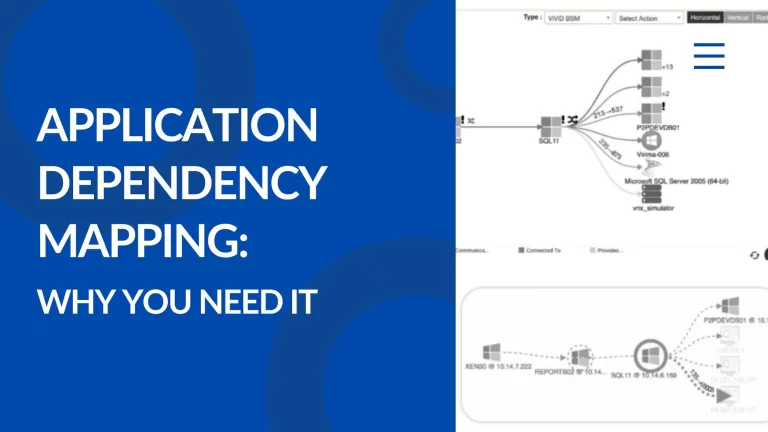
Once service definitions are provided, manually, by spreadsheet import, or through an enterprise architecture integration, ViVID™ builds dependency maps from that input and does not invent which applications form a service. ViVID™ turns your CMDB from a static database into an operational tool. It overlays ITSM records (open incidents, pending changes) and NIST NVD vulnerability data for Windows Server configuration items onto dynamic service maps, so your team sees how assets connect and what is happening across those connections.
Application dependency maps expose relationships between CIs, which speeds up root cause analysis and change impact assessment. Virima Discovery captures time-of-scan and historical configuration data, giving your team a record of what changed and when. That supports compliance reporting and IT audits without separate tracking tools.
Business rules also capture institutional knowledge, such as asset ownership, lifecycle status, and business criticality, that technical discovery alone cannot gather. That metadata flows into the CMDB alongside discovery data, so your ServiceNow CI records carry the context your incident and change teams need.
High-frequency discovery for proactive operations
Virima runs scheduled discovery scans on high-frequency discovery cycles to keep your CMDB current, capturing configuration changes during every scan cycle. That keeps your team working from current data instead of outdated records, so they can trust the system and act faster.
ViVID™ adds alerts from monitoring and event tools to your service maps alongside NIST NVD vulnerability data for Windows Server CIs, all in one place. That combination helps your team spot risks early, such as an unpatched issue on a critical asset, and act before it affects a service. Because the context is visible in one map, teams move from reacting to problems toward preventing them.
Working inside ServiceNow
Virima plugs directly into the ServiceNow CMDB, with discovery insights and mapped data managed natively within ServiceNow. Synced assets include action links to rescan, view ViVID™ business service maps, and link assets to related service requests. Your team stays inside ServiceNow while getting Virima’s discovery and visualization, without switching between platforms.
When should teams choose Virima for ServiceNow CMDB?
Choose Virima for ServiceNow CMDB work when change and incident teams need bidirectional no-code sync, high-frequency discovery cycles, and ViVID™ maps after service definitions with ITSM and Windows Server NIST NVD context on one operational view. Stay on Device42’s integration when one-way CI push is enough.
Device42 vs. Virima: A direct comparison for ServiceNow CMDB
Here is how Device42 and Virima compare for ServiceNow CMDB integration: For a broader Device42 feature and ITAM alternative view, see Compare Device42 features with top discovery and ITAM alternatives.
| Capability | Device42 | Virima |
| Discovery method | Agentless + optional agents (Windows, Mac, Linux, FreeBSD) | Agentless (hundreds of extendable probes) + agents (Windows, macOS, Linux) |
| CMDB sync to ServiceNow | Scheduled or on-demand sync; requires DOQL query configuration and transform map setup | No-code integration with 100+ blueprints; business rules automate selective or full sync |
| Service mapping | Application dependency mapping with impact charts and relationship visualization | ViVID™ dynamic service maps with ITSM record and NIST NVD vulnerability data overlays |
| Cloud discovery | AWS, Azure, Google Cloud, Alibaba Cloud, Oracle Cloud, Linode, DigitalOcean, OpenStack, Kubernetes | AWS and Azure via API integration |
| Vulnerability data | Not a native feature; relies on third-party tools | NIST NVD lookups for Windows Server CIs, overlaid onto ViVID™ service maps after service definitions |
| ITSM platform support | ServiceNow, Jira Service Management, Freshservice, Cherwell, Zendesk, and others | ServiceNow, Jira Service Management, Ivanti, HaloITSM, Cherwell, Xurrent, Hornbill. See the integrations hub for the full partner list |
| Integration approach | One-directional push from Device42 to ServiceNow CMDB; DOQL-based customization | Bidirectional sync with ServiceNow, Jira Service Management, Ivanti, HaloITSM, Cherwell, Xurrent, Hornbill; ViVID™ ingests ITSM records back onto service maps |
| Setup complexity | Requires deploying a virtual appliance, Remote Collectors, Cloud Connector, and DOQL configuration | No-code configuration through the web admin portal |
| Subcomponent data | Syncs CPU, RAM, disk, OS details to ServiceNow | Hardware change tracking across scan cycles (CPU, memory, and more) |
| CI metadata enrichment | EnrichAI standardizes vendor, OS, and software names; adds EOL/EOS data | Business rules capture ownership, lifecycle, and business-criticality metadata alongside discovery data |
| Security certification | SOC 2 Type II | AICPA SOC 2 Type II certified |
| Deployment model | On-premises virtual appliance | SaaS platform on AWS; lightweight Discovery App deployed on-prem for scanning |
The ROI case for choosing Virima over Device42 ServiceNow integration
Here is how choosing Virima over the Device42 ServiceNow integration can reduce operational costs and improve ROI.
Lower operational costs
High-frequency discovery and no-code CMDB sync reduce the manual labor that drives up Device42’s total cost of ownership. Your IT team spends less time on data entry and more time on incident resolution, change planning, and audit preparation. Early issue identification through ViVID™ also helps prevent costly outages before they happen.
Faster incident resolution
An accurate, current CMDB paired with ViVID™’s visual dependency maps means your team identifies root causes and affected services with map context instead of multi-tool cross-reference alone. Current CMDB data from recurring scans, combined with ViVID™’s ITSM and vulnerability overlays, reduces mean time to recovery (MTTR).
Better decision-making
ViVID™ gives change managers, incident responders, and capacity planners a shared visual of how infrastructure, applications, and services connect. Decisions about cloud migration, infrastructure upgrades, or resource allocation are based on actual dependency data, not assumptions.
Sustainable value
Virima’s platform is built on AWS for multi-tenancy with full data segregation between tenants. The platform and CMDB are delivered as SaaS, so there are no servers to provision or databases to maintain on your end. The lightweight Discovery App is deployed to a Windows server on your network to run scans; it updates automatically and requires less overhead than managing a full on-premises discovery platform.
Virima is independently certified for AICPA SOC 2 Type II audited controls, which gives security and compliance teams confidence that discovery and CMDB data are handled under enterprise-grade security standards.
| Why teams move from Device42’s ServiceNow integration to Virima Device42’s ServiceNow integration is a one-way CI sync built on DOQL queries and transform maps. Virima offers a different ServiceNow path: bidirectional sync, no-code configuration, and ViVID™ service maps that overlay ITSM records and NIST NVD vulnerability data for Windows Server CIs after service definitions are provided. Teams that need operational maps and bi-directional CMDB hygiene often dual-run or move the ServiceNow-facing discovery plane onto Virima while keeping Device42 where multi-cloud inventory or DCIM strengths still win. |
Stay on Device42’s ServiceNow integration if: one-way CI push, DOQL-operated sync, and Device42 multi-cloud or DCIM strengths already meet the job, and operational maps live elsewhere.
Dual-run Device42 and Virima if: Device42 remains the inventory or data center plane while ServiceNow-facing relationships, bidirectional sync, and ViVID™ maps after service definitions run on Virima.
Move ServiceNow discovery and CMDB operations onto Virima if: one system must own high-frequency discovery cycles, no-code ServiceNow mapping, and blast-radius context inside incident and change workflows.
Accurate CMDB data, faster incident resolution, and lower change risk for your ServiceNow investment
The Device42 ServiceNow integration provides a basic connection between the two platforms. Virima goes further with high-frequency discovery, no-code integration, and ViVID™ service mapping that addresses the gaps in Device42’s approach.
With hundreds of extendable discovery probes, no-code ServiceNow integration, cloud discovery for AWS and Azure, and NIST NVD vulnerability lookups for Windows Server CIs included at no extra cost, Virima gives your ServiceNow CMDB the accurate data it needs for faster incident resolution, lower change risk, and confident audit reporting.
| See what Trusted runtime truth looks like for your ServiceNow CMDB |
See how high-frequency discovery, no-code ServiceNow sync, and ViVID™ maps after service definitions turn CI lists into operational runtime truth for change and incident work.
Frequently Asked Questions
Can you use a third-party discovery tool with ServiceNow CMDB?
Yes. ServiceNow ITSM can ingest configuration data from third-party discovery tools through supported integration patterns, including REST-based approaches. Virima connects with no-code transform maps and business rules so discovery-sourced CIs land in ServiceNow tables with selective sync and duplicate controls. Device42 can remain a separate inventory or DCIM plane when that split fits your operating model.
Does Virima support cloud discovery for ServiceNow?
Yes. Virima uses API-based cloud discovery for AWS and Azure. Cloud resources can land in the CMDB alongside on-premises assets, and ViVID™ maps dependencies after service definitions are provided so ServiceNow users get hybrid relationship context without a separate cloud-only mapping tool.
When is Device42’s ServiceNow integration still the right fit?
Device42’s ServiceNow integration still fits when one-way CI push, DOQL and transform map control, multi-cloud inventory breadth, or DCIM-style depth is the primary job. Stay on that path when operational dependency maps and bidirectional CMDB hygiene already live elsewhere.
What does ViVID™ add beyond a CI sync into ServiceNow?
After service definitions are provided, ViVID™ builds dependency maps and can overlay open incidents, pending changes, and NIST NVD findings for Windows Server CIs. That gives change and incident teams relationship context on the same operational view instead of only a populated CI list.
Should teams dual-run Device42 and Virima with ServiceNow?
Dual-run is common. Device42 can remain the inventory or data center plane while Virima owns ServiceNow-facing bidirectional sync, discovery-populated relationships, and ViVID™ maps after service definitions. Full move makes sense when one system must own the ServiceNow operational discovery plane end to end.