Virima vs Axonius: Cybersecurity Asset Management vs IT Asset Management

The Virima vs Axonius comparison comes down to one question: Should asset visibility live with your security team or your IT operations team? Both platforms solve the same starting problem, because you can’t manage what you can’t see. They just solve it from opposite ends. Axonius approaches the challenge as cyber asset attack surface management (CAASM), aggregating data from your existing security tools. Virima approaches it as IT asset management and CMDB automation, built on direct discovery across your environment.
That visibility gap is expensive. IBM’s Cost of a Data Breach Report 2024 found that 40% of breaches involved data spread across multiple environments, and those breaches took the longest to identify and contain, an average of 283 days, in large part because of how hard it is to track assets and data across public cloud, private cloud, and on-premises (IBM). Whether the team that closes that gap reports to security or to IT operations is exactly what the Virima vs Axonius decision turns on.
If you’re evaluating both, you’re caught between a security-driven and an operations-driven model. The choice isn’t really about feature checklists. It’s about which team owns the problem and which outcomes matter most.
Virima vs Axonius: Security Focus vs Operations Focus
Axonius built its platform around cybersecurity needs. It aggregates data from security tools to give a unified view of assets for vulnerability management, compliance, and threat response, and it answers questions like “Which devices lack endpoint protection?” or “What’s our exposure to this new vulnerability?”
Virima approaches asset visibility from IT operations. It discovers assets across hybrid environments, maintains an accurate CMDB, and maps service dependencies to support incident response, change management, and day-to-day operational decisions. The questions it answers sound different: “What will break if we change this server?” or “Why is this application running slowly?”
Both platforms see your assets. They serve different use cases, different stakeholders, and different definitions of “done.”
Discovery Methods and Scope
This is where the Virima vs Axonius difference starts to show up in practice.
How Axonius approaches discovery
Axonius takes an aggregation-first approach rather than running its own network discovery. It pulls data from existing security tools, IT management systems, and cloud platforms and correlates it into one view. That works well when you already have heavy tooling in place. The trade-off: its visibility is bounded by what your current tools can see. If you have coverage gaps today, an aggregation layer won’t fill them.
How Virima approaches discovery
Virima runs direct, high-frequency discovery cycles using three complementary methods:
• Agentless discovery scans networks without installing software on target systems.
• Agent-based discovery provides deeper visibility on systems where agents can be deployed.
• API-based discovery pulls data directly from cloud platforms and management tools.
Cloud discovery covers AWS and Azure through API-based connectors that map cloud services and their dependencies. Because Virima discovers assets directly rather than relying on other tools to report them, it can populate and refresh the record on its own across on-premises, cloud, and hybrid estates.
CMDB and Configuration Management
Where Axonius sits
Axonius doesn’t position itself as a CMDB. It maintains an asset inventory with security-relevant attributes, but it isn’t built for the configuration management that IT operations teams lean on, the operational relationships and dependencies behind a change or an incident. Its center of gravity is security posture and compliance status.
Where Virima sits
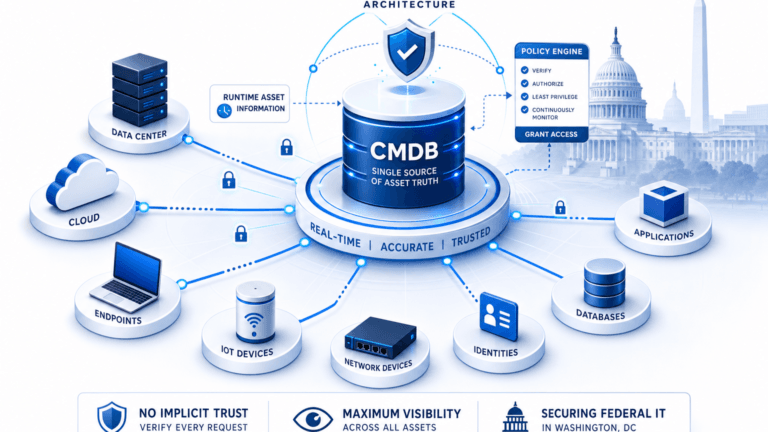
CMDB accuracy is the core of Virima’s value. The platform populates and maintains configuration items with minimal manual effort, which addresses one of the most common reasons CMDB initiatives stall: nobody can keep them current by hand. A Virima CMDB includes:
• Complete asset lifecycle tracking.
• Dynamic dependency maps built by ViVID™ Service Mapping, not hand-drawn diagrams.
• Bidirectional sync with popular ITSM platforms, including ServiceNow, Ivanti, Halo, Jira Service Management, and Xurrent.
• Recurring discovery cycles that keep configuration items aligned with real changes in the environment, with refresh driven by what your workflows actually need rather than brute-force constant scanning.
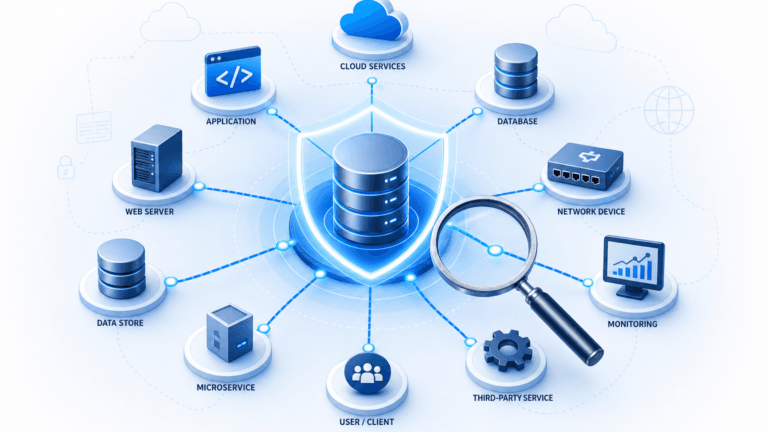
The ViVID™ visualization engine shows not just what assets exist, but how they connect, what depends on what, and how each one ties back to a business service.
Service Dependency Mapping
This is one of the clearest dividing lines in the Virima vs Axonius comparison.
Axonius surfaces asset relationships mainly from a security angle, showing which devices connect to which networks or applications. That’s useful for threat hunting and exposure assessment, but it doesn’t reveal operational dependencies.
Virima’s service dependency mapping shows the full application stack and the infrastructure beneath it. When an incident hits, you can see the impact immediately and understand which business services are at risk. When you’re planning a change, you can visualize exactly what depends on the component you’re about to touch, before you touch it.
Integration Ecosystems
Axonius integrations
Axonius connects to hundreds of security and IT tools, which makes it strong for organizations with diverse security stacks: endpoint protection, vulnerability scanners, cloud security tools, identity systems, and network security devices. Those connections are security-data focused, so you won’t find the deep ITSM and operational-monitoring ties that IT teams work in every day.
Virima integrations
Virima’s integrations target IT operations workflows. It connects bidirectionally with major ITSM platforms, including ServiceNow, Ivanti, Halo, Jira Service Management, and Xurrent, and feeds discovered asset data straight into those tools. Cloud discovery for AWS and Azure runs through API-based connectors that map cloud services and their dependencies, and Virima also pulls operational context from monitoring and network management tools.
Use Case Alignment
When Axonius makes sense
Lean toward Axonius if your primary drivers are:
• Security team ownership: Your CISO or security team leads the asset-visibility initiative.
• Vulnerability management: You need to correlate vulnerability data across multiple security tools.
• Compliance reporting: Security and compliance requirements drive your inventory needs.
• Existing security tooling: You already have broad security coverage, but struggle to correlate it.
• Risk assessment: Your focus is on security posture and threat exposure.
When Virima fits better
Virima aligns with teams where:
• IT operations ownership: Your infrastructure or operations team leads the initiative.
• Incident response: You want faster mean time to resolution (MTTR) through better dependency visibility.
• Change management: Reducing risk during changes is a priority.
• CMDB accuracy: You’ve fought with stale or manually maintained configuration data.
• Service mapping: Understanding application dependencies and change impact matters.
• ITSM integration: You want asset data to flow into your existing ITSM workflows, not sit in another silo.
Pricing and Implementation Considerations
Axonius pricing typically scales with the number of security tools you’re aggregating, and complex integrations often involve professional services, so value and implementation effort grow together.
Virima prices around discovered assets and includes discovery in the base platform. Implementation centers on network access and API connections rather than wiring together a long list of third-party tools.
Choosing Between Virima vs Axonius for Your 2026 Asset Strategy
The decision comes down to your primary use case and who owns the outcome.
If your initiative starts in security, vulnerability management, compliance reporting, or threat response, Axonius gives you the security-focused aggregation it was built for, especially when you already have broad tooling that needs better correlation.
If your drivers are operational, faster incident response, confident change management, or a CMDB you can actually trust, Virima delivers the IT operations focus you need, with direct discovery, dependency mapping, and ITSM integration in one platform.
Plenty of organizations eventually want both a security view and an operations view. Starting with the platform that matches your most pressing pain and your ownership model is what gets you to value faster. The Virima vs Axonius question, in the end, is less about features and more about whether your asset truth should serve security operations or IT operations.
Your CMDB should reflect reality, and your asset visibility should serve the workflows your team actually runs. See how Virima’s discovery-driven asset visibility and CMDB automation hold up against your environment. Request a demo.